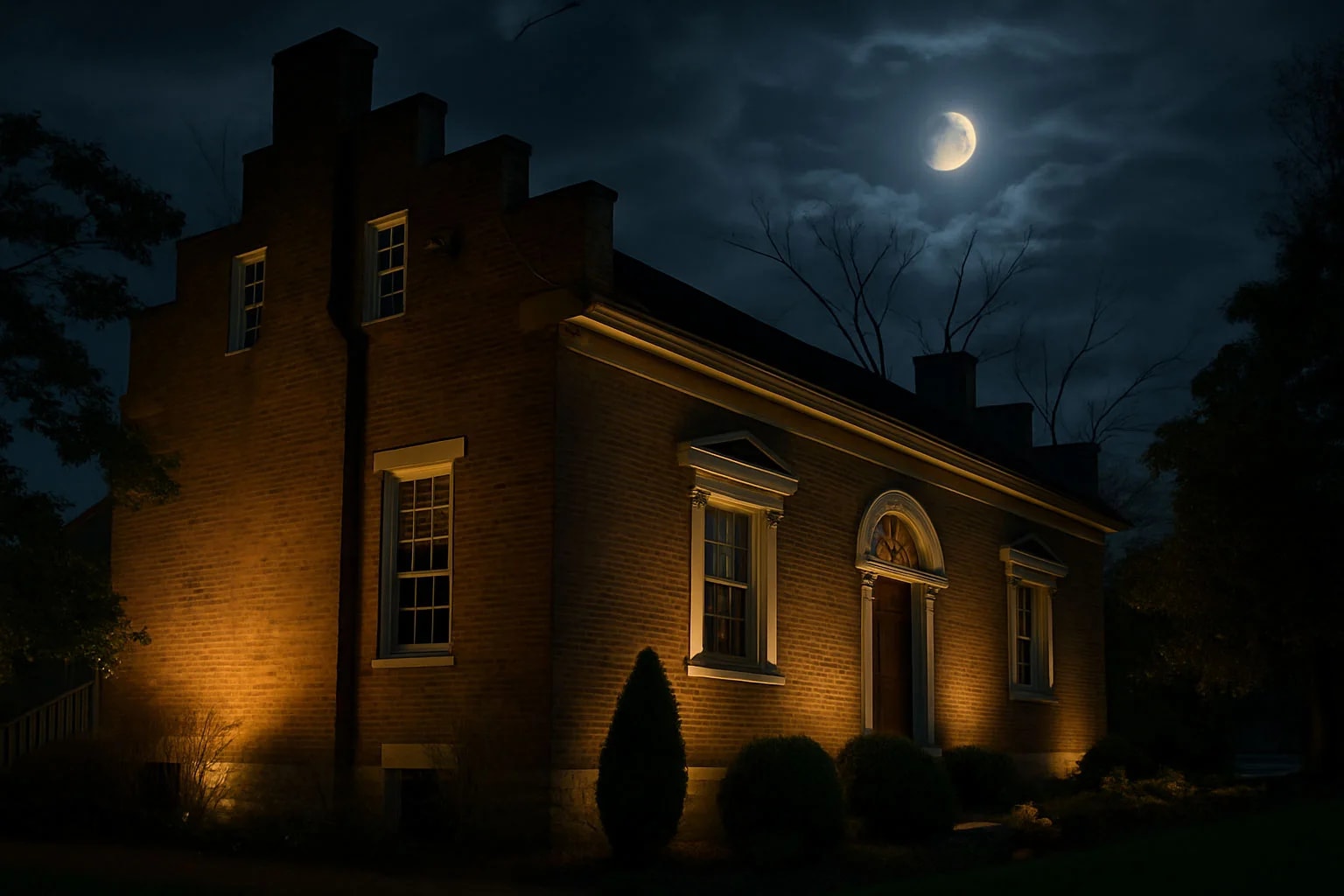
At 510 West Main Street, the pointed windows and weathered brick of St. Paul's Episcopal Church rise from one of Franklin's oldest neighborhoods. Its sanctuary remains a place of worship, filled with colored light, quiet prayer, and nearly two centuries of memory.
Yet St. Paul's has not always been so peaceful.
During the Civil War, soldiers occupied the sanctuary, burned its furnishings, damaged its columns, and brought horses inside. After the Battle of Franklin, its nave became a hospital crowded with wounded men. The building was later reduced to a stable and carpenter's shop before a small congregation reclaimed it from ruin.
With such a history, it is unsurprising that some visitors sense something lingering within its walls. St. Paul's does not possess the loud, theatrical reputation of certain haunted landmarks. Its atmosphere is more solemn—a place where the boundary between history and memory can seem unusually thin.
The Mother Church of Tennessee
St. Paul's congregation was organized on August 25, 1827, when a small group gathered in Franklin's Hiram Masonic Lodge No. 7. The meeting was led by the Reverend James Hervey Otey, a young minister and educator who became an important figure in the development of the Episcopal Church across the South.
Otey helped establish churches, schools, and other institutions throughout the region. He later became Tennessee's first Episcopal bishop while also overseeing Episcopal work in Louisiana, Mississippi, Arkansas, and Indian Territory.
St. Paul's became known as the "Mother Church of the Diocese of Tennessee." It is recognized as the state's oldest Episcopal congregation and its oldest Episcopal church building in continual use.
Construction of the permanent church began in 1831 and was completed in 1834. Handmade bricks between eighteen and twenty-four inches thick formed its walls. The completed building measured approximately forty feet wide and eighty-three feet long.
Its original interior followed a "three-decker" arrangement consisting of the main nave, an undercroft, and elevated galleries. Those galleries preserve an important and painful part of the church's history: enslaved Black people were required to sit there during services. Franklin's historic-preservation records state that enslaved labor also contributed to the church's construction.
The original arrangement therefore reflected both the religious aspirations and racial hierarchy of antebellum Tennessee. St. Paul's was a house of worship, but it was also part of a society sustained by slavery.
War Comes to the Sanctuary
The Civil War abruptly interrupted the life of the parish.
When the conflict began, the church closed. Its rector resigned and entered the Confederate Army of Tennessee. Federal forces occupied Franklin in 1862, and Union soldiers took possession of St. Paul's.
The sanctuary became a barracks.
During the cold months, soldiers needed fuel. They dismantled the church's pews and burned them for warmth. The pulpit and a mahogany pipe organ met the same fate. Fires were built directly on the floor, and openings were cut through the roof so the smoke could escape.
The church's linen was reportedly taken for use as saddlecloths. Interior columns were cut and damaged as soldiers fashioned watering troughs for their horses. Marks left by that wartime treatment can still be seen.
Two important pieces of St. Paul's history escaped destruction. Members of the parish buried the church's silver and register across the street, hiding them until they could be recovered safely. The altar silver, originally presented by the women of the parish in 1834, remains part of the church's life today.
While the cherished objects were concealed underground, the sanctuary continued to suffer above them.
A Hospital After the Battle of Franklin
On November 30, 1864, the Battle of Franklin erupted south of town.
In approximately five hours, thousands of soldiers were killed, wounded, or captured. The scale of the casualties overwhelmed Franklin. Nearly every substantial building that could offer shelter was pressed into service as a hospital.
St. Paul's received wounded Federal soldiers first. Confederate wounded were treated there later.
The church's broad nave, once filled with worshippers, became a ward of injured and dying men. Bloodied uniforms replaced Sunday clothes. The voices of surgeons and suffering soldiers filled a space previously occupied by hymns and prayers.
Medical care during the Civil War was limited and often brutal. Surgeons worked under crowded and unsanitary conditions. Amputations were common, infection was difficult to prevent, and many wounds that might be survivable today proved fatal.
The names of every man treated inside St. Paul's are not known. Nor is there a complete record of how many died there. Nevertheless, the church's use as a hospital is documented by both its congregation and historical authorities.
That history provides the foundation for its haunted reputation. It does not prove that spirits remain in the sanctuary, but it establishes that intense suffering and death once occupied the space.
From Sacred Space to Stable
The end of the war did not immediately restore St. Paul's.
The battered building was subsequently used to stable horses and mules. A carpenter briefly turned it into a workshop. By 1869, it stood largely abandoned, neglected, and infested with rats.
Little more than its heavy walls remained intact.
The Reverend Edward Bradley arrived that year to find a congregation consisting of only seventeen women and four men. Together, they began the difficult work of reclaiming the church.
Restoring St. Paul's was more than a construction project. The parish had to transform a former barracks, hospital, stable, and workshop into a sacred place once again. Years of military damage and neglect had to be repaired without erasing the building's identity.
The church was reconsecrated in 1871.
Over the following decades, worshippers furnished the sanctuary and added richly colored memorial windows. The surviving stained glass eventually became one of St. Paul's defining features, filling the nave with shifting light and providing a vivid contrast to the destruction of the war years.
The restoration did not remove every scar. Some were allowed to remain as visible evidence of what the building had endured.
The Quiet Haunting of St. Paul's
Unlike locations associated with a particular named apparition, St. Paul's is better understood as a place of atmosphere.
Stories connected with the church tend to concern a sensed presence rather than a clearly identified ghost. Visitors have described an unusual stillness, the impression of unseen occupants, and a feeling that the empty sanctuary is not entirely empty. Traditions also include faint footsteps or indistinct movement within the historic building.
Such experiences have not been scientifically verified, and they should not be confused with the documented history of the church. Old buildings produce unfamiliar sounds. Heavy masonry, wooden floors, changing temperatures, and the acoustics of a high sanctuary can transform an ordinary creak or echo into something difficult to locate.
A visitor who knows the church once held wounded soldiers may also experience the space differently. History shapes perception. Silence becomes heavier when one knows what previously happened in the room.
Yet that explanation does not make the experience meaningless.
A haunting does not always require an apparition. Sometimes it is the sensation that a place remembers—that events have left an emotional imprint even when no physical trace remains. At St. Paul's, the surviving damage, hospital history, and nearly two centuries of worship create precisely that effect.
The Scars That Remain
The most compelling "ghosts" of St. Paul's may be the marks that can still be examined in daylight.
Damage to the columns recalls the soldiers who converted church architecture into equipment for their horses. The restored interior calls attention to everything that was lost: the original pews, pulpit, organ, and other furnishings consumed during the occupation.
The altar silver tells a different story. Buried for protection while the sanctuary was being stripped, it survived to be used by later generations. It became a physical connection between the congregation that existed before the war and the community that rebuilt afterward.
The building itself serves a similar role.
St. Paul's survived not because it remained untouched, but because people returned to it after it had been violated and nearly abandoned. Its beauty is inseparable from that survival.
Where History Feels Close
St. Paul's Episcopal Church is sometimes approached as a haunted location, but that description captures only a fraction of its significance.
It is the Mother Church of the Diocese of Tennessee. It is an architectural landmark constructed in part through enslaved labor. It is a survivor of military occupation, wartime destruction, and the Battle of Franklin. It is also an active church whose congregation reclaimed a desecrated building and restored it to worship.
Those histories coexist within the same walls.
No surviving document can confirm that footsteps heard in an empty room belong to a Civil War soldier. No historical marker can prove that an unseen presence lingers in the nave. What the record does confirm is powerful enough: soldiers slept where parishioners had prayed, fires burned where services had been held, wounded men lay beneath the high ceiling, and horses stood among damaged columns.
Perhaps the atmosphere inside St. Paul's comes entirely from knowing those things. Perhaps its stillness is simply the natural quiet of an old church.
Or perhaps a building that has witnessed nearly two centuries of faith, suffering, destruction, and renewal retains more than its visible scars.
At St. Paul's, history does not need to announce itself. It waits quietly in the colored light, the old brick, and the silence between footsteps.
See St. Paul's on a Ghost Tour
St. Paul's Episcopal Church is featured on Ghost City Tours' What Waits in the Dark Tour, Franklin's adults-only ghost tour through the darkest chapters of the Battle of Franklin. Stand outside the old brick walls after nightfall and hear the full story of the church that became a barracks, a hospital, and a stable before it was reclaimed.
For more of the town's haunted landmarks, explore our complete guide to Haunted Franklin.
Historical note: The founding, construction, Civil War occupation, hospital use, postwar restoration, and architectural importance of St. Paul's are documented by the church, the Tennessee Encyclopedia of History and Culture, the City of Franklin, and the National Register of Historic Places. Accounts of unexplained sounds or sensed presences are presented as local tradition rather than verified fact.

St. Paul's Episcopal Church, the Mother Church of the Diocese of Tennessee, on West Main Street in Franklin