During business hours, McCreary’s Irish Pub is one of downtown Franklin’s most inviting gathering places. Conversation fills the narrow dining room, glasses meet across crowded tables, and Celtic music brings a small corner of Ireland to historic Main Street.
After closing, however, the atmosphere reportedly changes.
When the final patrons have departed and employees begin preparing the pub for the night, ordinary sounds become harder to explain. Voices have been heard when no one else was present. Glasses have fallen without being touched. Shadowy figures have appeared inside the pub and along the sidewalk outside.
No one knows who—or what—may be responsible.
Unlike hauntings associated with a named former resident or a documented tragedy, the stories surrounding McCreary’s offer no convenient identity for its supposed spirits. There is no recognized ghost with an established biography. There is only a growing collection of strange experiences in a building that becomes very different when the lights are lowered and Main Street grows quiet.
A Narrow Piece of Historic Main Street
McCreary’s occupies 414 Main Street in the heart of Franklin’s historic commercial district.
The address sits among buildings that reflect generations of growth, rebuilding, and changing commerce. During the late nineteenth and early twentieth centuries, Main Street became the business center of Williamson County. Merchants, tradespeople, travelers, farmers, and townspeople passed through its stores and offices each day.
Commercial property records assign the building at 414 Main Street an approximate construction date of 1900, although dates attached to old downtown properties are not always precise. Buildings were expanded, combined, divided, and given new façades as their uses changed.
One tradition holds that the unusually narrow space occupied by McCreary’s was originally an alley or passage between neighboring buildings. Old wooden fixtures along its brick walls have been described as places where people once tied horses. The passage was reportedly enclosed and eventually adapted for commercial use.
That account is architecturally plausible, but it has not been fully confirmed through surviving maps or property records. It is best understood as part of the building’s oral history.
Before becoming an Irish pub, the space reportedly housed a pizza restaurant. In 2002, it began its present life as McCreary’s Irish Pub & Eatery.
The Pub Comes to Franklin
Darryl and Annie McCreary established the pub in 2002, creating an intimate gathering place centered on Irish and Irish-American food, Guinness, music, and conversation.
From the beginning, McCreary’s emphasized the communal nature of a traditional pub. Its compact dimensions became part of its charm. Diners and musicians shared a close space where strangers could quickly become part of the same conversation.
Live Celtic music contributed to the pub’s identity. Musician Sean McNamara and the group Nosey Flynn helped develop that tradition, performing songs with roots extending back centuries.
Natasha Hendrix joined McCreary’s as a server when it opened. In 2009, she took ownership of the business and continued its community-oriented character with the help of her family.
Today, the pub remains a familiar Main Street destination. Its reputation is built on hospitality, music, hearty meals, and a comfortable lack of pretension.
Its supernatural reputation developed much more quietly.
After the Doors Are Locked
Many of the unusual incidents associated with McCreary’s reportedly happen after closing.
That timing matters. During the day, the pub is full of ordinary explanations for unexpected sounds and movement. People enter and leave. Glassware is handled constantly. Conversations overlap. Music plays, kitchen equipment operates, and vibrations travel through the narrow building.
After closing, those explanations begin to disappear.
Employees working in an otherwise empty pub have reportedly heard voices. The words are not always clear, but the sound resembles someone speaking nearby rather than noise passing in from the street. A worker may believe another employee has said something, only to discover that no one is there.
At other times, the voice appears to come from a part of the pub known to be unoccupied.
The experiences are brief. There is no prolonged conversation and no message revealing the speaker’s identity. A few unexplained words emerge from the silence and then stop.
That absence of an explanation may be the most unsettling part of the encounter.
Falling Glasses
Glasses are another recurring element in the stories.
Employees and patrons have reported glasses falling without an obvious cause. In a working pub, broken glass is normally unremarkable. Wet surfaces, hurried movement, uneven shelving, and accidental contact can easily send a glass to the floor.
The incidents remembered as unexplained are different. A glass may appear secure before suddenly dropping or being displaced when no one is close enough to touch it. There is no visible hand, vibration, or movement to account for what happened.
One falling glass proves very little. Even several incidents may have ordinary causes. Old buildings settle, shelves shift, and objects placed near an edge can move gradually before falling.
Yet when an object seems to move in an empty room—or when the same type of disturbance occurs repeatedly—it becomes part of the building’s lore.
At McCreary’s, the sound of breaking glass after closing is not always followed by a clear answer.
Figures in the Shadows
The most visually striking reports involve shadowy forms.
Employees, patrons, and GCT guides have described fleeting shapes that resemble people but cannot be identified as anyone physically present. Some have been noticed inside the pub. Others have appeared outside, close to the building, after activity along Main Street has subsided.
These figures are rarely seen clearly. They are usually caught at the edge of someone’s vision: a dark form passing a doorway, movement near a window, or a human-sized shadow where no person should be standing.
When the witness looks directly toward it, the figure is gone.
Peripheral vision is particularly sensitive to movement but less reliable at identifying details. Reflections from storefront windows, passing headlights, pedestrians, and shifting interior light can produce convincing illusions. Downtown Franklin also remains active well into the evening, providing any number of natural explanations for movement outside.
But witnesses sometimes report shadows when the street is quiet and the immediate area appears empty. Those encounters leave behind an uncomfortable question: if no one was there, what moved?
A Haunting Without a Name
Ghost stories often become attached to a known historical figure. A mysterious woman is identified as a former resident. A soldier becomes connected to a nearby battle. An unexplained voice is assigned to someone who died in the building.
No such identification can presently be made at McCreary’s.
There is no evidence that a particular person died at 414 Main Street and remained there. No documented tragedy explains the falling glasses, voices, or shadows. The current commercial space may not even have existed in its present form during the Civil War.
That uncertainty is important.
Franklin’s association with the Battle of Franklin makes it tempting to label every unexplained figure a soldier. Doing so without evidence turns speculation into false history. Nothing presently connects the reported activity at McCreary’s with a particular soldier, former merchant, patron, or employee.
Even the reason for the alleged activity remains unknown.
If the space began as an alley, thousands of people may have passed through it before it became an enclosed business. If the circa-1900 date is accurate, the building has still witnessed more than a century of commerce and change. Yet age alone does not identify a ghost.
The honest conclusion is less satisfying but more intriguing: people report unusual activity at McCreary’s, and no one knows who—or what—may be causing it.
Old Buildings and Ordinary Explanations
Historic commercial buildings can behave in unfamiliar ways.
Brick retains and releases heat. Wooden floors flex under changes in temperature and humidity. Pipes knock, cooling equipment cycles, and sounds travel through shared walls from adjoining properties. Reflections multiply across windows, mirrors, bottles, and polished glass.
The narrow proportions of McCreary’s may further complicate its acoustics. A voice on the sidewalk, in an upstairs office, or inside a neighboring building might seem to originate within the pub. Vibrations from traffic or closing doors could disturb glassware.
These explanations should not be ignored. A building does not have to be haunted to produce strange experiences.
Nevertheless, ordinary explanations are most convincing when they account for the details. Employees familiar with a workplace learn its usual noises and rhythms. They know how the refrigerators sound, which floorboards creak, and where voices carry.
When those same employees say that something was different, their experience deserves to be recorded—even if it cannot be proven supernatural.
The Last Ones to Leave
Perhaps McCreary’s is most unsettling because its stories are so ordinary.
There is no elaborate legend, secret burial chamber, or neatly identified apparition. The accounts come from familiar objects and brief interruptions: a glass that falls, a voice in an empty room, or a shadow that seems to belong to someone who is not there.
They are the kinds of incidents that can be dismissed individually. Together, they have given the pub a quiet reputation for unexplained activity.
During the day, laughter and music fill the narrow space. Patrons sit shoulder to shoulder, meals leave the kitchen, and glasses move for entirely understandable reasons.
After closing, the same room becomes still. Employees finish their work beneath lowered lights. The historic buildings of Main Street settle into the night, and every sound becomes distinct.
Most nights, perhaps nothing happens.
On other nights, a glass falls from a secure place. Someone hears a voice and turns to answer it. A shadow passes outside after the sidewalk appears empty.
McCreary’s may be haunted, but its supposed spirits have offered neither names nor explanations. For now, whatever occupies the shadows of 414 Main Street remains as anonymous as it is elusive.
And when the last employee locks the door, there is no way to know with certainty that everyone has left.
Historical note: McCreary’s opening, ownership, and modern business history are documented through the pub’s published history and independent restaurant coverage. The property’s circa-1900 date comes from commercial records, while its reputed origin as an alley remains an incompletely verified local tradition. Accounts of voices, falling glasses, and shadowy figures are firsthand and locally collected reports presented as paranormal claims rather than established fact.
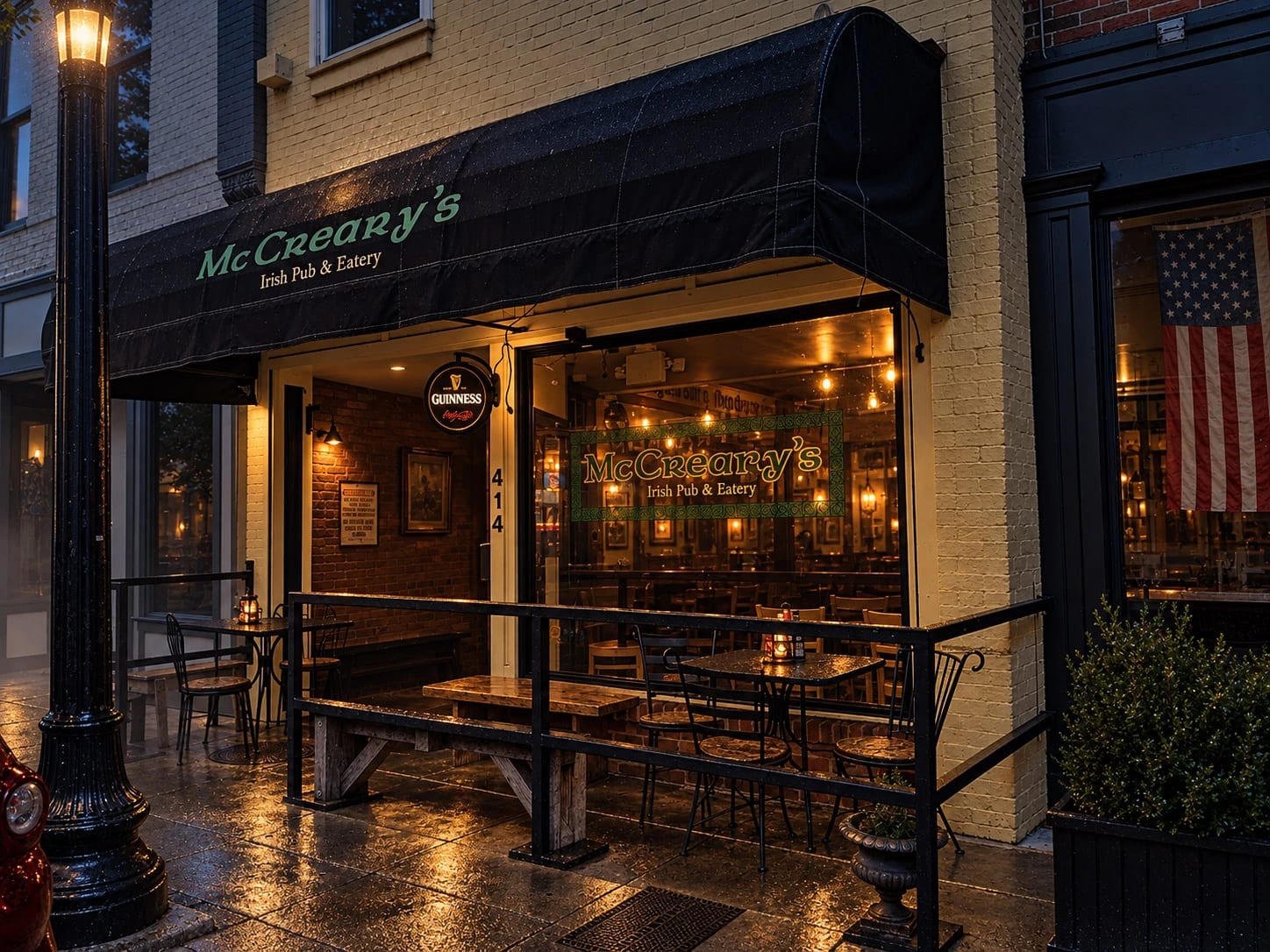
McCreary’s Irish Pub & Eatery on Main Street in downtown Franklin