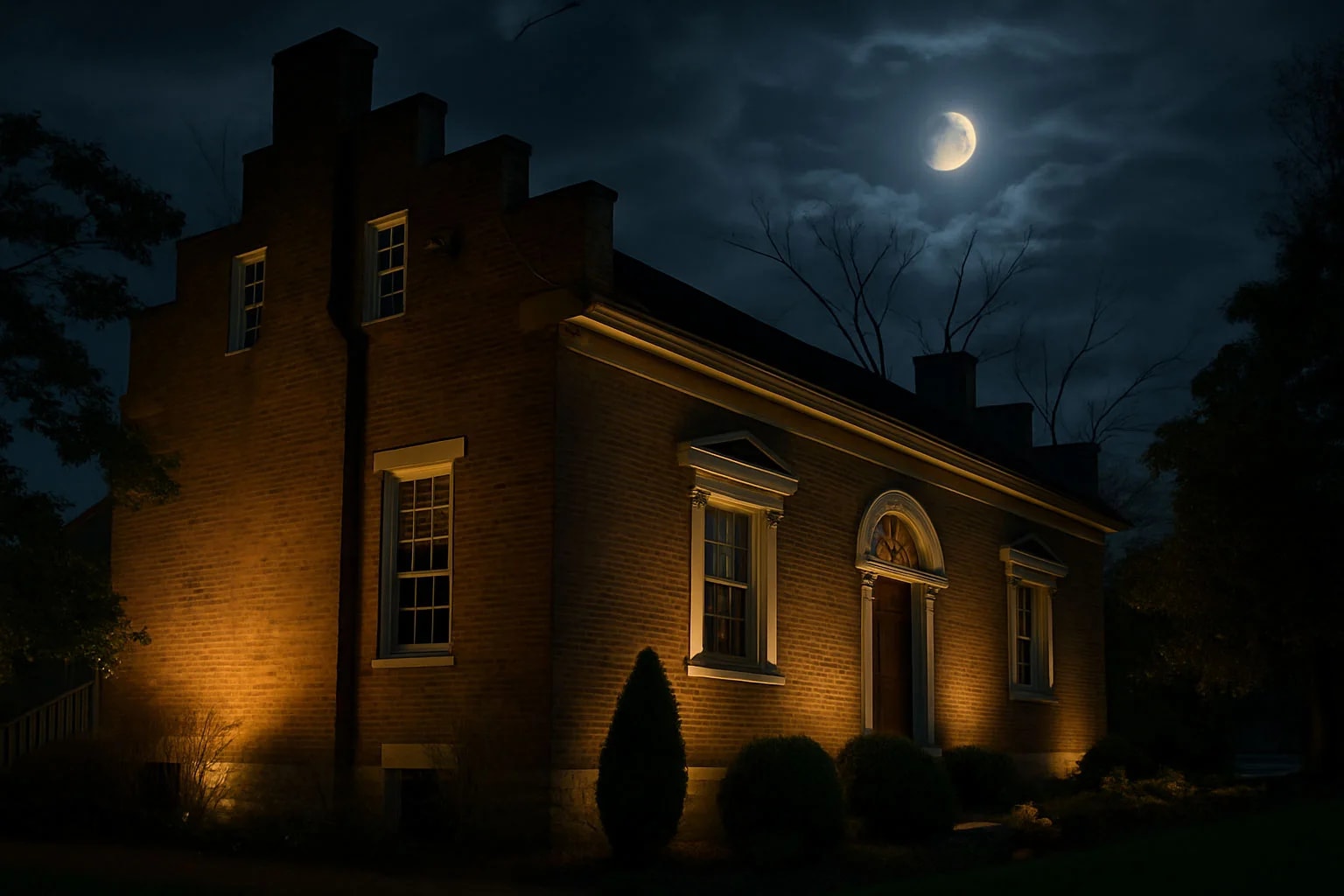
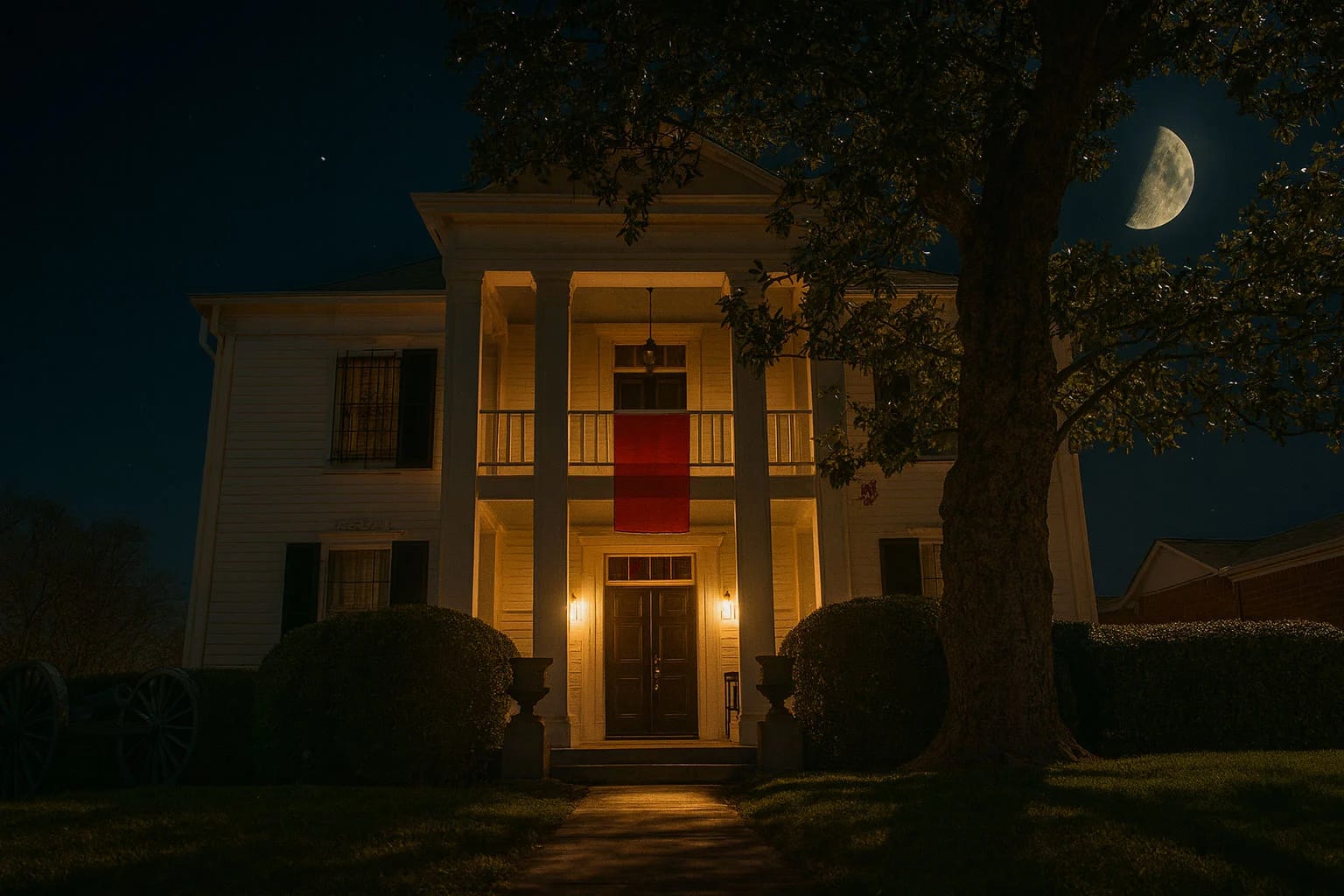
At the corner of Third Avenue North and Bridge Street stands one of downtown Franklin's oldest—and reportedly most restless—landmarks. Known variously as the Perkins–Howarth House, the Howarth House, and Cherry Manor, the stately building at 137 Third Avenue North has watched Franklin change for more than two centuries.
Its age alone would be enough to inspire curiosity. Yet the house is remembered for more than its architecture. Over the generations, it has reportedly sheltered families, Civil War occupants, schoolgirls, nursing-home residents, students, and office workers. Along the way, stories accumulated of a woman at an upstairs window, footsteps in empty rooms, moving objects, and disturbances that defy easy explanation.
Today, Cherry Manor is frequently described as one of Franklin's most haunted buildings. Separating its documented history from its folklore, however, reveals a story that is more interesting than any single ghost tale.
A Survivor from Early Franklin
The Perkins–Howarth House was constructed around 1820, when Franklin was still a young frontier town. Founded in 1799 and incorporated in 1815, the community was only beginning to develop the public square and surrounding residential streets that now form its historic center.
Cherry Manor therefore predates most of the downtown visitors see today. Its approximately 6,000 square feet, high ceilings, fireplaces, large rooms, and surviving period details suggest that it was built as a substantial residence. Standing only a short distance from the square, it occupied a prominent position in the life of the growing town.
The house now falls within Franklin's protected downtown historic area and the National Register–listed Franklin Historic District. A plaque at the property recognizes its place in the National Register district, while Franklin's historic-preservation records identify the building as dating to approximately 1820.
Those designations acknowledge the house's architectural and historical value. They do not, despite a common misunderstanding, certify its ghost stories.
The building has nonetheless provided plenty of material for them.
The House During the Civil War
Franklin's defining nineteenth-century tragedy arrived during the Civil War.
Federal troops occupied the town for extended periods, and the Battle of Franklin on November 30, 1864, brought catastrophic bloodshed almost to its doorstep. Thousands of men were killed, wounded, or captured in only a few hours. Houses, churches, public buildings, and businesses throughout Franklin were pressed into service as headquarters, shelters, and makeshift hospitals.
Published histories of the Perkins–Howarth House describe it as having provided shelter during the war. Some later accounts go further and identify it as a hospital. That possibility is understandable given what occurred throughout Franklin after the battle, but surviving evidence does not yet establish precisely how the building was used, by whom, or for how long.
Stories also persist that soldiers occupied the property and damaged portions of its interior. Such details remain part of local tradition rather than firmly documented history.
What can be said with confidence is that the house stood in an occupied town during one of the most violent episodes in Tennessee history. Its proximity to the square placed it within the wartime landscape, whether it served as a residence, refuge, military space, or some combination of the three.
For believers in paranormal activity, the Battle of Franklin supplies an obvious explanation for reports of shadowy male figures and a sense of unease inside the house. History requires more caution. The war unquestionably surrounded Cherry Manor, but the identities of any supposed spirits remain unknown.
From Residence to School
One of the house's most intriguing chapters began when it was used for educational purposes.
Local histories state that a girls' school elsewhere in Franklin was damaged or destroyed by fire during the late nineteenth century. While that institution was being rebuilt, classes were reportedly moved temporarily into the Perkins–Howarth House.
The story appears to have left a tangible clue. Names and markings attributed to schoolgirls have reportedly survived on old window glass in the house. Unlike a fleeting apparition, these inscriptions are physical reminders that young students once occupied rooms originally built for domestic life.
The school period later became entangled with one of Cherry Manor's best-known legends: that the presence of a young woman or girl remains inside the building. Some versions connect her to the fire at the original school. Others simply describe an unidentified female figure on the upper floor.
No documentary evidence presently identifies a student who died in the house or proves that the school fire was deliberately set. Those dramatic elements should therefore be understood as folklore. The historical core—that the building once accommodated a girls' school—is much more credible.
In a house with so many former uses, fact and legend have had two centuries to grow together.
A Nursing Home, Classrooms, and Offices
The building reportedly served at different times as a nursing home and as college classroom space. Eventually, it was adapted for professional offices.
Each transition brought a new population into the house. Residents slept there. Students passed through its halls. Employees worked late in rooms designed generations before electric lights, modern plumbing, or automobiles existed.
These different uses may help explain the unusual variety of stories associated with Cherry Manor. It is not supposedly haunted by one clearly identified former resident. Instead, witnesses have described men, women, footsteps, voices, cold air, displaced objects, and the persistent feeling of an unseen presence.
That collection of reports resembles the building's history: layered, crowded, and resistant to a single explanation.
The Woman Upstairs
The apparition most often associated with Cherry Manor is a woman seen on or near the second floor.
She is commonly described as wearing white or appearing as a pale, indistinct figure. People outside the building have reported seeing a woman looking from an upper window when no one was believed to be inside. Others have placed a female figure near the staircase or in the upstairs hallway.
One former occupant, Jim Short, publicly recalled awakening to a sudden sensation of cold and seeing what appeared to be a misty woman hovering above him. Children in the house later reportedly described a woman at the top of the stairs.
Some accounts give the apparition the name "Peggy," although no reliable historical record has established who she was or whether that name belonged to anyone associated with the property. Assigning names to unidentified apparitions is common in ghost lore, and this identification should not be treated as biography.
The repeated image of a woman upstairs nevertheless remains the house's most consistent supernatural motif. Whether it represents a former resident, a schoolgirl, a nursing-home patient, or the power of suggestion depends entirely upon whom one asks.
A House That Moves Things
Not all of the reported activity takes human form.
People familiar with the building have described books falling from shelves and pictures dropping from walls. Decorative plates have allegedly broken without an apparent cause. Chandeliers are said to have shaken, while music has reportedly begun playing in an otherwise empty room.
Other witnesses describe footsteps when no one is visible, unexplained voices, abrupt cold spots, and the uncomfortable impression of being watched. Some visitors report feeling uneasy before they have been told about the building's reputation.
Old houses naturally produce noises. Wood contracts, foundations settle, plumbing knocks, and passing vehicles can make windows or suspended fixtures vibrate. Objects placed on uneven floors or aging plaster can fall without supernatural assistance. Expectation also matters: a person entering a famously haunted building is likely to interpret an ordinary sound differently than someone entering an ordinary office.
Yet witnesses maintain that certain incidents at Cherry Manor exceeded those familiar explanations. Their accounts have kept the building's reputation alive even as its occupants and uses have changed.
History, Memory, and Folklore
There is no historical designation for "most haunted house," and there is no objective method for proving that Cherry Manor deserves the title often given to it. Its supernatural reputation rests upon personal testimony, repeated local tradition, and stories passed from one generation to another.
Its historical importance is easier to establish.
The Perkins–Howarth House is a rare survivor from Franklin's early development. It stood through the Civil War and the Battle of Franklin. It was adapted for education, institutional care, and commerce while retaining much of its nineteenth-century character. The building's endurance connects modern Franklin with a town that existed before the railroads, before the war, and before the familiar Victorian storefronts surrounding the public square.
Its ghost stories are part of that inheritance, even when they cannot be verified. Folklore reveals how a community remembers a place—what it fears, what it values, and which parts of the past it believes have not entirely disappeared.
Perhaps the woman in the upper window is only a reflection. Perhaps falling books, shaking chandeliers, and nighttime footsteps have ordinary causes. Or perhaps two centuries of life have left something behind that cannot be captured in property records and preservation surveys.
Either way, Cherry Manor remains a place where Franklin's history feels unusually close.
During the day, it is an elegant survivor from the early nineteenth century. After dark, its tall windows offer another possibility: that the people who once called the Perkins–Howarth House home may not all have left it.
Historical note: The building's circa-1820 construction date and historic-district status are supported by Franklin preservation records and its National Register marker. Accounts of supernatural activity are unverified reports and local folklore, included here as part of the property's cultural history.

Cherry Manor, the Perkins–Howarth House, one of downtown Franklin's oldest surviving buildings