A House That Refuses to Feel Empty
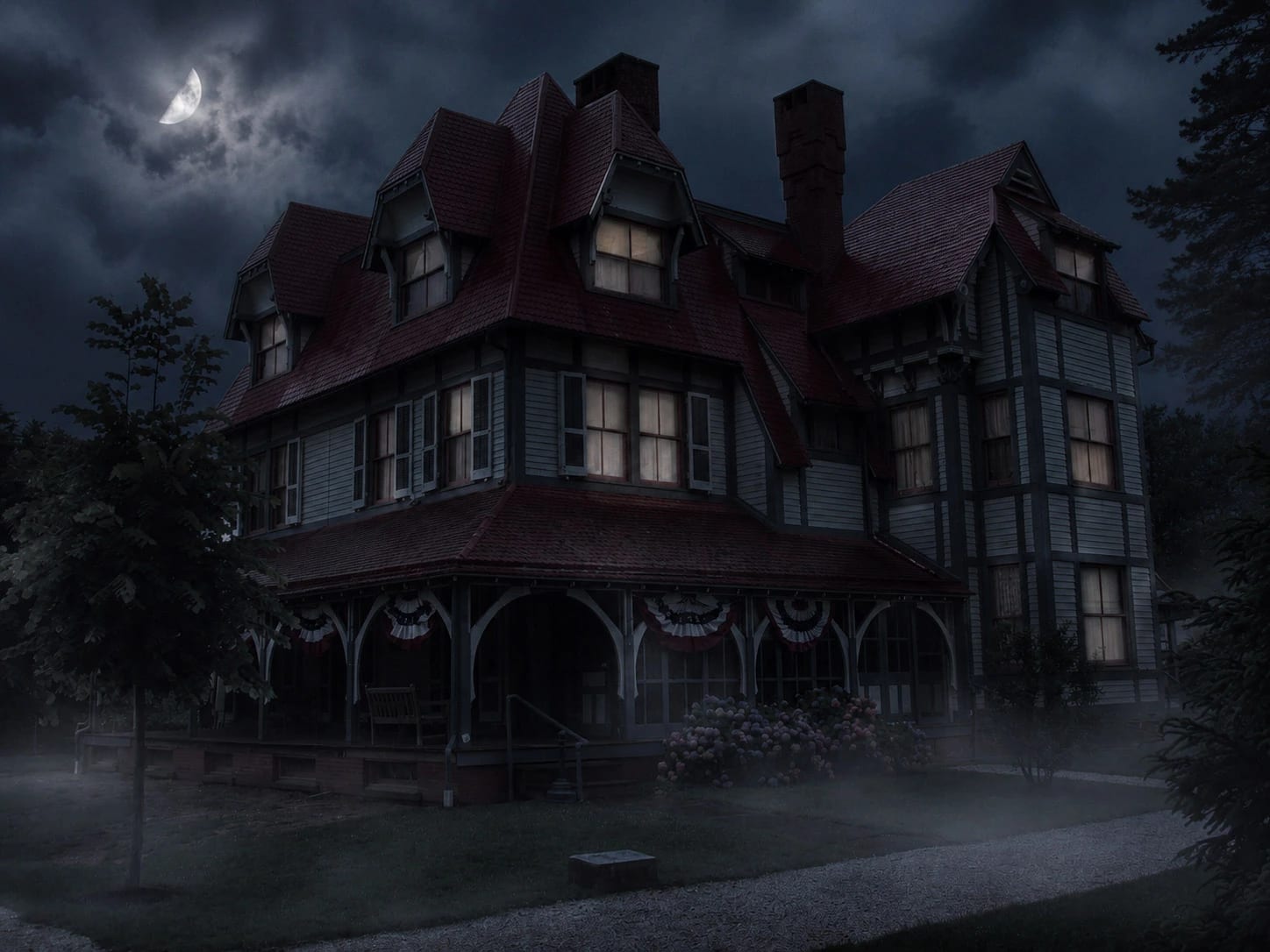
You see it before you reach it. The Emlen Physick Estate sits back from Washington Street behind a wide lawn, an eighteen-room Victorian that looks a little too severe to be charming. Steep roofs. Oversized brackets under the eaves. Chimneys that flare out at the top instead of tapering the way you'd expect. There's a wraparound porch and a tower, and the whole thing seems to lean toward you a little, the way a person does when they're listening.
Go inside on an ordinary afternoon and the air changes. Visitors describe it differently — a heaviness, a held breath, the sense of walking into a room where a conversation just stopped. Plenty of people put it down to the dark woodwork and the period furniture. Old houses are supposed to feel like this.
But the Physick Estate has a reputation that runs well past atmosphere.
For more than a century this was home to Dr. Emlen Physick, his mother, his aunt, and a household that knew its share of comfort and loss. The doctor died in 1916, and by most accounts the family's story ended there. The trouble is that the stories didn't. Staff, volunteers, tour guests, and paranormal investigators have all walked out of this house convinced they weren't alone in it.
To understand why, you have to start with the man whose name is still on the door.
The Man Who Built One of Cape May's Most Recognizable Homes
Who Was Emlen Physick?
Emlen Physick Jr. was born into Philadelphia money in 1855. The family name carried weight — his great-grandfather, also named Emlen, is often called the father of American surgery, and the Physicks moved comfortably through the upper reaches of Philadelphia society. Young Emlen trained as a physician himself at the University of Pennsylvania.
He never really practiced. By the time he finished his training he had inherited enough to live as he pleased, and what pleased him was Cape May. So he left the city behind and made the shore town his permanent home, bringing his widowed mother, Frances, and his aunt, Emilie Parmentier, along with him.
Building the Estate
Construction began in 1879. The design is usually credited to Frank Furness, the Philadelphia architect known for buildings that broke every polite rule of their day, and the estate has all his fingerprints on it — the exaggerated proportions, the upside-down chimneys, the heavy brackets that make the roofline look almost stern.
It didn't look like its neighbors, and it wasn't meant to. While the rest of Cape May leaned toward gingerbread trim and pastel paint, the Physick house went dark, angular, and imposing. It's the best surviving example of Stick Style architecture anywhere in the area, and even now, surrounded by tidy grounds, it reads as a house with opinions.
Life at the Estate
For decades the household ran the way a wealthy Victorian household did. There were servants, gardens, carriage horses, and the steady rhythm of seasons in a resort town that filled up a little more with summer visitors every year. Emlen kept dogs he doted on. His mother and aunt managed the home. Guests came and went.
It was a full house, in other words. Full of routine, full of personalities, full of the small daily dramas of three strong-willed adults living under one roof for the better part of their lives. That matters later. The places that seem to hold onto the dead are almost always the places where people truly lived, and the Physick Estate was lived in hard.
It wouldn't stay full forever.
Decline, Loss, and the End of an Era
Financial Troubles
The Physick fortune was large, but it wasn't bottomless, and the family's standing slipped slowly over the years. Cape May itself went through hard times — fires, shifting tastes, the long decline that turned a once-fashionable resort into something quieter and shabbier by the early twentieth century. The grand house on Washington Street started to feel like a holdover from a world that was ending.
Death at the Estate
Frances Ralston, Emlen's mother, died in the home. So did his aunt, Emilie. One by one the household he had built around himself came apart, until the doctor was the last of the three left in the big house with his memories and his dogs.
Emlen Physick died in 1916, at sixty-one. He left no wife and no children to inherit the estate or carry the name forward. In this branch, the family line simply stopped.
A large Victorian house tends to absorb the lives lived inside it. Decades of meals, arguments, illnesses, griefs, and quiet ordinary evenings settle into the woodwork until the building feels less like a structure and more like a record. When the last of the family was gone, the house was left holding all of it.
According to the people who spend their days there now, it never quite let go.
Saving a Mansion from Destruction
The Estate After the Physicks
With no heirs, the house passed out of the family and into a long, uncertain middle age. Over the next half-century it served a handful of purposes and suited none of them especially well. It sat empty for stretches. It aged. By the early 1970s the estate had fallen into rough enough shape that there was serious talk of tearing it down and putting the land to other use.
Preservation Efforts
What saved it was a fight. In 1970 a group of Cape May residents organized to stop the demolition, and that effort grew into the Mid-Atlantic Center for the Arts and Humanities, the organization that still runs the estate today. They raised money, made their case, and slowly brought the house back — restoring rooms, recovering period furnishings, and reopening it as a museum of Victorian life.
Restoration work is strange work. It means long hours alone in a half-finished historic building, often after dark, with the heat off and the rooms stripped back to their bones. The crews who restore old houses tend to be the first to notice when something feels off, and the people who worked on the Physick Estate were no exception. Some of the earliest modern accounts of activity here come from exactly that period — workers alone in the place, hearing things they couldn't trace.
Once the doors reopened to the public, the reports only multiplied.
The Ghost Stories of the Emlen Physick Estate
The Woman in White
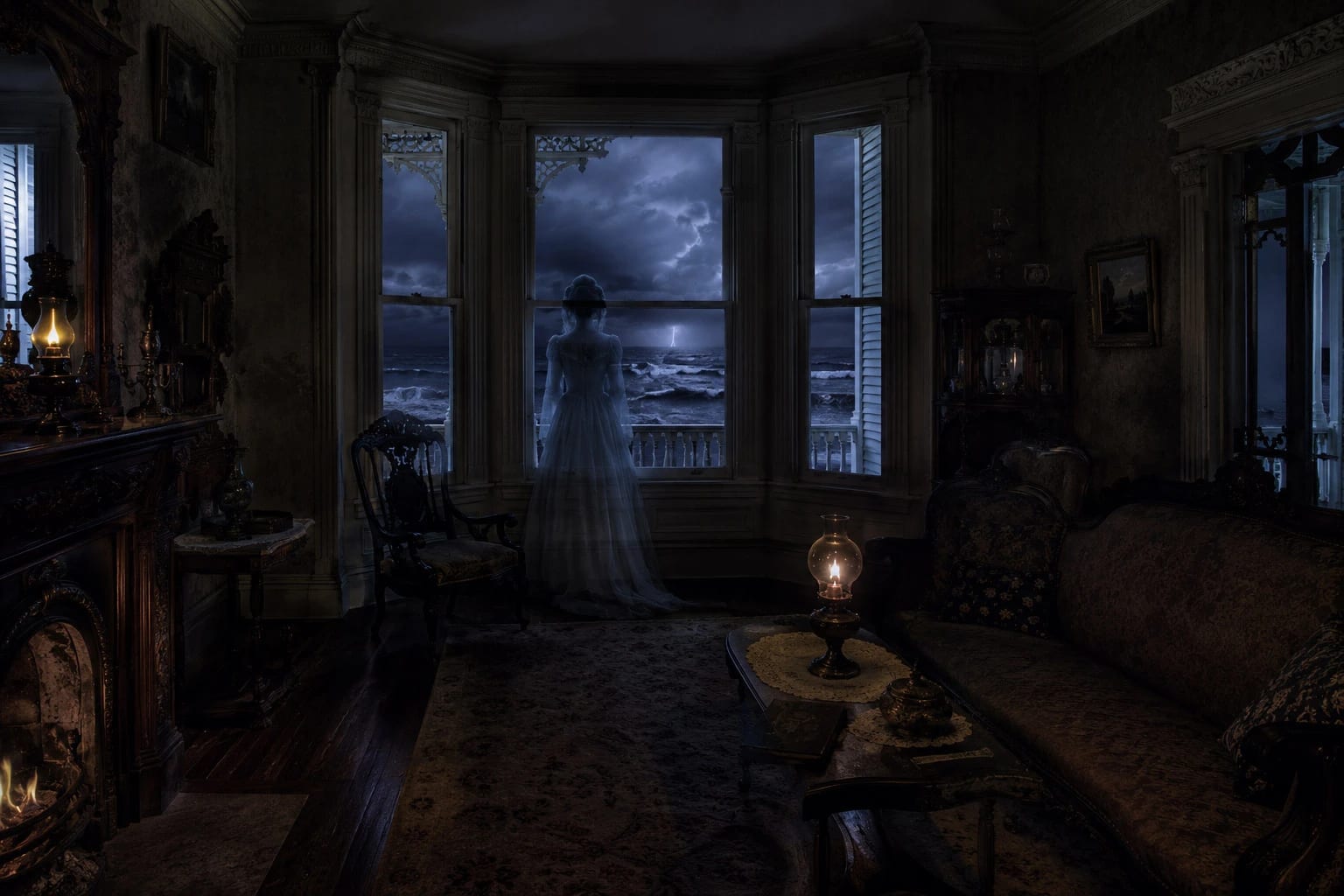
The most persistent story at the estate is a woman. She turns up at the windows, usually on the upper floors, framed in the glass for a moment and then gone. Visitors out on the lawn have pointed up at a figure in a pale, old-fashioned dress, only to be told that no one was upstairs at all. Sometimes she's seen inside, at the end of a hallway or just passing a doorway, there and not there in the space of a blink.
Most people who tell the story assume she's Frances Ralston, Emlen's mother, who lived and died in the house and ran it for much of her life. Others think she might be his aunt, Emilie. A few don't try to put a name to her at all. Whoever she is, she's been the estate's signature haunting for decades.
Footsteps in Empty Rooms
Then there's the sound of someone walking.
Footsteps cross the floors overhead when the upper rooms are closed. They move along the hallways and up and down the staircase, steady and unhurried, the pace of someone who knows exactly where they're going. Staff have climbed the stairs to check and found nothing. Doors that were shut are found standing open. Doors that were open ease closed on their own.
These reports tend to cluster in the quiet hours — early morning before the house opens, or evening after the last guests have gone, when the building should be empty and isn't behaving like it.
Unexplained Voices
People hear talking.
Sometimes it's a single voice, low and indistinct, coming from a room no one is in. Sometimes it's the murmur of a conversation just past the edge of understanding, the words almost but never quite clear. Staff have reported hearing their own names called when they were alone in the house. Visitors have turned toward a voice behind them and found no one there.
The voices don't seem to be trying to frighten anyone. They sound, by most accounts, like the ordinary background noise of a household — which is somehow worse, because that household has been gone for more than a hundred years.
The Feeling of Being Watched
Ask anyone who works at the estate and you'll hear about this one.
It's the most common experience in the house and the hardest to put into words. A room will be perfectly still, and then the air seems to shift, and you become certain you're being watched. Some rooms bring it on more than others. People describe a prickle at the back of the neck, a sudden drop in temperature, an urge to leave that they can't quite explain. Children sometimes notice it before the adults do.
There's nothing to photograph and nothing to record. It's only a feeling — but it's a feeling specific enough, and reported often enough, that the staff stopped dismissing it a long time ago.
Encounters Reported by Staff and Guests
The strength of the Physick Estate's reputation isn't any single dramatic event. It's the repetition.
Tour guides describe the same cold spots in the same rooms year after year. Volunteers tell of objects moved overnight, of lights and sounds with no source, of the unmistakable sense of company in an empty house. Guests who came for the Victorian furniture and the architecture leave talking about something else entirely. Different people, different years, no reason to compare notes — and the same handful of stories keep surfacing.
That consistency is what separates a genuinely haunted reputation from a good campfire tale.
Paranormal Investigations
The estate's fame has naturally drawn ghost hunters, and over the years investigators have spent nights in the house with cameras, recorders, and the usual array of equipment. They've reported temperature swings, stray noises, and the occasional voice captured on tape that no one in the room remembers hearing.
It's worth being honest about what that does and doesn't prove. None of it is evidence in the courtroom sense, and a patient skeptic can account for a great deal of it. But the investigators tend to leave saying the same thing the staff and the visitors say — that something about the Physick Estate doesn't sit quite right, and that the house seems aware of the people moving through it.
Why the Emlen Physick Estate Became Cape May's Most Famous Haunted House
Plenty of Cape May buildings have a ghost story or two. The Physick Estate has something more durable than that, and it comes down to a combination of things.
Start with the house itself. It's strange to look at — dark, angular, a little forbidding — and a building that unsettles people in daylight has a head start on its reputation after dark. Then there's how completely it's been preserved. You're not walking through a renovation that happens to be old. You're walking through the actual rooms where the Physick family lived and died, with their things still in place, which makes the past feel close enough to touch.
There's also the emotional pull. People connect with the family's story — the doctor who never practiced, the mother and aunt who shared his life, the line that ended inside that house — and that connection makes the hauntings feel personal rather than generic.
And the estate sits at the center of Cape May's ghost-tour culture. It's a regular stop on Cape May ghost tours, and our adults-only Dark Water Rising tour lingers on the darker corners of the town's history, the Physick Estate among them. Decades of guests hearing these stories on the lawn at dusk have only deepened the legend.
Put it together and you get the building that lands, again and again, at the top of every list of haunted places in New Jersey.
A House That Still Holds Its Stories
Stand on the lawn again at the end of the day, when the light goes long and gold across the front of the house and the windows turn to dark glass. From out here it looks like exactly what it is — a beautifully preserved Victorian mansion, one of the finest anywhere on the Jersey shore.
But some houses feel like museums, and some houses feel lived in, and the Physick Estate has never quite managed the former. People keep walking out of it with the same expression, a little unsettled, glancing back over a shoulder at an upper window.
Maybe it's the architecture. Maybe it's suggestion, a hundred years of stories doing their slow work on the imagination. Or maybe Frances never really left the home she ran for so long, and she's still up there, watching strangers cross her lawn. If you'd rather decide for yourself, the best time to stand in front of it is after dark, when our guides bring its history to life on a Cape May ghost tour.
Perhaps the real mystery isn't whether something still walks the halls of the Emlen Physick Estate. It's why so many people leave convinced they were never entirely alone.