The Last Thing Sailors Wanted to See
Picture a ship coming up the coast in the dark, late in the season, with the wind already turning mean. The crew can't see land. They can feel the swell changing under the hull, shorter and steeper, the way it goes when the water starts to shallow, and they know what that means even when they can't see it. Somewhere off the bow is the place where the Atlantic meets the mouth of the Delaware Bay, and it has killed better sailors than them.
Then, finally, a light.
For most people a lighthouse means safety. For generations of sailors it meant something sharper. It meant they had made it. The light was proof they'd lived through the part of the trip most likely to drown them, and every man who saw it knew exactly how many others hadn't.
The Cape May Lighthouse exists because this coast was killing people. Ships went down here often enough, and badly enough, that the government kept building towers to warn them off — and kept watching the sea take the towers too. The one standing today has guided vessels safely past the point since 1859.
It has also stood over more loss than any one building should have to hold. Maybe that's why so many people who climb it come back down with the feeling that they weren't the only ones on the stairs.
To understand the ghosts, you have to start with the water.
The Coastline That Earned a Reputation
Sailors had a name for this region long before there was a tower here, and it wasn't a kind one. The southern tip of New Jersey is where the Atlantic shipping lanes bend toward the Delaware Bay, funneling traffic bound for Philadelphia and Wilmington into a narrowing, crowded channel. That alone makes for dangerous water. What the sea floor is doing down there makes it worse.
The bottom around Cape May Point won't sit still. Sandbars build up, shift, and vanish, so a chart that was accurate last year might run you aground this one. Hidden shoals sit just under the surface, waiting. The currents where the bay empties into the ocean can be vicious, pulling in directions that don't make sense until it's too late to correct for them.
Then there's the weather. Storms come up this coast fast, and the nor'easters that blow through in fall and winter can turn a routine passage into a fight for the ship. A captain who knew these waters still had to respect them. A captain who didn't usually paid for it.
For most of the 1800s, wrecks along this coast were common enough that they barely made the papers unless the loss of life was severe. Cargo washed up on the beaches. So did bodies. The people of Cape May got used to the grim arithmetic of a coastal town — the storms offshore, the silence afterward, and the things the tide brought in once the wind died down.
This is the part visitors forget while they're photographing a pretty white tower against a blue sky. The lighthouse isn't decoration. It's a response to a body count. Somebody decided too many people were dying out there, and that a light might save the next ones.
Building a Lighthouse for the Living—and the Dead
The Earlier Lighthouses
The tower you see today is the third to stand at Cape May Point. The first was lit in 1823, a little distance from where the current light rises. The sea, predictably, came for it. Erosion ate the ground out from under the early lighthouses, and the same restless coastline that wrecked the ships refused to leave the towers alone either. A second lighthouse went up in 1847 and didn't last long.
There's something fitting in that. The place was so hostile it kept destroying the very structures built to make it safer. Twice the keepers watched the ocean creep closer until the only choice was to abandon the building and start again on higher, firmer ground.
Construction of the Current Lighthouse
The third tower was finished in 1859, set back far enough from the water to have a fighting chance, and it has held its ground ever since. It rises about 157 feet, and the climb to the top runs 199 steps up a tight cast-iron spiral. The original light was a first-order Fresnel lens, the most powerful class made, throwing a beam far enough out to sea to give a struggling crew real warning.
It worked. For more than a century and a half the Cape May Light has been one of the most important navigational markers on this part of the coast, and it remains an active aid to navigation today.
Life Inside the Tower
But a lighthouse is only as good as the people who keep it, and that's the part the postcards leave out.
Somebody had to climb those 199 steps every single day. Somebody had to trim the wick, clean the lens, haul the oil up the tower, and keep the light burning all night, every night, in weather that would keep anyone sane indoors. The keepers and their families lived right there at the point, at the edge of all that dangerous water, often isolated and always on call.
Imagine those nights. A storm screaming around the tower, the windows streaming, a keeper at the top doing the one job that might mean the difference between a ship making port and a ship breaking apart on the shoals. Some nights the light was enough. Some nights it wasn't, and the keeper had to stand there and watch it fall short, knowing men were dying within sight of his beam and there was nothing more he could do.
That kind of duty leaves a mark on a person. A lot of people think it left a mark on the building too.
The Stories the Lighthouse Never Recorded
Lighthouse keepers kept logs, but the logs were about the light. Oil consumed, weather observed, repairs made — the mechanical bookkeeping of the job. They were not where a man wrote down the worst things he saw.
And the keepers at Cape May saw plenty.
Think about how many ships went down within sight of this point over the years. Each wreck was its own small catastrophe: a crew that started the night alive and didn't finish it, families somewhere up the coast or across an ocean who would keep waiting for a ship that was already gone. Some of the dead washed ashore on the beaches near the tower in the days that followed. Many never did. The sea kept them, and the people they belonged to never got an answer — just an absence that never quite resolved into a grave.
The town carried those stories even when the official record didn't. Locals remembered the bad storms, the names of the ships, the mornings the beach was a field of wreckage. They remembered which families lost someone and which bodies were never found. That kind of memory doesn't live in a logbook. It lives in the people who were there, gets handed down, and settles over a place.
Here's the thing about ghost stories: most of them start right here, in grief that never got to finish. A death with no body. A goodbye that never happened. A person who went out into the dark and simply didn't come back. Cultures all over the world tell the same kind of tale about the drowned, the ones taken by water and never returned, because there is something about that particular loss that refuses to settle.
The Cape May Lighthouse stood over decades of it. It was the last human-made thing a lot of doomed sailors ever saw, the light they were straining toward when the sea took them. If any structure on this coast was going to gather ghosts, it makes a terrible kind of sense that it would be this one.
The Ghosts of the Cape May Lighthouse
Footsteps on the Stairs
The most common experience here is also the simplest. People hear someone on the stairs.
The climb is a narrow cast-iron spiral, and footsteps carry strangely inside it — metallic, echoing, hard to place. Visitors partway up have reported the distinct sound of someone climbing behind them, steady and deliberate, only to turn and find the steps below them empty. Others have heard footfalls overhead, coming down from the lantern room, when staff swear no one was up there.
The sounds get reported most often near closing time, once the crowds thin and the tower goes quiet enough to actually listen. Skeptics point out that an old metal structure makes all kinds of noise as it cools and the wind works on it, and they aren't wrong. But it's one thing to hear a building tick and settle. It's another to hear footsteps keeping pace with yours.
The Keeper Who Never Left
Then there are the figures.
The most enduring belief at Cape May is that one of the old keepers is still on duty. People have described a shadowy figure near the lantern room at the top of the tower, a dark shape that shouldn't be there, gone by the time anyone looks twice. Some say they've seen a man in an old-style uniform out on the gallery deck. Others just catch a silhouette where there is no one standing.
Which keeper? Nobody can say, and the people who tell the story are usually careful not to pretend otherwise. That uncertainty is part of why it has lasted. A specific named ghost can be checked and picked apart. A keeper who never quite gave up his post is harder to argue with, because it fits everything the job actually was.
Voices Above the Wind
Up near the top, people hear voices.
Sometimes it's a name, called clearly enough that visitors turn around expecting to find whoever said it. Sometimes it's the fragment of a conversation that no one is having. The wind at the top of a 157-foot tower is constant and loud, and it does strange things — it moans through the railings, it carries sound from far below, it can absolutely fool a tired brain into hearing words that were never spoken.
That explanation covers a lot of it. Probably most of it.
Does it cover all of it? The people who have heard their own name said at the top of an empty lighthouse tend not to think so.
Figures Seen in the Windows
Some of the most unsettling reports come from people who never went inside at all.
From the ground, looking up, visitors have spotted human shapes in the windows of the tower — a dark silhouette behind the glass on a level that was closed, a figure that moves and then isn't there. These sightings happen often enough, from enough different people, that they've become their own thread in the lighthouse's reputation. A child points up and asks who's in the window. A photographer catches something in the frame that wasn't visible to the eye.
None of it proves anything on its own. But the pattern is hard to wave off. The same windows, the same kind of figure, described by people with no reason to compare notes.
The Feeling That Someone Is Watching
Not every encounter is something you see or hear. The most common one might be something you simply feel.
People climbing the tower describe a point where the mood shifts — a sudden unease, a certainty they aren't alone, a strong pull to get back down to the open air. It tends to hit in the same stretches of the climb. Some visitors get emotional without quite knowing why. Some just leave a particular landing faster than they meant to.
There's nothing to measure here, and that's exactly why it sticks. You can talk yourself out of a noise. It's harder to talk yourself out of the conviction, standing in a tight stairwell a hundred feet up, that something is paying attention to you.
Paranormal Investigations
The lighthouse's reputation has brought ghost hunters, the way it always does. Investigators have come with recorders and cameras and the rest of the kit, and they've come away reporting the usual catalog — cold spots, odd readings, EVPs that seem to carry a word or two no living person spoke.
It's worth staying level-headed about it. Recordings catch stray radio signals and ordinary sounds the ear missed. Cold spots in a drafty stone-and-iron tower beside the ocean are not exactly mysterious. A good skeptic can take most of this apart, and a good skeptic should.
What the skeptic can't quite explain away is the consistency — the fact that the keepers, the staff, the investigators, and the casual tourists who never heard a single story before they climbed all tend to come back down describing the same handful of things.
Why So Many Haunted Lighthouses Exist
Cape May is not alone in this. Go down almost any coast in the world and you'll find a lighthouse with a ghost story attached. There's a reason for that, and it isn't just that old towers look the part.
Start with isolation. Lighthouses were built in the loneliest, most exposed places we have, and the people who kept them lived apart from everyone else, sometimes for years. Long solitude in a remote place does things to the mind, and it breeds the kind of fierce attachment to a building that folklore loves.
Add the duty. Keeping a light was relentless, unglamorous, life-or-death work, and the people who did it poured themselves into it. The job was the whole life. It's easy to believe someone who gave that much of themselves to a tower might not be ready to leave it.
Then there's the constant nearness of death. A lighthouse exists because people die where it stands. Its keepers spent their lives at the edge of disaster, watching the sea claim ships and crews, sometimes helpless to stop it. That's a heavy thing to live beside, night after night.
Put those together — loneliness, devotion, and a front-row seat to tragedy — and you have the recipe for a haunted place anywhere on earth. Cape May just has more of each ingredient than most. Deadlier water. More wrecks. A tower the sea destroyed twice before the third one finally held. If the pattern is true anywhere, it's true here.
Standing Beneath the Tower After Dark
Come back at the end of the day, after the gift shop has closed and the last visitors have driven off toward town. The beach empties out. The light up top still turns, the way it has since 1859, sweeping over the same water that earned this place its name. The wind keeps moving around the tower the way it always has.
More than a hundred thousand people climb the Cape May Lighthouse in a good year. Most leave with photographs and sore legs and not much else. A few leave with something they can't quite explain — a sound on the stairs, a figure in a window, the certainty that they were being watched from the top.
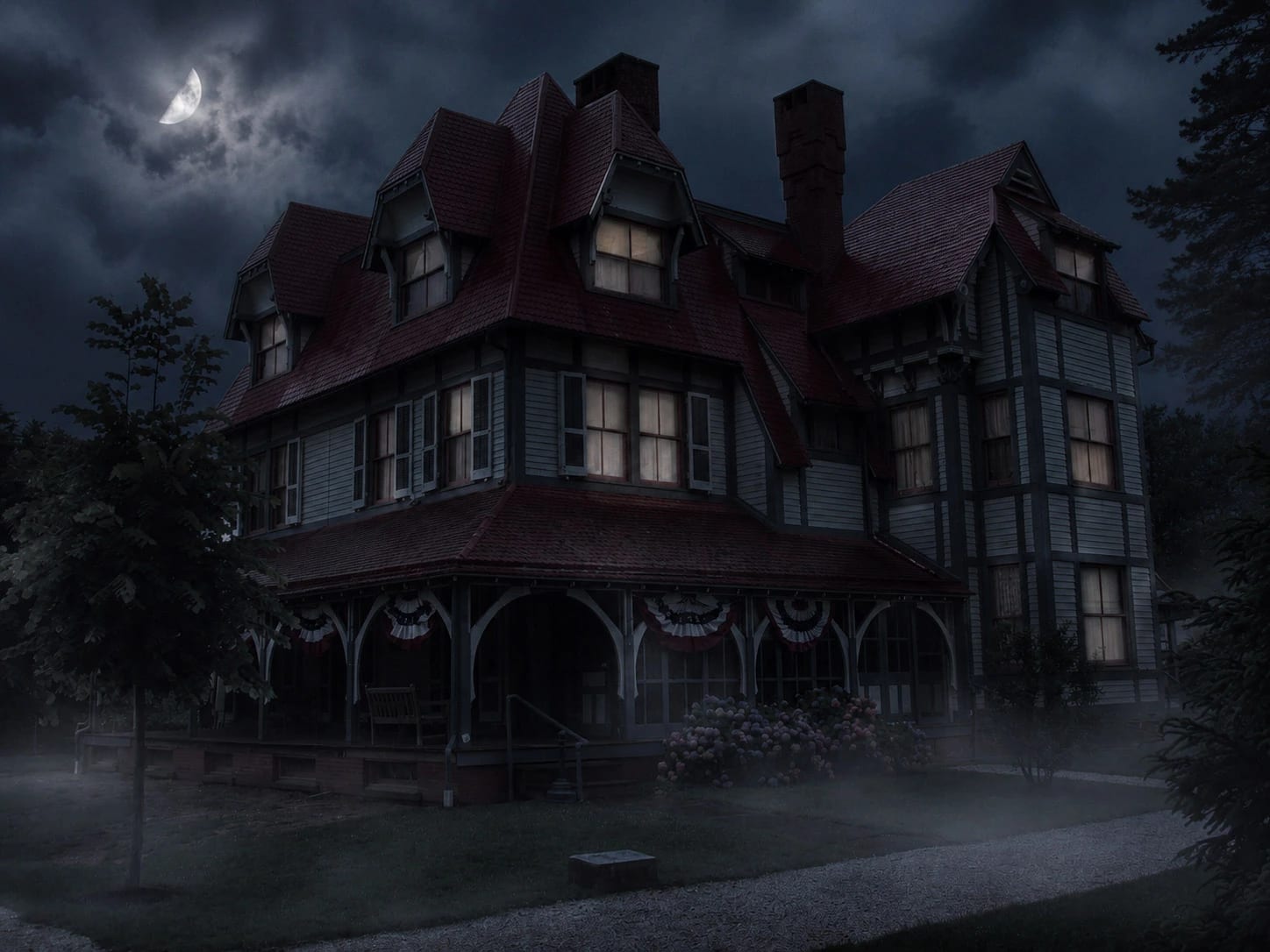
It's one of the most haunted spots in a town full of them. If its stories pull you in, the Emlen Physick Estate — Cape May's most famous haunted house — is worth your time too, and our guides walk this kind of history every night on a Cape May ghost tour, including the adults-only Dark Water Rising.
Stand under the tower long enough and a strange thought creeps in. The lighthouse was built for one purpose: to keep people from being lost to the sea. What if, in some way, it's still doing that job? Not guiding ships anymore — but holding onto the memory of everyone who saw its light and never made it home.