On a quiet block of West Baltimore stands a small brick rowhouse that looks like a thousand others — two and a half stories, a few narrow rooms, steep stairs winding up to a cramped garret under the roof. There's nothing grand about it. That's the first thing that strikes you. The house where Edgar Allan Poe lived is modest to the point of severity, a poor family's rented home, and the contrast between those plain rooms and the enormous shadow Poe casts over American literature is the whole story in miniature.
This is the Edgar Allan Poe House on Amity Street, one of Baltimore's most important historic landmarks and one of the places most closely bound to the writer's name. Poe lived here as a young man, before the fame, when he was poor, ambitious, and surrounded by the family that would shape both his life and his fiction.
Poe's writing helped define Gothic literature — the dread, the grief, the obsession with death and the thin membrane between the living and the dead. But his own life was filled with mysteries, tragedies, and unanswered questions, and it ended, fittingly and terribly, right here in Baltimore in a way no one has ever fully explained. Nearly two centuries later, that combination still generates ghost stories.
This is meant to be a portrait of Poe the man as much as Poe the ghost. We'll trace his Baltimore years and the family he lived with, the house itself and the work it shaped, the losses that haunted his fiction, his baffling death, and the paranormal reports attached to the property. It's one of the cornerstones of our Haunted Baltimore collection and a fixture of the city's haunted identity that we return to often on our Baltimore ghost tour.
What Is the Poe House?
The Edgar Allan Poe House sits at 203 North Amity Street, in the Poppleton neighborhood west of downtown Baltimore. It's a small brick rowhouse, built in the early 19th century, of the modest sort put up for working families — the kind of home that survives more by luck than by grandeur. This one survived because of who once lived inside it.
Poe lived here in the early-to-mid 1830s, during the years his family rented the house, and that brief tenancy is the reason the building still stands. When much of the surrounding block was later cleared, the Poe House was spared and preserved precisely because of its connection to the writer. It has operated as a museum for the better part of a century, and it is recognized as a National Historic Landmark — a remarkable status for so plain a structure, earned entirely by its literary associations.
Today the house is run as the Edgar Allan Poe House & Museum, cared for by a nonprofit devoted to Poe's Baltimore legacy. It holds furnishings and artifacts evoking the period, and it preserves the cramped, low-ceilinged rooms much as they would have been when Poe climbed those stairs. The museum has weathered its own struggles over the years, including funding crises that briefly threatened its operation, but it has endured — appropriately enough for a shrine to a writer whose own life was a long struggle against poverty and obscurity.
It's worth establishing the house as a serious historical and literary site before turning to its ghosts. This is not a haunted attraction that happens to invoke Poe. It is the genuine home of one of America's most important writers, and the ghost stories, whatever you make of them, are a late addition to a building whose real significance is biographical and literary.
Edgar Allan Poe's Life in Baltimore
Poe's road to Amity Street ran through a childhood marked by loss. Born in Boston in 1809 to traveling actors, he was orphaned young — his father abandoned the family, and his mother, Eliza Poe, died in Richmond in 1811 when Edgar was not yet three. He was taken in, though never formally adopted, by the Richmond merchant John Allan and his wife Frances, whose surname Poe carried as his middle name. That relationship soured over money and temperament, and by the early 1830s Poe, estranged from Allan and chronically broke, made his way to Baltimore and the household of his father's side of the family.
The home on Amity Street held a tight knot of Poes and Clemms. There was Maria Clemm, Poe's paternal aunt — 'Muddy,' as he came to call her — a poor widow who held the household together through sheer will. There was her daughter, Virginia Clemm, Poe's young first cousin, who would later become his wife. There was Poe's grandmother, Elizabeth Cairnes Poe, the widow of his Revolutionary War grandfather, whose small military widow's pension was one of the family's few reliable sources of income. For a time there was also Poe's older brother, Henry, a would-be writer himself, who died of tuberculosis in 1831, one more early death in a life already full of them.
These were hard years. The family lived close to destitution, and Poe scrambled for any income his pen could earn. But Baltimore is also where his literary career began in earnest. In 1833, he won a fifty-dollar prize from a local newspaper, the Baltimore Saturday Visiter, for his short story 'MS. Found in a Bottle' — a modest sum that brought him desperately needed money and, more importantly, his first real public recognition and the notice of influential literary men.
It was in Baltimore, in other words, that Poe began to become Poe: not the celebrated author he would briefly be, nor the tragic legend he became after death, but a young writer finding his voice in a crowded, impoverished rowhouse. He left around 1835 for an editorial position in Richmond, and married Virginia the following year, but the Baltimore years were formative. The city gave him his start, his family, and — eventually — his grave.
The House That Shaped a Literary Legend
Step into the Amity Street house and the first thing you feel is how small it is. The rooms are narrow, the ceilings low, the stairs steep and tight, and the garret under the roofline — traditionally pointed out as the space associated with Poe — is barely more than a crawl-height attic. This was not a writer's romantic retreat. It was a cramped, cold, crowded home shared by several people with very little money.
It's tempting to draw straight lines from those surroundings to Poe's fiction, and that temptation should be resisted in its cruder forms. Poe did not simply transcribe his life; he was a deliberate craftsman who built his effects with great care, and most of his famous tales were written years after he left Baltimore. The claustrophobic rooms of Amity Street did not directly produce 'The Tell-Tale Heart' or 'The Fall of the House of Usher.'
What can be said, more carefully, is that the conditions of these years — poverty, confinement, the constant nearness of illness and death, the emotional intensity of a household clinging together against the world — belonged to the same emotional landscape Poe would later mine so brilliantly. The dread of premature burial, the obsession with dying young women, the terror of confinement and decay that run through his work all grew from a sensibility formed in hard, close circumstances like these. The house didn't write his stories. But it helped shape the man who did, and standing in those rooms gives a visitor a visceral sense of the world he came out of.
That, more than any ghost, is what makes the Poe House worth the visit: the chance to feel, physically, the smallness and difficulty of the life behind the towering literary reputation.
Tragedy, Death, and Loss in Poe's Life
No American writer is more associated with death, and Poe came by the association honestly. Loss stalked him from infancy to the grave.
It began with his mother, Eliza, dead of tuberculosis before he turned three, a scene the toddler reportedly witnessed. His foster mother, Frances Allan, died in 1829, when Poe was twenty. His brother Henry died in 1831. The same disease that took his mother — consumption, the slow, wasting killer of the 19th century — moved through his life like a recurring character, claiming the women he loved one after another.
The deepest wound came later, and not in Baltimore, but it belongs to the story. In 1836 Poe married his cousin Virginia, who had been a child in the Amity Street house. She was, by every account, the great love of his life. In 1842, while singing at a piano, Virginia burst a blood vessel — the first sign of tuberculosis — and began a long, agonizing decline. She died in 1847 at the Poe cottage in Fordham, New York, at just twenty-four. Poe never recovered. The grief deepened his drinking and his instability and shadowed the last two years of his own life.
Grief, in fact, was Poe's great subject. The death of a beautiful woman, he once wrote, was the most poetic topic in the world — a chilling line from a man who watched it happen again and again. His fixation on mortality, mourning, and the refusal of the dead to stay safely dead was not an affectation. It was drawn from a life in which death was the most constant presence he knew. That biography, more than any creak on a staircase, is the true source of the haunted feeling people bring to the Poe House. The man himself was haunted long before anyone called the house so.
Why Is the Poe House Considered Haunted?
Of all the writers in American history, Poe is the one whose name attaches itself to ghosts most naturally — and that fact explains a great deal about the Poe House's reputation.
Poe invented much of the modern vocabulary of literary horror. He gave us premature burials, beating hearts beneath floorboards, a raven croaking of nevermore, the collapse of a cursed family house. For generations of readers, his name has been shorthand for the macabre itself. When the man who taught America to be afraid has a surviving home, that home is going to be called haunted whether or not anything unusual ever happens inside it. The expectation arrives with the visitor.
Layer onto that the genuine tragedy of his life and the true mystery of his death — both rooted in Baltimore — and the haunted reputation becomes almost inevitable. A poor, grief-stricken genius who died young and strangely in this very city, in a home preserved as a kind of shrine, is the perfect candidate for a ghost story. The legends grow from the unique overlap of his literary legacy and his real suffering.
So the reports that follow should be read in that light: as folklore and reported experience layered onto an extraordinary life, part of Poe's cultural afterlife rather than established fact. The most honest way to understand the Poe House hauntings is as the natural consequence of housing the memory of America's great poet of death.
Is Edgar Allan Poe's Ghost Still Here?
The question visitors most want answered is the simplest and the least answerable: does Poe himself walk the Amity Street house?
The stories exist, certainly. Over the years, visitors and staff have reported the kinds of encounters you'd expect at a place this charged. Some describe a figure — a man in dark, old-fashioned nineteenth-century clothing — glimpsed in a doorway or on the stairs and gone an instant later. Others report the sense of a presence in the garret or the upper rooms, a feeling of being accompanied through the empty house. Because the building is so completely identified with Poe, witnesses inevitably read any such figure as the writer himself, returned to the home of his struggling youth.
I'd treat the Poe-specific sightings with particular care, more than most. There is no place on earth where the power of suggestion is stronger than inside the preserved home of Edgar Allan Poe. Every visitor arrives primed by a lifetime of associations; the house is small, dim, and atmospheric; and the desire to encounter Poe is part of why many people come at all. Those are close to laboratory conditions for seeing exactly what you expect to see. A glimpsed shadow becomes Poe almost automatically.
There's also a quieter, more interesting set of reports that has nothing to do with Poe directly. Some accounts describe not a brooding male figure but an older woman — a heavyset, gray-haired presence — which longtime tellers sometimes connect to Maria Clemm, the aunt who anchored the household, or to Poe's grandmother. These are the stories I find more curious, precisely because they don't fit the legend the building markets. A visitor expecting Poe and reporting an old woman instead is doing something other than projecting the obvious.
None of it, of course, is proof of anything. The encounters are brief, subjective, and unverifiable, and the most famous of them are exactly the ones suggestion can best explain. But the reports are real as reports, and they keep the question alive. Whether or not Poe lingers on Amity Street, the idea that he might is now permanently attached to the house — which is its own kind of haunting.
Paranormal Activity Reported at the Poe House
Beyond the apparitions, the Poe House generates the familiar catalog of reports common to small, old, atmospheric historic homes.
Visitors and staff describe footsteps on the stairs and in rooms known to be empty — a particular kind of report in a house with such tight, loud old staircases. People mention voices or faint sounds with no obvious source, cold spots and sudden drafts in specific rooms, and the persistent feeling of being watched, especially in the upper floors and the garret. A few accounts describe taps or knocks, which visitors, steeped in 'The Raven,' are quick to find significant.
It's worth separating the streams. The most grounded reports come from museum staff and guides — people who spend long hours alone in the building and know its ordinary noises well enough to notice when something seems off. Visitor accounts are more numerous but also more suggestible, gathered from people moving through a famously eerie writer's home already hoping for a frisson. And the house, like any site with this reputation, has drawn paranormal investigators over the years, whose recordings and readings add to the lore without resolving anything.
The honest assessment is the same one any old rowhouse deserves. A small, drafty, two-century-old brick building with steep wooden stairs will produce footsteps, creaks, cold spots, and odd sounds entirely on its own, and a visitor's expectations supply the meaning. That doesn't make the experiences any less real to the people who have them. It only means the Poe House offers, as it always has, atmosphere in abundance and proof of nothing — which may be exactly how its most famous resident would have wanted it.
Poe, Death, and America's Ghost Culture
Step back from Amity Street and a larger pattern comes into view: Poe is attached to ghosts everywhere, not just here.
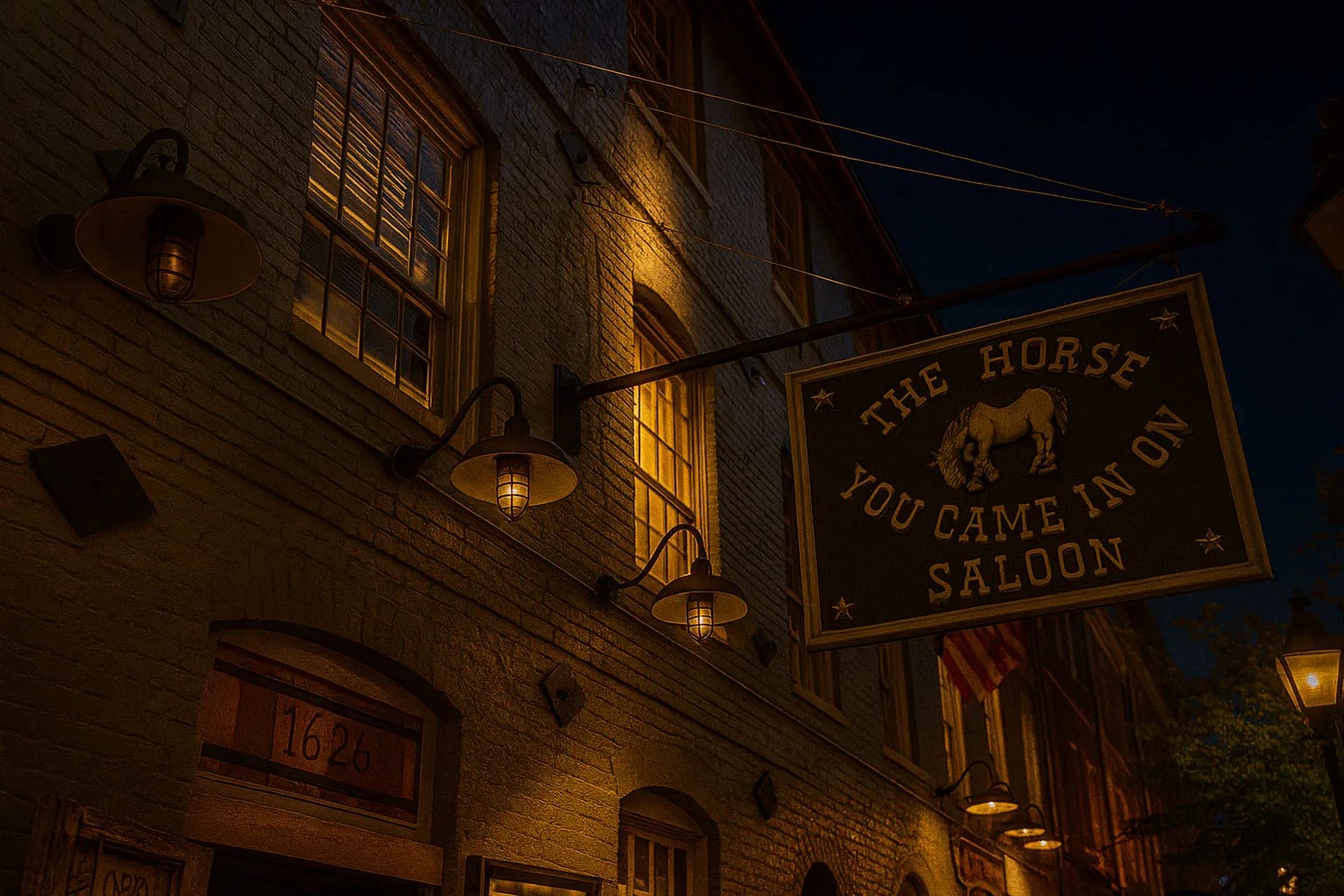
More than perhaps any other figure, Poe shaped American horror, and in doing so he became inseparable from it. His face — the high forehead, the dark eyes, the drooping mustache — is instantly legible as a symbol of the macabre. His name is invoked on haunted tours in cities where he barely set foot. Bars, hotels, and houses with the thinnest connection to him claim his ghost, because a Poe association is the most potent shorthand for 'haunted' that American culture possesses. We covered one such case at The Horse You Came In On, the Fells Point saloon whose Poe legend outruns the evidence.
This says something about how literary legends and hauntings feed each other. Poe wrote so convincingly about the dead refusing to stay dead that the culture has, in a sense, refused to let him stay dead. He has become a kind of permanent literary ghost, summoned wherever a story needs a touch of dread and a famous name. The ghost stories are a continuation of his work by other means — the macabre imagination he perfected, turned back upon his own memory.
The Poe House sits at the center of that phenomenon with a better claim than most. Here, at least, the association is genuine: Poe really lived in these rooms, really suffered here, really died in this city. If any place has earned the right to its Poe ghost, it's this one. But the broader truth is worth keeping in view — much of what we call 'haunted' around Poe is really the long reach of his writing, and the culture's unwillingness to let go of the man who wrote it.
The Mystery of Poe's Death and Its Connection to Baltimore
No account of the Poe House is complete without the death, because it happened in Baltimore and remains genuinely unsolved — the historical mystery from which much of the later folklore grows.
The documented facts are stranger than most inventions. In late September 1849, Poe left Richmond bound for Philadelphia and then New York. He never arrived. On October 3, 1849, he was found at Ryan's Tavern, also called Gunner's Hall, on East Lombard Street in Baltimore — delirious, disheveled, and reportedly wearing clothes that were not his own. A Baltimore acquaintance, the editor Joseph Snodgrass, was summoned and had him taken to Washington College Hospital. There Poe drifted in and out of consciousness, never lucid enough to explain what had happened, and died on October 7, 1849, at age forty.
What killed him has never been established. Theories have multiplied for more than 170 years: acute alcoholism, exposure, a beating and robbery, heart disease, rabies, and the once-common election-day crime of 'cooping,' in which men were seized, drugged with liquor, and forced to vote repeatedly at multiple polls — which would account for the strange clothing and the location at a tavern doubling as a polling place. The medical records are lost; the contemporary accounts conflict; the truth is almost certainly unrecoverable.
Poe was buried in Baltimore and lies today at the Westminster Burying Ground, where his grave became a pilgrimage site and the focus of its own enduring tradition — the mysterious 'Poe Toaster,' who for decades left roses and cognac at the grave each January on the writer's birthday. We tell the fuller story of that burying ground, and the death, at Westminster. A death this mysterious, in the city that holds his home and his grave, was always going to breed ghost stories. The unanswered questions are the engine; the folklore is the exhaust.
The Poe House and Baltimore's Haunted Legacy
Poe is not merely one of Baltimore's haunted figures. He is, in many ways, the central one — the patron ghost of the whole city's paranormal identity.
Baltimore claims Poe more fiercely than any other place, grave and all, and his shadow falls across the rest of its haunted landscape. The Horse You Came In On built its reputation on a Poe legend. The waterfront taverns and the wider lore of Fells Point lean on his memory. Even sites with no real Poe connection borrow his name for atmosphere. Where the Admiral Fell Inn haunts through maritime tragedy and the Baltimore Almshouse through forgotten poverty, the Poe House haunts through literature — through the enduring power of the man's work and the city's claim on his life and death.
That makes the Poe House unique in the Baltimore catalog. Most haunted places are defined by what happened in them. The Poe House is defined by who lived in it, and by what he went on to write. Its haunting is, at bottom, literary — the lingering presence not of a violent event but of an imagination, and of the grief that fed it.
It's the cornerstone of how Baltimore understands itself as a haunted city, and a fixed point in our Haunted Baltimore collection. Whatever else the city's ghosts may be, they all stand, in some sense, in Poe's shadow.
Can You Visit the Poe House Today?
Yes. The Edgar Allan Poe House & Museum is open to the public on a seasonal schedule, and a visit is one of the essential experiences for anyone serious about American literature or Baltimore history. The house is small, so tours are intimate; you move through the same cramped rooms and up the same steep stairs Poe knew, with the museum's interpreters and exhibits filling in the life around you.
The crowd it draws says everything about the place. Literary pilgrims come to stand in the home of one of the most influential writers in the language. Historians come for the genuine artifact of early Baltimore and early American letters. And paranormal enthusiasts come hoping to feel the presence of the master of the macabre himself. All three find what they're looking for, more or less, in the same small rooms.
The museum is a nonprofit and depends on visitors and supporters to keep its doors open, so going is also a small act of preservation. If you want to set the Poe House in the wider context of the city's haunted past, our Baltimore ghost tour walks the stories that connect Poe to the rest of Haunted Baltimore.
The Man Behind the Ghost
Whether or not you encounter anything unexplained on Amity Street, the Poe House offers something rarer than a ghost: the chance to stand inside the actual world that helped shape one of America's most influential writers. The smallness of the rooms, the steepness of the stairs, the plainness of a poor family's home — these tell you more about Poe than any portrait or plaque, and more, in the end, than any ghost story.
That's the irony worth carrying out the door. Poe spent his art convincing readers that the dead remain among us, and the culture has returned the favor by refusing to let him rest, summoning his ghost in Baltimore and far beyond. But the deepest haunting here isn't a figure on the stairs. It's the life itself — the poverty, the grief, the relentless losses, and the extraordinary imagination that turned all of it into literature that still unsettles us nearly two centuries on.
Come meet the man behind the ghost. Explore the rest of our Haunted Baltimore stories, read how Poe's legend shaped The Horse You Came In On, or come walk the city's haunted history with us on one of our Baltimore ghost tours, like the Ghosts of Baltimore Tour.
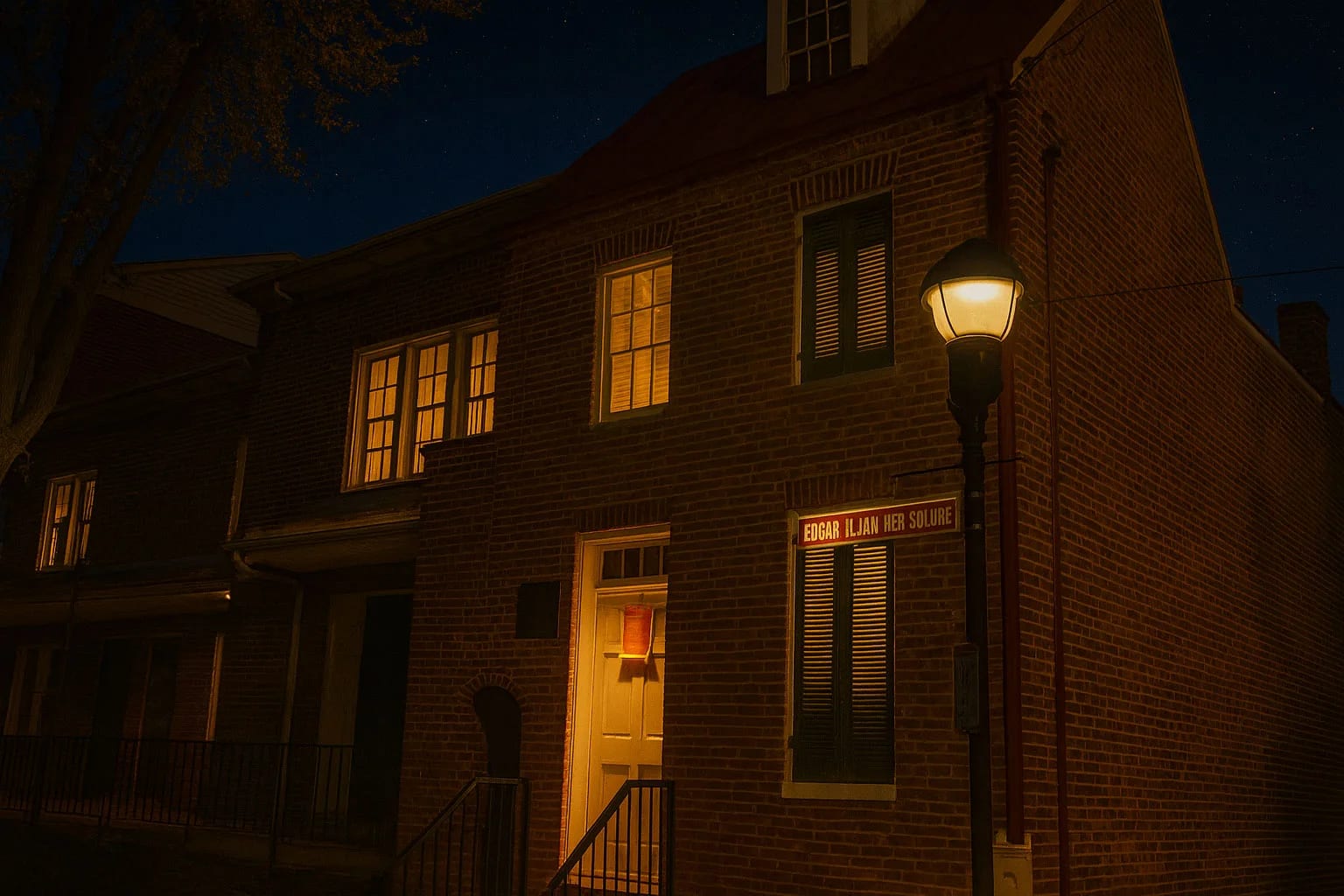
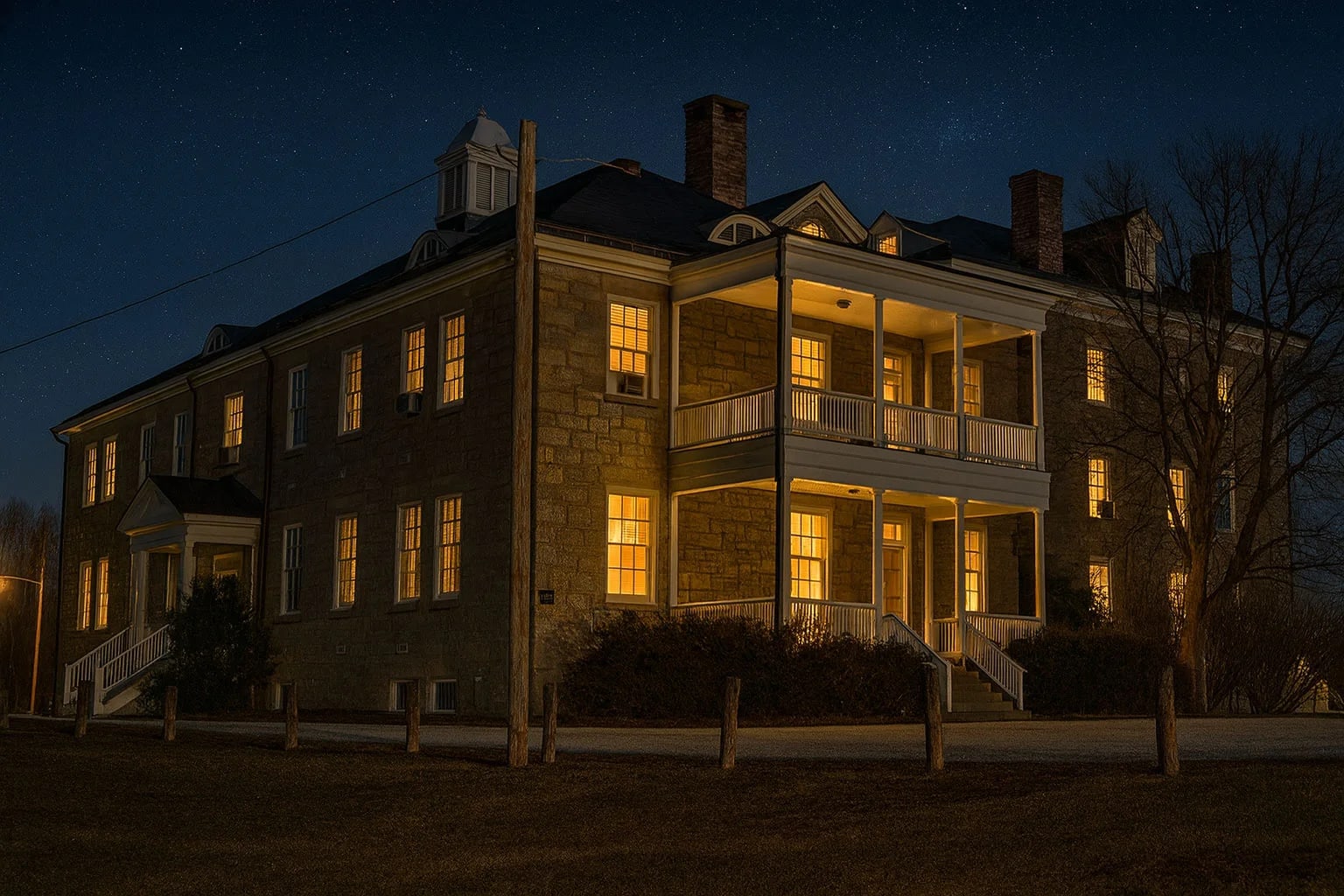
The Edgar Allan Poe House on North Amity Street, the modest rowhouse where the young writer lived in the early 1830s