The Place Where America Said Goodbye
The drive into Oak Ridge Cemetery is quiet and green, the road curving up through old trees and older headstones until the monument comes into view: a granite obelisk rising more than a hundred feet, ringed with bronze soldiers, a statue of Lincoln himself out front. At the entrance there's a bronze bust of his head, and its nose is worn to a bright gold shine from generations of hands. Almost everyone rubs it. Nobody is entirely sure why anymore — for luck, for closeness, for the simple need to touch something connected to him.
That's the strange thing about this place. People wander through historic homes out of curiosity and walk battlefields out of interest. They come to Lincoln's tomb for something more personal. You can see it in how they move — slower, quieter, the way people behave at a grave that somehow feels like it belongs to them too.
And a lot of them leave saying they felt something here. Not all of them mean it the way ghost hunters do. Some mean the sheer weight of the place, the sadness that settles over you on the steps. Others mean something more — a figure, a sound, a presence near the burial chamber that they can't quite explain away on the drive home.
To understand why, you have to go back to how Lincoln got here. Because the country didn't simply lose a president in the spring of 1865. It came apart with grief, and it carried that grief seventeen hundred miles to lay him down in this Illinois cemetery.
Bringing Lincoln Home
The Assassination That Changed America
On the night of April 14, 1865, with the war all but won, Abraham Lincoln was shot at Ford's Theatre in Washington. He died the next morning. The country had been bracing for celebration; instead it woke to the news that the man who had carried it through four years of slaughter was gone, murdered in a theater box at the very moment of peace.
The shock is hard to overstate now. Church bells that had been ringing for the war's end fell silent and began to toll. Cities draped themselves in black. People who had never met Lincoln wept in the streets. Whatever they had made of him in life — and plenty had hated him — his death landed like a death in the family, across an entire nation at once.
And almost immediately, the question turned toward home. Lincoln belonged to the country, but he had belonged to Springfield first, and Springfield wanted him back.
The Funeral Train
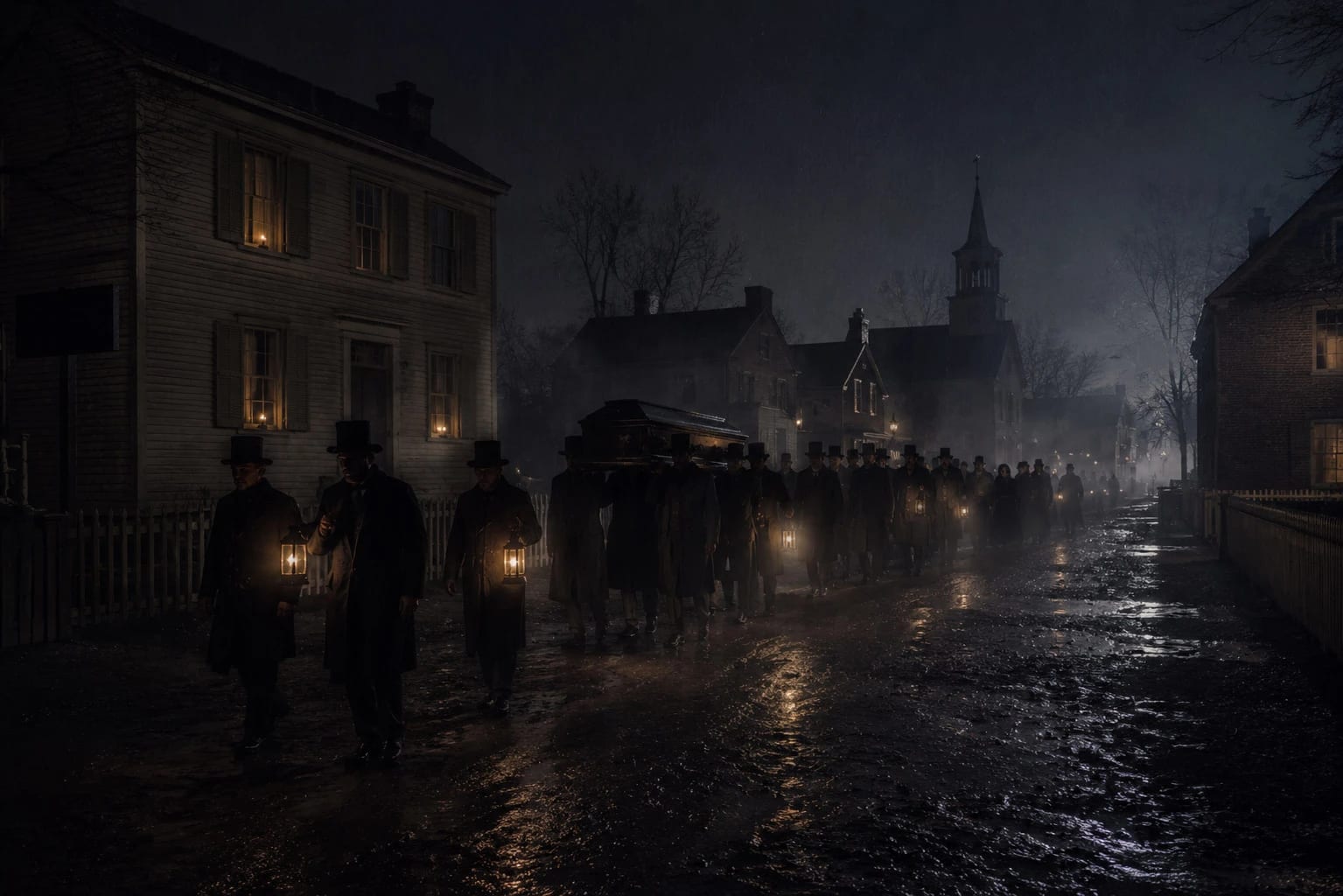
What happened next was unlike anything before or since. Lincoln's body was placed aboard a funeral train and carried home to Illinois — not by the direct route, but along a winding seventeen-hundred-mile path that retraced much of the journey he had taken to Washington as president-elect four years earlier. The trip took about two weeks.
It became a slow, rolling act of national mourning. The train passed through Baltimore, Philadelphia, New York, Albany, Buffalo, Cleveland, Columbus, Indianapolis, Chicago, and on toward Springfield, stopping in city after city so the body could lie in state and the public could file past. Millions came. They stood along the tracks in the dark, in the rain, in the middle of the night, in towns where the train didn't even stop, just to watch it pass. Bonfires lit the route. Parents held their children up to see.
Lincoln did not make the journey alone. The body of his son Willie, who had died in the White House in 1862, was taken up and carried with him, so that father and son could be buried together in Springfield. A grieving family, folded into a grieving country.
Arrival in Springfield
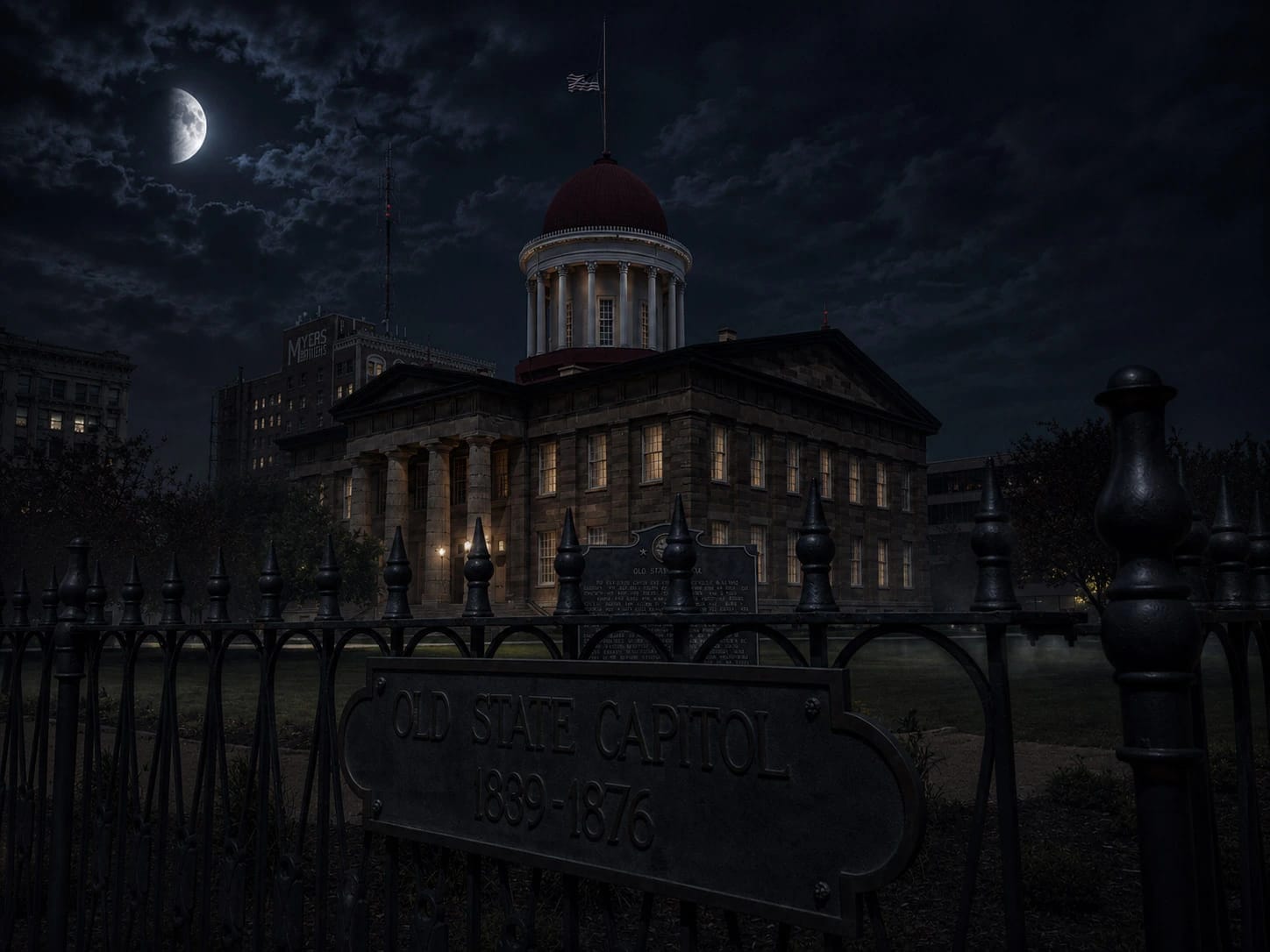
When the train finally reached Springfield in early May, the town Lincoln had left as president-elect received him as a martyr. His body lay in state at the Old State Capitol — the same building where he had argued cases and delivered the 'House Divided' speech — and the people who had known him as a neighbor and a lawyer filed past the coffin.
Then they carried him out to Oak Ridge Cemetery, on the edge of town, and placed him in a temporary vault while the city set about building something worthy of him. The grief finally had a place to go. It just didn't have its monument yet.
Building a Monument to a President
The Creation of Lincoln Tomb
A monument like this had never really been attempted for an American. Money poured in from across the country — ordinary people sending what they could toward a fitting resting place for the murdered president. The design, by the sculptor Larkin Goldsmith Mead, called for a granite obelisk soaring more than a hundred feet, with bronze statuary below: Lincoln himself, and groups of soldiers and sailors representing the war he had seen the nation through.
It took years. The tomb was completed in 1874, and Lincoln was moved into it — the centerpiece of a structure built not just to hold a body, but to give a country somewhere to bring its sorrow.
A National Shrine
From the start, this was more than a grave. It became a destination, a place of pilgrimage. People came from everywhere to stand where Lincoln was buried, the way they might visit a sacred site, and they have never stopped coming. Over time the tomb came to hold not only Abraham but Mary Todd Lincoln and three of their four sons — Eddie, Willie, and Tad — a family reunited in death in the city where they had been happiest and where their losses had begun.
What grew up around the monument was never really about architecture. It was about need. A nation that had loved and lost this man wanted a place to feel close to him, and so it built one. That kind of accumulated emotion, poured into a single spot for over a century, tends to leave a mark — and according to a great many who visit, it did.
The Strange History Inside the Tomb
Here's something most visitors never learn standing at the polished bronze nose: Lincoln's body has not rested quietly. Its history is genuinely bizarre, and it goes a long way toward explaining the folklore that has gathered here.
Attempts to Steal Lincoln's Body
On election night in November 1876, a gang of Chicago counterfeiters came to Oak Ridge Cemetery to steal the body of Abraham Lincoln.
The plan was as brazen as it sounds. Their best engraver was sitting in prison, and the counterfeiting operation had fallen apart without him. So the gang hatched a scheme to break into the tomb, haul the president's remains out into the Illinois night, and hold the body for ransom — two hundred thousand dollars and the engraver's release. They pried open the marble sarcophagus and had begun to move the coffin when lawmen, tipped off by an informer planted in the gang, closed in. The thieves fled, and were caught weeks later.
It sounds like a tall tale. It happened. And it left the men responsible for Lincoln with a lasting terror that someone would try again.
Moving the President
What followed was decades of secrecy. To keep the body safe, Lincoln's coffin was quietly hidden — moved to unmarked spots inside the monument, buried in the basement, shifted from place to place while the public went on paying respects to a sarcophagus that, for years, didn't actually hold him. For a long stretch, only a small circle of men knew where Abraham Lincoln truly lay.
Finally, in 1901, his son Robert ordered the matter settled for good. The coffin was lowered into a deep vault and encased in a cage of steel and tons of concrete, where it remains, far below the floor where visitors stand. Before they sealed it, a handful of witnesses insisted on opening the coffin one last time to be certain it was really him. It was. His face, they said, was unmistakable.
A body stolen, hidden, moved, and buried again and again. It would be stranger if a place with that history hadn't gathered ghost stories.
The Ghost Stories of Lincoln Tomb
The hauntings here are bound up with grief, which makes them quieter and sadder than most. People rarely describe terror at Lincoln's tomb. They describe sorrow, and the sense of not being alone in it.
Sightings of Abraham Lincoln
Lincoln himself is the figure people most hope, and fear, to see. Visitors have described a tall, lean man near the monument or inside the burial chamber — there for a moment in the half-light, gaunt and unmistakable in silhouette, gone when they look again. Some report only a long shadow where no one is standing. The descriptions tend to agree on one thing: the figure seems weighed down, sorrowful, exactly the way the country remembers him in his final year.
Strange Encounters Near the Monument
Others describe figures that never resolve into anyone in particular. A shape on the steps at dusk. Someone near the obelisk who isn't there a second later. A person in old-fashioned clothing glimpsed among the bronze soldiers and mistaken for a reenactor, until they simply aren't anywhere. Monuments like this draw these stories partly because of what they are — solemn, isolated, built for the dead — and partly because of who this one belongs to.
Voices and Unexplained Sounds
Then there are the sounds. Visitors and staff have reported footsteps on the marble when the chambers are empty, low voices with no source, and — most hauntingly — the sound of someone weeping. The crying is sometimes attributed to Mary, whose grief was the defining fact of her life, though no one can say for certain. People have turned toward the sound expecting a mourner and found the room empty.
The Presence Many Visitors Describe
Far more common than any sighting is a feeling. People step into the burial chamber and are hit, without warning, by a wave of emotion — a heaviness, a deep sadness, sometimes tears that come from nowhere. Others describe the opposite: an unexpected calm, a quiet sense of peace standing before the sarcophagus. Many simply feel watched. None of it photographs. All of it tends to stay with people long after they have left.
This is the part that's hard to wave off, because it happens to people who arrived thinking about nothing but their itinerary, and it happens again and again, in the same room.
Encounters Reported by Caretakers and Staff
The people who tend the cemetery and the monument — caretakers, security, volunteers — have the steadiest stream of stories, and the most reluctance to tell them. They describe lights and sounds with no cause, a sense of company in the chambers after closing, the feeling of being quietly accompanied while locking up. As at most places like this, the striking thing is the repetition: people who spend real time at the tomb tend to come away with their own version of the same few experiences.
Paranormal Investigations
The tomb's fame has naturally drawn paranormal interest, and investigators have reported the usual — recordings that seem to carry a voice, temperature changes, instruments reacting near the burial chamber. As a revered state historic site, it isn't open to the kind of free-for-all ghost hunting some places allow, which keeps the claims relatively modest. It's worth holding all of it loosely. A stone monument is full of drafts and echoes, suggestion runs strong in a place this charged, and none of it proves anything. What lingers is how consistent the gentler reports are, across generations of people who had no reason to compare notes.
Why Lincoln's Ghost Appears Across America
Lincoln's tomb is far from the only place people claim to encounter him, and that's worth sitting with. He may be the most widely reported ghost in American history.
The White House is thick with Lincoln stories. Staff, guests, and even visiting heads of state have claimed to feel him, hear him, or see him in the halls and bedrooms where he worked and grieved — the Lincoln Bedroom most famously of all. There are stories tied to Ford's Theatre, to the old Springfield home, to the route the funeral train traveled. For a single historical figure, the geographic spread of the hauntings is remarkable.
Why Lincoln? Part of it is simply that everyone knows him. A ghost story needs a name people recognize, and there is no more recognizable name in American history. Part of it is how he died — murdered, suddenly, at the hinge of the nation's story. And part of it is that we have never been willing to let him go. We quote him, argue over him, build him into the way we explain ourselves to ourselves.
The tomb in Springfield isn't an isolated haunting. It's the center of gravity for a much larger national tradition — the place where the man himself was laid down, pulling toward it the same grief and fascination that follows him everywhere else.
The Weight of Memory
Set aside the question of whether anything supernatural walks Oak Ridge Cemetery, and something undeniable remains: this is a place built entirely out of emotion.
Most graves hold one family's grief. This one holds a nation's. The sorrow that flowed toward Lincoln in 1865 was vast and genuine and shared by millions, and it was poured, deliberately, into this single monument — a place designed to gather and hold the mourning of a whole country. More than a century and a half of visitors have added their own quiet grief to it, day after day, standing where he lies.
Places like that tend to feel different, and people tend to sense it. Whether what they feel is the residue of all that emotion, the power of suggestion in a solemn place, or something that genuinely lingers, is a question the tomb doesn't answer. It simply produces the experience, reliably, and leaves each visitor to decide what it was.
That may be the most honest way to hold the ghost stories of Lincoln's tomb. They grow out of real grief, on a scale almost nowhere else can match, and that grief is the one thing no one disputes.
Standing Before the Tomb
Visitors still come every day. They climb the steps, run a hand over the bronze nose worn smooth by all the hands before theirs, leave flowers, and stand a while without saying much. Some are tourists checking off a landmark. Many are something closer to pilgrims, even if they would never use the word.
Some places feel different because of what happened there. Others feel different because of what they mean. Lincoln's tomb is both, which is rare, and maybe that's why people walk away carrying more than they expected to.
You can hear these stories where they belong, after dark, when our guides walk the history of haunted Springfield on a Springfield ghost tour — the tomb, the Lincoln Home, and the rest of the city's connections to its most famous resident.
Perhaps the most remarkable thing about Lincoln's tomb isn't the ghost stories at all. It's that more than a hundred and fifty years after his death, people still come here looking for some connection to Abraham Lincoln — and some of them leave believing they found one.