The House Lincoln Left Behind
The street is quiet, brick-paved and lined with wood-frame houses kept the way they looked in the 1850s. No cars. No power lines. You half expect to hear a horse. And then there's the house itself, on the corner — a handsome but ordinary two-story home, brown with green shutters, the kind of place a successful small-town lawyer would have been proud of and nobody would look at twice if they didn't know.
That's the strange part. Most of the famous Lincoln sites are grand — the marble tomb, the great memorial in Washington, the domed capitol where he argued his cases. This is just a family home. It doesn't perform its importance. It sits there, plain and preserved, and lets you walk through the actual rooms where the rest of it started.
Children ran up and down these stairs. A husband and wife argued and made up in these rooms. A man paced this parlor working through the ideas that would tear the country apart and stitch it back together. And in a downstairs room, on a winter morning in 1850, that same man and his wife watched their little boy die.
People come here for the history. A surprising number of them leave talking about something else — a feeling in a particular room, a sadness that arrives out of nowhere, the sense that the house is not as empty as it looks. Which raises a question worth sitting with. When a home becomes bound so tightly to one of the most important people who ever lived, does some part of that life stay behind in it?
The House Where Abraham Lincoln Became Abraham Lincoln
Purchasing the Home
When Abraham Lincoln bought the house in 1844, he wasn't a monument yet. He was a thirty-five-year-old lawyer with a growing practice, a new wife, and a baby son, looking for a home that fit his rising station. He paid around fifteen hundred dollars for the place — bought, fittingly, from the Episcopal minister who had married him to Mary Todd two years earlier.
It was the only home Lincoln would ever own. For the next seventeen years, nearly everything that mattered to him happened here or close to it.
Building a Family
The Lincolns filled the house with children. Robert came first, in 1843. Eddie followed in 1846, Willie in 1850, and Tad in 1853. The home that started as a modest cottage grew along with the family — in 1856 the Lincolns expanded it to a full two stories, giving the boys room and giving Mary the kind of house she felt their position deserved.
Day to day, it was an ordinary, noisy household. Lincoln was an indulgent father, known among his neighbors for letting his sons run wild — riding on his shoulders, tearing through his law office, interrupting serious conversation while he grinned and let them. Mary ran the home, managed the money, and pushed her husband's ambitions as hard as he did. There were servants and chores and dinners and illnesses, the ordinary rhythm of a family living its life.
A Future President Under This Roof
It was also where Lincoln became the man the country would eventually need. He rode the legal circuit for months at a time and came home to this house. He read and argued and thought in these rooms. When his political career caught fire in the 1850s over the question of slavery, this was the home he returned to between the speeches and the campaigns.
By 1860, men were coming to this front door to tell a prairie lawyer he might be president. He learned that he had won the election while living here. But before any of that — before the war, before the monuments — this was simply where the Lincolns lived. Home first. History second.
Joy, Grief, and the Lincoln Family
The Death of Eddie Lincoln
The worst thing that ever happened in this house happened to a three-year-old.
Eddie Lincoln — Edward Baker Lincoln, named for a friend — fell ill in the winter of 1849 and didn't recover. For nearly two months he wasted away, most likely from tuberculosis, while his parents nursed him at home and watched him slip further out of reach. He died on February 1, 1850, in the house, just short of his fourth birthday.
It broke them both. Lincoln, a man who held his feelings close, was undone by it. Mary collapsed into a grief so total that family worried she would not eat or rise from bed. The loss of a child was tragically common in that century, but knowing that has never made it survivable, and the Lincolns did not come through it cleanly. Something in the house changed after Eddie.
Mary Todd Lincoln and Grief
Mary Todd Lincoln has been treated unkindly by history — painted as difficult, unstable, extravagant. What gets lost in that caricature is how much she lost. She loved her children with an intensity that left her terribly exposed, and across her life she would bury three of her four sons, and then her husband, murdered beside her.
It started here, with Eddie. The grief that would shadow the rest of Mary's life took root in this house, in the room where her little boy died. When people today report feeling a wave of sorrow in certain corners of the home, it's almost always Mary they reach for as the explanation — the mother whose mourning never really ended.
The Family Leaves Springfield
In February 1861, the Lincolns packed up the house and prepared to leave for Washington. Lincoln rented the home out rather than sell it; some part of him clearly meant to come back to it.
He never did. On a rainy morning at the Springfield depot, he said goodbye to the town that had made him, telling the crowd he didn't know whether he would ever return, and admitting he faced a task greater than the one Washington itself had carried. It's a strange thing to read now, knowing what was coming. He left as a man with a family and a house he planned to grow old in. He came back, four years later, in a coffin.
After the Lincolns
The House Becomes History
After the assassination, the home Lincoln had rented out became something nobody had planned for: a destination. People wanted to stand where he had stood. A grieving country needed places to put its grief, and this ordinary house on Eighth Street became one of them almost overnight.
For a couple of decades the family held onto it, renting it out, while public interest only grew. Then, in 1887, Robert Lincoln — the only one of the four boys to live to adulthood — donated the home to the state of Illinois, on the condition that it be kept in good repair and that visitors never be charged to enter. Both conditions still hold today.
Turning a Home into a Historic Site
Over the years the house was restored to look as it did when the Lincolns lived in it, and eventually the National Park Service took over, preserving not only the home but the whole surrounding block of 1860s Springfield. Today rangers lead visitors through the rooms in a steady stream, telling the family's story dozens of times a day.
And somewhere across all those years of visitors and restoration and retelling, the reports began — quiet at first, then steady enough that the people who work here stopped brushing them off. Some visitors, and some staff, came to believe the house had never become entirely empty.
The Ghost Stories of the Lincoln Home
The hauntings here are not the stuff of horror movies. They're soft, sad, and oddly domestic — which is exactly what you'd expect from a home rather than a haunted house.
Abraham Lincoln Still at Home?
Lincoln's own ghost is reported more often at other sites — the White House most famously — but visitors to the Springfield home have described their share. A tall, thin figure glimpsed in a doorway. A long shadow where no one is standing. More than anything, people describe a presence in certain rooms, a sense that the man himself is somehow near without ever quite being seen. The reports tend to be subtle, almost reverent, the way Lincoln stories usually are.
Mary Todd Lincoln's Presence
If any spirit is said to keep this house, it's Mary's. Visitors and staff have reported a woman in mid-1800s dress moving through the rooms, sometimes seeming to straighten or rearrange things, as if she were still keeping her home. Some have caught the scent of something floral with no source. Others describe a female figure near the windows or on the stairs, there and then gone.
Why Mary? Partly because she loved this house and poured herself into it. Partly because her grief is the emotional center of the whole place. The woman who lost so much here is the one people most expect to find still walking the halls, and the stories have followed that expectation for generations.
The Child Who Never Grew Up
The hardest reports involve a child.
Visitors have described the sound of small footsteps overhead in empty rooms, faint laughter, the quick flash of a small figure on the stairs. A few have felt a little hand slip into theirs for a moment. People almost always connect these experiences to Eddie, the boy who died in the house before he turned four, and it's hard not to. There's something unbearable in the idea, and something tender too — a child still at home, still close to his mother, in the only place he ever knew.
Whether these moments are spirits or the mind's response to a profoundly sad place, they tend to affect people more than any dramatic apparition could. Grown adults leave the house wiping their eyes without quite knowing why.
Strange Encounters Reported by Staff
The rangers and volunteers who spend their days here are, understandably, careful about what they'll say. But spend enough time around them and the stories come out. Objects that don't stay where they're placed. A rocking chair that moves on its own. Doors found open that were closed, or closed that were left open. Cold spots in particular rooms, especially the one tied to Eddie. Footsteps in the house before or after hours, when the rooms are supposed to be empty.
What gives these accounts weight is the repetition. New staff arrive skeptical, work the building long enough, and end up adding their own version to the same handful of stories the last ones told.
The Feeling of Presence
Most people never see anything at all. What they take away is a feeling.
Again and again, visitors describe an unexpected wave of emotion in the house — a heaviness, a sadness that comes from nowhere, the sense of being quietly watched. It hits hardest in the rooms tied to the family's grief. People who came as casual tourists, who weren't thinking about ghosts in the slightest, find themselves moved in a way they struggle to explain by the time they reach the sidewalk.
Experiences like that are common at places where something enormous happened, and few American homes carry more weight than this one. Whether you call it a haunting or simply the residue of a life and a loss too big to fade, the effect on people is real and remarkably consistent.
Paranormal Investigations
The home's fame has naturally drawn paranormal interest over the years, and investigators have reported the usual catalog — temperature drops, recordings that seem to hold a word or two, instruments reacting in the rooms with the heaviest histories. As a federally protected site, the home isn't a free-for-all for ghost hunters, which keeps the claims more modest than at some locations.
It's worth being clear-eyed. An old house has drafts and noises, suggestion is powerful in an emotionally charged place, and none of this rises to proof. But the consistency is what lingers — the same rooms, the same feelings, the same gentle, grieving stories, told by people across more than a century who had no reason to invent them.
Why Lincoln Ghost Stories Refuse to Disappear
There's a reason Lincoln hauntings outnumber almost everyone else's, and it isn't really about whether his ghost walks anywhere. It's about us.
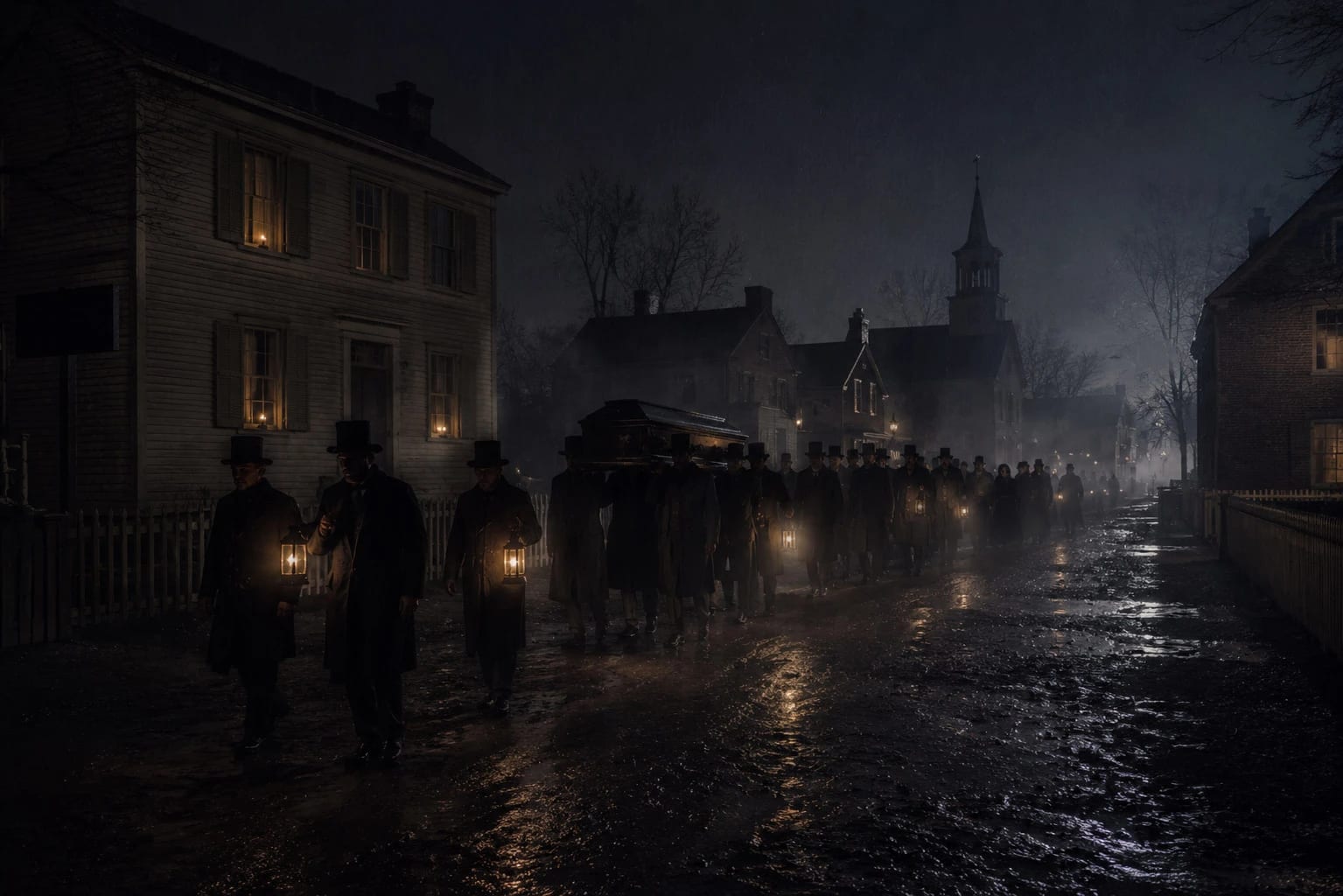
No American has held the country's imagination the way Lincoln has. He led the nation through its bloodiest trial and was murdered the week it ended, in a theater, in front of a crowd, at the very moment of victory. The grief that followed was unlike anything the country had felt — his funeral train carried him home to Springfield over thirteen days, while enormous crowds came out to watch it pass. A loss that large does not simply close.
Ghost stories tend to gather around the people we can't let go of, and Lincoln is the one we have never let go of. More than a century and a half later, we still argue about him, still quote him, still visit the places he touched as if standing close might tell us something. A figure that present in the living imagination is never going to rest quietly in the ground.
So when people sense Lincoln, or his wife, or his lost little boy in that house on Eighth Street, they're reaching for something true even if no spirit is there at all. The Lincolns are not finished with us, and we are plainly not finished with them.
A Light Still Burning in the Window
The house stands today much as it did the morning the Lincolns rode out of Springfield for the last time. The brick street is quiet. Rangers walk visitors through the rooms. Cameras come out on the corner where everyone wants the same photograph of the plain brown house that holds so much.
Most people come for the history — to stand where Lincoln stood, to see how the family lived. A lot of them leave talking less about politics or the presidency and more about something they felt inside: a room they didn't want to linger in, a sadness that found them on the stairs, the quiet certainty that they weren't alone.
You can hear these stories the way they're meant to be told after dark, when our guides walk the streets of haunted Springfield on a Springfield ghost tour.
Maybe the reason so many people feel something at the Lincoln Home isn't that it's haunted in the usual sense. Maybe it's that some lives press so hard on the world that the mark never quite lifts — and that you can still feel it, all these years later, the moment you step through the front door.