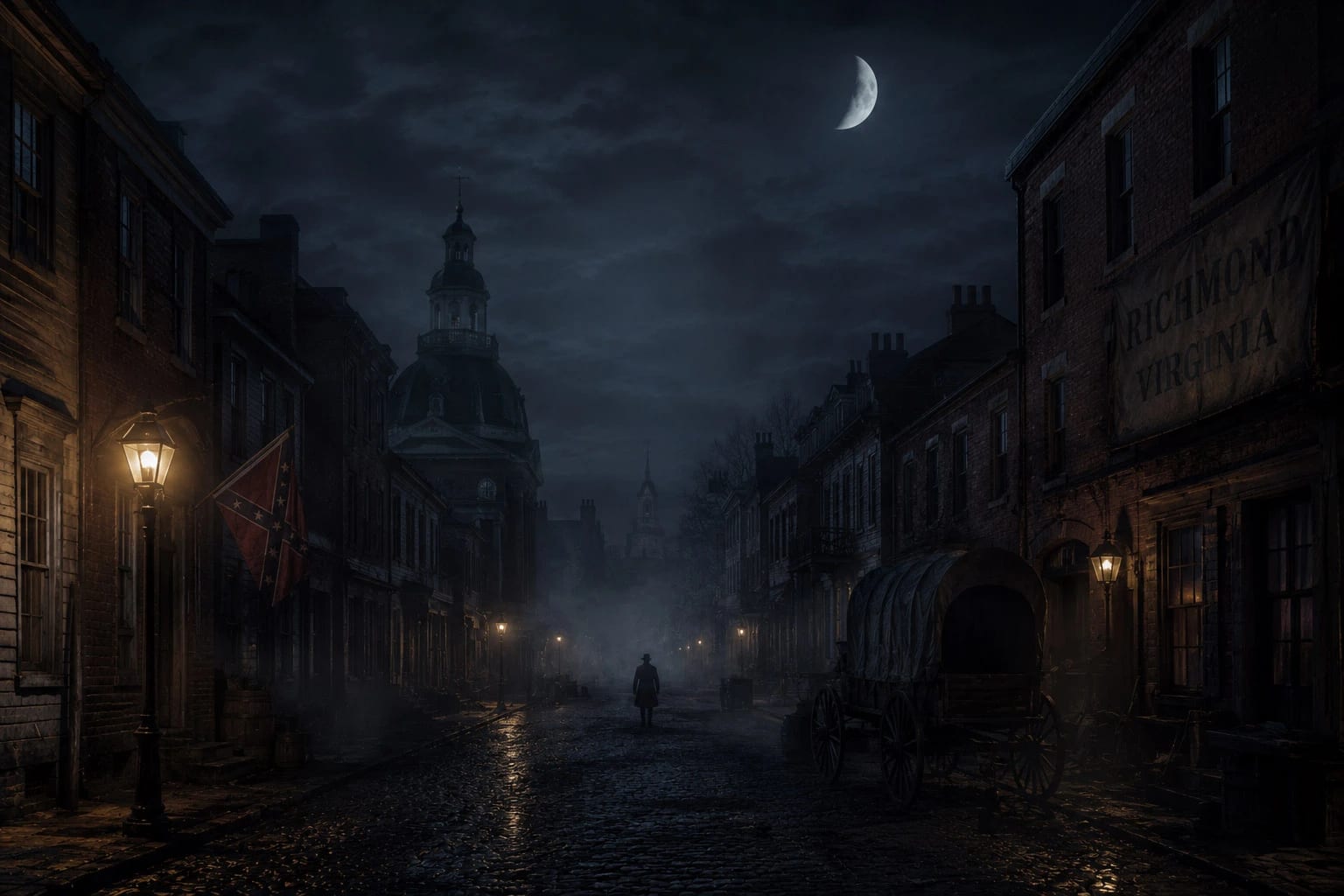
The Grand Hotel That Never Sleeps
Walk into the lobby and the room does what it was built to do: it stops you. Marble underfoot, columns climbing into a vaulted ceiling, chandeliers throwing light across the famous staircase that sweeps up from the Rotunda. A statue of Thomas Jefferson stands watch in the middle of it all, white marble, exactly where it has stood since the 1890s. A bellhop crosses the floor. A wedding party gathers for photographs. Somewhere a piano is playing.
The Jefferson has looked more or less like this since it opened in 1895, and Richmonders have been coming here their whole lives — for proms and anniversaries, for Sunday brunch, for the simple pleasure of sitting in a beautiful room. It's the grandest hotel in the city and one of the grandest in the country.
Most people come for that. The luxury, the history, the staircase everyone wants a photo on. And most of them leave with exactly what they came for.
But a building that has taken in guests for over a century collects more than good reviews. It collects lives — thousands of them, layered into the same rooms and hallways, the best days and the worst days of strangers who checked in, stayed a night or two, and moved on. The people who work the quiet hours here will tell you that not all of those stays seem to have ended. The stories they tell aren't loud. That's part of why they stick.
Building Richmond's Crown Jewel
Lewis Ginter's Vision
The Jefferson exists because one man wanted Richmond to have something worthy of the country's great cities. Lewis Ginter had made a fortune in tobacco — he's often credited with helping popularize the cigarette — and by the 1890s he was pouring that money back into Richmond. The hotel was his grand gesture, a Gilded Age statement that the old capital could stand beside anywhere in America.
Ginter spared nothing. He brought in the prestigious New York firm of Carrère and Hastings, the architects who would go on to design the New York Public Library, and told them to build the finest hotel in the South.
An Ambitious Hotel
What they delivered, when it opened in 1895, was something Richmond had never seen. Beaux-Arts grandeur, imported marble, electric lights and elevators when both were still a novelty, and a level of luxury meant to pull travelers down from across the country. The Rotunda and the grand staircase became landmarks immediately. So, famously, did the alligators — the hotel kept live ones in the marble pools of the Palm Court for decades, a detail so strange and beloved that Richmonders still talk about the last of them, Old Pompey, who lived there into the 1940s.
Early Guests
The Jefferson set out to be the center of Richmond society, and it got its wish. The city's elite held their galas and debutante balls in its rooms. Travelers of means made it their address when business or pleasure brought them south. From the beginning it was less a place to sleep than a stage where Richmond performed its best self — and where, night after night, thousands of people lived out the important hours of their lives.
Fires, Renovations, and Reinvention
The Jefferson nearly didn't survive its first decade. In 1901 a fire tore through the hotel and gutted much of it, destroying a great deal of Ginter's original interior. He had died the year before and never saw the damage, but the hotel had become too important to Richmond to let go. It was rebuilt and reopened in 1907, grander than before, the Rotunda and the great staircase restored to full effect.
Fire came back in 1944, another hard blow to a building that seemed to keep tempting it. Again the Jefferson was repaired. Through the middle of the century it rode the same decline that wore on grand old hotels everywhere — changing tastes, lean years, a long stretch when its future looked anything but certain. It closed for a time and underwent a massive restoration before reopening, brought back to the standard Ginter had intended.
What's striking is how little the essential building changed through all of it. Fire, decline, restoration — the Jefferson absorbed each one and came back looking like itself. The marble, the staircase, the statue of Jefferson: the bones of the place have stood for more than a century. Whatever has gathered in those rooms has had a very long time, in a setting that barely changed, to settle in.
The People Who Passed Through the Jefferson
A hotel like this is, in its way, an archive — not of documents but of people. Every guest who ever checked in left some faint trace, most of it lost the moment they checked out. Some of it, maybe, not.
The famous names are easy to list. The Jefferson has hosted more than a dozen U.S. presidents over its lifetime. Hollywood came through too — Charlie Chaplin, the kind of star who drew a crowd to the lobby. F. Scott Fitzgerald is said to have stayed here. So is Elvis Presley. For generations, when someone important came to Richmond, they came to the Jefferson.
But the famous guests are a sliver of the story. The far larger part is everyone else — the honeymooning couples, the businessmen closing deals, the families dressed up for a once-a-year dinner, the brides coming down that staircase, the travelers who just needed a room. Tens of thousands of people across more than a century, each carrying their own reason for being there.
Think about what that means inside a single room. Thousands of nights, thousands of conversations, thousands of private moments — joy and grief and celebration and heartbreak — held one after another within the same four walls. Most of it is gone, forgotten the way nearly everything is. The hotel's stories raise a quiet question: whether all of it is.
The Ghost Stories of The Jefferson Hotel
The hauntings at the Jefferson match the building. They're understated, refined, easy to miss — the kind of thing you talk yourself out of on the elevator ride down.
The Woman in White
The story heard most often is a woman. Guests and staff have described a female figure in a pale, old-fashioned gown, seen in the upper hallways or near the staircase, there and then not there. She doesn't menace anyone. She's simply present for a moment — a woman dressed for an evening that ended a hundred years ago — and gone when anyone looks twice.
Who she is, nobody can say. Some imagine a bride, given how many weddings the hotel has seen. Some picture a guest who loved the place. The descriptions vary enough that it may not be one woman at all. In a building that has dressed thousands of women for the most important nights of their lives, it's almost harder to picture the hallways being empty.
Unoccupied Rooms
Staff tell of rooms that aren't as empty as the system says. Voices behind the door of a room with no guest checked in. The sound of someone moving overhead in a space that should be still. A television or a faucet found running in a room no one had entered. In a hotel there's nearly always a mundane explanation, and the staff reach for it first. It's the handful of times the explanation doesn't fit that get passed along.
Late-Night Encounters
The best stories, as always, come from the people who work here. Housekeepers, night security, maintenance crews — the ones moving through the building at three in the morning when the guests are asleep and the grand rooms are empty. They describe a figure glimpsed at the end of a corridor, an elevator that travels to a floor no one selected, the feeling of being watched while restocking a quiet hallway. Employees become the keepers of a hotel's legends because they're the ones still inside when the building lets its guard down.
Footsteps in the Hallways
Guests on the upper floors report the oldest hotel haunting there is: footsteps. Someone walking the corridor outside the door, unhurried, late at night — and an empty hallway when they check. Doors heard opening and closing down the hall when the rooms are vacant. None of it dramatic. All of it easy to dismiss, right up until it's your door the steps stop outside of.
Guests Who Could Not Be Found
Then there are the strangers. A guest trades a few friendly words with an older gentleman in the elevator, dressed a touch formally, and mentions him later to a clerk who has no idea who they mean. A figure passes on the stairs and is gone around a landing that leads nowhere they could have reached in time. These brief, polite encounters with people who can't be accounted for turn up in grand old hotels everywhere, and the Jefferson has its share — guests who were never at the front desk, never on the register, present just long enough to be remembered.
Paranormal Investigations
A hotel this famous and this old has naturally drawn investigators, and they've come away with the usual: a recording that seems to hold a stray voice, cold spots, instruments reacting near the staircase and in certain rooms. It deserves a fair hearing both ways. A century-old building is full of drafts and noises, and a marble lobby plays tricks with sound; a careful skeptic can explain a great deal of it. What's harder to explain is why the same quiet stories keep surfacing — from guests, from staff, from investigators who arrived as strangers to one another — and why they all describe roughly the same small, understated things.
Why Historic Hotels Create Their Own Legends
It's worth asking why hotels, of all buildings, gather so many ghost stories. A house holds one family. A hotel holds everyone.
People don't check into a place like the Jefferson on ordinary days. They come for the wedding, the anniversary, the honeymoon, the funeral that brought the family to town, the trip that changed something. They arrive at the high and low points of their lives and live those hours out in a rented room, then hand back the key and go. Multiply that by more than a century and tens of thousands of guests, and a hotel becomes a layering of human experience unlike almost any other kind of building.
If you believe strong emotion can leave a residue in a place — and a surprising number of people who'd never call themselves believers come around to it after a strange night in an old hotel — then the Jefferson is exactly the sort of building where you'd expect it to gather. Not in dramatic hauntings. In small ones. A figure on the stairs. A voice in an empty room. The faint sense, in a beautiful old hallway, that the place is fuller than it looks.
Checking Out Isn't Always the End of the Story
The Jefferson is still very much a working hotel. Guests check in every afternoon. Couples still pose on the grand staircase. Afternoon tea is still served beneath the chandeliers, and the statue of Thomas Jefferson still presides over a lobby that looks much as it did when Lewis Ginter's first guests walked in.
The stories keep pace with the guests. They're part of the place now, traded by staff on the late shift and by visitors who came for the luxury and left with something stranger. It's one of several haunted Richmond landmarks worth knowing, alongside the hills of Hollywood Cemetery and the buried dark of the Church Hill Tunnel — and our guides tell all of them after dark on a Richmond ghost tour.
For more than a century, people have checked into the Jefferson Hotel expecting a memorable stay. Some have left wondering whether they shared the building with more guests than the front desk ever recorded.