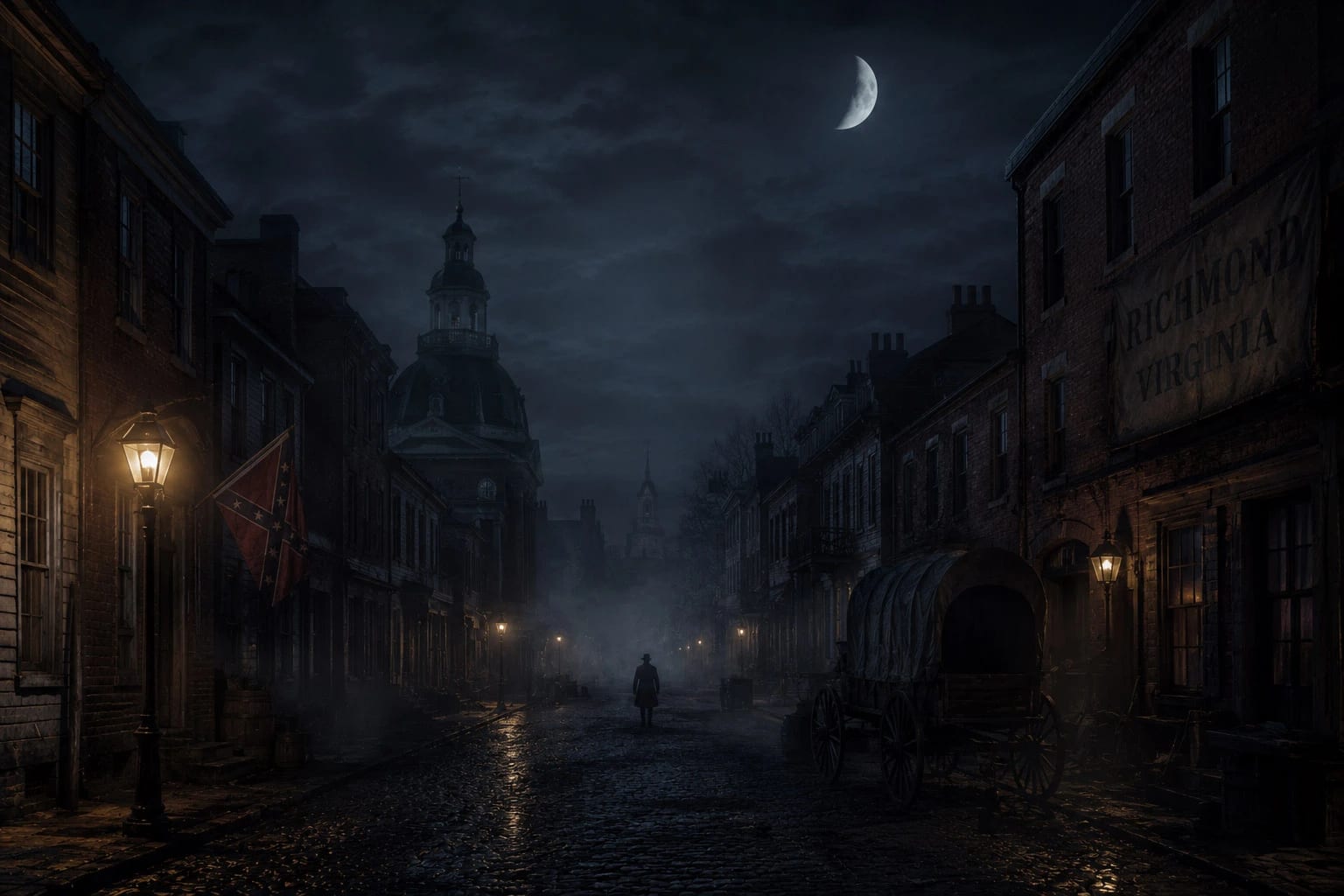
Beneath Richmond, Something Went Wrong
Picture it from the inside. A railroad tunnel deep under Church Hill, lit by a few work lamps and the open firebox of a locomotive. The air is thick — coal smoke, wet clay, the breath of a dozen men working in close quarters. Picks ring against rock. Somebody calls out. And then, over all of it, a sound nobody wants to hear underground: the slow, grinding shift of the earth deciding to move.
There's a beat where the men look up. A beat where they understand. And then the roof comes down.
That was October 2, 1925, and it made Church Hill Tunnel one of the most infamous sites in Richmond. People still stand on the ground above it and lower their voices, because they know what's down there. A train. The men who didn't get out. And, depending on who's telling it, something else that did.
Most ghost stories start with a death. This one starts with a catastrophe — a disaster bad enough that the city simply sealed the wound and left it buried, locomotive and all, rather than finish digging the dead out. Richmond has never quite recovered from that decision, and it has spent the hundred years since turning the tunnel into a legend.
To understand how a railroad project became the city's most frightening story, you have to go back to why anyone dug under Church Hill to begin with.
Richmond's Ambitious Railroad Project
A Growing City
In the years after the Civil War, Richmond was clawing its way back. The city that had burned in 1865 rebuilt fast, and by the early 1870s it was an industrial hub again — tobacco, iron, flour, and above all railroads, the thing that moved everything else. Whoever controlled the rail lines controlled the money, and Richmond's hills, beautiful as they were, sat right in the way.
The Chesapeake and Ohio Railway needed a route east through the city to the waterfront. Going over Church Hill, one of Richmond's oldest and steepest neighborhoods, wasn't practical. So they decided to go under it.
Building Church Hill Tunnel
The tunnel was cut between 1871 and 1873, running nearly a mile beneath the homes and churches of the hill. From the start, the ground fought back. Church Hill is built on a treacherous mix of clay and marl that turns slick and unstable when it's wet, and water was everywhere in the dig. Cave-ins happened during construction. Men died building the thing before a single train ever ran through it.
It opened in 1873, but it was never trusted. The tunnel leaked and shifted, and the railroad eventually routed its main traffic elsewhere, sealing the troublesome passage in 1902. For more than twenty years it sat abandoned under the neighborhood, slowly filling with water and bad air.
That should have been the end of it. Instead, in 1925, the C&O decided the old tunnel was worth saving after all, and sent crews back down to bring it up to standard. The ground had spent two decades getting weaker. The men who went in to fix it were working against a problem that had been waiting a very long time to come due.
The Collapse That Shocked Richmond
October 2, 1925
That afternoon, a steam locomotive backed into the tunnel hauling a string of flatcars, with a work crew aboard to clear debris and shore up the walls. Estimates of how many men were inside vary — that uncertainty is part of the tragedy, and we'll come back to it. What's certain is that they were deep under Church Hill when the tunnel failed.
It didn't come down all at once. Sections of the roof let go, then more, the collapse rolling through the passage and pinning the locomotive under tons of earth. Clay and rock filled the tunnel. The lamps went out. In an instant the men were in absolute darkness, buried alive under a neighborhood that had no idea anything was wrong.
Word reached the surface fast, and Richmond came running. Crowds gathered above the tunnel mouths. Rescue parties tried to push in from the western end, digging by hand and by lamplight into ground that was still moving, still dangerous, threatening to come down on the rescuers too.
Chaos Beneath the City
For the men inside it was a nightmare with no good ending. Some were close enough to an opening to crawl, claw, and stumble their way out, choking on dust, their clothes torn, their skin scalded where the wrecked locomotive vented its steam into the dark. They came out of the ground looking like something that shouldn't have survived — and that detail matters later.
Others were trapped beyond reach. Rescuers could hear, or thought they could hear, men somewhere in the rubble, and they dug toward the sound with a desperation you can imagine. But the tunnel kept shifting. Every foot of progress risked another fall. The clay swallowed their efforts as fast as they could make them.
The Dead and the Missing
The locomotive's engineer, Tom Mason, was found still in the cab of his engine, buried where he'd been working. A fireman named Benjamin Mosby made it out of the tunnel horribly scalded by steam — skin hanging, teeth broken — and died of his injuries soon after. Those two have names the records kept.
The others are harder to account for, and that's the part that still sits wrong. Much of the labor crew was made up of Black workers whose names and numbers were not carefully recorded, and in the confusion no one could say with certainty how many men had gone into the tunnel that day or how many never came out. The official death toll is usually given as a small number. A lot of people in Richmond have never believed it was that small.
After days of failed, dangerous rescue attempts, the city made a terrible decision. Rather than risk more lives digging for men who were almost certainly dead, they sealed the tunnel — with the locomotive, and with whoever was still inside, left where they lay. They are there now. Under the homes and streets of Church Hill, a buried train and an unknown number of the dead have spent a hundred years in the dark.
The Story That Refused to Die
A disaster like that doesn't just end when the digging stops. A city has to do something with the horror of it — the men sealed underground, the families with no bodies to bury, the sheer wrongness of a train entombed beneath the neighborhood. Richmond did what people have always done with horror they can't resolve. It told a story.
The Creature from the Tunnel
The way the legend goes, the rescuers weren't the first thing to come out of the collapsed tunnel that day. Something else got there first.
Witnesses, so the story says, saw a figure emerge from the rubble that wasn't a man at all. Its skin hung from its body in bloody ribbons. Its teeth were jagged and bared, its mouth slick and red, its whole face a ruin. It moved wrong. And when the crowd at the tunnel mouth got a look at it, they did the only sensible thing — they screamed and scattered.
This is the creature Richmond would come to call the Richmond Vampire. The details shift depending on who's telling it, the way real folklore always does, but the core image never changes: something with torn flesh and red teeth, climbing out of a hole in the earth where men had just died.
The Chase Through Richmond
Then comes the chase. The thing fled the tunnel and ran, the story goes, with a crowd of horrified Richmonders behind it. It moved across the city, west, toward the river and the hills, until it reached the gates of Hollywood Cemetery. There it slipped inside and vanished into a mausoleum on the slope — a granite tomb marked with the name W. W. Pool.
To this day people walk up to that mausoleum and stare through the gate, half-daring the story to be true.
Is any of it real? Almost certainly not, at least not the way it's told. The 'creature' was, in all likelihood, the fireman Benjamin Mosby — a living, dying man so badly scalded that panicked witnesses mistook him for a monster, his story later tangled up with old neighborhood gossip about the man buried in the Pool tomb. But here's what's worth sitting with: the legend says something true even when the facts don't. It's the shape Richmond gave to a real terror. A city watched men get swallowed by the ground it lived on, and out of that came a monster — because sometimes a monster is easier to look at than the truth.
Ghost Stories from Church Hill Tunnel
Strip away the vampire and the tunnel still has its hauntings, the quieter kind, reported by people who live near it and walk above it.
Voices Underground
The oldest and most chilling reports are sounds. People near the sealed tunnel and the old cuts at either end have described voices coming from underground — muffled, indistinct, sometimes rising into something that sounds like a shout, or a scream, or a man calling for help. Residents of Church Hill have talked for generations about noises that seem to come up through the ground itself, in a place where there should be nothing but sealed earth and a buried train.
It's easy to explain away. Old ground settles. Water moves. Sound does strange things near hollow spaces. But knowing what's down there has a way of turning an ordinary noise into something much worse.
Shadow Figures Near Tunnel Entrances
The overgrown cuts where the tunnel once opened have their own reputation. People have reported dark shapes near the old entrances — human forms standing at the edge of the tree line, figures that are there and then aren't, shadows that don't match anything casting them. The descriptions tend toward the same thing: a man-shaped darkness, seen near the mouth of a tunnel that no longer opens.
The Presence That Many Visitors Describe
More common than any sighting is a feeling. People who go looking for the tunnel — and plenty do — often describe a wave of unease as they get close. A heaviness. A reluctance to go further. A sudden anxiety with no obvious cause, strong enough that some turn around and leave. Whether that's the spirits of the place or simply the weight of knowing what happened there, the effect is real enough that the same description comes up again and again.
The Workers Who Never Left
And then there are the stories that say the men are still down there in more than body. Local lore holds that some of the workers sealed in the collapse never moved on — that the voices and the figures and the dread are them, still trapped in the dark, still trying to get out a hundred years after the roof came down. It's a hard legend to hear, because unlike the vampire, it doesn't require any monster. It only requires that the dead remember being left behind.
Paranormal Investigations
The tunnel's fame has drawn investigators over the years, especially around efforts to study or recover the buried locomotive. They've reported the usual: recordings that seem to hold voices, cold readings, equipment behaving oddly near the site. None of it amounts to proof, and the ground around the tunnel is genuinely unstable, which keeps serious access limited. A skeptic can dismiss most of what's been gathered. What no one can dismiss is the thing underneath all of it — that this is not a legend invented from nothing. Men really died here, and they're still here, and everybody knows it.
Why Richmond Still Talks About Church Hill Tunnel
A hundred years is a long time to keep telling the same story, and Richmond has never stopped telling this one. Part of that is the vampire — a great, lurid piece of folklore that's easy to pass on. But the legend isn't really why the tunnel holds on to the city's imagination.
It holds on because of what's true. Most haunted places trade in maybes. Church Hill Tunnel doesn't have to. There is, without question, a buried train under the neighborhood, and there are, without question, men who went into the dark and were never brought back out. The horror is verifiable. You can stand on the ground above it.
That's what makes the site so unusual. It's a historical landmark, a disaster site, a ghost story, and an urban legend all at once, stacked on the same patch of buried ground. Very few places carry all four. Most ghost stories ask you to believe something. This one asks you to remember something, and then leaves you to decide how much of the rest you'll let in.
The vampire is the part Richmond tells for fun. The men under the hill are the part it can't put down.
What Remains Beneath Church Hill?
Today most people cross over Church Hill Tunnel without a second thought. Cars move along the streets above it. The neighborhood goes about its life. The old tunnel mouths have gone to brush and shadow, and there's not much to see at ground level to tell you what's underneath.
But it's there. The sealed passage, the entombed locomotive, and the men the city decided it could not safely reach — all of it still waiting in the dark, a hundred years on. You can hear the whole story, the disaster and the legend both, when our guides walk the streets of haunted Richmond after dark on a Richmond ghost tour.
Maybe the reason Church Hill Tunnel still grips Richmond isn't the Richmond Vampire at all. Maybe it's the simpler, heavier fact underneath the legend — that real men died down there, that some of them were never recovered, and that reality, once you sit with it, is far more unsettling than any monster the city could invent.