Quick Facts
- The Boston Massacre took place on March 5, 1770, on King Street (now State Street) in front of the Old State House.
- Five colonists were killed: Crispus Attucks, Samuel Gray, James Caldwell, Samuel Maverick, and Patrick Carr.
- John Adams — future President of the United States — defended the British soldiers at trial.
- The site is marked today by a ring of cobblestones at the corner of State Street and Devonshire Street.
- Crispus Attucks, often called the first American to die for the Revolution, is buried in the Granary Burying Ground alongside the other massacre victims.
The Powder Keg of Boston
By the winter of 1770, Boston had become a city under occupation. British regulars — the despised "redcoats" — had been stationed in the city since 1768 to enforce the Townshend Acts and keep colonial resistance in check. Bostonians resented the presence of armed soldiers in their streets, and tensions had been climbing for nearly two years.
The soldiers were not popular guests. They competed with locals for off-duty work, drank in the same taverns, and bristled at every taunt thrown at their uniforms. Brawls in the streets had become commonplace. The colonists called them "lobsters" and "bloody-backs." The soldiers, for their part, made little secret of their contempt for the residents who jeered at them daily.
What happened on the night of March 5, 1770, did not come out of nowhere. It came out of two years of accumulated grievance. All it needed was a spark.
The Night of March 5, 1770
It began with an argument over an unpaid wig-maker's bill. A young apprentice named Edward Garrick taunted a British officer outside the Custom House on King Street, and a lone sentry, Private Hugh White, struck the boy with the butt of his musket. The boy ran off, but a crowd quickly gathered.
Word spread through Boston that a soldier had attacked a child. Within an hour, a mob of several hundred Bostonians had converged on the Custom House, hurling snowballs, ice, oyster shells, and insults at the lone sentry. Church bells began to ring — a signal that traditionally indicated a fire, and one that brought even more people pouring into the streets.
Captain Thomas Preston, the British officer of the watch, arrived with seven additional soldiers to relieve the embattled sentry. They formed a semicircle in front of the Custom House, muskets fixed with bayonets. The crowd pressed closer, throwing whatever they could find, daring the soldiers to fire.
Accounts differ wildly on what happened next. Someone — possibly a colonist striking a soldier with a club, possibly the soldier himself startled by a thrown object — caused Private Hugh Montgomery to discharge his weapon. In the chaos that followed, the other soldiers fired into the crowd.
The Five Who Died
When the smoke cleared, three men lay dead on the cobblestones, and two more were mortally wounded:
Crispus Attucks — A man of African and Native American descent, a sailor and rope maker, possibly an escaped slave. He stood at the front of the crowd and was struck twice in the chest. He is widely remembered as the first American to die for the cause of independence.
Samuel Gray — A rope maker who had been involved in earlier brawls with off-duty British soldiers. He was killed instantly by a musket ball to the head.
James Caldwell — A sailor and ship's mate, struck in the back as he turned to flee. He died on the street.
Samuel Maverick — A seventeen-year-old apprentice ivory turner who had been standing across the street as a spectator. A musket ball ricocheted and struck him in the chest. He died the following morning at his mother's home.
Patrick Carr — An Irish leather worker who lingered for nine days before dying of his wounds on March 14. From his deathbed, he reportedly told a doctor that the soldiers had fired in self-defense — testimony that would later be used by John Adams at the soldiers' trial.
The Trial
Captain Preston and his eight soldiers were arrested and charged with murder. In an act that astonished his fellow patriots, John Adams agreed to defend them. He believed that the rule of law had to apply even to men everyone in Boston wanted to see hang.
The trial was held in the very building the killings had taken place beside — the Old State House. Adams argued that the soldiers had been provoked, that they had feared for their lives, and that the crowd had been the aggressor. He famously declared, "Facts are stubborn things," and reminded the jury that justice must not bend to passion.
Captain Preston was acquitted. Six of the soldiers were acquitted. Only two were found guilty — not of murder, but of manslaughter — and were branded on the thumb before being released.
The verdict outraged the colonists. The propaganda value of the massacre, however, was enormous. Paul Revere's engraving of the event — a fictionalized scene showing the soldiers firing in cold blood at orderly civilians — circulated throughout the colonies and helped harden anti-British sentiment in the years leading up to the Revolution.
The Funeral
The funeral procession for the massacre victims was the largest gathering Boston had ever seen. Estimates suggest as many as ten to twelve thousand mourners — nearly the entire population of the city — followed the four coffins (Carr was buried separately after his later death) through the streets to the Granary Burying Ground.
There, in a single tomb, Crispus Attucks, Samuel Gray, James Caldwell, and Samuel Maverick were laid to rest. Patrick Carr joined them nine days later. Their graves became a pilgrimage site almost immediately, and the date of the massacre was commemorated annually in Boston for the next thirteen years as the anniversary of the city's first martyrs to liberty.
The Hauntings of King Street
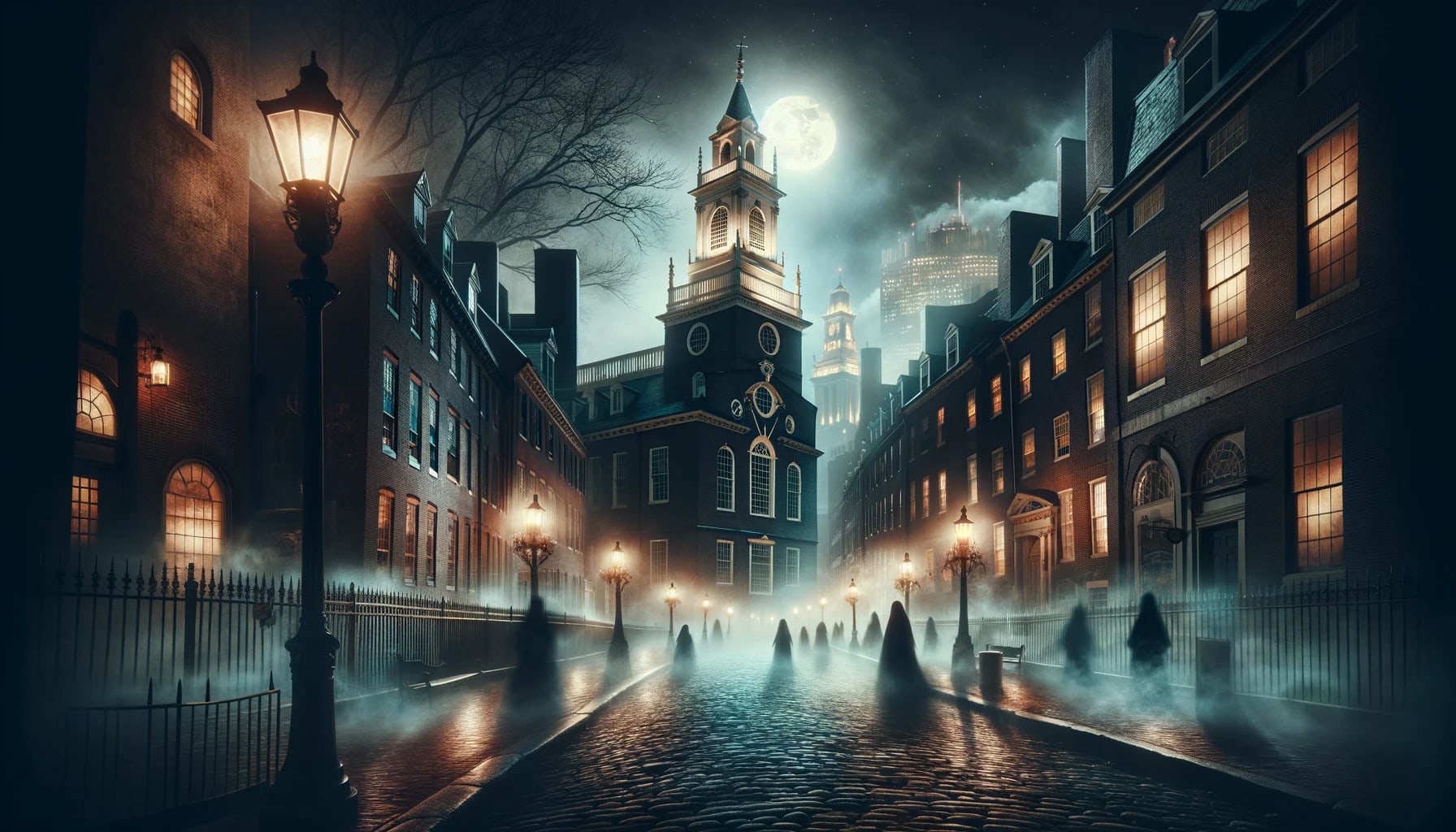
More than 250 years have passed since the gunfire echoed off the Custom House walls, but the spot where the five men fell has never quite settled. The cobblestones of State Street, just outside the Old State House, are one of the most reported paranormal locations in Boston.
The Cobblestone Marker
A ring of cobblestones set into a small traffic island at the corner of State and Devonshire Streets marks the approximate spot where the victims fell. Today the area is surrounded by the financial district — tall office buildings, suited commuters, and a constant flow of tourists making their way along the Freedom Trail. It is one of the busiest pieces of pavement in Boston.
And yet visitors who pause at the marker often report a sudden, unaccountable change in atmosphere. People describe the air growing noticeably colder as they step onto the cobblestones — a cold that seems specific to the spot itself, not the weather. Some report a tightening sensation in the chest, a feeling of being watched, or a wave of inexplicable sadness that lifts the moment they step away.
Ghost tour guides who stop at the marker dozens of times a year report that some groups are entirely unaffected — and others go silent, visibly shaken, the moment the story is told.
The Apparitions
Witnesses over the decades have described seeing figures near the Old State House that seem out of place — and out of time:
The Tall Man in Dark Clothing: Often interpreted as Crispus Attucks. Witnesses describe a tall, dark-skinned figure in eighteenth-century sailor's clothing standing at the curb near the cobblestone marker, particularly in the early morning hours. He does not respond when addressed, and witnesses report that he simply isn't there when they look back.
The Bleeding Soldier: A young man in a powder-blue colonial coat has been reported staggering away from the Old State House with a wound visible on his chest. Some believe this may be Samuel Maverick, the seventeen-year-old apprentice who was mortally wounded as a bystander.
The Crowd: Several witnesses have reported a more disturbing phenomenon — the sense of being suddenly surrounded by a large, agitated crowd, complete with the muffled sound of many voices, only to look up and find State Street empty. One ghost tour guide has described the experience as standing inside the memory of the night itself.
Phantom Musket Fire
By far the most commonly reported phenomenon is auditory. Multiple witnesses, independently of one another, have described hearing the sound of musket fire near the Custom House site — not fireworks, not a car backfiring, but the distinctive sharp crack of a black-powder weapon, followed sometimes by a chorus of cries.
The sounds are reported most often in March, particularly in the days surrounding the anniversary of the massacre. Some witnesses describe hearing not just gunfire, but the rolling murmur of a crowd, the shouts of soldiers being given an order, and, occasionally, the ringing of distant bells.
Electronic Voice Phenomenon (EVP) recordings taken at the site by paranormal investigators have reportedly captured fragments of voices speaking with eighteenth-century cadence — phrases like "hold the line," "God help us," and a single, distinct word: "fire."
The Granary Connection
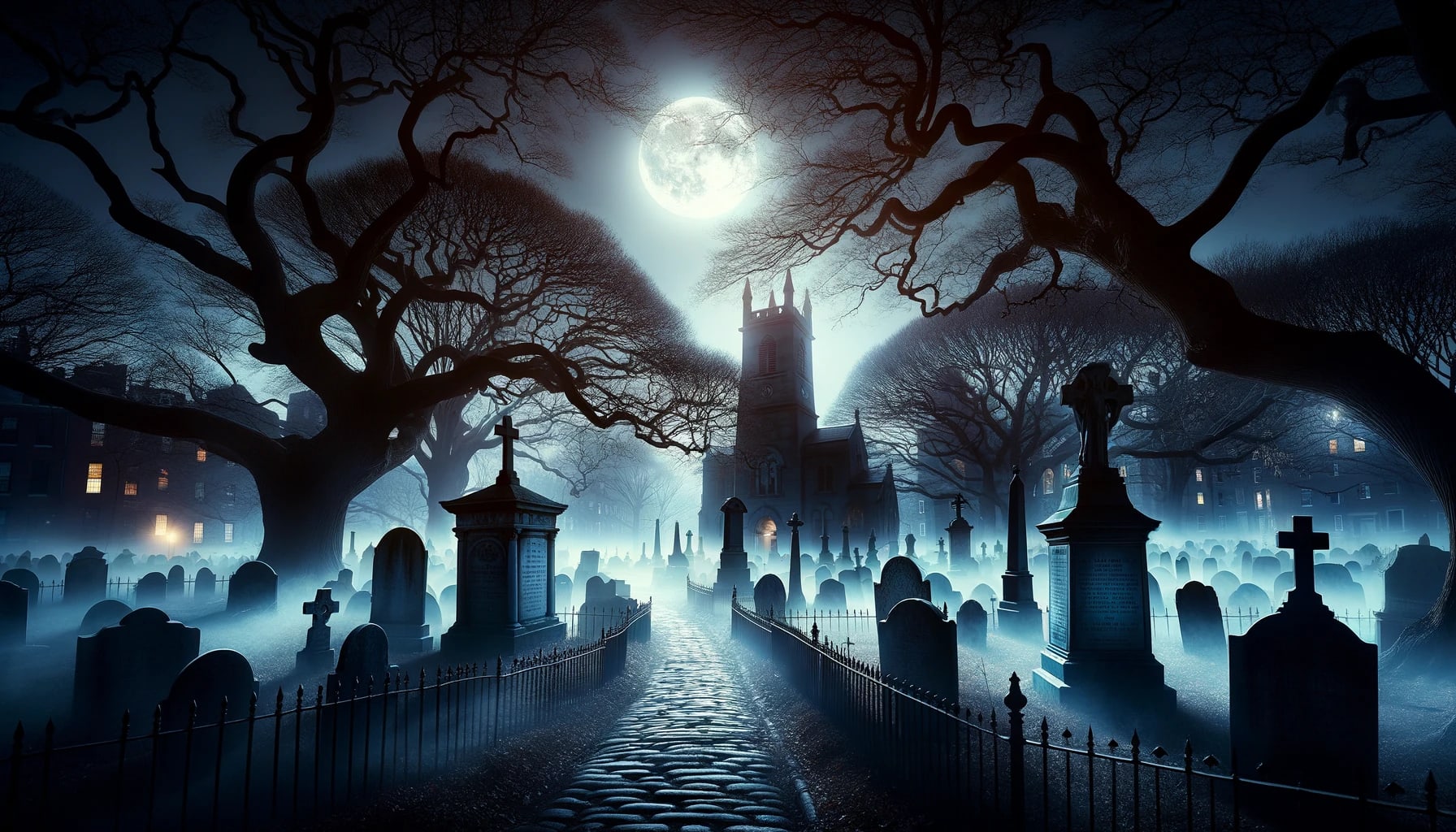
The spirits of the Boston Massacre are not confined to the place where the victims died. Just a short walk away, at the Granary Burying Ground, the tomb that holds the five victims is itself one of the most active paranormal locations in the cemetery.
Visitors to the Granary report cold spots concentrated near the massacre victims' tomb, even on warm summer afternoons. Photographs taken in the area frequently show orbs and unexplained mists. Several visitors have described seeing the figure of a man standing motionless near the tomb at dusk — a figure that vanishes as soon as it is approached.
The Granary is also the resting place of Paul Revere, Samuel Adams, and John Hancock — men whose lives were shaped by what happened on King Street that night. Some sensitives believe the proximity of so many revolutionary figures, all tied to a single defining tragedy, has made the burying ground a kind of psychic anchor for the events of 1770.
The Legacy of the Massacre
The Boston Massacre changed the course of American history. It transformed Boston from a city of grumbling colonists into a city of martyrs. The annual commemorations, the engravings, the orations delivered each March in memory of the dead — all of it built a sense of shared grievance that helped carry the colonies into open rebellion five years later.
The Boston Massacre was not, in strict historical terms, a planned atrocity. It was a tragedy of escalating fear and bad luck on a crowded winter night. But it was a tragedy with consequences — and its dead were not allowed to be forgotten. They were elevated to symbols, their funeral the largest the city had ever seen, their graves a place of pilgrimage.
It should not be surprising, then, that the place where they fell refuses to grow quiet.
Why the Spot Still Echoes
Paranormal researchers and historians alike have long observed that the most actively haunted sites in any city tend to share certain qualities: sudden violence, intense emotion, and a public, witnessed death. The Boston Massacre had all three. Five men died in front of hundreds of witnesses, in a moment of confusion and fear, on a small patch of cobblestones in the heart of the city.
In the years that followed, those same cobblestones were walked across by funeral processions, by John Adams on his way to defend the soldiers, by Paul Revere on his way to the engraver's, and by thousands of Bostonians who had come to mourn or to swear they would not forget. Few places in America carry that kind of layered psychic weight.
Visiting the Site Today
The cobblestone marker can be visited at any hour, free of charge. It sits in the small traffic island just east of the Old State House, at the corner of State and Devonshire Streets, directly on the route of the Freedom Trail.
Most paranormal activity is reported in the very early morning, just before dawn, or in the evening hours after the financial district has emptied out. Visitors during the anniversary week — late February through early March — report the highest concentration of unusual experiences. The massacre is one of many tragedies behind the centuries of death and tragedy that have made Boston so haunted, and the cobblestone marker remains one of the most quietly powerful stops on any tour of haunted Boston.

Paul Revere's famous 1770 engraving of the massacre

The Old State House, where the massacre took place outside