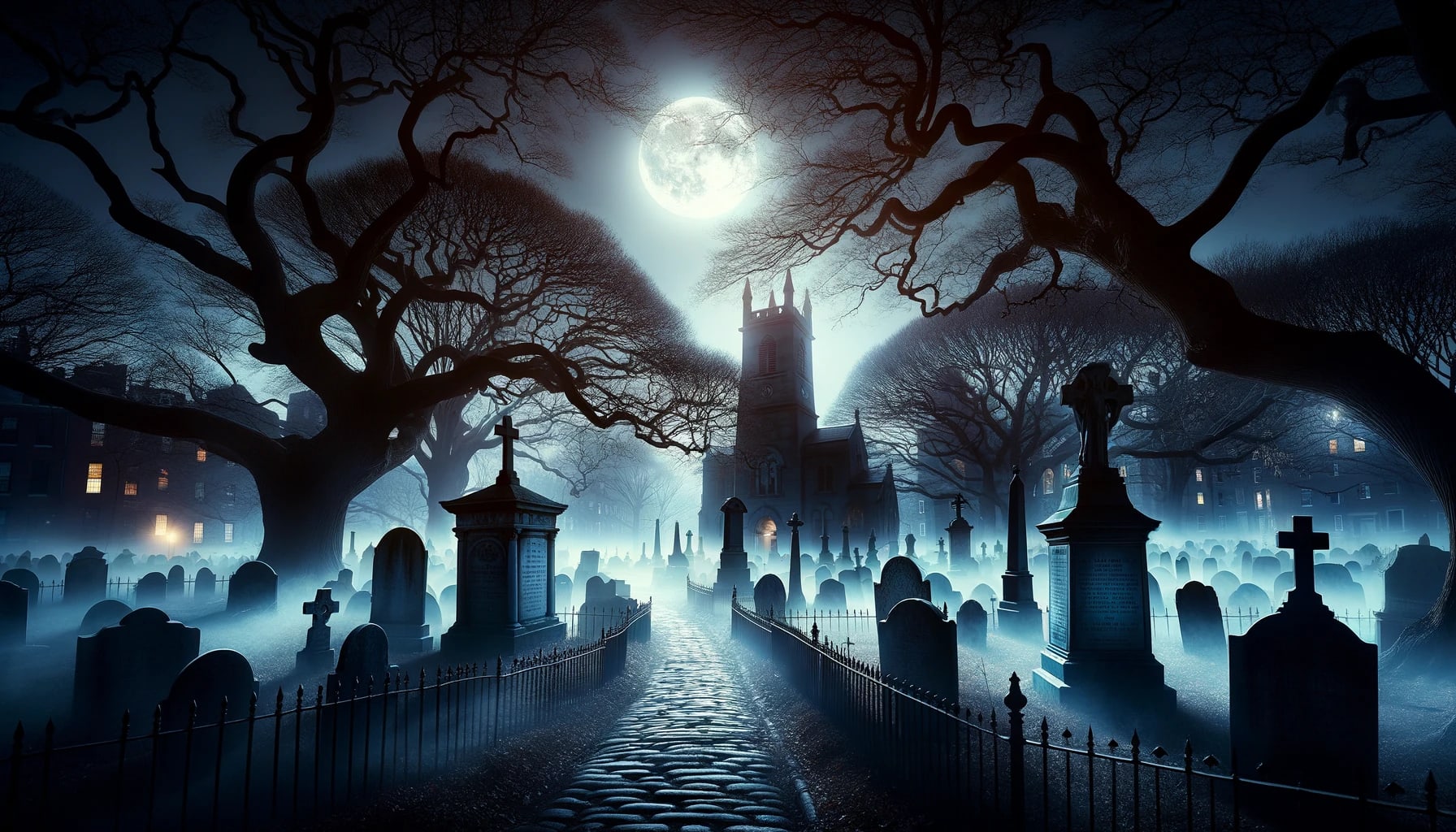
Boston's Haunted Cemeteries: Where the Dead Still Speak
Boston is one of the oldest cities in America, and death has been its constant companion since the Puritans arrived on the Shawmut Peninsula in 1630. The settlers who founded this city did not build it peacefully. They built it through starvation, disease, exposure, and violence — and they buried their dead in the ground beneath their feet because there was nowhere else to put them.
The burial grounds that remain visible today — the Granary, King's Chapel, Copp's Hill, and the Central Burying Ground on Boston Common — are the ones that survived. They survived because they were too full to move, too famous to demolish, and too deeply embedded in the city's identity to pave over. But they are only part of the story. Boston's expansion over the centuries involved filling in marshland, leveling hills, and building over areas that had once been used for burials — both official and unofficial. Human remains have been unearthed during construction projects throughout the city's history, evidence of the emergency burials during epidemics and the informal interments of the poorest residents.
The result is a city that is, quite literally, built on its dead. The burial grounds that remain are not quiet, decorative parks. They are concentrated repositories of human remains — thousands of bodies compressed into spaces that were full centuries ago, stacked five and six deep, their headstones moved and rearranged so many times that the markers no longer correspond to the remains they were meant to identify. The dead here are not at rest. They are overcrowded, disturbed, and — if the reports that have accumulated over three centuries are to be believed — they are aware of it.
For a deeper understanding of the death, disease, and violence that created these conditions, read Why Is Boston So Haunted?. For a guided tour of the city's darkest locations, explore the most haunted places in Boston. What follows is the story of the burial grounds themselves — the four cemeteries where Boston's dead are concentrated most densely, and where the paranormal activity is most intense.
Why Boston's Cemeteries Are Different
Every old city has cemeteries. What makes Boston's different is the relationship between the city and its dead — a relationship defined by overcrowding, disturbance, and an almost systematic failure to leave the dead alone.
Boston's burial grounds were established in the 1600s, when the city was a small colonial settlement. The plots were adequate for a town of a few thousand people. They were not adequate for a city that would grow to tens of thousands and then hundreds of thousands over the following centuries. But the cemeteries could not expand — they were surrounded by the buildings and streets of a city that was growing in every direction. So the dead were stacked. New burials were placed on top of old ones. Headstones were moved to accommodate new graves, severing the connection between the markers and the remains they identified. Family plots that were designed for two or three bodies received five, six, eight.
Then the city built on top of them.
The Central Burying Ground lost an unknown number of graves when the Boylston Street subway station was constructed directly beneath it in 1895. Workers unearthed remains that were relocated — hastily, without ceremony, and without complete records — to make room for the tunnel. King's Chapel was built partially over its own burying ground, the foundations of the church resting on graves that were never moved. Construction projects throughout Boston's history have turned up bones in locations where no cemetery was ever mapped, evidence of the mass burials during smallpox epidemics and the informal graves of people too poor or too forgotten to warrant a marked plot.
In Boston, the dead were never truly left alone. They were buried, then stacked upon, then moved, then built over, then disturbed again by every new generation that needed the space more than it needed to respect the dead. Paranormal researchers point to this pattern as a primary driver of the activity reported in and around Boston's cemeteries. Disturbed graves produce disturbed spirits. And Boston has been disturbing its dead for nearly four hundred years.
Granary Burying Ground
The Granary Burying Ground is the cemetery that most visitors think of when they think of haunted Boston — and it earns that reputation with a density of death that is difficult to comprehend until you are standing inside the gates.
Established in 1660, the Granary holds the remains of more than 5,000 people in a space roughly the size of a city block. Only 2,300 headstones remain. The math is stark: more than half the dead here have no marker, no name, no record of where they lie. They are somewhere beneath your feet — compressed into soil that has been accepting human remains for over 360 years, stacked in layers that construction and time have compressed into a substrate of bone and earth that extends several feet below the surface.
The names that are marked here read like a roll call of the American Revolution. Paul Revere. Samuel Adams. John Hancock. The five victims of the Boston Massacre — Crispus Attucks, Samuel Gray, James Caldwell, Samuel Maverick, and Patrick Carr — are buried in a shared grave near the front of the cemetery. Benjamin Franklin's parents rest here. So do thousands of ordinary Bostonians whose names have been lost to time and whose headstones were moved, reused, or simply disappeared over the centuries.
At dusk, the Granary undergoes a transformation that no amount of historical context can fully prepare you for. The headstones — many of them carved with death's heads, winged skulls, and skeletal figures that reflected the Puritan obsession with mortality — cast shadows that lengthen and merge until the entire cemetery floor is dark. The iron fence separates you from Tremont Street, but it does not separate you from the feeling that rises out of the ground as the light fails. Cold spots concentrate around specific headstones. The air becomes heavier. And the sensation of being watched — of eyes tracking your movement from somewhere among the crooked stones — is reported with such consistency that guides who visit the Granary nightly have stopped treating it as unusual. It is simply what happens here.
Photographs taken at the Granary routinely capture anomalies. Mist that was not visible to the naked eye. Light that has no identifiable source. Shapes in the background that resolve, upon examination, into forms that look disturbingly human. Whether these images constitute evidence of the paranormal or artifacts of camera technology is a debate that will never be settled. But the sheer volume of them — thousands of photographs, taken over decades, by visitors with no expectation of capturing anything unusual — creates a body of visual data that is difficult to dismiss entirely.
King's Chapel Burying Ground
Walk north from the Granary along Tremont Street and within minutes you will reach King's Chapel Burying Ground — Boston's oldest cemetery, established in 1630, the same year the Puritans arrived.
The people buried here died in a world that would not see American independence for another century and a half. They were the first generation — the governors, ministers, merchants, and ordinary settlers who crossed the Atlantic with the expectation of building a godly society in the wilderness and discovered instead a landscape of disease, starvation, and conflict that killed them at a rate they had not imagined possible. The graves at King's Chapel are the oldest in Boston, and the weight of that — the sheer accumulation of time and death in a space barely larger than a modest house lot — is palpable the moment you step inside.
King's Chapel Burying Ground carries an additional burden that the other cemeteries do not. When King's Chapel itself was constructed in 1749, the building was erected partially over the burying ground. The foundations of the church rest on graves that were never exhumed. The dead beneath King's Chapel did not consent to having a building placed on top of them, and the reports that have emerged from the cemetery over the centuries suggest that they have not accepted it quietly.
Visitors describe hauntings here that feel more personal than the Granary — more intimate, more direct. The cold spots are not diffuse atmospheric phenomena. They are concentrated, localized, and they follow. A chill that settles on the back of your neck and moves with you as you walk between the headstones. A whisper that is not a whisper — too close, too clear, too near your ear to be wind or traffic noise. The feeling of a hand on your shoulder that is not there when you turn. These are the kinds of experiences that people do not report unless they are genuine, because they sound, even to the person describing them, like the kind of thing that should not be real.
Judge Samuel Sewall is buried at King's Chapel, and his ghost is among the most frequently reported presences. Sewall served as one of the judges during the Salem Witch Trials of 1692 — one of the men who sentenced innocent people to death on the basis of spectral evidence and community hysteria. Unlike the other judges, Sewall publicly repented. In 1697, he stood before his congregation and accepted blame for the innocent blood that had been shed. He spent the rest of his life observing an annual day of fasting and repentance. But repentance, it seems, was not enough to grant him rest. Visitors and guides have described a figure near Sewall's grave — a man in dark clothing, pacing with the restless energy of someone who has been trying to make amends for three centuries and has not yet succeeded. He does not speak. He does not approach. He paces. Back and forth, across the same few feet of ground, as though the circuit of his guilt has worn a groove in the earth that not even death can release him from.
Copp's Hill Burying Ground
Copp's Hill Burying Ground occupies a rise in the North End that overlooks Boston Harbor — a vantage point that made it strategically valuable during the Revolution and spiritually significant for the centuries that preceded it.
Established in 1659, Copp's Hill is Boston's second oldest cemetery and the final resting place of thousands of artisans, merchants, free African Americans, and ordinary colonists who built the North End into one of the most densely populated neighborhoods in the city. The gravestones here tell a different story than the Granary's roster of revolutionary heroes. These are the working dead — the coopers, the sailmakers, the tanners, the people whose labor built Boston but whose names appear in no history textbook.
The Revolution added a layer of violence to Copp's Hill that distinguishes it from every other cemetery in Boston. When the British occupied the city, they recognized the cemetery's elevated position as an ideal artillery emplacement. They set up cannons among the headstones and directed fire toward Charlestown during the Battle of Bunker Hill — shelling an American town from a position surrounded by the American dead. And in the intervals between bombardments, British soldiers used the headstones for target practice. They fired musket balls into the carved faces of the dead — into the death's heads and cherubs and inscriptions that the families of the deceased had commissioned to honor their memory. The bullet holes are still visible in some of the stones today, nearly 250 years later.
The desecration matters. Paranormal researchers consistently point to the disturbance or disrespect of burial sites as a trigger for heightened activity, and Copp's Hill was not merely disturbed. It was weaponized. The dead here were not just buried and neglected. They were used as cover by an occupying army and their memorials were defaced for sport. The reports from Copp's Hill reflect this violation. Visitors describe an atmosphere of anger — not the quiet sadness of the Granary or the intimate unease of King's Chapel, but something sharper, more aggressive. Shadows that move between headstones with a purposefulness that does not feel random. The sound of voices speaking in accents that predate the Revolution — low, intense, and unmistakably hostile. The feeling, reported by visitors who have no knowledge of the cemetery's military history, of being unwelcome. Of trespassing on ground that belongs to the dead and that the dead are prepared to defend.
Central Burying Ground
The Central Burying Ground on the southern edge of Boston Common is the cemetery that Boston forgot — and it may be the most haunted of them all.
Established in 1756, more than a century after the Granary and King's Chapel, the Central Burying Ground was designated for the people that colonial Boston's other cemeteries would not accept. The records describe them as the "lower sort" — strangers passing through the city, soldiers without families, immigrants without connections, the indigent, the friendless, the people who died in Boston with no one to claim their bodies and no church willing to provide them a plot. The Central Burying Ground was where Boston buried its forgotten dead.
Smallpox victims were interred here during the epidemics that swept through the city in the 18th century. The burials were hasty, shallow, and unmarked — conducted by men who wanted to spend as little time as possible in proximity to the contagious dead. Soldiers from the Revolutionary War and the War of 1812 were buried here when they died of wounds or disease in Boston's hospitals, their graves marked with wooden markers that rotted away within a generation. The painter Gilbert Stuart — famous for his portrait of George Washington that appears on the one-dollar bill — is believed to be buried somewhere in the Central Burying Ground, though the exact location of his grave has been lost.
Then the subway came.
In 1895, construction of the Boylston Street subway station — one of the first subway stations in America — cut directly through the Central Burying Ground. Workers unearthed remains that had been underground for over a century. The bones were collected, placed in boxes, and reburied elsewhere in the cemetery — hastily, without ceremony, and without complete records of who was moved or where they were relocated. The disturbance was massive. An unknown number of graves were destroyed entirely. An unknown number of remains were left in place, buried beneath the subway tunnel that still carries passengers through the ground where the forgotten dead once rested.
The paranormal activity at the Central Burying Ground reflects the nature of its dead — forgotten people who died alone, were buried without ceremony, and were dug up and discarded when the city needed the space for something it considered more important. The hauntings here are not dramatic or attention-seeking. They are quiet, persistent, and suffused with a sadness that visitors describe as physical — a weight that settles on the chest and shoulders, a heaviness in the air that has nothing to do with humidity or temperature. The forgotten dead are often the most restless, because they have the most reason to be. No one mourned them. No one maintained their graves. No one remembers their names. And when the city built a subway through their cemetery, no one objected on their behalf.
They are still here. In the soil beneath the headstones that remain. In the ground beneath the subway tunnel. In the quiet, heavy atmosphere that settles over the southern edge of Boston Common when the daylight fails and the park empties and the tourists move on to places that feel less burdened by the weight of the unnamed dead.
The Ghosts of Boston's Cemeteries
The paranormal reports that emerge from Boston's burial grounds are not entries in a catalog. They are encounters — moments when the boundary between the living and the dead becomes thin enough to cross, and someone on this side of it notices.
The Woman in White at the Granary appears on evenings when mist rolls in from the harbor and settles among the headstones like a second layer of ground. She moves between the graves — not walking exactly, but drifting, her white dress catching what little light remains in the cemetery after dusk. She pauses at certain headstones. She bends forward as though reading inscriptions that she already knows by heart. And then she moves on, deeper into the cemetery, toward the oldest section where the markers are so weathered that the names have been erased by time. Visitors who have seen her describe the same detail: she is searching. Not wandering, not performing, but searching — methodically, patiently, with the focused intensity of someone who has been looking for a very long time and is not prepared to stop. She is believed to be a mother looking for her child's grave — a grave that may have been moved, remarked, or lost entirely during the centuries of rearrangement that have made the Granary's headstones unreliable maps to the dead beneath them.
At King's Chapel, Judge Sewall's ghost keeps its circuit. The pacing has been observed by visitors and guides for generations — a dark figure moving back and forth near the judge's grave with the restless energy of a man who confessed his sins publicly, spent the remainder of his life in penitence, and still cannot find the forgiveness that would allow him to stop moving. Sewall's repentance was genuine — historians agree on that. But the dead he helped condemn in Salem were also genuine, and the gap between confession and absolution is apparently wider than a lifetime of fasting can bridge. He paces. He does not speak. He does not look at the living. He simply walks the same few feet of ground, over and over, as though repetition might eventually wear through the floor of his guilt and release him into whatever comes next.
The soldiers at Copp's Hill are different. They do not drift or pace. They stand. Visitors describe figures in colonial military uniforms — not British, American — positioned at the edges of the cemetery as though posted on guard duty. They are still. They are watchful. And they carry the bearing of men who have been assigned a task and intend to carry it out regardless of how long it takes. Some visitors report being acknowledged — a nod, a slight inclination of the head — before the figures dissolve into the darkness between the headstones. These are not the angry presences associated with the British desecration. These are the American dead, standing watch over a cemetery that was violated by the enemy and that they apparently intend to protect for as long as protection is needed.
At the Central Burying Ground, the encounters are the quietest and the saddest. A woman in black mourning attire has been seen kneeling at unmarked graves — not at a single grave, but at different locations throughout the cemetery, as though she is visiting every forgotten burial in turn. She weeps. The sound is not dramatic or theatrical. It is the sound of private grief — the kind that is not performed for an audience but endured alone, in the dark, over graves that no one else visits. She is believed to be a mother who lost children to one of the smallpox epidemics that filled the Central Burying Ground with hastily buried dead. Her children's graves may no longer exist. The subway construction may have destroyed them. But she returns anyway, kneeling in the grass above ground that may or may not hold what she is mourning, and the sadness she carries is so concentrated that visitors who encounter her describe feeling it physically — a tightness in the chest, a heaviness behind the eyes, the sudden, inexplicable urge to cry in a cemetery where they know no one.
What It Feels Like to Be Here
The most common question people ask about Boston's haunted cemeteries is not about the ghosts. It is about the feeling — the experience of standing among the dead in a city where the dead are concentrated so densely that the ground beneath your feet contains more human remains per square yard than most modern cemeteries contain in an entire section.
The first thing visitors notice is the silence. Not the absence of sound — Boston is a city, and traffic noise is always present at some level — but the quality of the silence within the cemetery walls. It is heavier than the silence outside. Denser. The iron fences that surround Boston's burial grounds are only a few feet high, but the acoustic difference between the sidewalk and the cemetery interior is striking. Sound seems to be absorbed by the ground, by the headstones, by the air itself. Conversations become quieter without anyone deciding to lower their voice. Footsteps sound different — more distinct, more isolated, as though each step is being registered and recorded by something beneath the surface.
The second thing is the cold. Boston's cemeteries produce cold spots that do not correspond to shade, wind patterns, or any other identifiable source. You can be standing in full sunlight on a warm afternoon and feel a pocket of cold air settle around you — localized, contained, and intense enough to raise the hair on your arms. The cold does not dissipate when you move. It follows for a step or two, then vanishes as abruptly as it appeared. Guides who visit the Granary nightly can identify the locations where cold spots appear most frequently — they cluster around specific headstones and seem to intensify around dusk.
The third thing — the thing that stays with people longest — is the feeling of being watched. Not the vague sense of unease that comes from being alone in a dark place. Something more specific. The certainty that eyes are on you — tracking your movement, noting your position, assessing your presence with an attention that is not hostile but is unmistakably intentional. You turn and see nothing. You scan the headstones and find no figure, no shadow, no movement. But the feeling does not go away. It accompanies you through the cemetery and sometimes beyond it — following you down the sidewalk, lingering at the edge of your awareness like a thought you cannot quite complete.
These experiences are not reported by paranormal enthusiasts seeking confirmation of their beliefs. They are reported by tourists, by locals walking through on their lunch break, by families with children who stopped to read the historical markers and left with a feeling they could not explain and have not forgotten. Boston's cemeteries do not require belief. They require presence. Stand among the dead long enough, and the dead will make themselves known.
Why These Cemeteries Are So Haunted
The paranormal activity concentrated in Boston's burial grounds is not random. It follows patterns that researchers have identified in haunted cemeteries around the world — patterns that are amplified in Boston by the city's unique combination of age, density, and history.
The first pattern is overcrowding. Burial grounds that exceed their intended capacity — where bodies are stacked in layers, where graves are reused, where the dead are compressed into spaces that cannot accommodate them — produce more paranormal reports than cemeteries with adequate space. Boston's colonial burial grounds are among the most overcrowded in the country. The Granary alone holds over 5,000 bodies in a space designed for perhaps a tenth of that number. The dead here are not resting in individual plots. They are compressed, layered, and intermingled in ways that make it impossible to know whose remains are beneath any given headstone.
The second pattern is disturbance. Cemeteries where graves have been opened, moved, or built over produce more activity than undisturbed sites. Every one of Boston's burial grounds has been disturbed — by construction, by war, by the relentless expansion of a city that needed the space more than it needed to respect the boundaries of the dead. The Central Burying Ground was cut in half by subway construction. King's Chapel was built partially over its own cemetery. Copp's Hill was used as an artillery emplacement. The Granary's headstones have been rearranged so many times that they function as decoration rather than identification.
The third pattern is emotional intensity. Cemeteries associated with violent death, epidemic disease, or extreme suffering produce more reports than those associated with peaceful, natural death. Boston's burial grounds check every box. They hold the victims of smallpox epidemics. They hold the casualties of the American Revolution. They hold the executed — the hanged pirates, the condemned Quakers, the accused witches. They hold children who died of diseases that no longer exist and soldiers who died of wounds that modern medicine would have treated in an afternoon. The emotional residue of these deaths — the fear, the grief, the rage, the helplessness — has been accumulating in these burial grounds for nearly four centuries.
Boston's cemeteries are haunted because everything that produces hauntings — overcrowding, disturbance, violent death, unresolved grief — is concentrated here in a density that few American cities can match. For the full story of how these conditions created one of the most haunted cities in the country, read Why Is Boston So Haunted?.
Walk These Grounds Yourself
Reading about Boston's haunted cemeteries gives you the history. Standing among the headstones at dusk gives you the experience — and the experience is what stays with you.
Ghost City Tours offers two walking tours that visit Boston's most haunted burial grounds, each designed for a different kind of visitor:
The Ghosts of Boston Tour is a family-friendly experience that covers the city's most famous haunted locations, including the burial grounds where thousands of colonial dead rest in overcrowded, disturbed, and deeply unsettled ground. The stories are grounded in real history, told by guides who know the burial grounds at a depth that no plaque or guidebook can match. This is the tour that has made Ghost City Tours the highest-rated ghost tour company in Boston.
The Death & Dying Tour goes deeper. This is the adults-only experience — the tour that explores the epidemics, the executions, the mass burials, and the systematic disturbance of the dead that created the conditions for Boston's most intense hauntings. The burial grounds are central to this tour, and the stories told here are the ones that the family-friendly version leaves out.
The dead have been here for nearly four centuries. They are not going anywhere. But the experience of walking among them — of feeling the silence thicken and the air grow cold and the weight of forty thousand unresolved deaths press upward through the ground beneath your feet — that is something you can only get by being here.
Book your Ghost Tour in Boston and walk the ground where the dead still speak.
Frequently Asked Questions

Ancient headstones at Granary Burying Ground

Boston's oldest cemetery beside King's Chapel