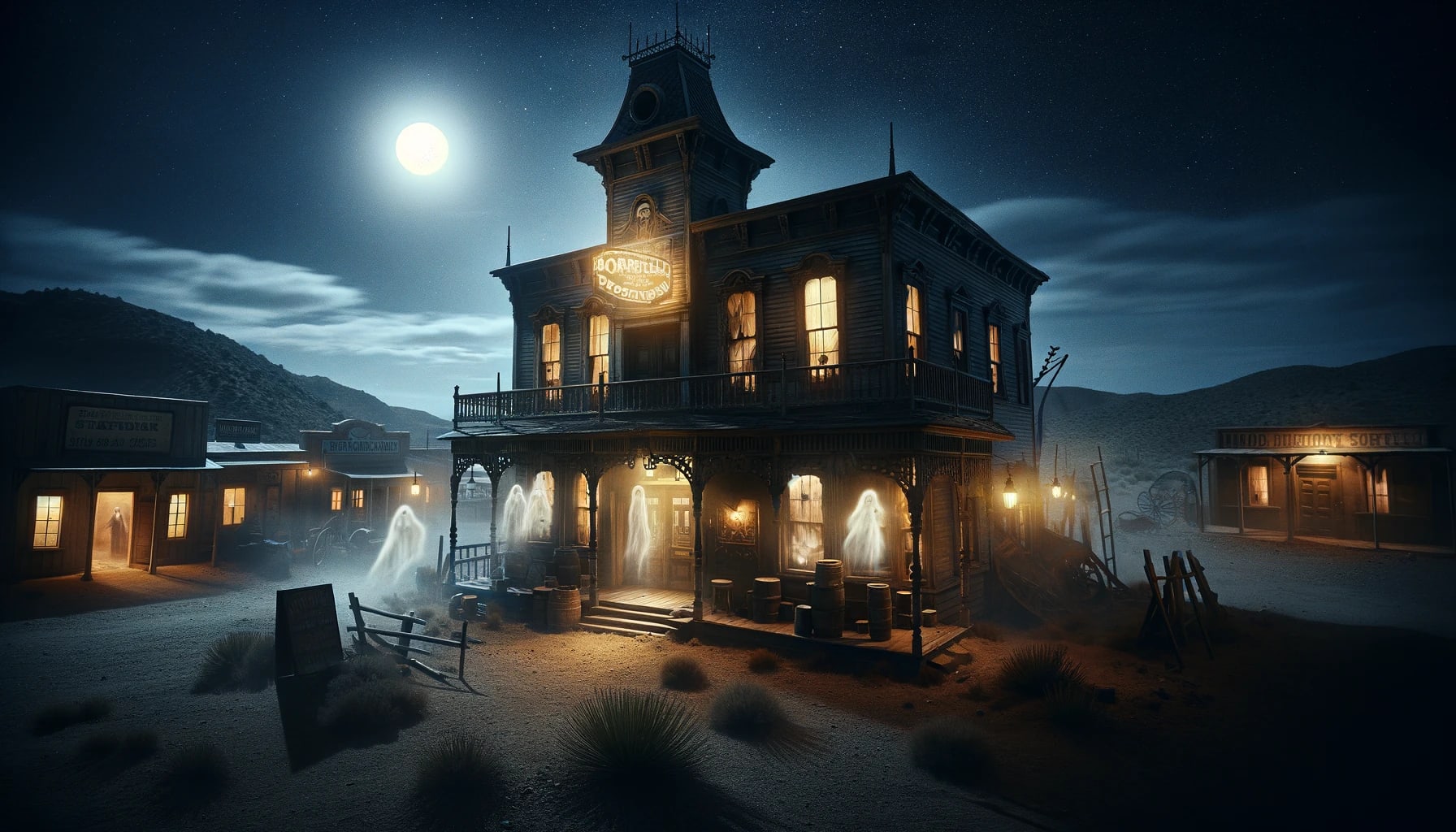
The Tombstone Most People Think They Know
The Tombstone most people think they know was built by Hollywood. Slow-motion gunfights. Dramatic standoffs on dusty streets. Clear-cut heroes facing down unmistakable villains. From the earliest Western films of the 1940s through the blockbusters of the 1990s, Tombstone became a canvas for a version of the American frontier that was vivid, exciting, and — in many important ways — wrong.
Western films didn't just depict Tombstone. They replaced its history with something simpler: morality plays set in the desert, where good men wore badges and bad men wore black. The real Tombstone — a boomtown driven by silver speculation, political factionalism, frontier economics, and an extraordinary concentration of volatile, ambitious people — was far more complicated than any screenplay could capture.
So how much of Tombstone's story is cinematic exaggeration? How much is genuine history? And does the difference matter?
The answer is yes — it matters enormously. Because while Hollywood amplified and dramatized events, the real history of Tombstone is compelling enough on its own. The violence was real. The deaths were documented. The haunted locations that draw visitors today are original buildings, standing on original foundations, carrying the weight of everything that actually happened inside them.
Ghost City Tours is committed to separating documented history from entertainment — because the truth, it turns out, is more powerful than the myth.
Hollywood's Tombstone vs Historical Records
The mythologizing of Tombstone began almost as soon as the events themselves concluded. Dime novels in the 1880s and 1890s dramatized frontier violence for Eastern audiences. But it was the Western film genre — from John Ford's My Darling Clementine (1946) through Gunfight at the O.K. Corral (1957), Tombstone (1993), and Wyatt Earp (1994) — that cemented the version of Tombstone most Americans carry in their heads.
These films shared a common set of distortions:
Dramatized showdowns. The actual Gunfight at the O.K. Corral lasted approximately 30 seconds. It was not a slow, deliberate face-off between clearly identified good guys and bad guys. It was a chaotic, close-range exchange of gunfire in a narrow vacant lot near Fremont Street — not at the O.K. Corral itself, but in its general vicinity. Three men died. Several were wounded. The entire event was over before most bystanders understood what had happened.
Clear "good guy vs bad guy" narratives. Hollywood needed heroes and villains. The real political landscape of 1880s Tombstone was a web of competing business interests, personal grudges, jurisdictional disputes, and factional alliances that resisted simple moral framing. The Earps were not paragons of justice. The Cowboys were not a unified criminal organization. Both groups operated in shades of gray that screenwriters found inconvenient.
Overstated violence frequency. Films depicted Tombstone as a town where gunfights erupted daily. In reality, while Tombstone experienced extraordinary violence for its size, the frequency was concentrated in specific periods and specific contexts — political conflicts, saloon disputes, mining camp tensions. The town also had churches, schools, a newspaper, and civic organizations working to establish order.
Rewritten timelines. Events that occurred over months or years were compressed into single dramatic sequences. Characters who never interacted were placed in scenes together. Motivations were simplified. The messy, politically complex reality of Tombstone was edited into something that fit a two-hour running time.
The real events were messy, political, and human — not cinematic morality plays. Understanding that distinction is the first step toward understanding what Tombstone actually was.
The Myth-Making of Wyatt Earp
No figure in Tombstone's history has been more aggressively mythologized than Wyatt Earp — and no figure better illustrates the gap between Western legend and historical reality.
Earp was a complex, ambitious, and sometimes contradictory man. He held law enforcement positions in Wichita, Dodge City, and Tombstone. He was also a saloon keeper, a gambler, a real estate speculator, and a man with deep financial and political interests in the communities where he served. His involvement in the O.K. Corral gunfight and the subsequent Vendetta Ride — a campaign of retaliatory killings that went well beyond the boundaries of legal authority — placed him in territory that was difficult to reconcile with the heroic archetype he would later become.
The transformation of Earp into a frontier hero was largely the work of one man: Stuart Lake. In 1931, Lake published Wyatt Earp: Frontier Marshal, a biography that Earp himself had helped shape in the final years of his life. Lake's account was selective. It elevated certain events, minimized others, and constructed a narrative arc — the stoic lawman bringing order to the wilderness — that was tailor-made for the emerging Western film genre.
Hollywood embraced Lake's version without reservation. It was dramatic. It was simple. It was marketable. And it became the foundation for every subsequent portrayal of Earp on screen.
The real Earp was more interesting than the myth. He was a man navigating frontier politics with a combination of courage, self-interest, and moral flexibility that doesn't fit neatly into any single category. His motivations at the O.K. Corral were as much about business and political power as they were about law enforcement.
Demythologizing Earp does not diminish history — it clarifies it. And clarity is what Ghost City Tours aims to provide.
How Stories Get Blown Out of Proportion
The exaggeration of Tombstone's history didn't happen by accident. It followed patterns that are predictable, identifiable, and — once you understand them — easy to spot.
Oral storytelling traditions. Before radio, film, and television, stories traveled by word of mouth. Each retelling added detail, drama, and embellishment. A single shooting became a dramatic showdown. A brief altercation became a legendary standoff. By the time stories reached Eastern newspapers, they bore only a passing resemblance to the original events.
Frontier newspapers seeking readership. The Tombstone Epitaph and the Tombstone Nugget were rival newspapers with rival political allegiances. Both had financial incentives to dramatize events, vilify opponents, and frame stories in ways that served their respective factions. Reporting was advocacy, not objectivity. Modern researchers who rely on these sources without cross-referencing inherit the biases of 1880s frontier journalism.
Tourism reinforcing dramatic narratives. As Tombstone transitioned from a working town to a tourist destination, the stories that attracted visitors were preserved and amplified. Dramatic stories brought foot traffic. Nuanced, politically complex stories did not. Over decades, the marketable version of Tombstone's history became the default — repeated so often that it was assumed to be fact.
Repetition creating assumed "fact." A claim that is repeated enough times acquires the weight of truth, regardless of its origin. Overstated body counts, fabricated last words, and apocryphal gunfight stories have been repeated in books, documentaries, and tour scripts for so long that questioning them can feel contrarian — even when the original sources don't support the claims.
Examples are everywhere. Body counts at specific locations are routinely inflated. Claims that every building on Allen Street was the site of a deadly shootout don't hold up to scrutiny. The romanticizing of saloon and brothel culture strips away the exploitation, disease, and violence that defined those industries.
But here's the important pivot: even when exaggerated, Tombstone experienced extraordinary violence for its size. The exaggeration doesn't mean the history was mild — it means the history was dramatic enough that it didn't need embellishment to be compelling.
Despite the Myth — Tombstone Is Still One of the Most Haunted Towns in the West
Strip away the Hollywood mythology. Remove the inflated body counts and the fabricated dialogue. Look only at what's documented — and Tombstone is still one of the most historically intense communities in the American West.
The facts alone are extraordinary:
A high concentration of documented violent deaths. Court records, newspaper accounts, and cemetery records confirm a rate of violent death in 1880s Tombstone that was exceptional even by frontier standards. Gunfights, stabbings, assaults, and political assassinations occurred with a frequency that reflected the town's volatile combination of wealth, transience, and minimal law enforcement infrastructure.
Mining accidents and underground fatalities. The silver mines that created Tombstone also killed the men who worked in them. Tunnel collapses, flooding, equipment failures, and explosions produced a steady stream of casualties — many of whom were buried without ceremony in unmarked graves. The underground world beneath Tombstone carried its own death toll, separate from the violence on the surface.
Disease outbreaks. Tuberculosis, dysentery, and sexually transmitted infections circulated freely in a town with limited sanitation, no public health infrastructure, and a transient population that resisted organized care. Disease killed quietly, without the dramatic flair that attracted newspaper coverage — but it killed consistently.
Political instability. The factional conflict between the Earps and the Cowboys was not an isolated feud — it was a symptom of deeper structural instability. Competing claims to legal authority, revenue, and political control created an environment where violence was not an aberration but a tool of governance.
Preserved architecture that anchors memory. Unlike many Western boomtowns that burned, collapsed, or were demolished, Tombstone's buildings survived — preserved by the dry desert climate and, later, by conscious preservation efforts. The Bird Cage Theatre, Boothill Graveyard, and the Cochise County Courthouse are original structures. Whatever happened inside them — the violence, the suffering, the death — happened in rooms and corridors that are still accessible today.
Tombstone does not need exaggeration to be compelling. Its documented history is intense enough to sustain the haunted reputation it carries — and the paranormal reports that continue to emerge from its original buildings.
Why Ghost Tours Must Be Historically Grounded
There is a difference between theatrical storytelling and historical interpretation. Both have value. But they serve different purposes and carry different responsibilities.
Theatrical storytelling prioritizes entertainment. It uses dramatic pacing, exaggerated characters, and simplified narratives to create an experience that is engaging and memorable. It does not require accuracy. It requires emotional impact.
Historical interpretation prioritizes truth. It presents documented events in their full complexity — including the ambiguity, the contradictions, and the uncomfortable details that theatrical versions tend to omit. It requires accuracy. It requires context. And it requires a willingness to say "we don't know" when the evidence is insufficient.
Ghost tours sit at the intersection of these two traditions. They are entertainment products. They are also representations of real history — real people who lived, suffered, and died in specific places. That dual nature creates a responsibility that not every tour operator takes seriously.
Credibility matters. Guests who are told fabricated stories may enjoy the experience — but they leave with a distorted understanding of the places they've visited. Guests who are told documented stories, presented with skill and context, leave with something more valuable: a real connection to the history of the place.
The responsibility extends to the people being represented. The men who died in mining accidents. The women who worked in bordellos. The families who buried children. These are not characters in a story — they were real people, and representing them accurately is a matter of basic respect.
Exaggeration can undermine authenticity. And once authenticity is lost, the entire experience becomes hollow — a performance that feels disconnected from the place where it's happening.
Guests deserve more than folklore repeated without context. They deserve history — told well, told honestly, and told with the seriousness that the subject demands.
How Ghost City Tours Separates Truth from Fiction
Ghost City Tours takes a research-first approach to every tour we operate. This isn't a marketing claim — it's a methodology.
Research-driven scripts. Every tour script begins with primary source research. We consult newspaper archives, court records, census data, and published academic histories before writing a single word. Claims are verified before they're presented to guests.
Cross-referencing primary sources. Frontier newspapers were partisan. Memoirs were self-serving. Biographies were often hagiographic. We don't rely on any single source. We cross-reference multiple accounts to identify what's documented, what's disputed, and what's fabricated.
Consulting historical archives. The Arizona Historical Society, the Cochise County records, and the National Archives contain primary documentation that contradicts many popular Tombstone narratives. We use these resources — not because they make better stories, but because they make more accurate ones.
Avoiding inflated body counts or fabricated dialogue. If we can't document it, we don't present it as fact. We won't claim that 26 people died in the Bird Cage Theatre if the documented number is different. We won't put words in Wyatt Earp's mouth that he didn't say. Accuracy is not optional.
Presenting both documented history and reported hauntings transparently. When we discuss paranormal phenomena, we present what witnesses and investigators have reported — without asserting proof or making claims we can't support. We describe the experiences. We provide the historical context. We let guests form their own conclusions.
Ghost City Tours offers two distinct Tombstone experiences: our family-friendly Dead Men's Tales Ghost Tour and our adults-only Bullets & Bordellos Ghost Tour. Both are built on the same foundation of historical research and honest storytelling.
Explore the full collection of haunted locations in Tombstone — each one presented with the context and accuracy the history deserves.
Ghost City Tours doesn't strip away mystery — it grounds mystery in reality. And reality, it turns out, is more than enough.
Why Accuracy Makes the Hauntings More Powerful
This is the part that surprises people.
The assumption is that stripping away the myth makes the stories less compelling. That accuracy is the enemy of atmosphere. That demythologizing Tombstone somehow diminishes the experience.
The opposite is true.
When guests understand the real political tension behind the O.K. Corral — the business rivalries, the jurisdictional disputes, the personal vendettas that had been building for months — the gunfight becomes something far more unsettling than a Hollywood showdown. It becomes a moment where real people, with real grievances and real families, tried to kill each other over money and power. That's not less dramatic. That's more human.
When guests learn about the documented mining tragedies — the tunnel collapses, the flooding, the men who were buried alive beneath the streets they'd walked that morning — the underground history of Tombstone acquires a weight that no fictional embellishment could match.
When guests hear the real stories of the women who worked in Tombstone's bordellos — the exploitation, the disease, the violence, the quiet deaths in rooms that are still standing — the bordello hauntings stop being ghost stories and start being human stories. And human stories resonate in a way that fabricated ones cannot.
When guests understand the short life expectancy of frontier workers, the absence of medical care, the isolation from family and community — the emotional landscape of 1880s Tombstone comes into focus. And within that landscape, the ghost stories feel more real — not less.
Accuracy doesn't diminish the hauntings. It gives them context. It gives them weight. It transforms them from campfire tales into something that connects to the actual experience of the people who lived and died in this town.
That's what Ghost City Tours provides. Not less mystery — but mystery that matters.
So… Is Tombstone's History Exaggerated?
The honest answer has two parts.
Yes — Hollywood amplified it. The gunfight was dramatized. The standoffs were invented. The timelines were compressed. Certain figures were mythologized into archetypes that served narrative convenience rather than historical accuracy. Some stories grew in the telling, gaining details and drama with each retelling until the original events were barely recognizable.
Yes — certain elements of the popular Tombstone narrative are exaggerated. Body counts at specific locations don't always match the records. Dialogue attributed to historical figures was often fabricated by later writers. The clear moral framework — heroes and villains — that Hollywood imposed on Tombstone's history doesn't hold up under scrutiny.
But:
No — the violence wasn't imaginary. Court records, cemetery logs, newspaper accounts, and official reports document an extraordinary rate of violent death in a town of a few thousand people. The gunfights were real. The mining accidents were real. The deaths in saloons and bordellos were real.
No — the deaths weren't invented. The men buried at Boothill Graveyard are documented individuals with documented causes of death. The women who died in the red-light district left records — sparse, often dismissive records, but records nonetheless.
No — the trauma wasn't theatrical. The suffering that occurred in Tombstone's mines, saloons, bordellos, and streets was genuine human suffering — concentrated in a small geographic area, compressed into a brief historical window, and preserved in buildings that are still standing.
Tombstone's reality is dramatic enough. It doesn't need screenwriters. It needs researchers. It needs historians. It needs tour operators who respect the difference between entertainment and truth.
That's what Ghost City Tours provides.
Experience the Real Tombstone — Not the Movie Version
Ghost City Tours of Tombstone is built on a simple principle: the real history is powerful enough.
We don't need to inflate the stories. We don't need to invent dramatic dialogue or manufacture supernatural claims. The documented history of this town — the political violence, the mining disasters, the exploitation, the death — provides more than enough material for an experience that is immersive, compelling, and honest.
Our guides are researchers and storytellers. They are trained to distinguish between documented history and popular mythology. They present reported hauntings transparently, without asserting proof or manufacturing drama. They respect the real people whose lives and deaths shaped this town.
Our family-friendly Dead Men's Tales Ghost Tour covers Tombstone's haunted history in a way that is accessible and appropriate for all ages. Our adults-only Bullets & Bordellos Ghost Tour explores the darker chapters — the vice, the violence, the exploitation — with the seriousness the subject demands.
Explore the full collection of haunted locations in Tombstone. Read about why Tombstone is so haunted, the mining tragedies beneath the streets, and the history of the bordellos that still stand today.
Book your Tombstone ghost tour today. Context over spectacle. Research over mythology. Truth over fiction.
That's how Ghost City Tours tells this story.
Frequently Asked Questions
Is the Gunfight at the O.K. Corral exaggerated in movies?
Yes — significantly. The actual gunfight lasted approximately 30 seconds. It was not a slow-motion, dramatic standoff between clearly defined heroes and villains. It was a chaotic, close-range exchange of gunfire involving roughly nine men in a narrow vacant lot near Fremont Street — not at the O.K. Corral itself, but nearby.
Three men died. Several others were wounded. The motivations were political and personal — rooted in business rivalries, law enforcement jurisdiction disputes, and long-simmering factional conflict in Cochise County. Hollywood compressed the political complexity into a simple good-versus-evil narrative, added dramatic pacing, invented dialogue, and relocated the fight to a more visually compelling setting.
The reality was messier, faster, and more human than any film version has depicted. Ghost City Tours covers the documented history of the gunfight on our Tombstone ghost tours.
Was Wyatt Earp really a hero?
Wyatt Earp was a complex, ambitious, and sometimes contradictory figure — not the straightforward frontier hero that Hollywood created. He held law enforcement positions in several towns, but he was also a saloon keeper, a gambler, and a man with deep financial and political interests in the communities where he served.
His role in the O.K. Corral gunfight and the subsequent Vendetta Ride involved violence that went well beyond the boundaries of legal authority. Much of the heroic narrative comes from a biography by Stuart Lake, published in 1931, which Earp helped shape in the final years of his life. Lake's account selectively elevated certain events while minimizing others, creating an archetype that Earp himself was more complicated than.
Demythologizing Earp doesn't diminish the history. It clarifies it — and that clarity is what makes the ghost stories at locations like the O.K. Corral and the Courthouse more powerful.
Did Hollywood change Tombstone's history?
Hollywood didn't change Tombstone's history so much as it replaced it. Beginning with early Western films in the 1940s, filmmakers used Tombstone as a setting for morality plays — stories about good and evil, law and chaos. These films took real names and real locations but stripped away the political complexity and moral ambiguity that defined the actual events.
By the time major films like Tombstone (1993) reached theaters, the mythologized version had become the default narrative. Most visitors arrive in Tombstone with a version of history written by screenwriters, not historians. Ghost City Tours works to separate what's documented from what's dramatized.
Is Tombstone actually haunted or just a tourist myth?
Tombstone's haunted reputation is grounded in documented historical conditions, not tourism marketing. The town experienced an extraordinary concentration of violent death during the silver boom — gunfights, mining accidents, disease outbreaks, and the chronic violence of frontier bordellos.
Many of the original buildings where these events occurred are still standing. Locations like the Bird Cage Theatre, Boothill Graveyard, and the Cochise County Courthouse have been investigated by paranormal researchers for decades. Whether one interprets the reports as supernatural or psychological, the historical basis for Tombstone's reputation is not fabricated.
How accurate are Ghost City Tours in Tombstone?
Ghost City Tours builds every tour script from primary historical sources — newspaper archives, court records, census data, and published academic research. We cross-reference claims before presenting them as fact. We do not inflate body counts, invent dramatic dialogue, or present folklore as documented history.
When we discuss reported hauntings, we present them transparently — describing what witnesses and investigators have reported without asserting proof. Our guides are trained researchers and storytellers. Ghost City Tours offers two Tombstone experiences: our family-friendly Dead Men's Tales Ghost Tour and our adults-only Bullets & Bordellos Ghost Tour.