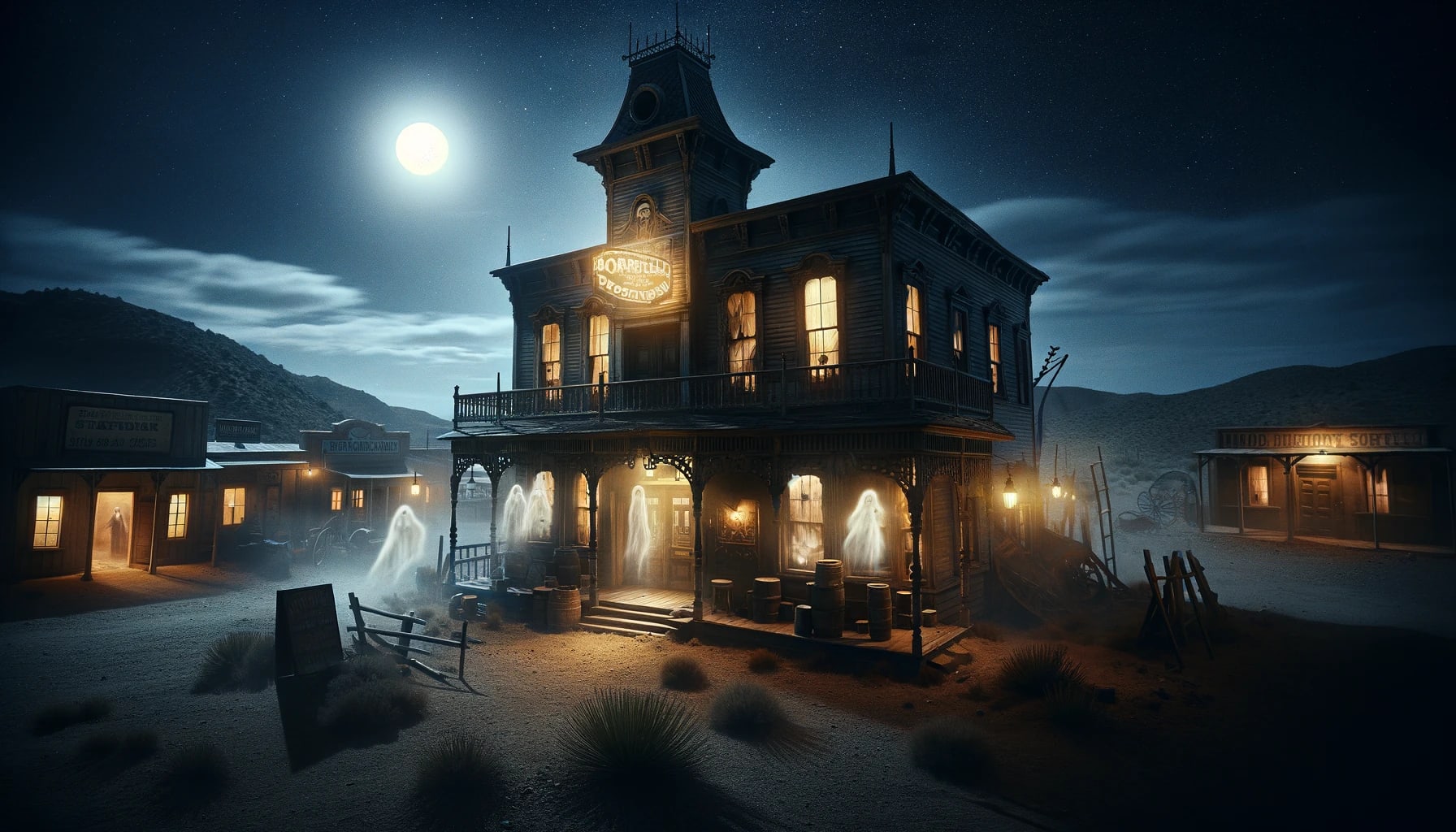
A Town That Refuses to Let Go
At dusk, Tombstone goes quiet. The tourist crowds thin out. The desert wind picks up along Allen Street, rattling the wooden boardwalks that line the same storefronts gunfighters walked past more than 140 years ago. The town looks almost exactly as it did in the 1880s — and if the stories are true, some of the people who lived and died here never left.
Tombstone is a small town. A few blocks of preserved frontier architecture in the high desert of southeastern Arizona. But its reputation for death and violence is wildly outsized for its geography. In less than a decade — from 1879 to the late 1880s — Tombstone produced more documented violent deaths per capita than almost any settlement in the American West. Gunfights, mining disasters, disease, political assassination, frontier justice — all of it compressed into a space you can walk across in fifteen minutes.
That's why Tombstone is considered haunted. Not because of theatrical ghost stories or Hollywood mythology, but because of the sheer density of trauma that defined its boom years. The hauntings reported here — at the O.K. Corral, the Bird Cage Theatre, Boothill Cemetery, and dozens of other sites — are tied to documented history. Real people. Real deaths. Real buildings that still stand.
Many of these locations are featured on Ghost City Tours in Tombstone, where our guides walk you through the authentic history behind the hauntings. Whether you join our family-friendly Dead Men's Tales Ghost Tour or the adults-only Bullets & Bordellos Ghost Tour, you'll walk the same streets where this history played out — and where the dead, according to countless witnesses, refuse to rest. You can explore the full collection of haunted locations in Tombstone on our site.
Boomtown Violence & Short Lifespans
Tombstone was founded in 1879 after prospector Ed Schieffelin discovered silver in the hills of what was then Apache territory. He'd been warned he'd find nothing out there but his own tombstone. He named the town after the threat.
Within two years, the population exploded from a handful of prospectors to thousands of miners, merchants, gamblers, prostitutes, con men, and gunfighters. The town had no established infrastructure. No stable government. Law enforcement was faction-driven — the Earps represented one political interest, the Cowboys another. Justice was negotiable, and disputes were often settled with firearms.
Gambling halls operated around the clock. Saloon fights were nightly occurrences. Armed confrontations in the streets were common enough that newspapers barely covered them unless someone died — and someone frequently did. Political rivalries between the town's factions created an atmosphere of sustained tension that occasionally erupted into targeted violence.
Life expectancy in frontier towns like Tombstone was significantly lower than in established Eastern cities. Men arrived alone, lived hard, and died young — often without family to claim the body. The result was a town saturated with unresolved death, much of it violent, much of it barely documented.
This wasn't exaggerated frontier mythology. The violence in Tombstone was systemic. It was frequent. And it left a mark that, according to visitors and investigators alike, has never fully faded. The O.K. Corral stands as the most famous example, but it was far from the only site of bloodshed.
Mining Deaths Beneath the Desert
The silver mines were the reason Tombstone existed. They generated enormous wealth — and they killed with quiet efficiency.
Shaft collapses were a constant risk. The mines around Tombstone were dug deep into unstable desert rock, and structural failures buried men alive with little warning. Underground flooding was another persistent danger. In 1881, miners struck a massive underground water table that would eventually flood multiple shafts and contribute to the town's economic decline. Workers drowned in the dark, hundreds of feet below the surface.
Toxic air accumulated in poorly ventilated tunnels. Explosions from unstable blasting charges killed and maimed without discrimination. Silicosis — the slow suffocation caused by inhaling rock dust — shortened the lives of miners who survived the acute dangers. Most of these men were working-class laborers whose deaths received minimal documentation. No headlines. No trials. No monuments.
This is the forgotten layer of Tombstone's trauma. The town's reputation was built on silver, and the men who extracted it paid with their bodies and their lives. Their deaths didn't produce famous gunfights or courtroom dramas, but the sheer volume of loss — quiet, accumulated, and largely unacknowledged — contributed to a foundation of grief beneath the town's streets.
The mining accidents and their ghostly aftermath represent a chapter of Tombstone's haunted history that deserves far more attention than it typically receives. These weren't gunslingers or outlaws. They were workers. And their stories are part of why this town carries the weight it does.
Brothel Culture, Disease & Hidden Tragedies
Tombstone's red-light district was not a footnote to the town's history — it was an economic engine. In a boomtown populated overwhelmingly by young men with disposable income and no social structure, brothels operated as openly as saloons. They were concentrated along Allen Street and the blocks south of it, and they represented a significant share of the town's commerce.
But behind the glamorized image of the frontier saloon was a far harsher reality. The women who worked in Tombstone's brothels faced exploitation, violence, and disease. Many had arrived under false pretenses or economic desperation. Sexually transmitted diseases were rampant and untreatable by the standards of 1880s medicine. Tuberculosis, addiction, and abuse shortened lives that were already constrained by circumstance.
Some of these women died in the rooms where they worked. Others disappeared from the historical record entirely — no burial notice, no grave marker, no mention in the local paper. Their trauma was private, persistent, and largely invisible to the men who profited from it.
The Bird Cage Theatre was the epicenter of this world — a combination theater, saloon, gambling hall, and brothel that operated twenty-four hours a day for years. The curtained "cribs" that lined its upper balcony were where many of these transactions took place. Today, the Bird Cage is considered one of the most haunted buildings in the United States. The Bordello Bed & Breakfast carries its own legacy — guests report encounters with spirits who seem trapped in a cycle of the lives they lived.
The emotional reality behind these locations matters. These weren't characters. They were people — and their suffering didn't end when Tombstone's boom years did.
The Gunfight at the O.K. Corral — And Its Aftermath
On October 26, 1881, roughly thirty seconds of gunfire on Fremont Street near the O.K. Corral changed Tombstone's history — and cemented its identity — forever.
The facts are well-documented. Wyatt Earp, his brothers Virgil and Morgan, and Doc Holliday confronted Billy Clanton, Tom McLaury, Frank McLaury, and Ike Clanton in what had been a simmering political and personal feud. When the shooting stopped, Billy Clanton and both McLaury brothers were dead or dying. Virgil and Morgan Earp were wounded. Doc Holliday had been grazed. Ike Clanton had fled.
But the gunfight was not the end of the story — it was the beginning of a long, violent aftermath. Murder charges were filed against the Earps. A preliminary hearing divided the town along factional lines. In December 1881, Virgil Earp was ambushed and shot, permanently crippling his left arm. In March 1882, Morgan Earp was assassinated while playing billiards — shot through a window from the alley behind the saloon.
Wyatt Earp's vendetta ride followed. He and a small posse tracked and killed several men suspected of involvement in his brothers' attacks, operating outside any legal authority. The violence rippled outward from Tombstone into the surrounding territory.
The paranormal reports at the O.K. Corral are among the most consistent in town. Visitors describe phantom gunshots that seem to come from the preserved site itself. Cold spots appear without explanation on warm desert evenings. Shadowy figures have been seen near the markers that indicate where each participant stood during the gunfight. Some visitors report a momentary shift — a brief sensation of being present during the original confrontation — before reality reasserts itself.
The O.K. Corral isn't just a tourist attraction. It's a place where documented violence and reported hauntings converge with unusual clarity.
Boothill Cemetery & Unmarked Graves
"Died with his boots on." The phrase that gave Boothill Graveyard its name captures something essential about Tombstone — the people buried here didn't die peacefully. They died suddenly, violently, and often without anyone to mourn them.
Boothill Cemetery holds the remains of gunfight victims, including Billy Clanton and the McLaury brothers. But they're only the most famous residents. The cemetery also contains miners killed in shaft collapses and flooding. Disease victims — tuberculosis, typhoid, cholera. Men who died in bar fights that never made the newspapers. And a significant number of unmarked graves — burials for people whose names were never recorded or have been lost entirely.
Poverty burials were common. Many of the dead had no family in Tombstone, no money for a proper funeral, and no one to ensure their grave was maintained. The result is a cemetery with an unusually high concentration of anonymous dead — people who lived, worked, and died in this town without leaving a trace beyond the ground they're buried in.
This density of death matters. Boothill isn't a large cemetery, but the number of people buried there — and the circumstances of their deaths — create a concentration of loss that is unusual even by frontier standards. The incomplete records, the missing names, the bodies buried quickly and without ceremony — all of it contributes to the persistent legends that surround this place.
Visitors report cold spots among the graves, unexplained mists in photographs, and a pervasive sense of being watched. Whether those experiences are supernatural or psychological, they reflect something real about what happened here. You can explore the full history of Tombstone's burial grounds and haunted landmarks at haunted Tombstone.
The Courthouse & Frontier Justice
The Tombstone Courthouse was where the town attempted to impose order on chaos — with mixed results.
Following the gunfight at the O.K. Corral, a preliminary hearing was held to determine whether the Earps and Doc Holliday should face murder charges. Justice of the Peace Wells Spicer presided over weeks of testimony in a proceeding that divided the town. The Earps were ultimately cleared, but the ruling satisfied no one. The factional violence that followed — the shootings of Virgil and Morgan Earp, the vendetta ride — demonstrated how fragile frontier justice really was.
The courthouse also served as the seat of Cochise County government, handling property disputes, mining claims, and criminal cases ranging from petty theft to murder. The holding cells beneath the courthouse held prisoners awaiting trial — or, in some cases, awaiting execution. The territorial justice system operated under enormous political pressure, and outcomes were often influenced by which faction held power at any given moment.
Today, the Courthouse is a state historic park and museum. It is also one of Tombstone's most consistently reported haunted locations. Staff and visitors describe footsteps echoing through empty hallways. Sudden, inexplicable cold spots in rooms that should be warm. Doors that close on their own. The sound of voices in courtrooms where no one is present.
These reports cluster around the areas associated with the most emotionally charged proceedings — the courtroom where the Earp hearing took place, and the holding cells where accused men waited in uncertainty. Whatever you believe about the nature of these experiences, the Courthouse remains a place where Tombstone's history of conflict and consequence feels unusually present.
The Psychology of Frontier Towns
To understand why Tombstone feels haunted, it helps to understand what frontier towns did to the people who lived in them.
Rapid population turnover was the defining feature of boomtown life. Men arrived chasing silver, spent months or years in dangerous, isolating conditions, and either left broke or died before they could leave at all. Social bonds were shallow and temporary. Community institutions — churches, schools, civic organizations — were either absent or embryonic. There was no safety net.
Extreme wealth disparity created constant tension. Mine owners and successful merchants lived well. Laborers, gamblers, and sex workers lived on the edge. Alcohol was the primary social lubricant, and gambling was the primary entertainment. The combination produced an environment of sustained desperation punctuated by episodes of explosive violence.
Men died far from their families. Many had come west specifically to escape — debt, scandal, prosecution, or simply the constraints of Eastern society. When they died in Tombstone, there was often no one to grieve for them, no one to tell their story, and no one to ensure they were properly remembered. Their deaths went unprocessed, their grief unresolved.
And then there's the myth-making. Tombstone's identity was built around conflict and survival from the very beginning. The town's name is a death reference. Its most famous event is a gunfight. Its most visited site is a graveyard. This isn't a town that moved past its trauma — it preserved it, monetized it, and made it the core of its identity.
That psychological dimension matters. Whether or not ghosts are real in the supernatural sense, the emotional residue of Tombstone's history is undeniable. The town was built on violence, sustained by exploitation, and preserved in the exact form it held when the trauma was at its peak. If any place in America has earned its haunted reputation through sheer accumulated human suffering, it's Tombstone.
So… Is Tombstone Really Haunted?
Here's what we know.
Tombstone experienced one of the highest concentrations of violent and accidental deaths per capita in frontier Arizona. In less than a decade, the town produced gunfight casualties, mining disaster victims, disease deaths, execution subjects, and hundreds of undocumented burials — all within a footprint you can walk in under twenty minutes.
Its architecture remains unusually preserved. The Bird Cage Theatre, the O.K. Corral, the Courthouse, Big Nose Kate's Saloon, the Crystal Palace — these aren't reconstructions. They're original buildings, standing on original foundations, containing original fixtures. Whatever energy or memory those walls absorbed during the 1880s, the physical containers remain intact.
Its identity is built around conflict and survival. Tombstone didn't forget its past or pave over it. It preserved every bullet hole, every grave marker, every piece of the story. The town exists today because of its dead — and it makes no effort to move beyond them.
Whether the experiences reported in Tombstone are supernatural, psychological, or some combination of both, something about this town lingers. The gunshots that echo from empty streets. The cold spots in rooms with no drafts. The figures glimpsed at the edge of vision near Fremont Street. The persistent, unshakable feeling that you are not alone on those wooden boardwalks after dark.
Tombstone earned its name. And if the thousands of visitors, residents, and investigators who have reported unexplained experiences here are to be believed, the town continues to earn it — every night.
Experience Haunted Tombstone for Yourself
Ghost City Tours of Tombstone offers the most historically grounded ghost tour experience in town. Our guides are researchers and storytellers — not actors. Every location we visit, every story we tell, is rooted in documented frontier history. We don't exaggerate, and we don't fabricate. The real history of Tombstone is dramatic enough.
Our family-friendly Dead Men's Tales Ghost Tour takes you through Tombstone's most haunted streets with stories appropriate for all ages. Our adults-only Bullets & Bordellos Ghost Tour explores the darker chapters — the red-light district, the saloon violence, and the frontier justice that shaped this town.
Explore the full collection of haunted locations in Tombstone, including the O.K. Corral, the Bird Cage Theatre, Boothill Cemetery, and the Tombstone Courthouse. And stay tuned for our upcoming deep dive into Tombstone's mining accidents and their ghostly legacy.
Book your Tombstone ghost tour today and walk the streets where the Old West's most violent history — and its most persistent ghosts — are waiting.
Frequently Asked Questions
Why is Tombstone considered one of the most haunted towns in Arizona?
Tombstone experienced one of the highest concentrations of violent and accidental deaths per capita in frontier Arizona. Between the silver mining boom of the 1880s, the gunfight at the O.K. Corral, rampant saloon violence, mining shaft collapses, and widespread disease in the red-light district, thousands of people died in a very small area over a very short period of time.
The town's architecture remains unusually well-preserved, and many of these original buildings — including the Bird Cage Theatre, the Courthouse, and Big Nose Kate's Saloon — continue to report paranormal activity to this day. Ghost City Tours of Tombstone visits many of these locations on our nightly walking tours.
Is the O.K. Corral really haunted?
The O.K. Corral is widely considered one of Tombstone's most active paranormal locations. The gunfight of October 26, 1881, killed Billy Clanton and brothers Tom and Frank McLaury in roughly thirty seconds of concentrated violence.
Visitors and staff regularly report phantom gunshots, cold spots, shadowy figures, and full-body apparitions near the preserved site. Some visitors have reported hearing shouting and the sound of horses where none exist. The site is a key stop discussed on our Tombstone ghost tours.
Can you visit Boothill Cemetery at night?
Boothill Graveyard is officially open during daytime hours and typically closes at dusk. However, some of the most compelling paranormal reports from Boothill come from visitors near closing time, when the desert light fades and the cemetery takes on a different character.
Photographs taken at Boothill have captured unexplained mists, orbs, and what some believe are spectral figures near the grave markers. Our Tombstone ghost tours share the full history of those buried at Boothill, including the gunfight victims, miners, and the many unmarked graves.
What locations are included on Ghost City Tours in Tombstone?
Ghost City Tours of Tombstone offers two walking tours that cover the town's most haunted locations. Our family-friendly Dead Men's Tales Ghost Tour and our adults-only Bullets & Bordellos Ghost Tour both take you through the historic streets where Tombstone's violent past played out.
Stops and stories cover locations including the O.K. Corral, the Bird Cage Theatre, Boothill Cemetery, the Tombstone Courthouse, Big Nose Kate's Saloon, and the Crystal Palace Saloon. Each tour is led by expert local guides who share authenticated history — not theatrical exaggeration.
Are Tombstone ghost tours historically accurate?
Ghost City Tours prides itself on historical accuracy. Our tour content is researched and grounded in documented frontier history — court records, newspaper accounts, mining reports, and first-person testimony. We don't embellish or fabricate stories for entertainment.
The real history of Tombstone is dramatic enough on its own. Our guides are trained storytellers who understand the difference between legend and record, and they'll tell you which is which. That commitment to authenticity is why Ghost City Tours has earned a 4.9-star rating from thousands of guests.
Is a Tombstone ghost tour appropriate for children?
Ghost City Tours offers two distinct Tombstone experiences. Our Dead Men's Tales Ghost Tour is designed to be family-friendly and appropriate for children ages 6 and older. It covers Tombstone's haunted history in a way that's engaging and age-appropriate without graphic content.
For adults looking for a more intense experience, our Bullets & Bordellos Ghost Tour is restricted to guests 16 and older and explores the darker, more mature side of Tombstone's past — including the red-light district, saloon violence, and frontier justice. Children 5 and under are free on our family-friendly tour.