The Man Who Became the West
Tombstone, 1881. Dust hangs in the October air. The political tension that has been building for months between the Earp faction and the Cowboys is about to boil over into thirty seconds of gunfire that will define a town, a man, and an entire mythology of the American West.
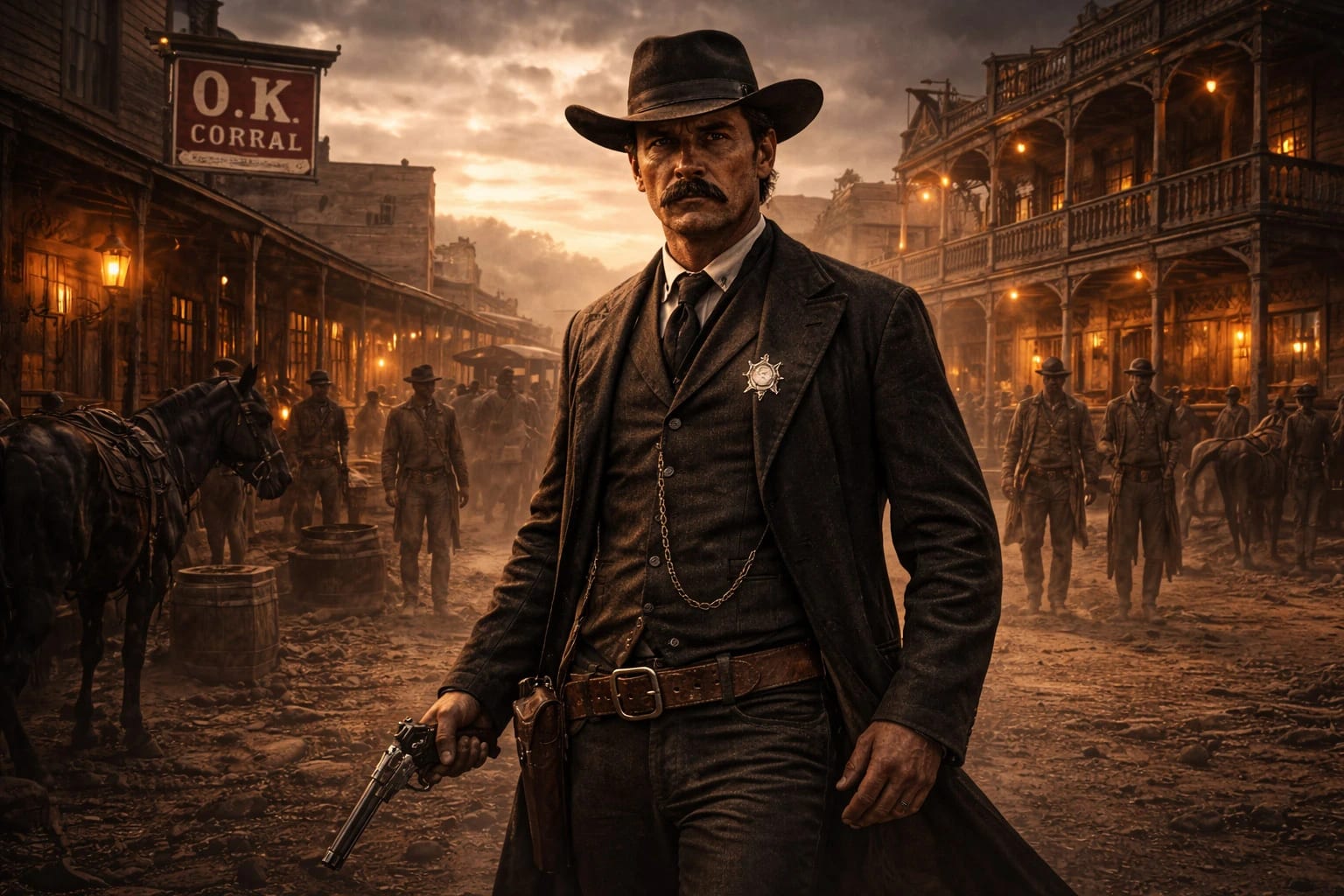
No figure defines Tombstone more than Wyatt Earp. His name is inseparable from the town's identity — from the O.K. Corral to the Vendetta Ride, from the silver boom to the ghost stories that still circulate on Allen Street after dark. He is the man most visitors think of first when they hear the word "Tombstone." He is the archetype of the frontier lawman, the stoic gunfighter, the man who stood his ground when the bullets flew.
But how much of that reputation is earned — and how much was constructed after the fact?
The answer, like the man himself, is complicated. Wyatt Earp's reputation was shaped both by real events — events that were genuinely dramatic, violent, and consequential — and by decades of myth-making that began in his own lifetime and accelerated through Hollywood's twentieth-century Western genre. The real Wyatt Earp was more complex, more ambitious, and more morally ambiguous than any film has depicted.
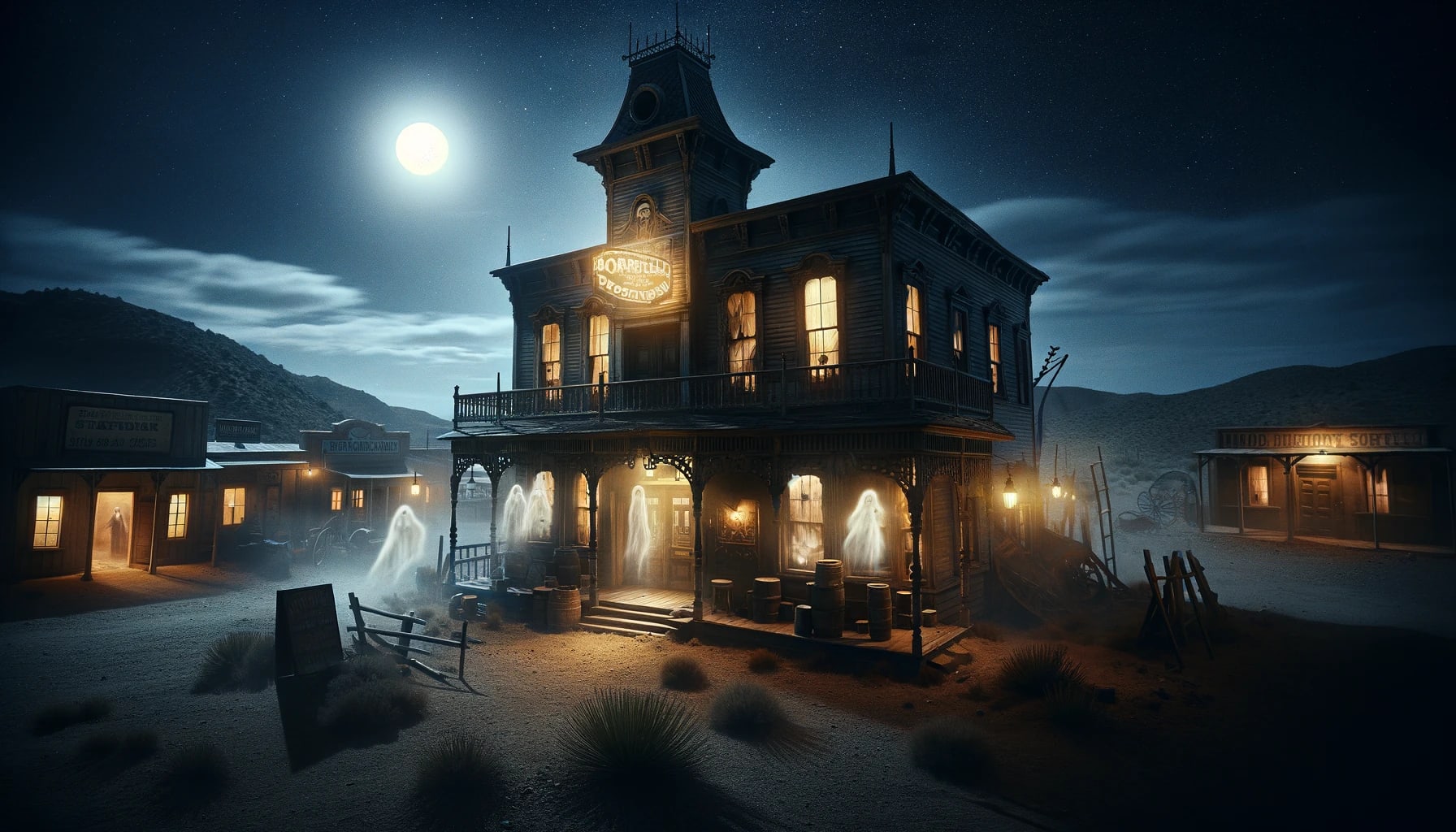
And today, many believe his presence still lingers in haunted Tombstone — a figure seen at the edges of the old streets, a watchful shadow near the places where his story played out.
This is the documented history. This is what actually happened. And this is what people report seeing in the town that made him famous.
Who Was Wyatt Earp Before Tombstone?
Wyatt Berry Stapp Earp was born on March 19, 1848, in Monmouth, Illinois — one of six siblings in a family that would migrate westward multiple times during his childhood. His early life was defined by instability, movement, and the kind of opportunism that characterized frontier America.
Before Tombstone, Earp's occupations were varied and sometimes contradictory. He worked as a teamster, a buffalo hunter, a gambler, and — intermittently — a lawman. He served briefly as a constable in Lamar, Missouri, where he was also accused of horse theft. He spent time in Wichita, Kansas, where he served as a police officer before being dismissed. He moved to Dodge City, where he built a more substantial reputation as a deputy marshal — but even in Dodge, his record was mixed. He enforced the law. He also operated saloons. He collected debts. He navigated the volatile intersection of frontier politics and frontier commerce with a pragmatism that didn't always align with the heroic narrative that would later be written about him.
By the time Earp arrived in Tombstone in late 1879, he was not yet a legend. He was a frontier opportunist — intelligent, physically imposing, personally ambitious, and skilled at reading the political landscapes of boomtowns. He was looking for opportunity, not destiny.
Tombstone would give him both.
Wyatt Earp Arrives in Tombstone
Wyatt Earp arrived in Tombstone in late 1879, during the earliest months of the silver boom. He came with his brothers — Virgil, Morgan, James, and Warren — and with an eye toward the economic opportunities that a mining boomtown inevitably created. The Earps were not missionaries. They were businessmen.
Virgil Earp secured a position as a deputy U.S. marshal — a federal appointment that gave the family a foothold in local law enforcement. Wyatt pursued a variety of ventures: he dealt faro at gambling tables, invested in mining claims, and eventually sought appointment as Cochise County sheriff — a position that carried both political influence and financial reward through the collection of tax revenue.
But Tombstone's political landscape was divided. The Earps and their allies — including Doc Holliday, Bat Masterson (briefly), and various Republican-aligned business interests — represented one faction. On the other side were the Cowboys — a loosely organized group of ranchers, rustlers, and Democratic-aligned figures who operated with considerable power in the rural areas of Cochise County. The Cowboys included men like Ike and Billy Clanton, Tom and Frank McLaury, and Curly Bill Brocius.
The tension between these factions was not primarily about law and order. It was about money, political control, and jurisdiction. Who would collect taxes? Who would control the lucrative contracts? Who would benefit from the river of silver wealth flowing out of the desert?
Tombstone in the early 1880s was a pressure cooker — a boomtown where fortunes were made and lost overnight, where political allegiances shifted with the wind, and where the line between law enforcement and vigilantism was often invisible. The Earps arrived into this environment not as reformers, but as participants. They wanted their share.
The confrontation that was building — the one that would explode near the O.K. Corral on October 26, 1881 — was the inevitable result of these competing ambitions colliding in a town that was too small, too rich, and too volatile to contain them.
The Gunfight at the O.K. Corral
The event that defined Wyatt Earp's life lasted approximately thirty seconds.
On October 26, 1881, Virgil Earp — acting in his capacity as town marshal — led Wyatt, Morgan, and Doc Holliday to confront a group of Cowboys in a narrow vacant lot near Fremont Street, close to the O.K. Corral. The Cowboys present included Ike and Billy Clanton, and Tom and Frank McLaury. The stated purpose was to disarm the Cowboys, who were allegedly carrying weapons in violation of a town ordinance.
What followed was not a cinematic showdown. It was a chaotic, close-range exchange of gunfire. Approximately thirty shots were fired. Billy Clanton was killed. Tom McLaury was killed. Frank McLaury was killed. Virgil Earp was wounded. Morgan Earp was wounded. Doc Holliday was grazed. Ike Clanton fled the scene unarmed.
Wyatt Earp emerged physically unharmed — a fact that would become central to his legend.
The immediate aftermath was not celebration. It was political backlash. The Cowboys and their allies accused the Earps of murder. Ike Clanton filed charges. A preliminary hearing before Justice of the Peace Wells Spicer examined the evidence over several weeks. Spicer ultimately ruled that the Earps had acted within the law — but the ruling did not settle the matter. The political division in Tombstone deepened.
The legend expanded after the gunfight — not during it. In the moment, it was a brief, violent eruption of a political conflict that had been building for months. It became the most famous gunfight in American history not because of what happened, but because of what was written about it afterward.
The Morgan Earp and Virgil Earp pages explore the fates of Wyatt's brothers — fates that would transform the O.K. Corral from a political incident into a personal vendetta.
The Vendetta Ride & Leaving Tombstone
The gunfight at the O.K. Corral did not end the conflict. It escalated it.
On December 28, 1881 — two months after the gunfight — Virgil Earp was ambushed while walking on Allen Street. Shotgun blasts shattered his left arm, leaving him permanently disabled. The attackers were never positively identified, though suspicion fell on Cowboys affiliated with the Clanton faction.
On March 18, 1882, Morgan Earp was assassinated. He was shot through the back while playing billiards at Campbell & Hatch's saloon. The bullet passed through his body and lodged in the wall. Morgan died within the hour. He was thirty years old.
Morgan's assassination transformed Wyatt Earp. Whatever political calculations had guided his actions before — whatever blend of self-interest, ambition, and genuine law enforcement motivation had defined his time in Tombstone — his brother's murder changed the equation. What followed was personal.
The Vendetta Ride was a campaign of retaliatory violence. Wyatt, Warren Earp, Doc Holliday, and a small group of allies rode through southeastern Arizona, hunting men they believed responsible for Morgan's death and Virgil's maiming. At least three men were killed during the ride — Frank Stilwell, Florentino Cruz, and Curly Bill Brocius. The killings were extrajudicial. They went well beyond anything that could be justified by legal authority.
Wyatt left Tombstone under controversy, with murder warrants outstanding in Arizona Territory. He never returned permanently. He spent the remaining decades of his life in Colorado, California, and Alaska — always moving, always seeking the next opportunity.
But Tombstone defined his legacy. Everything that came after — the mining ventures, the real estate deals, the saloon operations, the Hollywood consultations — existed in the shadow of those few months in 1881 and 1882. Wyatt left Tombstone. Tombstone never left him.
The Hollywood Creation of Wyatt Earp
The transformation of Wyatt Earp from a controversial frontier figure into America's archetypal lawman was a deliberate act of construction — and it began before Hollywood ever got involved.
In the final years of his life, Earp cultivated relationships with early filmmakers and writers in Los Angeles. He understood, perhaps better than any other figure of his era, that the story of the West was being rewritten — and that whoever controlled the narrative would control the legacy.
The most consequential collaboration was with Stuart Lake, a writer who spent time with Earp in the late 1920s and published Wyatt Earp: Frontier Marshal in 1931 — two years after Earp's death. Lake's biography was not journalism. It was hagiography. It elevated the O.K. Corral into a clear-cut battle between justice and lawlessness. It minimized Earp's gambling, his financial self-interest, and the moral ambiguity of the Vendetta Ride. It created the archetype — the stoic, principled lawman — that Hollywood would adopt without reservation.
Western films embraced Lake's version completely. From My Darling Clementine (1946) through Gunfight at the O.K. Corral (1957), Tombstone (1993), and Wyatt Earp (1994), the cinematic Wyatt Earp was a man of simple virtues facing down unmistakable evil. The political complexity vanished. The business motivations disappeared. The moral gray areas were edited out.
The result was a myth that replaced history — a version of Wyatt Earp that most Americans accept as fact, even though it was constructed by a writer working from a subject who had every incentive to shape his own story favorably.
Hollywood amplified the story. But it didn't invent the conflict. The violence was real. The deaths were real. The political tension was real. What Hollywood did was simplify — and in simplifying, it lost the complexity that makes the real story worth telling.
Did Wyatt Earp Die in Tombstone?
No. Wyatt Earp did not die in Tombstone. He left Arizona Territory in 1882, under the shadow of murder warrants related to the Vendetta Ride, and never returned permanently.
After leaving Tombstone, Earp spent decades moving through the American West. He mined in Colorado and Idaho. He ran saloons in San Diego. He refereed a controversial boxing match in San Francisco in 1896. He prospected during the Nome Gold Rush in Alaska at the turn of the century. He invested in real estate in Los Angeles.
In his final years, Earp lived quietly in Los Angeles, where he befriended early Western filmmakers — including, by some accounts, a young John Ford and a young John Wayne. He understood that the Western myth was being codified on screen, and he wanted to influence how his story was told.
Wyatt Earp died on January 13, 1929, in Los Angeles, at the age of eighty. He is buried at Hills of Eternity Memorial Park in Colma, California — a small cemetery town south of San Francisco. His grave is a modest flat marker, shared with his common-law wife, Josephine Marcus Earp.
He is not buried in Tombstone. He did not die in Arizona. His final decades were spent far from the desert streets where his reputation was forged.
And yet — his name remains permanently, irrevocably tied to this town. When people think of Tombstone, they think of Wyatt Earp. When they walk Allen Street, they walk in his shadow.
Which raises the question that visitors, investigators, and Ghost City Tours guides have been asking for years: if Wyatt Earp didn't die here, why do people still claim to see him?
Is Wyatt Earp's Ghost Seen in Tombstone?
The reports are recurring, consistent in their broad outlines, and impossible to verify.
Visitors and locals have described seeing a tall figure in period clothing near several of Tombstone's historic sites — a man who appears watchful, purposeful, and somehow out of place even in a town that is entirely dedicated to preserving its nineteenth-century character. The descriptions share common features: above-average height, dark clothing, a mustache, and an intensity of presence that observers describe as unsettling.
The most frequent sightings are reported near the O.K. Corral and along Fremont Street — the area where the gunfight took place. Witnesses describe a figure who appears briefly at the edge of the vacant lot, stands motionless, and then is no longer there. Not walking away. Not fading. Simply no longer present.
Shadow figures have been reported near the Cochise County Courthouse — the building where the preliminary hearing after the gunfight was conducted, and where the political future of the Earp faction hung in the balance for weeks. The courthouse is one of Tombstone's most investigated haunted locations, and the reports of a watchful presence in its corridors are not limited to the Earp narrative — but they include it.
Investigators at the Bird Cage Theatre have reported phenomena that some associate with the Earp era — unexplained sounds, EVP recordings, and the persistent sense of being observed in spaces where the Earps and their associates were known to have spent time.
These are reports and local lore — not verified claims. Ghost City Tours presents them as what they are: descriptions of experiences that people have had in locations with extraordinary historical weight. Whether they represent genuine hauntings, psychological responses to the intensity of the history, or something else entirely is a question we leave to each guest.
What is not in question is the history. The events happened. The buildings are original. The emotional weight of what occurred in these spaces is real — and it's that weight, more than any ghostly sighting, that gives Tombstone its power.
Why Would Wyatt Haunt Tombstone?
If hauntings are connected to moments of unfinished tension — to emotional imprints left on physical spaces by intense human experience — then Tombstone would be the logical place for Wyatt Earp's presence to persist. Not because he died here, but because this is where the defining chapter of his life was written.
Consider what Tombstone meant to Wyatt Earp:
This is where his brother Morgan was murdered — shot through the back while playing billiards, dead within the hour. This is where his brother Virgil was ambushed and permanently disabled. This is where Wyatt himself was accused of murder, defended in a controversial hearing, and ultimately driven from the territory by warrants he would never face.
This is where thirty seconds of gunfire on an October afternoon became the single event that would define his identity for the rest of his life — and for a century after his death.
This is where his reputation was forged in conflict — not in the sanitized version Hollywood would later create, but in the real, messy, politically charged violence of a frontier boomtown that was tearing itself apart.
Emotional imprint theory — the idea that intense human experiences can leave traces on physical spaces — offers one framework for understanding why certain locations seem to carry the weight of their history in ways that go beyond mere memory. Tombstone is haunted for many reasons, but the Earp story represents one of the most emotionally concentrated threads in the town's history.
Ghost stories often center on moments of unfinished tension — conflicts that were never resolved, losses that were never mourned, departures that felt like exile rather than choice. Wyatt Earp left Tombstone under warrants, with one brother dead and another maimed, having committed acts of violence that would follow him for the rest of his life. If that kind of unresolved emotional weight can leave a trace on a place — then Tombstone, of all places, would carry it.
Legend vs Reality — Does It Matter?
Wyatt Earp was not the man Hollywood made him. He was not a simple hero, and he was not a simple villain. He was a frontier figure operating in a world where the categories of hero and villain didn't apply cleanly — a world of competing ambitions, shifting allegiances, and violence that served political and personal purposes simultaneously.
His story was reshaped over time — by Stuart Lake's biography, by Western films, by tourism, by the repetition of simplified narratives that fit better on movie posters than in history books. The myth amplified his reputation. It turned a complex man into an archetype. It replaced nuance with clarity.
But the violence and tension in Tombstone were real. The gunfight happened. The assassinations happened. The Vendetta Ride happened. The buildings where these events took place are still standing. The graves are still marked. The history is documented.
Does the gap between myth and reality matter? It matters enormously — because understanding the real Wyatt Earp makes the story more powerful, not less. A simple hero in a simple showdown is a movie scene. A complex man, driven by grief and rage, hunting down the men who killed his brother in a campaign of extrajudicial violence — that is a human story. And human stories carry more weight than myths.
Ghost City Tours presents documented history first — then shares the reported hauntings transparently. We don't need to simplify the story. The complexity is the story. And it's the complexity that keeps Wyatt Earp's name alive in a town he left nearly a century and a half ago.
Experience Wyatt Earp's Tombstone for Yourself
Ghost City Tours of Tombstone tells the Earp story the way it deserves to be told — with historical accuracy, emotional honesty, and respect for the complexity of the real events.
Our guides are researchers and storytellers. They distinguish between documented history and popular mythology. They present the reported hauntings transparently, without asserting proof or manufacturing drama. They respect the real people — Wyatt, Virgil, Morgan, the Cowboys, and the women and men whose lives intersected with theirs — as historical figures, not fictional characters.
Our family-friendly Dead Men's Tales Ghost Tour covers the Earp family's role in Tombstone's haunted history in a way that is accessible and appropriate for all ages. Our adults-only Bullets & Bordellos Ghost Tour explores the darker chapters — the political violence, the Vendetta Ride, and the complex relationships that defined Tombstone's most turbulent years.
Explore the full collection of haunted locations in Tombstone, including the O.K. Corral, the Morgan Earp assassination site, and the Virgil Earp ambush location.
Book your Tombstone ghost tour today. Context over spectacle. Research over mythology. The real Wyatt Earp — not the movie version.
That's how Ghost City Tours tells this story.
Frequently Asked Questions
Did Wyatt Earp die in Tombstone?
No. Wyatt Earp did not die in Tombstone. After the Vendetta Ride of 1882, Earp left Arizona Territory and never returned permanently. He spent the following decades in various Western towns and cities, including San Diego, Nome (Alaska), and Los Angeles. He died on January 13, 1929, in Los Angeles, at the age of eighty.
Despite dying far from Tombstone, his name remains permanently associated with the town. The events of 1881 and 1882 — the O.K. Corral gunfight, the assassination of Morgan Earp, the wounding of Virgil Earp, and the Vendetta Ride — defined his public identity in ways that nothing else in his long life matched. Ghost City Tours covers the documented history of the Earp family on our Tombstone ghost tours.
Where is Wyatt Earp buried?
Wyatt Earp is buried at Hills of Eternity Memorial Park in Colma, California — a small town south of San Francisco. He was buried alongside his common-law wife, Josephine Marcus Earp. His grave is a modest flat marker.
Despite being buried in California, Earp's legacy lives in Tombstone. The O.K. Corral, the Cochise County Courthouse, and the streets where the defining events of his life took place are still standing — and still visited by people who associate Wyatt Earp with Tombstone, not with the quiet cemetery where he actually rests.
Is Wyatt Earp's ghost seen at the O.K. Corral?
There are recurring reports of a tall figure in period clothing seen near the O.K. Corral and along Fremont Street. Witnesses describe a watchful presence — a figure who appears briefly and is then no longer there. Cold spots and an unusual sense of tension have been reported in the area, particularly after dark.
Whether these reports represent a genuine haunting or a psychological response to the weight of the location's history is a question Ghost City Tours leaves to each guest. We present what has been reported and provide the historical context.
Was Wyatt Earp really a hero?
Wyatt Earp was a complex figure who resists simple categorization. He held law enforcement positions and demonstrated genuine courage. He also had financial and political interests that influenced his decisions. His role in the Vendetta Ride involved violence that went beyond legal authority.
Much of his heroic reputation was constructed through Stuart Lake's 1931 biography, which Earp helped shape. The real Wyatt Earp was more interesting than the myth — ambitious, intelligent, and willing to operate in moral gray areas. Ghost City Tours presents the documented history because the real story is more compelling than the legend.
Are Wyatt Earp stories included on Ghost City Tours?
Yes. The Earp family story is central to both of our Tombstone ghost tour experiences. Our family-friendly Dead Men's Tales Ghost Tour covers the Earps' role in Tombstone's history in an age-appropriate way. Our adults-only Bullets & Bordellos Ghost Tour explores the darker dimensions — the political violence, the Vendetta Ride, and the complex relationships between the Earps and the town's vice economy.
Both tours present documented history first, then share the reported hauntings associated with the Earp family. Ghost City Tours approaches Wyatt Earp's legacy with the historical accuracy and respect the real events demand.