The Other Industry That Built Tombstone
Tombstone in the early 1880s was a town running on adrenaline. Silver was flowing out of the desert hills. Miners with full pockets poured into town every evening. Gamblers, con men, and fortune seekers arrived by the stagecoach-load. Fortunes were made and lost in a single night at the faro tables. And alongside the saloons, the gambling halls, and the mining offices, another industry thrived — one that was just as visible, just as profitable, and just as essential to the town's economy.
Bordellos were not hidden in Tombstone. They operated openly, sometimes under informal political protection, sometimes as extensions of the saloon economy, and always as a direct response to the demographics of a boomtown that was overwhelmingly young, male, and flush with disposable income. They were structured businesses. They employed women. They generated revenue. And they were woven into the social and economic fabric of a town that had very few rules about how money could be made.
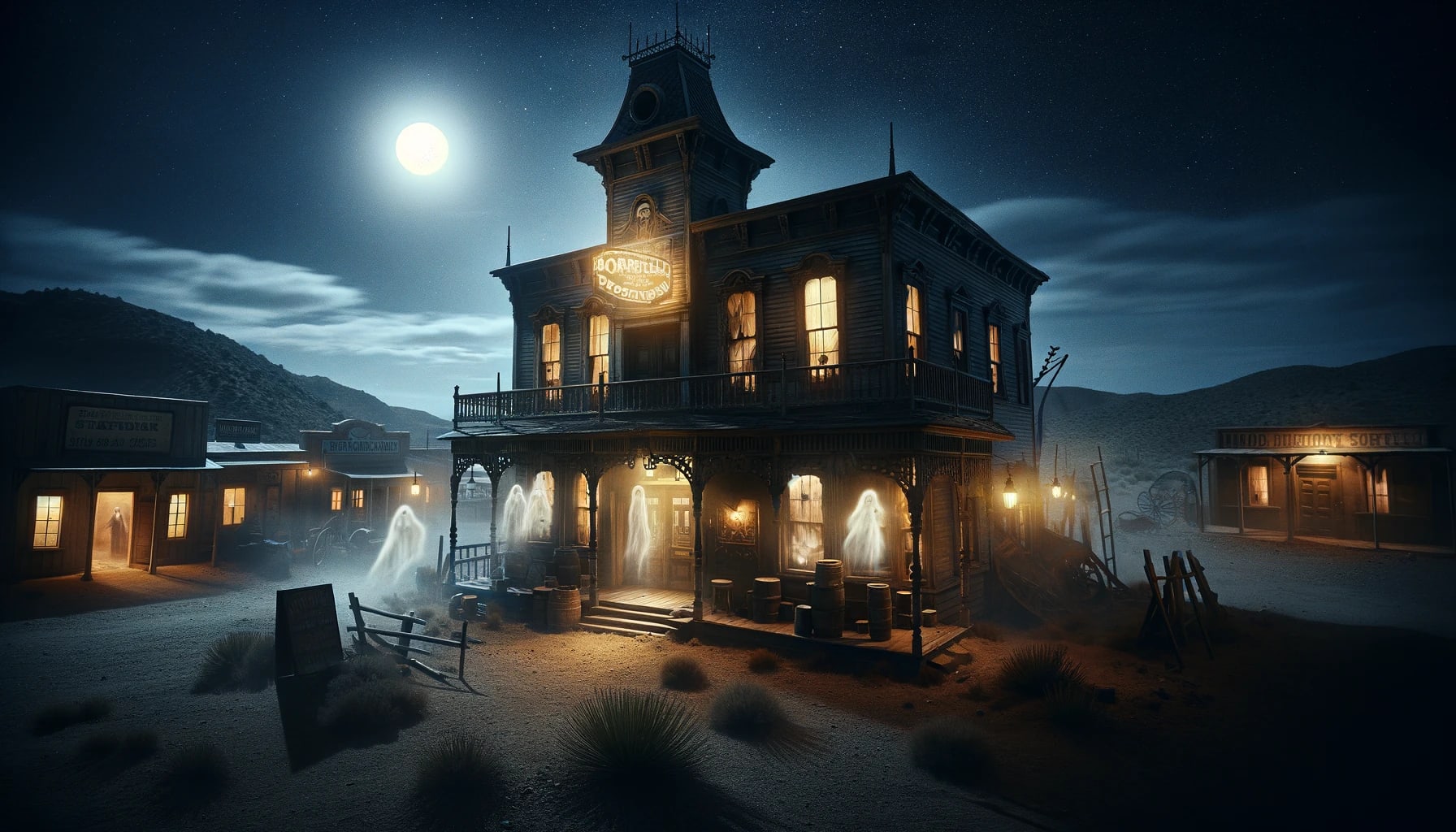
Today, many of Tombstone's former bordellos are said to be among the most haunted buildings in town. The Bird Cage Theatre, the Bordello Bed & Breakfast, and the buildings along Allen Street carry histories of exploitation, violence, disease, and death — the kind of trauma that, according to investigators and visitors alike, doesn't simply disappear when the buildings change hands.
Ghost City Tours of Tombstone explores this history on our adults-only Bullets & Bordellos Ghost Tour — with the seriousness and historical accuracy the subject demands.
Why Were Bordellos So Popular in Tombstone?
The answer is economics and demographics, not moral failure.
Tombstone's population during the silver boom was overwhelmingly male. Miners, prospectors, teamsters, merchants, and gamblers arrived in large numbers — most of them young, single, and far from home. The town was geographically isolated in the high desert of southeastern Arizona, hours from any major settlement. Entertainment options were limited to saloons, gambling, and the occasional traveling show.
In this environment, brothels filled a social and economic role that was openly acknowledged across the American frontier. They weren't fringe operations run by criminals. Many were structured businesses with regular customers, established pricing, and informal — sometimes formal — relationships with local law enforcement and political figures. In some frontier territories, bordellos were subject to licensing fees or designated to specific districts, making them effectively regulated enterprises.
Tombstone's red-light district operated under similar conditions. Brothels generated tax revenue, attracted customers to neighboring saloons and gambling halls, and provided employment for women who had few other economic options in a frontier town. Some madams became wealthy and politically connected. Others operated small, desperate establishments on the margins of the district.
The popularity of bordellos in Tombstone wasn't unique — it was a predictable consequence of boomtown conditions. A transient, male-dominated workforce with cash and limited social structure will reliably produce a vice economy. What made Tombstone different was the intensity. The silver boom compressed years of growth into months, creating a town whose psychology was defined by impermanence, risk, and excess.
How Tombstone's Red-Light District Operated
Tombstone's vice district was concentrated along Allen Street and the blocks immediately south of it — close to the saloons, the gambling halls, and the foot traffic that fueled the town's nighttime economy. Fremont Street, one block north, carried the town's more respectable commercial activity. The proximity was intentional. Vice and commerce operated side by side, often in the same buildings.
The district operated on a tiered system. At the upper end were the parlor houses — establishments that offered drinks, music, conversation, and private rooms in a relatively upscale setting. These were run by experienced madams who cultivated regular clientele and maintained a degree of order. Some parlor houses served as social hubs for the town's wealthier residents and visiting businessmen.
At the lower end were the cribs — small, partitioned rooms, sometimes no more than curtained alcoves, where individual women conducted transactions with little overhead and no protection. The crib system was the most exploitative tier of the industry. Women working cribs had no madam to negotiate on their behalf, no bouncer to intervene in disputes, and no recourse when customers became violent.
Between these extremes were the saloon-brothels — hybrid establishments where drinking, gambling, and prostitution occurred under one roof. The Bird Cage Theatre was the most famous of these, but it was not the only one. Several Allen Street saloons maintained upstairs rooms for the purpose.
Medical inspections existed in some frontier towns but were inconsistently enforced in Tombstone. Sexually transmitted diseases were rampant and, by 1880s standards, untreatable. Tuberculosis circulated freely. Violence against women — from customers, from competitors, from the men who claimed to protect them — was chronically underreported. The women who worked in Tombstone's red-light district faced risks that were constant, varied, and often fatal.
The Bird Cage Theatre — Gambling, Women, and Gunfire
The Bird Cage Theatre opened in 1881 and operated continuously — twenty-four hours a day, seven days a week — for nearly a decade. It was, by any measure, the epicenter of Tombstone's vice economy.
The main floor functioned as a theater and saloon. A stage at one end hosted variety shows, musical performances, and traveling acts. The bar ran constantly. Gambling tables occupied the remaining floor space — faro, poker, and monte were the primary games, and the stakes could be enormous. A single poker game in the Bird Cage's basement is said to have lasted over eight years, with players rotating in and out as the game continued without interruption.
Above the main floor, fourteen curtained compartments — known as cribs — lined both sides of the upper balcony. These were the Bird Cage's most notorious feature. The cribs were used for prostitution, and the women who worked in them were visible from the main floor below. The arrangement was deliberate. The Bird Cage made no effort to separate its various functions. Drinking, gambling, entertainment, and sex operated simultaneously, in full view of one another.
At least twenty-six bullet holes remain in the walls and ceiling of the Bird Cage Theatre. Multiple deaths occurred on the premises — the result of gambling disputes, personal vendettas, and the volatile combination of alcohol, firearms, and compressed male aggression.
Today, the Bird Cage is considered one of the most haunted buildings in the United States. Female apparitions have been reported on the upper balcony, near the former cribs. Visitors describe disembodied laughter, the sound of music from an empty stage, and shadow figures that move through the building after hours. Paranormal investigators have reported EVP recordings — electronic voice phenomena — capturing voices in rooms where no living person was present. The building's original fixtures remain largely intact, and its history of sustained violence and exploitation makes it a focal point of every Tombstone ghost tour.
The Bordello Bed & Breakfast — A Surviving Brothel
The Bordello Bed & Breakfast is exactly what its name suggests — a former working brothel that has been converted into a guest house while preserving much of its original character. The upstairs rooms, where transactions once took place, are now available for overnight stays. The building's history is not hidden or sanitized. It's the selling point.
Guests who stay at the Bordello frequently report experiences they didn't expect. The most commonly described phenomenon is the scent of perfume — floral, old-fashioned, and unmistakable — appearing suddenly in rooms where no perfume has been used. Objects are reported to move on their own. Doors open and close without explanation. Cold spots appear in rooms that should be warm.
The most frequently reported spirit is known as "The Madam" — a protective presence who seems connected to the building itself rather than to any specific historical individual. Guests have described the sensation of being watched, particularly in the upstairs rooms. Some have reported hearing footsteps in the hallway when no other guests are present. A few have described the feeling of someone sitting on the edge of the bed.
What makes the Bordello Bed & Breakfast significant from a paranormal perspective is the preservation of the space. The rooms have been maintained in a form that closely resembles their original configuration. The theory — held by many investigators — is that physical spaces can retain the emotional energy of what occurred within them. If that theory holds any weight, a building where women lived, worked, suffered, and in some cases died would be exactly the kind of place where that energy would persist.
The preservation of space as preservation of memory. That's the principle at work here — and it applies to much of what makes Tombstone feel haunted.
Who Were the "Soiled Doves" of Tombstone?
"Soiled dove" was the frontier euphemism for a prostitute — a term that managed to be simultaneously sentimental and dismissive. It acknowledged the women's existence while reducing them to a moral category. The real people behind the term were more complicated than any label could capture.
Many of the women who worked in Tombstone's bordellos were young. Some were widowed — left without income or support in a society that offered women very few paths to economic independence. Others had arrived under false pretenses, recruited by madams or procurers who promised legitimate employment. Some chose the work deliberately, seeing it as the fastest route to financial stability in a town where money flowed freely. The motivations were as varied as the women themselves.
A few became well-known figures in Tombstone's social landscape. Big Nose Kate — born Mary Katherine Horony in Hungary in 1850 — was the most famous. She was Doc Holliday's companion, a gambler, a prostitute, and by most accounts a woman of extraordinary independence and volatility. She once set fire to a building to create a diversion and help Holliday escape custody in Fort Griffin, Texas. Her testimony during the O.K. Corral proceedings added fuel to the political firestorm surrounding the case. She outlived nearly everyone in Tombstone's famous cast, dying in 1940 at the age of 89.
Margarita, associated with the Bird Cage Theatre, is one of the names most frequently cited in paranormal investigations of the building. Her historical documentation is thin, but her presence — if the investigators are to be believed — persists. She is described as a young woman who appears near the upper cribs, sometimes visible, sometimes present only as a scent or a sound.
"The Madam" at the Bordello Bed & Breakfast remains unidentified. She is described not as a specific historical person but as a presence — protective, watchful, and tied to the building itself. Her identity may never be established, which is itself a reflection of how poorly documented many of these women's lives were.
And then there are the unnamed women of Allen Street — the ones whose identities were never recorded, whose deaths went unnoticed, and whose stories survive only in the oral tradition of a town that has always been more interested in its gunfighters than in the women who served them. These are the women whose apparitions, if that's what they are, appear at the edges of the stories — unnamed, unidentified, and unresolved.
Why Are Bordellos Said to Be Haunted?
The question deserves a serious answer — one that goes beyond "because ghosts" and into the territory of history, psychology, and architecture.
Start with the trauma. The women who worked in Tombstone's bordellos experienced emotional and physical suffering that was chronic, often invisible, and rarely acknowledged. Violence from customers was routine. Disease — syphilis, gonorrhea, tuberculosis — was endemic and untreatable by the standards of the era. Addiction to laudanum and alcohol was common, both as self-medication and as a tool of control. Many of these women died young, often in the same rooms where they worked, and were buried without ceremony in graves that were rarely maintained.
That kind of sustained, unresolved suffering — concentrated in specific physical spaces — is precisely the pattern that paranormal researchers associate with residual hauntings. The theory is that intense emotional experiences can imprint on a location, creating phenomena that repeat over time regardless of who occupies the space.
Add the architectural factor. Tombstone's former bordellos are unusually well-preserved. The Bird Cage Theatre still contains its original fixtures. The Bordello Bed & Breakfast maintains rooms in near-original condition. These aren't reconstructions or themed attractions — they're original buildings, standing on original foundations, containing original materials. Whatever emotional energy was generated in those rooms, the physical containers remain intact.
Then there's the cultural dimension. Tombstone's identity is built around its violent past. The town has never moved beyond its boom-era history — it has preserved it, celebrated it, and made it the foundation of its economy. Bordello stories are retold nightly on ghost tours. Visitors arrive expecting to encounter the past. That cycle of expectation and storytelling reinforces the phenomena, whether the phenomena are supernatural, psychological, or some combination of both.
Tombstone is haunted for many reasons. But the bordellos may represent the most emotionally concentrated source of that haunting — places where suffering was routine, death was quiet, and the women who endured it were rarely given the dignity of being remembered by name.
Vice, Violence & the Aftermath of the Gunfight Era
The same volatility that fueled the gunfight at the O.K. Corral also fueled the red-light district. Political tension between Tombstone's rival factions extended into every corner of the town's economy — including the bordellos.
The Earps and their allies represented one set of political and business interests. The Cowboys represented another. Both factions had connections to the saloon and vice economy. Control of Allen Street wasn't just about law enforcement — it was about revenue, influence, and access to the cash that flowed through the town's entertainment district every night.
Public morality battles emerged as Tombstone matured. Civic leaders who wanted to attract Eastern investment and establish Tombstone as a legitimate city pushed for restrictions on vice. Others — including many of the town's most powerful figures — resisted, understanding that the red-light district was too economically important to shut down. The tension between respectability and revenue played out in council meetings, newspaper editorials, and occasional enforcement actions that were more performative than effective.
When the mines began to fail in the mid-1880s, the economic foundation that had sustained the vice district collapsed. Miners left. Saloons closed. Brothels that had operated for years found themselves without customers. Some women left Tombstone for other boomtowns. Others had nowhere to go. The decline of the red-light district wasn't a moral victory — it was an economic consequence. The same forces that had created the demand had simply moved on.
What remained were the buildings — empty, preserved by the dry desert climate, and carrying the weight of everything that had happened inside them.
Experience Tombstone's Darker History
Ghost City Tours of Tombstone approaches the bordello history with the seriousness it deserves. Our guides are researchers and storytellers — not actors in costume. We don't glamorize the red-light district, and we don't reduce the women who worked in it to punchlines or caricatures. We tell their stories with historical accuracy, emotional honesty, and respect for the complexity of their lives.
Our adults-only Bullets & Bordellos Ghost Tour is designed specifically to explore the darker chapters of Tombstone's past — the vice, the violence, the exploitation, and the ghost stories that have emerged from that history. It is a mature tour for guests who want the full, unvarnished story of this town.
Explore the complete collection of haunted locations in Tombstone, including the Bird Cage Theatre and the Bordello Bed & Breakfast. These buildings aren't attractions. They're original structures where real history — and real suffering — occurred.
Book your Tombstone ghost tour today. Context over sensationalism. History over spectacle. That's how Ghost City Tours tells this story.
Frequently Asked Questions
Why were brothels so common in Tombstone?
Tombstone's population during the silver boom was overwhelmingly male — miners, gamblers, prospectors, and merchants who had come west without families. The town was geographically isolated in the high desert of southeastern Arizona, with limited entertainment options. Brothels filled a social and economic role that was openly acknowledged in most frontier territories.
Many operated as structured businesses with regular customers, informal political protection, and integration into the town's broader economy. They weren't hidden or stigmatized in the way they would be in established Eastern cities. Ghost City Tours explores this history on our adults-only Bullets & Bordellos Ghost Tour.
Were Tombstone bordellos legal?
Prostitution occupied a legal gray area in 1880s Arizona Territory. While not formally legalized, it was widely tolerated and in many cases tacitly regulated. Some towns attempted to confine brothels to designated areas or impose licensing fees.
In Tombstone, bordellos operated openly along Allen Street, and law enforcement generally did not interfere unless violence or public disturbance was involved. The political factions that competed for control of Tombstone both had connections to the saloon and vice economy. Enforcement was selective and often influenced by political allegiance rather than legal principle.
Is the Bird Cage Theatre really haunted?
The Bird Cage Theatre is widely considered one of the most haunted buildings in the United States. It operated continuously for nearly a decade as a combination theater, saloon, gambling hall, and brothel. At least 26 bullet holes remain in the walls and ceiling. Multiple deaths occurred on the premises.
Paranormal investigators and visitors have reported female apparitions on the upper balcony near the former cribs, disembodied laughter, shadow figures, unexplained cold spots, and EVP recordings capturing voices. The building's original fixtures remain largely intact, making it a focal point of every Tombstone ghost tour.
Who was Big Nose Kate?
Big Nose Kate — born Mary Katherine Horony in Hungary in 1850 — was one of the most colorful figures in Tombstone's history. She was a companion of Doc Holliday, a gambler, a prostitute, and by most accounts a woman of remarkable independence and temper.
She is documented as having once set fire to a building to create a diversion and help Holliday escape custody. Her relationship with Holliday was volatile, and her testimony during the O.K. Corral proceedings added to the political tension surrounding the case. Big Nose Kate's Saloon in Tombstone is now one of the town's most popular haunted landmarks.
Is the Bordello Bed & Breakfast haunted?
The Bordello Bed & Breakfast is a former working brothel converted into a guest house while preserving much of its original character. Guests and staff have reported the scent of perfume in empty rooms, objects that move on their own, sudden cold spots, and the sensation of being watched.
The most frequently reported spirit is known as "The Madam" — a protective presence who seems connected to the building itself. Ghost City Tours discusses the Bordello's history on our Bullets & Bordellos Ghost Tour.
Are bordello stories included on Ghost City Tours?
Yes. Our adults-only Bullets & Bordellos Ghost Tour is specifically designed to explore Tombstone's darker history — including the red-light district, the women who worked in it, the violence they faced, and the ghost stories that emerged from that history. The tour approaches this material with historical accuracy and respect, not caricature or sensationalism.
For families, our Dead Men's Tales Ghost Tour covers Tombstone's haunted history in an age-appropriate way that does not include explicit bordello content.