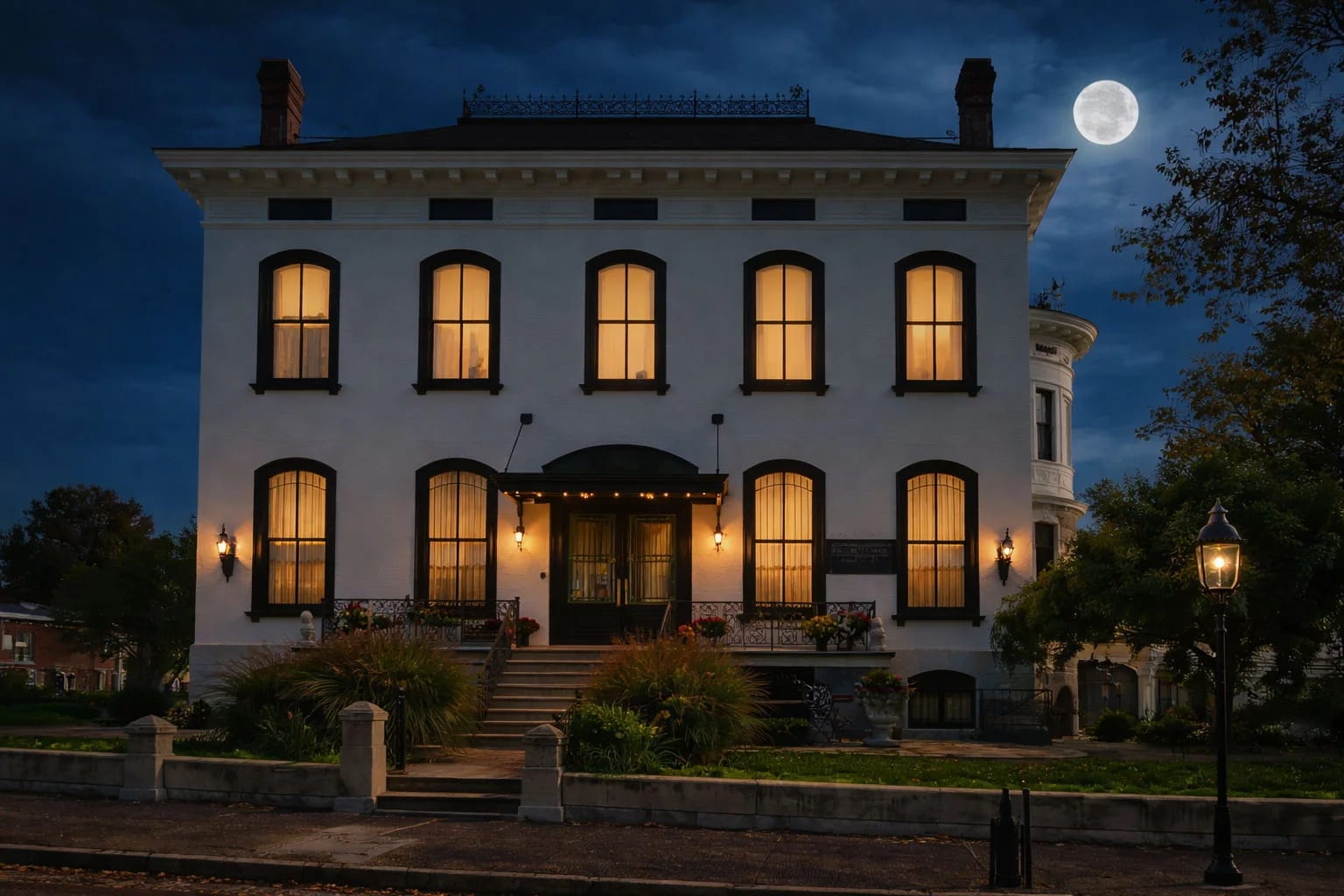
The Lemp Mansion rises from the streets of south St. Louis like a Victorian fever dream, its ornate facade concealing a history so dark that it has earned a place among the most haunted locations in America. Life magazine once declared it one of the ten most haunted places in the country, and countless paranormal investigators have confirmed what locals have known for decades - the spirits of the Lemp family have never left their ancestral home.
Between 1904 and 1949, four members of the Lemp family took their own lives, three of them within the mansion's walls. The family that once controlled the fourth-largest brewery in the United States crumbled under the weight of tragedy, scandal, and the self-destructive curse that seemed to follow them through generations. Today, the mansion operates as a restaurant and inn, but guests frequently encounter more than fine dining and historic accommodations.
Doors slam on their own. Glasses fly from tables and shatter against walls. Apparitions appear in period clothing, only to vanish when approached. The sound of a piano playing drifts through empty rooms. Visitors feel unseen hands touch them, and photographs capture mysterious figures that weren't visible to the naked eye. The Lemp Mansion is not merely rumored to be haunted - it is one of the most thoroughly documented paranormal locations in the world.
To understand the hauntings, one must first understand the tragedy. The story of the Lemp family is a cautionary tale of American success, European brewing traditions, and the demons that money cannot exorcise. It is a story of ambition, madness, forbidden love, and four gunshots that echoed through generations.
The History of the Lemp Mansion
The Lemp family story begins in Germany, where Johann Adam Lemp was born in 1798. A trained brewer, Lemp immigrated to the United States in 1838, settling first in Cincinnati before relocating to St. Louis in 1840. He brought with him the knowledge of lager brewing - a German technique virtually unknown in America at the time.
The Rise of the Lemp Brewing Empire
Johann Adam Lemp recognized that St. Louis possessed unique natural advantages for brewing. The city sat atop a vast network of limestone caves that maintained a constant cool temperature year-round - perfect for the cold storage that lager brewing required. He established a small brewery and began producing his German-style lager, storing it in the caves beneath the city.
American beer drinkers had never tasted anything like Lemp's lager. The existing American beers were primarily ales - darker, heavier, and less refreshing than the crisp German lager. Lemp's beer was an immediate sensation, and demand quickly outstripped supply. He expanded his operations repeatedly, purchasing additional cave storage and building larger brewing facilities.
When Johann Adam died in 1862, his son William J. Lemp took control of the business and transformed it into an empire. William was a business genius with an almost ruthless drive for expansion. Under his leadership, Lemp Brewing Company became the fourth-largest brewery in the United States, competing with Anheuser-Busch for dominance of the St. Louis market.
William purchased the house at 3322 DeMenil Place in 1876, choosing the location for its proximity to his brewery and the cave system that served as his storage facility. The house was originally built in 1868 by Jacob Feickert, but William extensively renovated and expanded it, creating the thirty-three room Italianate Victorian mansion that stands today. An underground tunnel connected the mansion directly to the brewery, allowing William to move between his home and business without ever stepping outside.
The Lemp Family at Their Peak
At the height of their success, the Lemps were among the wealthiest families in St. Louis. William and his wife Julia had nine children, and the mansion bustled with life and activity. The family entertained lavishly, hosting St. Louis society in their ornate parlors and dining rooms. They owned country estates, traveled the world, and lived with the confidence of people who had achieved the American dream.
But even during these years of success, darkness lurked at the edges of the Lemp story. One of William's children - a son named Frederick - suffered from health problems from birth. Some accounts suggest he may have had Down syndrome or another developmental condition, though records from the era are unclear. What is known is that Frederick was kept largely hidden from public view, a shameful secret in an era when families often concealed children with disabilities.
Frederick died in 1901 at the age of 28, officially from heart failure. His death devastated William, who had been closer to Frederick than to any of his other children. Those who knew William said he was never the same after Frederick's death - the light went out of his eyes, and he became increasingly withdrawn and morose.
The First Suicide: William J. Lemp
The first of the Lemp suicides occurred on February 13, 1904. William's closest friend, Frederick Pabst of the famous Pabst brewing family, had died just weeks earlier, and William had been in a deep depression ever since. Combined with his ongoing grief over Frederick's death, the loss of Pabst seemed to push William over the edge.
That morning, William shot himself in the head with a .38 caliber revolver in his bedroom at the mansion. He left no note, no explanation, only a grieving family and a brewing empire that suddenly needed new leadership.
William's eldest surviving son, William Jr., took control of the brewery. A capable businessman, William Jr. continued to expand the company, and by 1910, Lemp Brewing Company was producing over 900,000 barrels of beer annually. The company's flagship brand, Falstaff, became one of the most popular beers in America.
But William Jr. had inherited more than just his father's business acumen. He also seemed to carry the same dark tendencies that had claimed his father. His marriage to Lillian Handlan - nicknamed 'The Lavender Lady' for her obsession with the color - was troubled from the start. Lillian was a socialite who loved parties and attention; William Jr. was increasingly moody and withdrawn. Their divorce in 1908 was one of the most scandalous in St. Louis history, with accusations of infidelity, cruelty, and bizarre behavior flying from both sides.
Prohibition and the Fall of the Empire
The passage of the Eighteenth Amendment in 1919 dealt a fatal blow to the Lemp brewing empire. Unlike Anheuser-Busch, which pivoted to producing ice cream, yeast, and other products during Prohibition, William Jr. saw the writing on the wall and decided to close the brewery entirely.
In 1922, William Jr. sold the Lemp Brewing Company and all its holdings for a fraction of their worth - just $588,000 for an operation that had been valued in the tens of millions just years earlier. The famous Falstaff name was sold to a competitor, who would revive it after Prohibition ended.
The collapse of the family business seemed to accelerate the family's decline. With nothing to occupy their time and no purpose to drive them forward, the Lemps turned inward, their demons consuming them one by one.
The Second Suicide: Elsa Lemp
The second Lemp suicide came in 1920, the year after Prohibition began. Elsa Lemp Wright, William Jr.'s sister, shot herself at her home in St. Louis. Like her father, she left no explanation for her actions.
Elsa had been married twice - her first marriage ended in divorce, her second in her suicide. She was described as emotionally unstable, prone to mood swings and periods of deep depression. Whether this was a hereditary condition, the result of growing up in the dysfunctional Lemp household, or something else entirely remains unknown. What is known is that Elsa became the second Lemp to die by her own hand, continuing a pattern that would claim two more family members.
The Third Suicide: William Jr.
William J. Lemp Jr. spent the years after selling the brewery as a recluse in the family mansion. He rarely left the house, living among the ghosts of his family's past glories. He never remarried after his scandalous divorce from Lillian, and he seemed to have lost all interest in life.
On December 29, 1922 - less than a year after closing the brewery - William Jr. shot himself in the heart in the same building where his father had taken his own life. He was found in his office, a .38 caliber revolver in his hand. His final words to his secretary before the gunshot were reportedly 'I'm going to see my father.'
William Jr.'s death left the mansion to his brother Edwin, who continued to live in the house with his wife. Edwin was considered the most well-adjusted of the Lemp children, a quiet man who kept to himself and avoided the excesses and demons that plagued his siblings.
Charles and the Hidden Child
The most mysterious figure in the Lemp tragedy is Charles Lemp, another of William's sons. Charles was known for being eccentric and reclusive, living in the mansion with his brother Edwin but keeping largely to himself. He had an obsessive fear of germs and kept a pack of dogs as his primary companions.
But Charles harbored a dark secret. In the attic of the mansion, hidden from the world, lived a child - believed to be Charles's illegitimate son. The child, like Frederick before him, may have had developmental disabilities, and Charles kept him concealed to avoid scandal. The boy was raised in near-total isolation, cared for by servants sworn to secrecy.
The existence of this hidden child was not confirmed until after Charles's death, when references to 'the boy in the attic' were discovered in family papers. The child's fate remains unknown - some believe he died in the attic, others that he was eventually institutionalized. His ghost is among those said to haunt the mansion today.
The Fourth Suicide: Charles Lemp
On May 10, 1949, Charles Lemp became the fourth member of his family to commit suicide. At the age of 77, he shot himself in the head in his bedroom at the mansion - the same mansion where his father and brother had taken their lives before him.
But Charles's suicide was different from the others. Before shooting himself, Charles shot and killed his beloved dog. He left instructions that he wanted no funeral service, no mourning, and his body cremated and scattered with no marker or memorial. It was as if Charles wanted to erase himself from existence entirely.
With Charles's death, the direct Lemp line effectively ended. Edwin Lemp, the last surviving son, died of natural causes in 1970. He had lived in the mansion until his final years, apparently untroubled by the spirits of his father and brothers - or perhaps simply resigned to sharing his home with the dead.
The Mansion After the Lemps
After Edwin's death, the Lemp Mansion was sold and converted into a boarding house. The grand Victorian home fell into disrepair, its ornate fixtures stripped, its rooms divided into cheap apartments. For decades, it deteriorated, a sad monument to a family that had risen so high and fallen so far.
In 1975, the Pointer family purchased the mansion and began the long process of restoration. They converted it into a restaurant and inn, opening for business in 1977. Almost immediately, they began experiencing paranormal activity - and so did their guests.
Today, the Lemp Mansion operates as a restaurant, bed and breakfast, and paranormal destination. It has been featured on numerous ghost hunting television programs and investigated by countless paranormal research teams. The consensus is nearly unanimous: the Lemp Mansion is genuinely, actively haunted.
The Ghosts of Lemp Mansion
The paranormal activity at the Lemp Mansion is extensive, varied, and thoroughly documented. Hundreds of witnesses - staff, guests, paranormal investigators - have experienced phenomena that defy explanation. The spirits that haunt the mansion seem to include multiple members of the Lemp family, each with their own distinct presence and area of activity.
The Lavender Lady
One of the most frequently encountered spirits is known as 'The Lavender Lady' - believed to be Lillian Handlan Lemp, the first wife of William Jr. Despite their bitter divorce, Lillian's ghost seems to have returned to the mansion where she spent her married years.
The Lavender Lady is associated with the smell of lavender perfume that appears without explanation throughout the mansion. Guests and staff report suddenly catching the strong scent of lavender in rooms where no such fragrance exists. The smell often precedes other paranormal activity, as if Lillian is announcing her presence.
Apparitions of a woman in a lavender dress have been seen throughout the mansion, most frequently near the main staircase and in the rooms that would have been the family's private quarters. She appears as a full-bodied apparition, looking so real that guests have mistaken her for a living person - until she vanishes before their eyes.
William Sr. and William Jr.
Both Williams - father and son - are believed to haunt the mansion where they took their lives. Their spirits are most active in the areas where they died - the master bedroom for William Sr., and the office area for William Jr.
Guests staying in or near the former master bedroom have reported the sensation of being watched, cold spots that appear suddenly, and the feeling of a heavy, oppressive presence. Some have heard the sound of a gunshot late at night - a residual echo of William Sr.'s suicide that replays through the decades.
In the office area, visitors have experienced similar phenomena associated with William Jr. Papers have been found scattered that were previously neat, drawers open on their own, and the smell of cigar smoke - William Jr.'s preferred indulgence - permeates the air without source.
Both spirits are described as melancholy presences - not threatening, but profoundly sad. Psychic visitors often report sensing overwhelming depression and despair in the areas associated with the Williams, as if the emotional trauma of their deaths has permanently stained the atmosphere.
Charles and His Dogs
Charles Lemp's ghost is frequently reported in the mansion, often accompanied by the spirits of his beloved dogs. Visitors report hearing dogs barking in empty rooms, the sound of claws clicking on hardwood floors, and occasionally seeing spectral canines that vanish when approached.
Charles himself is seen as a tall, gaunt figure, often in the upper floors of the mansion where he spent most of his reclusive life. His ghost seems restless, moving from room to room as if searching for something - or perhaps guarding something. Given the secret of the hidden child, Charles may be eternally watching over the attic where his son was concealed.
Some visitors have reported hearing a child's laughter or crying from the attic area - the ghost of the mysterious hidden child. Staff members have heard the sound of a child running overhead when no one is upstairs. The attic remains one of the most active areas of the mansion, and many believe the spirit of the forgotten Lemp child still dwells there.
The Monkey-Faced Boy
One of the most disturbing apparitions reported at the Lemp Mansion is known as 'The Monkey-Faced Boy.' This spirit is believed to be either Frederick, William Sr.'s disabled son who died in 1901, or the hidden illegitimate child from the attic.
Witnesses describe seeing a figure with unusual facial features - a small, hunched form that doesn't quite look human. The spirit is typically glimpsed briefly, peering around corners or ducking through doorways. It seems shy and frightened, as if still hiding from the world that never knew of its existence.
The Monkey-Faced Boy is most often reported in the basement and attic areas - the hidden spaces of the mansion where he would have spent his secretive life. Some investigators believe there may have been more than one disabled Lemp child kept hidden over the generations, their existence erased from family records.
Poltergeist Activity
Beyond apparitions, the Lemp Mansion experiences significant poltergeist activity - the movement of objects by unseen forces. This activity has been witnessed by hundreds of visitors and staff over the decades.
Flying Objects: Glasses, bottles, and other items have been seen flying off tables and shelves, sometimes shattering against walls with considerable force. This happens frequently enough that staff warn guests to be prepared for unusual occurrences.
Doors: Doors throughout the mansion open and close on their own, sometimes slamming with great force. Locked doors have been found unlocked, and unlocked doors have been found locked. The activity seems intentional, as if the spirits are trying to communicate or control access to certain areas.
Furniture Movement: Heavy furniture has been found moved from its original position, sometimes overnight, sometimes while witnesses are briefly out of the room. Chairs have been rearranged, tables turned, and items relocated with no visible explanation.
The Piano: One of the most famous phenomena involves the mansion's antique piano, which has been heard playing on its own - usually late at night, usually a melancholy tune. Staff have found the piano playing when no one is anywhere near it, the keys depressing as if touched by invisible hands.
Electronic Disturbances
Modern technology seems particularly susceptible to the spirits of Lemp Mansion. Electronic devices malfunction with unusual frequency, batteries drain rapidly, and sensitive equipment picks up anomalies that defy explanation.
Paranormal investigators have captured compelling EVP (electronic voice phenomena) throughout the mansion - voices that weren't audible to human ears but appear on recordings. These voices have included names, phrases, and apparent responses to questions. One famous EVP appears to say 'I'm William' in response to a question about identity.
Photographs taken at the mansion frequently show anomalies - orbs, mists, and occasionally what appear to be full or partial apparitions that weren't visible when the photo was taken. Video recordings have captured shadow figures moving through rooms, objects moving on their own, and other phenomena.
EMF (electromagnetic field) detectors register significant spikes throughout the mansion, often in areas associated with the most intense hauntings. These spikes occur even when all electrical devices are turned off and no natural explanation can be found.
Physical Sensations
Many visitors to the Lemp Mansion report physical sensations associated with the hauntings:
Being Touched: Guests frequently feel touched by unseen hands - a tap on the shoulder, a tug on clothing, a gentle stroke on the cheek. These touches are usually gentle, though some visitors report being pushed or grabbed more forcefully.
Temperature Changes: Cold spots appear suddenly throughout the mansion, areas where the temperature drops dramatically in seconds. These cold spots are often associated with other activity - apparition sightings, sounds, or feelings of presence.
Emotional Overwhelm: Many visitors experience sudden, intense emotions while in the mansion - overwhelming sadness, anxiety, despair, or anger. These emotions seem to come from outside, imposed upon visitors rather than arising naturally. Psychics and sensitives are often overwhelmed by the emotional residue in the mansion.
Physical Symptoms: Some visitors experience headaches, nausea, or dizziness, particularly in the areas where suicides occurred. These symptoms typically dissipate upon leaving the mansion.
Paranormal Investigations at Lemp Mansion
The Lemp Mansion has been investigated by virtually every major paranormal research organization in the country and has been featured on numerous television programs dedicated to ghost hunting.
Television Features: The mansion has appeared on Ghost Hunters, Ghost Adventures, Paranormal State, and many other paranormal television programs. Each investigation has produced compelling evidence of supernatural activity, from EVP recordings to visual anomalies to personal experiences by the investigators.
Professional Investigations: Organizations from across the country have conducted formal investigations at the mansion, using sophisticated equipment to document the activity. The consistency of findings across multiple investigations by different teams lends credibility to the haunted reputation.
Key Evidence: Notable evidence gathered at the Lemp Mansion includes:
- Full-spectrum photographs showing apparent apparitions
- Thermal imaging anomalies suggesting unseen presences
- EVP recordings with identifiable voices and responses
- Video footage of objects moving on their own
- Documented readings of electromagnetic anomalies
The sheer volume of evidence collected at the Lemp Mansion over decades of investigation makes it one of the most documented haunted locations in the world. Skeptics struggle to explain away the consistent, repeated phenomena experienced by thousands of visitors and captured by countless investigators.
The Lemp Mansion welcomes serious paranormal investigators and hosts regular ghost hunting events for those who want to experience the hauntings firsthand.
Visiting Lemp Mansion Today
Today, the Lemp Mansion operates as a restaurant, bed and breakfast, and paranormal destination, offering visitors multiple ways to experience its haunted history.
Dining: The mansion's restaurant serves lunch and dinner in the atmospheric surroundings of the historic building. Diners can enjoy fine cuisine while surrounded by the grandeur - and the ghosts - of the Lemp family home. Many diners have reported paranormal experiences during their meals, making dinner at Lemp Mansion an adventure beyond the culinary.
Overnight Stays: For the brave, the mansion offers bed and breakfast accommodations in rooms where the Lemps once slept - and where some of them died. Each room has its own history and reported hauntings. Guests frequently report paranormal experiences during their stays, from mild phenomena to full apparition sightings.
Ghost Tours: The mansion offers regular ghost tours that explore the building's tragic history and documented hauntings. Knowledgeable guides share the stories of the Lemp family and the spirits that remain, visiting the most active areas of the mansion.
Mystery Dinners: Combining entertainment with hauntings, the mansion hosts mystery dinner theater events where guests can enjoy a show and a meal while keeping watch for genuine ghostly activity.
Private Investigations: For serious paranormal enthusiasts, the mansion offers overnight investigation packages. Groups can rent the mansion after hours and conduct their own investigation, using professional equipment in one of America's most active haunted locations.
The Lemp Mansion is located at 3322 DeMenil Place in south St. Louis, Missouri. Reservations are recommended for dining and required for overnight stays. Whether you come for the history, the cuisine, or the ghosts, the Lemp Mansion offers an experience unlike any other - a chance to walk the halls where tragedy unfolded and where the spirits of the Lemp family continue their eternal vigil.