Rising majestically in the heart of downtown Pittsburgh, the Omni William Penn Hotel stands as a monument to the city's Gilded Age glory. Built by steel magnate Henry Clay Frick in 1916, this palatial hotel was designed to be the finest accommodation between New York and Chicago - a bold statement from a man who helped build Pittsburgh into the industrial capital of America.
With its soaring marble columns, ornate crystal chandeliers, and luxurious appointments, the William Penn quickly became the social center of Pittsburgh high society. Presidents, celebrities, and captains of industry have all passed through its grand lobby. Lawrence Welk debuted his orchestra in the hotel's ballroom. John F. Kennedy and Richard Nixon both stayed here during presidential campaigns. The hotel has hosted everything from debutante balls to political conventions to countless weddings and celebrations over its century-plus of operation.
But the William Penn harbors darker secrets within its elegant walls. Staff members whisper of spectral figures glimpsed in hallways, of elevators that travel to floors on their own, of phantom music drifting from empty ballrooms late at night. Most unsettling of all are the reports of Henry Clay Frick himself - the man who built this monument to wealth and power - still walking its corridors, forever overseeing the hotel he created, his stern countenance appearing to guests and employees alike.
The ghosts of the William Penn are not angry or violent. They are, for the most part, simply present - remnants of an era when Pittsburgh was the richest city in America, when steel barons commanded empires, and when the William Penn was the crown jewel of a city that believed its prosperity would last forever. In a sense, at the Omni William Penn, that era has never truly ended.
Did you know?
- Henry Clay Frick built the William Penn Hotel in 1916 as a direct challenge to his former partner and bitter rival Andrew Carnegie, who had built Pittsburgh's previous finest hotel.
- The hotel's grand ballroom has hosted more U.S. presidents than any other venue in Pennsylvania.
- Lawrence Welk and his orchestra got their big break performing in the hotel's Urban Room, launching a career that would span five decades.
- The William Penn was the first hotel in Pittsburgh to have its own radio station, broadcasting live big band performances in the 1920s and 30s.
- Our own CEO, who grew up in Pennsylvania, has had his own paranormal experience at this legendary hotel during a late-night visit home.
The History of the William Penn Hotel
Henry Clay Frick's Vision
To understand the William Penn Hotel, one must first understand Henry Clay Frick - one of the most powerful and controversial figures in American industrial history. Born in 1849 in West Overton, Pennsylvania, Frick built a fortune in the coke industry before partnering with Andrew Carnegie to create the largest steel empire the world had ever seen.
Frick was Carnegie's right-hand man and the operational mastermind behind Carnegie Steel. He was also the man who ordered the Pinkerton agents to break the Homestead Strike of 1892, resulting in a bloody confrontation that left ten dead and Frick himself shot and stabbed by anarchist Alexander Berkman. Frick survived the assassination attempt and became even more ruthless in his business dealings.
By 1916, Frick had fallen out spectacularly with Carnegie, and the two men who had once been partners were now bitter enemies. When Frick decided to build a grand hotel in downtown Pittsburgh, it was seen by many as a direct challenge to Carnegie - a statement that Frick's legacy would overshadow his former partner's in their shared city.
Frick commissioned architect Janssen & Abbott to design the most luxurious hotel Pittsburgh had ever seen. The result was a masterpiece of Beaux-Arts architecture, featuring over 1,000 rooms, multiple restaurants and ballrooms, and every modern amenity of the era. The hotel was named after William Penn, the founder of Pennsylvania, but everyone knew it was really a monument to Henry Clay Frick's wealth and ambition.
The Golden Years
The William Penn opened on March 6, 1916, to immediate acclaim. Its grand lobby, with its marble floors, ornate columns, and stunning chandeliers, was unlike anything Pittsburgh had seen. The hotel quickly became the social center of the city, hosting balls, weddings, political events, and business meetings for Pittsburgh's elite.
The 1920s and 30s were the hotel's golden age. Big band orchestras performed nightly in the Urban Room, broadcasting live across the nation via the hotel's own radio station. Lawrence Welk got his start here, and his champagne music would become synonymous with American entertainment for decades. The hotel's restaurants were considered the finest in the region, and its guest list read like a who's who of American power and celebrity.
During Prohibition, like many grand hotels, the William Penn maintained discreet speakeasies for its wealthy clientele. Hidden rooms and secret passages allowed guests to enjoy illegal libations without fear of raids - though the hotel's political connections likely provided additional protection. These hidden spaces, some of which are said to still exist within the hotel's labyrinthine basement, may be home to some of the paranormal activity reported today.
The hotel also played a significant role in American political history. Multiple presidential candidates have stayed here during campaigns, and the hotel has hosted numerous political conventions and strategy sessions. It was at the William Penn that some of the most consequential political decisions in Pennsylvania history were made.
Decline and Restoration
Like Pittsburgh itself, the William Penn fell on hard times in the latter half of the 20th century. As the steel industry collapsed and Pittsburgh's population declined, the grand hotel struggled to fill its rooms. The building changed hands multiple times, and some feared it would be demolished or converted to other uses.
But Pittsburgh's renaissance in the 1980s and 90s brought new life to the William Penn. The Omni Hotel chain acquired the property and undertook a massive restoration, bringing the hotel back to its former glory while adding modern amenities. Today, the Omni William Penn stands once again as Pittsburgh's premier luxury hotel, its restored grandeur a testament to both the city's past and its future.
Yet even as the living returned to enjoy the William Penn's splendor, it seems the dead never left. In fact, some believe the restoration work may have stirred up paranormal activity that had lain dormant for decades. Guests and staff began reporting more frequent encounters with spectral figures - as if the spirits who called the William Penn home had awakened to find their hotel beautiful once more.
The Ghosts of the Omni William Penn
The Spirit of Henry Clay Frick
The most famous ghost of the William Penn is none other than Henry Clay Frick himself. Though Frick died in 1919, just three years after his hotel opened, his spirit seems unable to leave the monument he created.
Guests and staff have reported seeing a stern-faced man in old-fashioned formal attire walking the hotel's corridors, particularly in the upper floors where the most expensive suites are located. He is described as short, with a thick mustache and an intense, piercing gaze - matching historical photographs of Frick perfectly. The apparition never speaks, but those who encounter him report feeling judged, as if this spectral inspector is evaluating whether they belong in his hotel.
Some staff members believe Frick's ghost is particularly active when the hotel hosts important events or distinguished guests, as if the old industrialist wants to ensure everything meets his exacting standards. Others have reported seeing him standing at windows, gazing out at the Pittsburgh skyline - perhaps surveying the city he helped build, or perhaps mourning the industrial empire that has long since crumbled.
Frick's ghost has been reported most frequently in the hotel's grand ballroom and in the ornate corridors of the executive floors. He is always alone, always formal, and always watching. For a man who controlled every aspect of his business empire with an iron fist, it seems death has not diminished his need for oversight.
The Phantom Ballroom Dancers
On quiet nights, when the hotel's ballroom is empty, staff members have reported hearing the unmistakable sounds of a party in progress - music, laughter, the clink of glasses, and the shuffle of dancing feet. When they investigate, they find the ballroom dark and empty, the sounds vanishing the moment the doors are opened.
Some brave souls have peered through the ballroom doors without entering, and what they describe is extraordinary: couples in 1920s formal attire dancing to big band music, their forms translucent and glowing faintly in the darkness. The phantom dancers seem oblivious to the observers, lost in their eternal celebration.
These spectral parties are said to occur most frequently around the anniversaries of major events that were held in the ballroom during the hotel's golden age. It's as if the joy and energy of those celebrations imprinted themselves on the space, replaying like a recording for those sensitive enough to perceive them.
One long-time employee recalls setting up for a morning event and hearing a woman's laugh echo through the empty ballroom, followed by the distinct sound of champagne glasses clinking together. When he called out, the sounds stopped abruptly, leaving only an inexplicable chill in the air.
The Woman in White
Perhaps the most tragic ghost of the William Penn is a woman in a white gown who has been seen on several floors, but most often near the grand staircase. Legend holds that she was a bride who died on her wedding day sometime in the 1920s - some say from a sudden illness, others whisper of a broken heart when her groom failed to appear.
Guests have reported seeing her drifting through hallways, her white gown flowing behind her, her face obscured by a veil. She seems to be searching for something - or someone. Those who have encountered her describe an overwhelming sense of sadness that lingers long after she vanishes.
One guest reported waking in the night to find the woman in white standing at the foot of her bed, staring at her. Before the terrified guest could scream, the apparition faded away, leaving behind only the scent of roses and an inexplicable feeling of profound loss. The guest checked out the next morning and has never returned to the hotel.
Staff members have learned to look away when they catch a glimpse of white in their peripheral vision. The bride, they say, means no harm - she is simply lost in her grief, forever waiting for a wedding day that will never come.
The Haunted Elevator
The William Penn's historic elevators have a reputation for traveling to floors without being summoned, opening their doors on empty hallways where no one has pushed a button. Guests riding alone have reported the elevator stopping at floors where no one waits, the doors opening to reveal empty corridors - and sometimes, just for a moment, the glimpse of a figure walking away.
One particularly eerie account comes from a night security guard who was riding the elevator to the penthouse level during his rounds. The elevator stopped unexpectedly on the 17th floor, and when the doors opened, he saw a man in a bowler hat and old-fashioned suit standing in the corridor, facing away from him. When the guard called out, the figure turned - revealing a face that was nothing but shadow - before the elevator doors closed and continued their ascent. The guard quit his job the following week.
Engineers have examined the elevator systems repeatedly and found no mechanical explanation for these phantom stops. The elevators, it seems, still respond to calls from guests who checked out long ago.
The Children of the William Penn
Perhaps the most unsettling reports from the William Penn involve the sounds of children playing in the corridors late at night - running footsteps, giggling, the bounce of a ball. When guests emerge from their rooms to investigate, the hallways are always empty.
In the early 20th century, it was common for wealthy families to live in grand hotels for extended periods, and the William Penn was no exception. Children grew up within these walls, playing in the corridors and ballrooms, their laughter echoing through the ornate spaces. Some of those children, it seems, never left.
One guest reported seeing two children in old-fashioned clothing playing with a ball in the hallway outside her room. Assuming they were part of some historical event or tour, she smiled at them - but they vanished before her eyes, the ball continuing to bounce for a moment after they disappeared before it too faded into nothing.
These phantom children seem harmless, even playful. But their presence is a reminder that the William Penn has seen generations come and go, and not all who passed through its doors passed on to what lies beyond.
A Personal Encounter: Our CEO's Experience
The haunted reputation of the William Penn isn't just historical legend - it continues to this day. Our own CEO, who grew up in Pennsylvania and often stays at the William Penn when visiting family, had an experience at the hotel that he still can't explain.
It was a late October evening, and he had checked in late after a delayed flight. Exhausted, he went straight to his room on the 14th floor. Around 3 AM, he was awakened by what sounded like a party - music, conversation, the clink of glasses - coming from somewhere nearby. Assuming it was guests in an adjacent room, he tried to ignore it, but the sounds persisted.
What struck him as odd was the music. It wasn't modern music - it sounded like big band jazz, the kind of music his grandparents would have danced to. And there was something distant about it, as if it were coming from very far away and very close at the same time.
Finally, he got up to look through the peephole of his door. The hallway was empty and silent. But the moment he turned away from the door, the sounds resumed - and this time, he heard something that made his blood run cold: a woman's laugh, clear and distinct, that seemed to come from inside his room.
He didn't sleep the rest of that night. When he mentioned the experience to the front desk clerk the next morning, the young woman simply smiled knowingly and said, 'The old guests like to make themselves known sometimes. We think they appreciate when someone from Pennsylvania comes home.'
To this day, our CEO still stays at the William Penn when he visits Pittsburgh. 'If the ghosts have been there for a century,' he says, 'they're not going anywhere. And honestly, there's something comforting about it - like the hotel has its own guardians, watching over everyone who passes through.'
Paranormal Investigations
The Omni William Penn has been the subject of numerous paranormal investigations over the years, though the hotel maintains a discreet approach to its haunted reputation, preferring to let guests discover the ghosts on their own.
Investigators who have been granted access have reported significant findings:
EVP Recordings: Multiple sessions have captured unexplained voices, including what appears to be a man with a formal, clipped speaking style saying 'This is my hotel' - a phrase that investigators believe may be Henry Clay Frick himself.
EMF Anomalies: The grand ballroom and upper floor corridors show frequent electromagnetic fluctuations that cannot be attributed to the building's electrical systems. These spikes often coincide with reported sightings.
Temperature Variations: Cold spots are common throughout the hotel, particularly in the ballroom, near the grand staircase, and in certain guest rooms. Some of these temperature drops exceed 20 degrees and occur suddenly with no natural explanation.
Photographic Evidence: Numerous photographs taken in the hotel have captured unexplained anomalies - shadowy figures in mirrors, strange lights in the ballroom, and what appears to be a woman in white near the grand staircase.
One investigator who spent a night in the hotel described it as 'one of the most actively haunted locations I've ever studied. The spirits here aren't malevolent - they seem almost protective of the building. It's as if they want to make sure the William Penn remains the grand hotel it was always meant to be.'
Visiting the Omni William Penn Today
The Omni William Penn Hotel continues to operate as one of Pittsburgh's premier luxury accommodations, welcoming guests from around the world to experience its restored Gilded Age grandeur.
While the hotel doesn't actively promote its haunted reputation, staff members are generally willing to share stories with curious guests. Some visitors specifically request rooms on the upper floors in hopes of encountering Henry Clay Frick's ghost, while others simply enjoy the ambiance of a hotel where the past and present seem to coexist.
The grand lobby is open to the public and worth a visit even if you're not staying at the hotel. The ornate architecture, stunning chandeliers, and sense of history are palpable - and if you're sensitive to such things, you may feel the presence of those who came before.
The hotel's ballroom can be viewed during certain hours and is frequently used for weddings and special events. Standing in that magnificent space, it's easy to imagine the phantom dancers who are said to appear on quiet nights, forever celebrating the golden age that made Pittsburgh great.
For those seeking a paranormal experience, late-night visits to the hotel's common areas often yield strange sensations - cold spots, the feeling of being watched, and occasionally, glimpses of figures who shouldn't be there. The elevators, too, have been known to provide unexpected encounters.
The Omni William Penn Hotel stands at 530 William Penn Place in downtown Pittsburgh. Whether you come for the luxury, the history, or the ghosts, you'll find a hotel that has never forgotten its past - because at the William Penn, the past has never truly left.
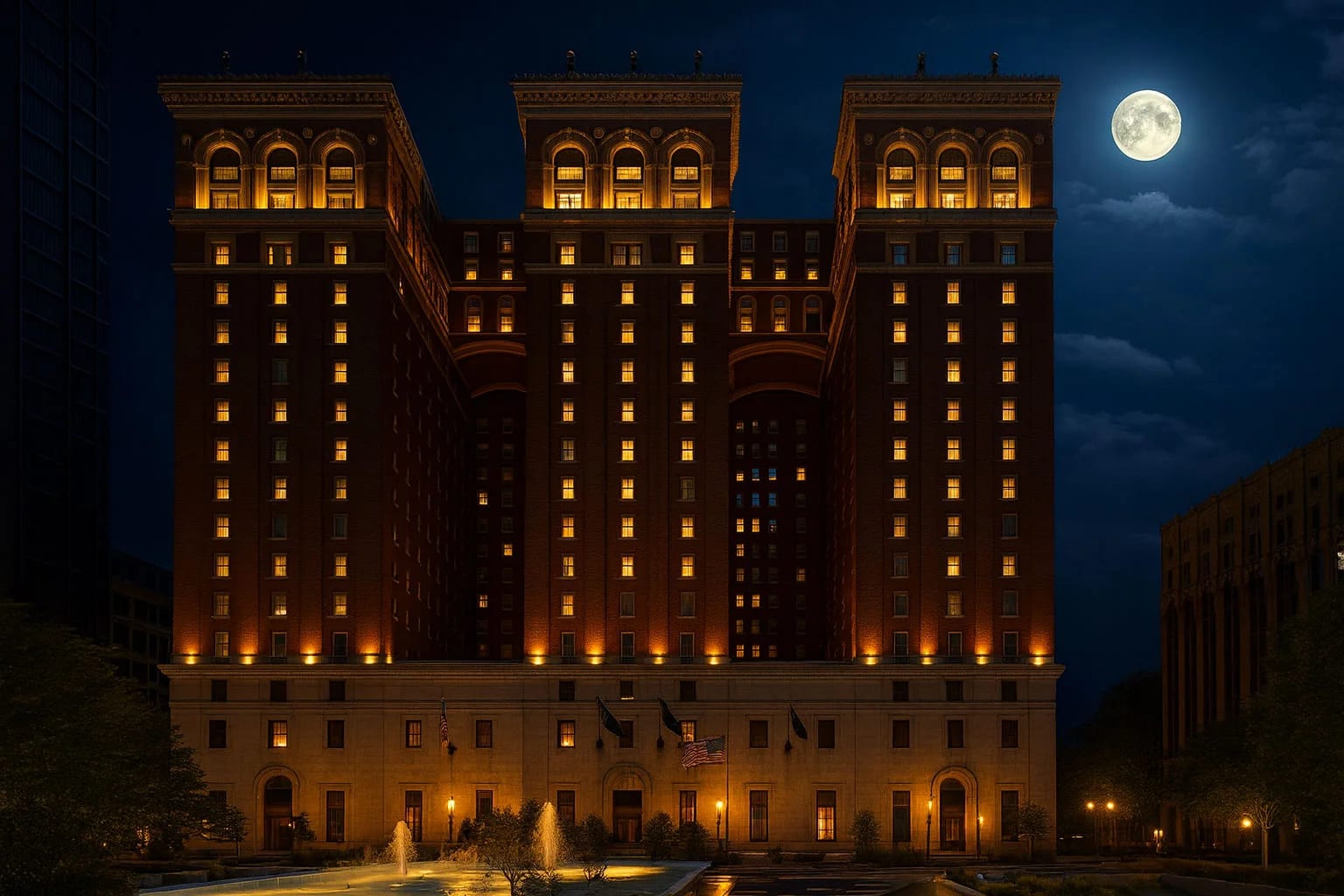
The historic Omni William Penn Hotel, Pittsburgh's grand haunted landmark
