In Pittsburgh's prestigious Point Breeze neighborhood stands Clayton, a stunning Victorian mansion that served as the family home of one of America's most powerful industrialists: Henry Clay Frick. Today, Clayton is the centerpiece of the Frick Pittsburgh complex, a museum campus that includes art galleries, a car and carriage museum, and beautiful gardens. Visitors come from around the world to glimpse how Pittsburgh's Gilded Age elite lived.
But Clayton holds secrets that no museum exhibit can fully capture. Staff members, visitors, and paranormal researchers have long reported strange occurrences within the mansion's walls - the sound of a child laughing in empty rooms, the scent of cigars in spaces where no one smokes, cold spots that appear without explanation, and glimpses of figures in Victorian clothing who vanish when approached.
The Frick family experienced tremendous wealth and power at Clayton, but also profound tragedy. Henry Clay Frick was one of the most ruthless businessmen of his era, a man who ordered armed guards to fire on striking workers and who survived an assassination attempt in his own office. But at home, he was a devoted father who suffered the worst loss any parent can imagine: the death of his young daughter Martha.
Martha Howard Frick died at Clayton in 1891, just five years old, likely from complications of swallowing a pin. Her death devastated Henry and his wife Adelaide, casting a shadow over the family that would never fully lift. Some say Martha never left Clayton - that her playful spirit still runs through the halls of her childhood home, forever five years old, forever searching for the family that loved her.
Clayton is a place where the past feels remarkably present - and where some believe that presence is literal.
Did you know?
- Henry Clay Frick survived an assassination attempt in 1892 when anarchist Alexander Berkman shot him twice and stabbed him in the leg - yet Frick finished his workday before seeking medical attention.
- Martha Frick died at Clayton in 1891 after swallowing a pin, and her death changed her father forever - he kept her room exactly as she left it.
- The Fricks had four children: Childs, Martha, Helen, and Henry Jr. Only Helen and Childs survived to adulthood.
- Adelaide Frick outlived her husband by twelve years and is said to have never recovered from her children's deaths.
- Clayton was one of the first homes in Pittsburgh with electric lighting, installed by Thomas Edison's company.
The History of Clayton
The Rise of Henry Clay Frick
To understand Clayton, one must first understand the man who made it famous. Henry Clay Frick was born in 1849 in rural Pennsylvania to a family of modest means. Through intelligence, ambition, and ruthlessness, he built a fortune in the coke industry - the process of refining coal into the fuel needed to make steel.
By his late twenties, Frick controlled most of the coke production in the Pittsburgh region. His dominance brought him to the attention of Andrew Carnegie, and the two formed a partnership that would create the largest steel company in the world. Frick became chairman of Carnegie Steel, the operational genius who turned Carnegie's vision into reality.
Frick was not a beloved figure. He was known for crushing labor organizing, for working men to exhaustion, and for his cold, calculating approach to business. The Homestead Strike of 1892 - which Frick provoked and then broke with Pinkerton agents, leaving ten dead - made him one of the most hated men in America. When Alexander Berkman attempted to assassinate him shortly after, many cheered.
But Frick was also a man of refined tastes and genuine feeling - at least within the confines of his family. He collected art voraciously, eventually amassing one of the finest private collections in America. And he loved his wife and children with an intensity that surprised those who knew only his business persona.
Clayton as Family Home
The Fricks purchased Clayton in 1882, when Henry was just 32 years old and already one of Pittsburgh's wealthiest men. The house had been built in 1870 and was substantial but not exceptional - Frick would transform it over the years into a showpiece of Gilded Age luxury.
Under the Fricks, Clayton expanded to 23 rooms, featuring the latest in Victorian technology and comfort. Thomas Edison's company installed electric lighting. The interior was filled with expensive furnishings, fine art, and all the trappings of new American wealth. A staff of servants attended to the family's every need.
But Clayton was more than a display of wealth - it was a home. Henry and Adelaide raised their children here, hosting birthday parties and holiday celebrations. The children played in the gardens and ran through the halls. For all his coldness in business, Henry was reportedly an affectionate father who delighted in his children.
The family lived at Clayton from 1882 to 1905, when they moved to New York City. These were the years that would define both the mansion's history and its hauntings - years of triumph and tragedy, of life and death, of events that seem to have imprinted themselves on the very walls of the house.
The Tragedy of Martha
Martha Howard Frick was born in 1885, the second of four Frick children. By all accounts, she was a bright, playful child who was the particular favorite of her father. Henry doted on Martha, and she adored him in return.
In the summer of 1891, when Martha was just five years old, tragedy struck. The exact details vary in historical accounts, but the most common story is that Martha swallowed a pin, which became lodged in her throat or stomach. Despite the efforts of doctors - including a famous specialist summoned from New York - infection set in. Martha died at Clayton on August 18, 1891.
Henry Clay Frick was devastated. The man who had faced down strikers, survived an assassination attempt, and crushed his business opponents was broken by the loss of his little girl. According to family accounts, he kept Martha's room exactly as she had left it, visiting it regularly to grieve. He carried a lock of her hair in a locket for the rest of his life.
The loss changed something in Frick - softened him in some ways, hardened him in others. His surviving daughter Helen would later write that her father never fully recovered from Martha's death, that he carried the grief with him until his own death in 1919.
This grief, some believe, is what keeps the spirits of the Frick family at Clayton. A father who couldn't let go of his daughter. A child who didn't understand why she had to leave. A family bound together by love and loss, unable to move on even after death.
Clayton After the Fricks
When the Fricks moved to New York in 1905, Adelaide's mother continued to live at Clayton until her death in 1920. The house then sat largely unused, though the family maintained it and occasionally visited.
When Helen Clay Frick, the surviving daughter, died in 1984, she left Clayton and its surrounding grounds to the public as a museum. Her gift stipulated that the house be preserved exactly as it was during her family's residence - a time capsule of Gilded Age Pittsburgh.
The Frick Pittsburgh complex opened in 1990, and Clayton became one of the best-preserved Gilded Age homes in America. Ninety-three percent of its furnishings are original to the Frick family, including furniture, artwork, and personal items. Walking through Clayton is like stepping back in time - and perhaps that's exactly the point.
Some paranormal researchers believe that Helen's desire to preserve Clayton 'exactly as it was' created the perfect conditions for hauntings. The house remains so true to its original state that the spirits of its former residents may not realize - or may not accept - that they've passed on.
The Ghosts of Clayton
Little Martha
The most frequently reported spirit at Clayton is that of Martha Frick, the little girl who died in the house in 1891. Staff members and visitors have reported numerous encounters with what appears to be a child's ghost:
Laughter and Footsteps: The sound of a child laughing is frequently reported in Clayton, particularly in the upstairs hallways and in what was once the children's wing. Small footsteps are heard running across floors when no children are in the building.
A Girl in White: Multiple witnesses have reported seeing a small girl in a white dress, usually glimpsed briefly at the end of hallways or on staircases. She appears to be about five years old - the age Martha was when she died. When approached, she vanishes.
Moving Toys: In the nursery area, toys have been reported moving on their own. A rocking horse has been seen rocking gently when no one is near it. Small objects appear in different locations than where staff left them.
The Scent of Flowers: Some visitors report smelling flowers in areas associated with Martha - a sweet, delicate fragrance that appears suddenly and then fades. Martha was reportedly buried with flowers, and her father filled her room with blooms after her death.
Those who have encountered Martha's ghost describe her as playful rather than frightening - a child who doesn't seem to know she's dead, still enjoying the home where she was once so happy. Some staff members say they feel a presence following them through the children's areas, watching them with curiosity.
Henry Clay Frick
The ghost of Henry Clay Frick has also been reported at Clayton, though his manifestations are quite different from his daughter's:
The Smell of Cigars: Frick was known to enjoy cigars, and the distinctive scent of cigar smoke is sometimes detected in his study and other areas of the house. The smell appears suddenly, lingers for a few moments, and then dissipates - despite the fact that smoking has been prohibited in the museum for decades.
A Stern Presence: Staff and visitors report feeling watched in certain areas of the house, particularly in Frick's study and bedroom. The sensation is often described as being observed by someone stern and judging - consistent with accounts of Frick's intimidating personality.
Footsteps in the Study: Heavy footsteps are sometimes heard in Frick's study, as if someone is pacing. Frick was known to pace while thinking through business problems, and some believe he continues the habit in death.
Apparition Sightings: On rare occasions, visitors have reported seeing a man in Victorian-era formal attire in the house. He is described as short, with a thick mustache and intense eyes - matching photographs of Henry Clay Frick. The figure appears to be inspecting the house, as if ensuring everything is in order.
Unlike his daughter's playful ghost, Frick's presence is often described as oppressive or uncomfortable. Some sensitive visitors report feeling unwelcome in certain areas, as if the master of the house is annoyed by their intrusion.
Adelaide and Other Spirits
While Martha and Henry are the most commonly reported ghosts at Clayton, other spirits have been sensed as well:
Adelaide Howard Frick: Henry's wife, who outlived him by twelve years, is sometimes sensed in the house. She is described as a sad presence, often felt in the rooms she would have used - the parlor, the master bedroom, and near the nursery. Adelaide lost two of her four children and was reportedly never the same after Martha's death.
Servants: Clayton employed a large staff during the Frick years, and some believe former servants may remain. The sound of activity in the kitchen, footsteps in the servants' quarters, and the sense of someone working in empty rooms have all been reported.
Children Playing: In addition to Martha, other childlike presences have been sensed - possibly the spirits of her siblings or of children who visited during the Frick years. The children's areas of the house are particularly active, with sounds of play and laughter frequently reported.
The overall impression from paranormal researchers who have studied Clayton is of a house that remains very much 'lived in' - not by the living, but by the spirits of those who called it home over a century ago.
Paranormal Investigations at Clayton
As a museum, Clayton has not been extensively investigated by paranormal teams, though staff members have documented numerous unexplained occurrences over the years:
Temperature Anomalies: Certain areas of the house, particularly the nursery and Henry's study, exhibit unexplained cold spots. These temperature drops can be significant - 10 to 15 degrees colder than surrounding areas - and appear suddenly without any natural explanation.
Electronic Disturbances: Security systems and electronic equipment have malfunctioned in ways that technicians cannot explain. Motion detectors have been triggered in empty rooms. Cameras have captured shadows and anomalies that shouldn't be there.
Staff Experiences: Museum staff have accumulated years of anecdotal experiences - footsteps in empty rooms, objects that move on their own, the feeling of being watched or followed. Several staff members have reported seeing apparitions, though most are reluctant to discuss their experiences publicly.
Visitor Reports: Visitors frequently report feeling 'presences' in the house, particularly those who are sensitive to such things. Some have been moved to tears in the nursery area, overwhelmed by feelings of sadness they can't explain. Others have reported seeing figures in their photographs that weren't visible when the pictures were taken.
The consensus among those who have experienced paranormal activity at Clayton is that the spirits are not malevolent - they are simply the remnants of a family that loved their home deeply and, for whatever reason, has never completely left.
Visiting Clayton Today
Clayton is open to the public as part of the Frick Pittsburgh museum complex, located at 7227 Reynolds Street in Pittsburgh's Point Breeze neighborhood. Guided tours of the mansion are offered regularly and provide a fascinating glimpse into Gilded Age life.
For those interested in the paranormal, visiting Clayton is a unique opportunity to experience one of Pittsburgh's most authentically preserved historic homes - a place where the past seems remarkably close to the present. While the museum doesn't promote its haunted reputation, staff members are often willing to share their experiences with curious visitors.
The best times to sense the supernatural at Clayton may be during quieter visiting hours, when the house is less crowded and it's easier to notice unexplained sounds or sensations. The nursery area and Henry's study are reportedly the most active locations.
Beyond Clayton itself, the Frick Pittsburgh complex includes beautiful grounds, art galleries, and a car and carriage museum - all worth exploring. The entire site offers a window into Pittsburgh's industrial heritage and the lives of the families who built fortunes in steel.
Whether you come for the history, the art, or the ghosts, Clayton offers an experience unlike any other - a chance to walk through rooms where Pittsburgh's most powerful family lived, loved, and lost. And if you feel a chill in the nursery, or catch a glimpse of movement from the corner of your eye, you may be experiencing something more than history - you may be encountering the spirits who still call Clayton home.
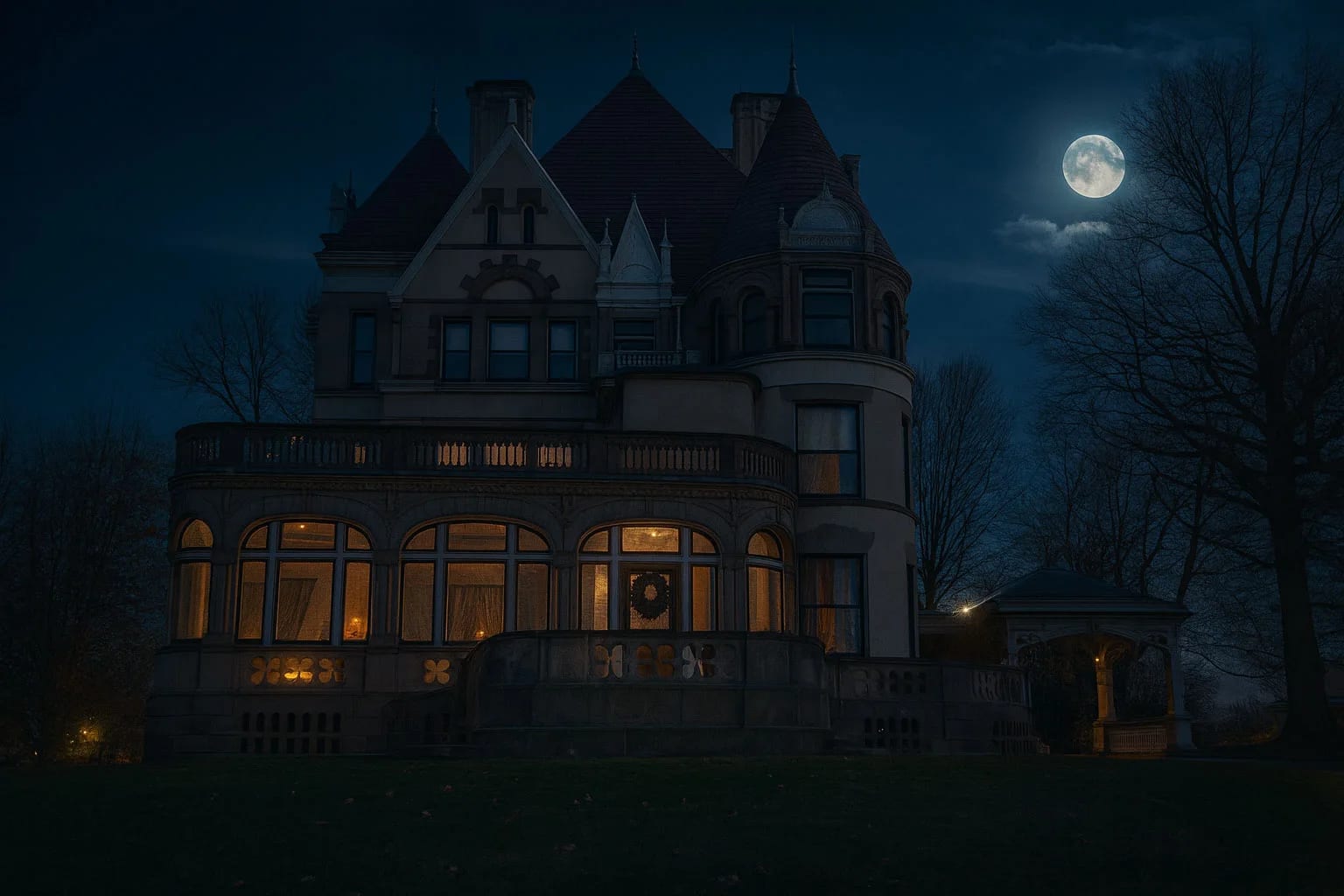
Clayton, the Frick family mansion, where Gilded Age ghosts still linger
