The Cathedral of Learning dominates the Pittsburgh skyline like something from a Gothic fairy tale. Rising 535 feet above the University of Pittsburgh campus in Oakland, this magnificent structure is the second-tallest university building in the world and a beloved symbol of the city itself.
Chancellor John Gabbert Bowman conceived the Cathedral in the 1920s as a monument to education that would inspire students for generations. He envisioned a 'skyscraper of learning' that would combine practical classroom space with awe-inspiring architecture. The result exceeded even his ambitious dreams - a Late Gothic Revival masterpiece that has been described as a 'temple of education' and 'the most outstanding example of Gothic architecture in the Western Hemisphere.'
But the Cathedral of Learning is more than an architectural wonder. Within its soaring halls and mysterious rooms, students and staff have reported strange phenomena for decades. Phantom footsteps echo in empty corridors. Figures are glimpsed in windows of locked rooms. The famous Nationality Rooms - 31 classrooms designed to represent different cultures - seem to harbor presences from across the globe and across time.
Some say the Cathedral is haunted by students who died before completing their studies, forever bound to the place where they pursued their dreams. Others believe the building's Gothic architecture and intense academic energy have created a kind of supernatural magnet, drawing spirits from throughout Pittsburgh's history. And some whisper that the Nationality Rooms, filled with authentic artifacts from around the world, may have brought more than furniture and artwork from distant lands.
Whatever the truth, the Cathedral of Learning stands as one of Pittsburgh's most intriguing locations - a place where the pursuit of knowledge meets the mysteries of the unknown.
Did you know?
- The Cathedral of Learning was funded in part by schoolchildren who donated dimes during the Great Depression - over 97,000 children contributed to its construction.
- The building's Commons Room on the first floor is one of the largest rooms in America without interior columns, measuring 50 feet high and half an acre in floor space.
- Construction workers who built the Cathedral reported strange experiences during its construction, including tools that moved on their own and the sound of voices when no one was present.
- The Early American Room in the Nationality Rooms collection is said to be particularly active, with reports of cold spots and shadowy figures.
- Some students swear they've seen a figure in 1930s-era clothing studying in the Commons Room late at night, only to vanish when approached.
The History of the Cathedral of Learning
A Bold Vision
The Cathedral of Learning was born from the ambitious vision of John Gabbert Bowman, who became Chancellor of the University of Pittsburgh in 1921. Bowman believed that the university needed a new kind of building - one that would not only serve practical educational needs but would inspire students with its grandeur.
Bowman's idea was radical: a skyscraper dedicated to education, built in the Gothic style that had long been associated with great European universities. Critics called his plan impossible, impractical, and far too expensive for a university still struggling to establish itself. But Bowman persisted, convincing donors, trustees, and eventually the public that his vision was worth pursuing.
The cornerstone was laid in 1926, and construction continued through the Great Depression - a remarkable achievement during a time of economic hardship. Bowman's fundraising efforts were creative and inclusive: he organized a campaign that encouraged schoolchildren throughout Western Pennsylvania to donate dimes to build 'their' Cathedral. Over 97,000 children contributed, and their names were recorded in a Book of Donors that still exists today.
The building was completed in 1937, and the University of Pittsburgh finally had its 'temple of education.' But from the very beginning, there were whispers that the Cathedral was home to more than students and faculty.
The Nationality Rooms
One of the Cathedral's most distinctive features is its collection of Nationality Rooms - classrooms designed to represent the cultures and heritage of various national and ethnic groups. The rooms were conceived as a way to celebrate Pittsburgh's diverse immigrant population and to remind students that knowledge has no borders.
The first Nationality Rooms opened in 1938, and the collection has grown to 31 rooms representing cultures from Africa to Wales. Each room was designed by architects and artisans from the represented country, using authentic materials and techniques. Many contain artifacts that are centuries old - furniture, textiles, decorative elements that carry the weight of history and, some say, the spirits of those who created and used them.
The Nationality Rooms are functioning classrooms during the academic year, but they're also a major tourist attraction. Thousands of visitors tour the rooms each year, marveling at the craftsmanship and the window they provide into cultures from around the world.
What visitors may not realize is that the Nationality Rooms are also the site of numerous paranormal reports. Perhaps it's the authentic artifacts. Perhaps it's the intense cultural and historical energy. Or perhaps spirits from around the world have followed their homeland's treasures to this Gothic tower in Pittsburgh.
Deaths and Tragedies
Any building as large and as old as the Cathedral of Learning has witnessed its share of deaths and tragedies. While the university doesn't publicize such events, stories have circulated for decades about students and faculty who died in or near the building under various circumstances.
The most persistent legend involves a student who died during the construction of the Cathedral in the 1930s - a young man who fell from scaffolding and whose body, some say, was never recovered from the structure. Whether this story is true or apocryphal, it's been told by students for generations, and some believe this construction worker's ghost still walks the upper floors of the building.
Other stories tell of students who took their own lives in the Cathedral, unable to bear the pressure of their studies or personal problems. These tragedies, while not unique to the University of Pittsburgh, may contribute to the building's haunted reputation. The intense emotions associated with such deaths - despair, fear, confusion - may leave impressions on the space that sensitive individuals can perceive.
There are also stories of professors and staff who dedicated their lives to the university and who, in death, seem unable to leave the Cathedral that was their second home. These spirits are generally described as benign - scholars who simply want to continue their work in the halls they loved.
The Ghosts of the Cathedral of Learning
The Phantom Student
The most frequently reported ghost of the Cathedral of Learning is a young man in 1930s-era clothing - high-waisted pants, a sweater vest, perhaps a newsboy cap. He's been seen throughout the building, but most often in the Commons Room, the vast Gothic hall on the first floor where students have gathered to study for nearly a century.
Witnesses describe seeing him hunched over books at a table, deeply absorbed in his studies. He looks like any student from a historical photograph of the university - except that when approached, he looks up with an expression of confusion before fading away.
Some believe this phantom student is the ghost of the construction worker who allegedly died during the building's construction. Others think he's a student from the 1930s or 40s who died before completing his degree and remains bound to the place where he pursued his education.
Whatever his identity, the phantom student seems harmless - perhaps even sympathetic. He appears to be eternally studying, forever preparing for exams he'll never take. Late-night studiers in the Commons Room have reported feeling a sense of camaraderie when they sense his presence, as if he's a fellow sufferer in the eternal struggle of academia.
The Nationality Room Spirits
The Nationality Rooms are hotbeds of paranormal activity, with different types of phenomena reported in different rooms:
The Early American Room: This room, designed to resemble a colonial-era American schoolhouse, is said to be one of the most active. Visitors report cold spots, the sensation of being watched, and occasionally glimpses of figures in period clothing. Some have reported hearing whispered conversations in archaic English.
The Syrian-Lebanese Room: This ornate room features authentic 18th-century Syrian decorative arts. Staff members have reported the scent of incense when none is burning and the sound of Middle Eastern music drifting through the space after hours.
The Russian Room: Containing artifacts from Tsarist Russia, this room has been the site of reports of a woman in elaborate dress appearing briefly before vanishing. Some speculate she may be connected to one of the room's authentic antiques.
The Irish Room: Modeled after a Celtic monastery, this room has its share of ghost stories. Visitors have reported hearing chanting in what sounds like Gaelic and feeling the presence of monks who may have used the artifacts now displayed here.
The Chinese Room: This room's Qing Dynasty furniture and decorative elements seem to carry their own spiritual energy. Staff have reported objects moving on their own and a pervasive sense of being observed by unseen eyes.
The diversity of phenomena in the Nationality Rooms suggests that the spirits here may indeed be connected to the rooms' countries of origin - as if the artifacts brought with them some essence of the cultures and people who created them.
The Upper Floors
The upper floors of the Cathedral of Learning are generally inaccessible to the public, containing offices, classrooms, and research facilities. But those who work in these areas report their own share of strange experiences:
Elevator Anomalies: The Cathedral's elevators are notorious for stopping at floors where no one has pressed a button and for delivering passengers to floors they didn't request. Some attribute this to mechanical issues in an aging building, but others believe unseen passengers are using the elevators.
Footsteps in Empty Hallways: Faculty members working late have reported hearing footsteps in corridors they know to be empty. The footsteps sometimes seem to follow them, stopping when they stop, continuing when they walk.
Lights in Windows: From outside the building, observers have occasionally reported seeing lights in windows of floors that should be empty and dark. When investigated, no source for the lights is found.
The Construction Worker: On the highest floors, there are reports of a man in work clothes from the 1930s, spotted briefly before vanishing. He's believed to be the ghost of the worker who allegedly died during the building's construction. If so, he has been walking the upper floors of the Cathedral for nearly a century.
The Woman in White: A female figure in a white dress has been reported on several upper floors. Her identity is unknown, but her presence is consistently described as melancholy - a sad spirit wandering the halls for reasons no one understands.
Paranormal Theories
Why should the Cathedral of Learning be haunted? Paranormal researchers have proposed several theories:
Stone Tape Theory: Some believe that the Cathedral's limestone construction may act like a recording medium, capturing impressions of intense events and replaying them under certain conditions. The building has witnessed generations of academic pressure, ambition, hope, and disappointment - emotions that may have left their mark on the stone itself.
Gothic Architecture and Energy: Gothic architecture has long been associated with the spiritual and supernatural. The soaring arches, pointed windows, and intricate stonework were originally designed to inspire religious awe. Perhaps they create an environment where the barrier between the physical and spiritual worlds is thinner.
Cultural Artifacts: The authentic artifacts in the Nationality Rooms may carry spiritual attachments from their countries of origin. Objects that are centuries old and have been used by many people may accumulate their own kind of energy - or even become homes for spirits connected to them.
Academic Intensity: The Cathedral is a place of intense mental activity, where thousands of students struggle with complex ideas and face the pressures of education. This mental energy may create conditions conducive to paranormal phenomena.
The Land Itself: Before the Cathedral was built, this area of Oakland was home to other structures and, before that, to Native American inhabitants. The land may carry its own history of spirits and energy that predates the university itself.
Visiting the Cathedral of Learning Today
The Cathedral of Learning is open to visitors and is a must-see destination for anyone interested in Pittsburgh's history, architecture, or supernatural legends.
The Commons Room on the first floor is freely accessible during university hours. This magnificent Gothic space is worth visiting just for its architectural splendor - soaring arches, intricate stonework, and a hushed atmosphere that feels more like a cathedral than a classroom. If you're hoping for a paranormal encounter, late-night visits when the space is nearly empty may offer the best opportunity.
The Nationality Rooms can be visited on guided tours, which are offered daily except during certain university holidays. The tours provide fascinating insight into the cultures represented and the craftsmanship of the rooms themselves. While tour guides may not discuss ghost stories, they're often aware of the legends and may share them if asked politely.
Self-guided tours are also available, allowing visitors to explore the Nationality Rooms at their own pace. This option may be preferable for those hoping to sense paranormal phenomena, as you can spend as much time as you like in rooms that feel particularly active.
The Cathedral of Learning stands at 4200 Fifth Avenue in the Oakland neighborhood, easily accessible by public transportation and surrounded by other University of Pittsburgh buildings. Whether you come for the architecture, the history, the education, or the ghosts, the Cathedral offers an experience unlike anything else in Pittsburgh - a place where the pursuit of knowledge meets the mysteries of the unknown, 42 stories above the city streets.
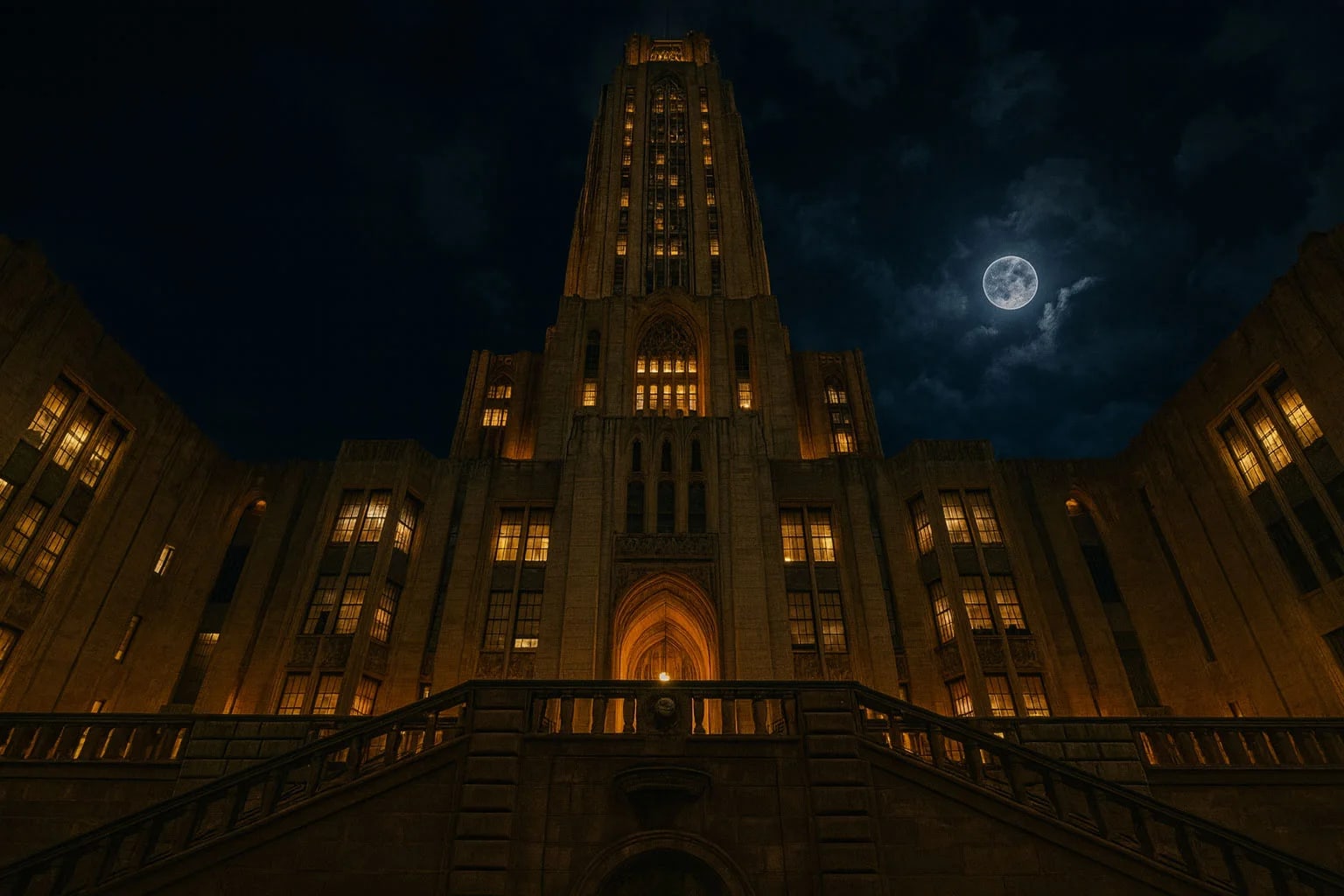
The Cathedral of Learning, Pittsburgh's Gothic tower of knowledge and spirits
