What Was Yellow Fever?
Yellow fever is a viral disease transmitted by the Aedes aegypti mosquito. The virus attacks the liver, and its name comes from the jaundice — the yellowing of the skin and eyes — that appears in severe cases. Symptoms begin with sudden fever, chills, and severe headache, then progress to nausea, muscle pain, and exhaustion. In the worst cases, patients develop what nineteenth-century physicians called black vomit — the vomiting of dark, digested blood — which was almost always a sign that death was imminent.
Mortality rates varied between outbreaks, ranging from roughly 10 percent in milder epidemics to over 50 percent in the most severe. There was no cure, no vaccine, and for most of the disease's reign in New Orleans, no understanding of how it spread. Physicians debated whether yellow fever was caused by "miasma" — poisonous air rising from swamps and rotting matter — or by direct contact with the sick. The actual vector, the mosquito, would not be identified until the very end of the nineteenth century.
Port cities were especially vulnerable. Ships arriving from the Caribbean and Central America carried both infected passengers and the mosquitoes that transmitted the virus. A single infected sailor stepping off a ship could ignite an epidemic that would kill thousands within weeks. For a city like New Orleans, which depended on river and maritime commerce for its economic survival, closing the port was not an option. The city kept its doors open, and the fever kept walking through them.
Why New Orleans Was Uniquely Vulnerable
New Orleans was, in many ways, engineered for catastrophe. The city sits in a subtropical zone with long, hot, humid summers — ideal breeding conditions for Aedes aegypti. It was built on reclaimed swampland between the Mississippi River and Lake Pontchartrain, surrounded by standing water that provided endless mosquito habitat. Open cisterns used for drinking water doubled as mosquito nurseries. Gutters ran with stagnant waste. Drainage was primitive at best.
The Mississippi River brought more than commerce. Ships from Havana, Veracruz, and other Caribbean ports arrived daily carrying cargo, passengers, and disease. Yellow fever was endemic in the Caribbean, meaning the virus circulated year-round in tropical ports. Every ship that docked in New Orleans was a potential delivery system.
Population density compounded the problem. The French Quarter and adjacent neighborhoods packed residents into tight blocks of multi-story buildings with shared courtyards and minimal ventilation. Immigrant communities — particularly Irish and German laborers who arrived in enormous numbers during the mid-nineteenth century — lived in the most crowded and least sanitary conditions. These newcomers had no acquired immunity to yellow fever, having never been exposed to the virus in their home countries. They died at catastrophic rates.
The city's sanitation infrastructure was virtually nonexistent by modern standards. Human waste, animal waste, and garbage accumulated in streets and open ditches. Dead animals were left to rot. The connection between these conditions and disease was suspected but not proven, and political will to address them was undermined by the costs involved and the competing interests of commerce. New Orleans was a city that made enormous amounts of money. Spending that money on sanitation was not a priority.
The Major Epidemics
The 1793 Outbreak
The first major yellow fever epidemic struck New Orleans in 1793, killing hundreds in a city with a population of only a few thousand. The outbreak generated widespread panic — residents who could afford to flee did so, while those who could not barricaded themselves in their homes. Physicians had no effective treatments and little understanding of transmission. Quarantine measures were attempted but poorly enforced. The epidemic established a pattern that would repeat itself for the next century: sudden onset, rapid spread, overwhelmed medical infrastructure, mass death, and eventual retreat as cooler weather killed the mosquito population.
The 1853 Epidemic: The Worst Year
The summer of 1853 brought the deadliest yellow fever epidemic in New Orleans history and one of the worst public health disasters in the United States. Between late May and November, more than 8,000 people died — roughly one out of every fifteen residents. At its peak, the epidemic was killing over 200 people per day.
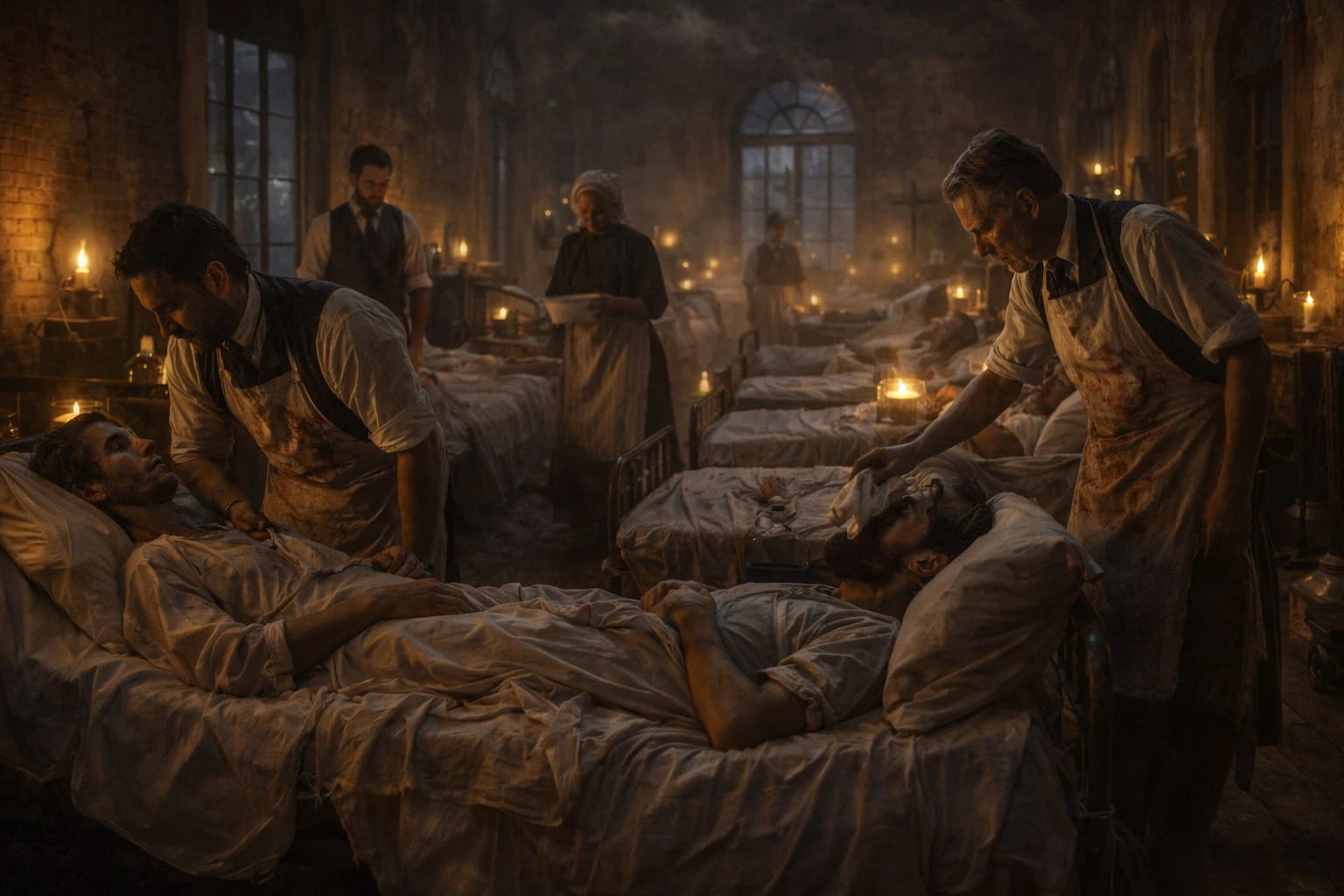
Hospitals were overwhelmed within the first weeks. Charity Hospital, the primary institution serving the poor, ran out of beds, supplies, and staff. Physicians worked until they themselves fell ill. Nurses were recruited from among the recovering, since those who survived yellow fever developed immunity. Entire city blocks fell silent as families were wiped out one by one.
The dead accumulated faster than they could be buried. Coffins were stacked outside the gates of St. Louis Cemetery No. 1 and other cemeteries, waiting for space. The stench of decomposition hung over the city for months. Some bodies were buried in hastily dug trenches without identification. Others were left in homes for days before anyone came to collect them.
The 1853 epidemic was especially devastating to the immigrant population. Irish and German workers, who made up a large portion of the city's labor force, had no immunity and no resources. Entire families of recent immigrants were found dead in their homes. The orphan crisis was staggering — thousands of children lost both parents in a matter of weeks. The city's orphanages overflowed, and many children simply disappeared into the streets.
The 1878 Epidemic
The 1878 epidemic was the last major catastrophic wave of yellow fever to strike New Orleans, though it was devastating on a regional scale. Approximately 4,000 people died in the city, and the disease spread up the Mississippi Valley, killing an additional 16,000 across the South. Memphis, Tennessee, was nearly destroyed — the city lost so many residents that its municipal charter was revoked.
The 1878 epidemic was significant because it finally generated the political momentum for serious scientific investigation. The following decades saw the identification of the mosquito as the disease vector, a discovery that would eventually end the epidemics. But that knowledge came too late for the tens of thousands who had already died.
The Social and Psychological Impact
Yellow fever didn't just kill individuals. It dismantled the social fabric of the city, year after year, for over a century.
Entire families were erased. A husband could be well at breakfast, feverish by noon, and dead by the following morning. His wife might follow within days, and their children shortly after. The speed with which the disease moved through households meant that there was often no time for proper grief, for settling affairs, or for making arrangements for surviving children. Death became routine — not in the sense that it was accepted, but in the sense that it was constant and inescapable.
Businesses shuttered during epidemic months. Wealthier residents fled to the countryside or to northern cities each summer, creating a seasonal exodus that left the poor, the working class, and the enslaved to endure the worst of the disease. This pattern reinforced economic divisions and created a city where survival was, in part, a function of wealth.
The psychological toll is difficult to overstate. Generations of New Orleanians grew up understanding that summer meant death. Parents taught children to recognize the early symptoms. Neighborhoods maintained informal quarantines. The arrival of the first frost each year was greeted with genuine relief, because it meant the mosquitoes — and the fever — would retreat for another season.
This normalization of death left a deep imprint on the city's culture. New Orleans developed an relationship with mortality that is markedly different from the rest of the country. The jazz funeral, the second line, the elaborate tomb — these are not morbid traditions. They are the cultural products of a city that learned, through bitter necessity, to live alongside death rather than pretend it didn't exist.
Mass Burials and the Expansion of the Cities of the Dead
The yellow fever epidemics permanently transformed how New Orleans buries its dead. The city's famous above-ground cemeteries — the "Cities of the Dead" — existed before the epidemics, a practical response to the high water table that made underground burial unreliable. But the epidemics expanded, accelerated, and cemented above-ground burial as the defining feature of New Orleans' funerary landscape.
During major outbreaks, the existing cemeteries could not accommodate the dead. St. Louis Cemetery No. 1, established in 1789, was already reaching capacity before the worst epidemics hit. New cemeteries were opened — St. Louis No. 2 in 1823, St. Louis No. 3 in 1854 — in direct response to the growing demand for burial space.
The above-ground tomb system, which allows a vault to be reused after a year and a day (the intense Louisiana heat essentially cremates remains within the sealed stone), was a practical solution to the problem of limited space. During epidemics, this system was strained to its limits. Tombs were opened and reused as quickly as legally permitted. In some cases, bodies were placed in temporary "receiving vaults" — communal holding spaces where the dead waited for permanent interment.
The urgency of epidemic burial also meant that many of the dead were interred without full religious rites, without proper identification, and without the rituals that Catholic tradition considered essential for the soul's passage. This detail matters in the context of the city's haunted reputation. In the spiritual traditions of both Catholicism and New Orleans Voodoo, an incomplete burial — one without proper prayers, rites, or mourning — is understood to leave the dead in a state of spiritual unrest. Whether one believes in ghosts or not, the cultural framework is clear: tens of thousands of people were buried hastily, incompletely, and without the dignity that tradition demanded.
The Unfinished Narrative: Why Epidemics Fuel Haunted Lore
The connection between yellow fever and New Orleans' haunted reputation is not supernatural — it is psychological and cultural. The epidemics created precisely the conditions that, across virtually every human culture, generate stories of restless spirits.
Sudden, unexpected death. Thousands of people died with no warning and no time to say goodbye. In cultures worldwide, sudden death is associated with spirits that linger — not because of any proven mechanism, but because the living process of grief is interrupted. There is no closure, no final conversation, no peaceful passing.
Mass burial. When the dead are buried anonymously, in haste, without individual recognition, the living carry a collective guilt. The names are forgotten. The graves are unmarked. The dead become, in a sense, unclaimed — and in the folklore of many traditions, unclaimed dead do not rest easily.
Trauma layering. New Orleans did not experience one epidemic. It experienced dozens, over more than a century. Each wave of death was layered on top of the last, in the same neighborhoods, the same buildings, the same streets. The cumulative weight of this repeated trauma, concentrated in a geographically small area where the original buildings still stand, creates an environment that many visitors describe as heavy, charged, or unsettling — even without knowing the specific history.
As we explore in depth in our article on why New Orleans is considered America's most haunted city, yellow fever is arguably the single most important factor in the city's paranormal reputation. Not because the fever victims haunt the French Quarter — that is a claim no one can prove — but because the epidemics created a density of death, a culture of mourning, and a landscape of burial that has no parallel in any other American city.
How Epidemics Concentrated in the French Quarter
The French Quarter was ground zero for yellow fever in New Orleans, and this geographic concentration is directly relevant to the neighborhood's reputation as one of the most haunted areas in the country.
The Quarter's proximity to the docks meant it was the first neighborhood exposed to infected arrivals. Ships from Caribbean ports unloaded cargo and passengers directly into the heart of the French Quarter, and the mosquitoes that carried the virus thrived in the standing water, open cisterns, and dense vegetation of the surrounding area.
Immigrant workers, who were most vulnerable to the disease, lived in the most crowded sections of the Quarter and the adjacent Faubourg Marigny. Multi-family dwellings with shared courtyards, minimal ventilation, and no sanitation created ideal conditions for transmission. Wealthier residents occupied the same neighborhood but could flee during epidemic months. The poor could not.
The result was a neighborhood where death occurred at extraordinary density. Within the roughly thirteen-by-six-block footprint of the French Quarter, thousands of people died of yellow fever over the course of a century. Many of those deaths occurred in buildings that still stand today — the same buildings that now house restaurants, hotels, bars, and shops. The LaLaurie Mansion, Muriel's Restaurant, Lafitte's Blacksmith Shop — these locations are famous for their individual ghost stories, but they exist within a broader context of neighborhood-wide death that the yellow fever epidemics created.
Why Yellow Fever Is Often Overlooked in Ghost Narratives
Most ghost tours in New Orleans focus on murders, voodoo, and colorful villains. The LaLaurie Mansion, the Sultan's Palace, Marie Laveau — these stories are dramatic, personal, and easy to narrate. They make for compelling entertainment.
Yellow fever, by contrast, is impersonal. There is no villain to blame, no dramatic confrontation, no single moment of horror. The disease killed slowly and anonymously, family by family, block by block, over the course of months and years. It is not theatrical. It does not lend itself to campfire storytelling.
But yellow fever killed far more people than all of New Orleans' famous murders combined. The 1853 epidemic alone killed more people than the entire death toll of the LaLaurie affair, the Axeman murders, and every other famous New Orleans crime put together, multiplied several times over. If hauntings are related to the concentration of death and suffering in a specific place — and that is the operating premise of most ghost tour companies — then yellow fever should be the central narrative of haunted New Orleans, not a footnote.
At Ghost City Tours, we believe that the most compelling stories are the ones grounded in documented history. The yellow fever epidemics represent the single largest source of death in New Orleans' history, and understanding them is essential to understanding why the city feels the way it does.
The Decline of Yellow Fever
The end of yellow fever in New Orleans came not through prayer or quarantine but through science. In 1881, Cuban physician Carlos Finlay proposed that mosquitoes transmitted the disease — a theory that was ridiculed for nearly two decades before being confirmed by U.S. Army physician Walter Reed in 1900. Reed's research, conducted during the American occupation of Cuba, proved definitively that Aedes aegypti was the vector.
The implications were immediate. If mosquitoes transmitted the disease, then eliminating mosquito breeding grounds could prevent epidemics. New Orleans undertook massive public works projects to drain standing water, improve sewage systems, and screen cisterns. The city's elaborate drainage system, much of which is still in use today, was built in direct response to the mosquito discovery.
The last significant yellow fever outbreak in New Orleans occurred in 1905, killing approximately 450 people — a fraction of earlier epidemics, but still a reminder of the disease's power. After 1905, improved sanitation, mosquito control, and eventually the development of a vaccine in the 1930s brought yellow fever under control in the United States.
The epidemics were over. But their legacy — in the cemeteries, in the architecture, in the stories, and in the cultural relationship with death that defines New Orleans — endures.
Lasting Cultural Impact on Haunted Lore
The yellow fever epidemics did not create ghosts. What they created was a city uniquely saturated with death — a place where dying was not an abstract concept but a seasonal certainty, where cemeteries were built above ground and maintained as communal gathering places, and where the cultural traditions surrounding death became central to civic identity.
This saturation of death, concentrated in a small geographic area over more than a century, produced an urban environment unlike any other in America. Generational storytelling kept the memory of the epidemics alive long after the last case was treated. Neighborhoods retained informal oral histories of which houses had been death houses, which blocks had been hardest hit, which families had been erased entirely. This neighborhood memory, passed from generation to generation, became part of the fabric of New Orleans identity.
The cemeteries themselves became landmarks — not just places of burial but architectural attractions, spiritual sites, and tourist destinations. The centrality of death in New Orleans' physical landscape reinforced the centrality of death in its cultural life. You cannot walk through the French Quarter without passing a building where someone died of yellow fever. You cannot visit St. Louis Cemetery without standing among the remains of epidemic victims. Death is not hidden in New Orleans. It is visible, present, and woven into every block.
Whether this history produces actual paranormal phenomena is a question that science has not answered. What it has produced, without question, is a city where the past presses against the present with unusual weight — where the accumulated trauma of centuries is not buried but displayed openly, in stone and story, for anyone willing to look.
Frequently Asked Questions About Yellow Fever in New Orleans
How many people died from yellow fever in New Orleans?
An estimated 41,000 people died of yellow fever in New Orleans during the nineteenth century. This figure represents documented deaths and the actual toll may have been higher, as many deaths among enslaved people, immigrants, and the poor went unrecorded.
When was the worst yellow fever outbreak in New Orleans?
The 1853 epidemic was the deadliest, killing more than 8,000 people in a single summer — roughly one in fifteen residents. At its peak, over 200 people were dying per day. It remains one of the worst public health disasters in American history.
Did yellow fever cause most of New Orleans' ghost stories?
Yellow fever is not the direct subject of most ghost stories, which tend to focus on murders, individual tragedies, and famous figures. However, the epidemics created the underlying conditions — the extraordinary density of death, the hasty burials, the trauma layering — that make New Orleans' haunted reputation credible. The epidemics are the foundation on which the city's entire paranormal narrative rests.
Why are bodies buried above ground in New Orleans?
New Orleans' high water table makes underground burial impractical — coffins buried below ground frequently resurfaced during floods and heavy rains. Above-ground tombs, built of brick and stone, keep remains safely contained. The sealed tombs also function as natural crematoriums in the Louisiana heat, allowing vaults to be reused after a legally mandated waiting period.
Did doctors understand yellow fever at the time?
No. For most of the epidemic era, physicians believed yellow fever was caused by "miasma" — bad air from swamps and decaying matter. The actual cause — transmission by the Aedes aegypti mosquito — was not confirmed until 1900. This lack of understanding meant that prevention efforts were largely ineffective, and the disease returned year after year.
When did yellow fever stop in New Orleans?
The last significant outbreak occurred in 1905. The identification of the mosquito as the disease vector in 1900 led to aggressive public health measures including drainage projects, mosquito control, and sanitation improvements. A vaccine was developed in the 1930s, effectively ending the threat in the United States.