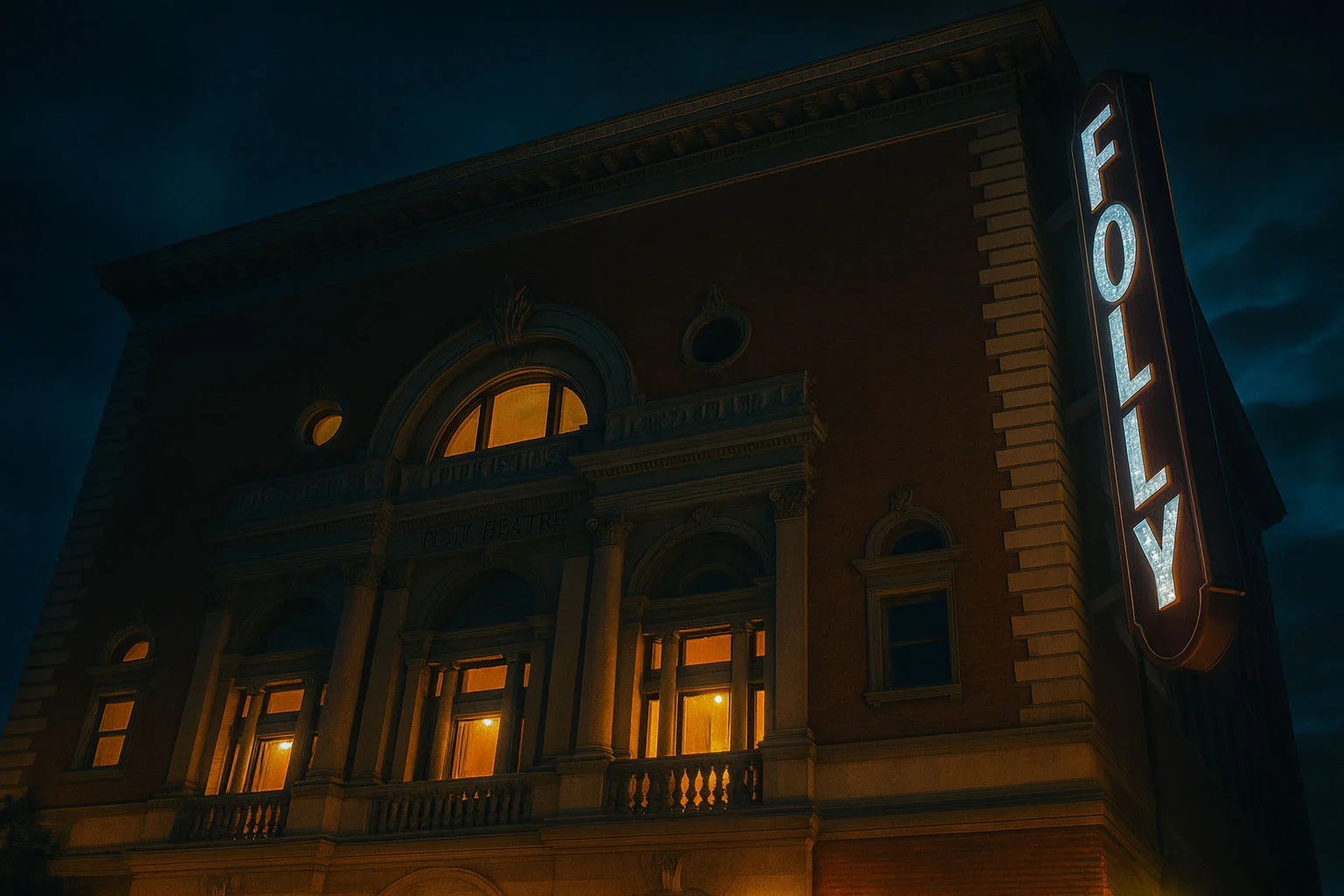
In the heart of downtown Kansas City, on 12th Street between Wyandotte and Central, stands a survivor. The Folly Theatre has weathered over 120 years of Kansas City history - boom times and busts, wars and peace, the rise and fall of vaudeville, the coming of motion pictures, urban decay and renewal. Through it all, the Folly has endured, the oldest surviving theater in the Midwest still in operation.
But the Folly Theatre is more than a survivor. It is, according to those who know it best, profoundly haunted.
The spirits that call the Folly home are as varied as the performers who have graced its stage over the century. There's the spectral stagehand, still working his post long after death. There's the mysterious lady in blue, an elegant apparition who watches from the balcony. There are phantom performers glimpsed on the empty stage, ghostly audiences heard applauding in the darkness, and countless unexplained phenomena that have made the Folly Theatre legendary among paranormal enthusiasts.
Theaters have always been associated with hauntings. The intensity of performance, the powerful emotions generated night after night, the dreams fulfilled and shattered upon their stages - all of this creates an atmosphere ripe for supernatural activity. The Folly, with its 120-plus years of continuous theatrical history, has accumulated layer upon layer of emotional residue, creating a haunting that is both rich and complex.
The Folly Theatre invites you to experience the magic of live performance. But be warned - the show at the Folly never truly ends. Even when the lights go down and the audience goes home, the theater's eternal performers continue their work, staging shows for audiences that only they can see.
The History of the Folly Theatre
The Folly Theatre's history is a microcosm of American entertainment history - from vaudeville to burlesque to cinema to live performance. Understanding this rich past helps explain the diverse spirits that seem to inhabit the theater.
The Birth of the Standard Theatre
The theater that would become the Folly opened on September 23, 1900, as the Standard Theatre. It was built by Edward Butler, a theater impresario who saw opportunity in Kansas City's growing entertainment district.
The Standard Theatre was designed as a vaudeville house, part of the national network of theaters that brought variety entertainment to American audiences in the pre-film era. The theater featured a main floor and balcony, ornate decorations in the style of the era, and all the mechanical apparatus needed to support the elaborate productions that vaudeville required.
Opening night was a sensation. Kansas City audiences packed the new theater to see a lineup of vaudeville acts - singers, dancers, comedians, acrobats, animal acts, and novelty performers. The Standard Theatre was an immediate success, establishing itself as one of Kansas City's premier entertainment venues.
In its early years, the Standard hosted some of the biggest names in vaudeville. Performers who later became household names played the Standard's stage on their way up the ladder of success. The theater was a proving ground, a stop on the circuit where careers were made or broken.
The Folly Era
In 1902, the Standard Theatre changed hands and was renamed the Folly Theatre. Under new management, the theater's programming shifted toward burlesque - a more risqué form of entertainment that combined comedy, music, and provocative performances.
The Folly Theatre became famous - some would say infamous - for its burlesque shows. Kansas City's red-light district surrounded the theater, and the Folly catered to audiences looking for adult entertainment. Famous burlesque performers played the Folly's stage, and the theater developed a reputation as one of the premier burlesque venues in the Midwest.
This was not the sanitized burlesque of later eras. Early burlesque was rough, rowdy, and sometimes dangerous. The audiences were predominantly male, often drunk, and occasionally violent. The performers led hard lives, traveling the circuit, performing multiple shows a day, dealing with difficult audiences and exploitative management.
Behind the glamour and scandal, tragedy accumulated. Performers died young from the rigors of their profession. Accidents occurred during performances. At least one performer is said to have taken her own life in the theater after a professional disappointment. These tragedies would leave their mark on the building, contributing to its haunted reputation.
The Workers Who Built the Magic
While performers received the glory, the Folly Theatre functioned only because of the army of workers who labored behind the scenes. Stagehands, electricians, carpenters, seamstresses, prop masters, box office staff, ushers, and countless others kept the theater running.
These workers often spent more time in the theater than the performers themselves. They developed deep connections to the building, knowing every backstage corridor, every hidden space, every quirk and idiosyncrasy of the old theater. For many, the Folly was their life's work.
The most famous ghost of the Folly Theatre is believed to be one of these workers - a stagehand who died in the theater and who continues his duties from beyond the grave. His dedication in life apparently continues in death, as he refuses to abandon his post even after his physical body failed.
Working conditions in early theaters were dangerous. Heavy scenery, complex machinery, inadequate lighting, long hours, and the constant pressure of show schedules led to accidents. Falls, crushing injuries, electrical shocks, and fires claimed the lives of theater workers across the country. The Folly was no exception.
Decline and Resurrection
The Folly Theatre faced multiple threats over its long history. The rise of motion pictures, changing entertainment tastes, economic downturns, and urban decay all threatened to close the theater permanently.
By the 1970s, the Folly was in dire straits. The neighborhood had declined, the building was deteriorating, and the future looked bleak. Demolition seemed likely - the fate of countless historic theaters across America during this era.
But Kansas City rallied to save the Folly. A preservation campaign raised money for restoration, and the theater was added to the National Register of Historic Places in 1980. Extensive restoration work brought the Folly back to its original grandeur, revealing the beauty that decades of neglect had hidden.
The restored Folly Theatre reopened as a performing arts venue, hosting concerts, comedy shows, and special events. It found new life as a treasured cultural institution, the last survivor of Kansas City's once-thriving theater district.
And with the restoration came increased paranormal activity. Workers and visitors reported that the spirits of the Folly seemed energized by the attention being paid to their theater. Sightings increased, phenomena intensified, and the Folly's reputation as a haunted theater grew alongside its reputation as a restored gem.
The Ghosts of the Folly Theatre
The Folly Theatre is home to numerous spirits, ranging from dedicated workers to performers to audience members from across the theater's long history. The paranormal activity is extensive and well-documented.
Eddie: The Spectral Stagehand
The most famous ghost of the Folly Theatre is Eddie, a stagehand who is said to have died in the theater sometime in the early twentieth century. Eddie's spirit remains at his post, still working to ensure the shows go on.
Eddie is usually encountered in the backstage areas, particularly in the fly gallery and the areas around the stage rigging. Staff members report feeling his presence, sensing that someone is watching them work, and occasionally catching glimpses of a figure in old-fashioned work clothes moving through the shadows.
Eddie seems to be a protective spirit. Strange things happen that seem designed to prevent accidents - tools are moved away from dangerous positions, lights turn on to illuminate hazardous areas, and workers report being physically guided away from danger by unseen hands. Staff members have come to see Eddie as a guardian of the theater, looking out for his living colleagues.
But Eddie can also be mischievous. Equipment moves on its own, pranks are played on crew members, and unexplained sounds echo through the backstage areas. Eddie seems to have a sense of humor about his eternal work, occasionally making his presence known in playful ways.
The identity of Eddie is uncertain. The name has been associated with the ghost for decades, but no definitive historical record has identified which worker might be the source of the haunting. Some researchers believe Eddie might be a composite of multiple workers who died in the theater, their spirits merging into a single identity.
The Lady in Blue
A female apparition, commonly called the Lady in Blue, has been seen in the Folly Theatre's balcony and upper areas. She appears as an elegant woman in a blue dress, her style suggesting the early twentieth century.
The Lady in Blue is most often seen sitting in the balcony, watching the stage as if waiting for a performance to begin. She appears solid and real, and ushers have occasionally approached her to offer assistance before realizing she isn't a living patron. She vanishes when approached too closely or when the observer looks away for a moment.
Some witnesses have seen the Lady in Blue standing at the balcony rail, looking down at the stage with an expression of longing or sadness. Others have encountered her in the upper hallways of the theater, walking with purpose as if on her way to her usual seat.
Who the Lady in Blue might be is the subject of much speculation. Some believe she was a performer who achieved her greatest successes at the Folly and cannot let go of those memories. Others suggest she might be a patron who loved the theater and chose to spend eternity there. Still others believe she might be connected to one of the tragedies that occurred in the theater's history.
The Lady in Blue seems benign, if melancholy. Her presence adds a touch of elegance to the haunting, a reminder that the Folly Theatre has been a place of beauty and culture as well as tragedy.
The Phantom Performers
The stage of the Folly Theatre is haunted by what appear to be spirits of former performers, still going through their routines long after their final curtain calls.
Witnesses have reported seeing figures on the empty stage - dancers moving through choreographed steps, singers at the microphone, comedians gesturing to invisible audiences. These phantom performers appear absorbed in their work, never acknowledging living observers.
Phantom music is sometimes heard accompanying these apparitions - the sounds of a vaudeville orchestra, ragtime piano, or burlesque band. The music has a distant, tinny quality, as if heard through time itself.
Some witnesses have reported more interactive experiences with the phantom performers. Applause has been heard following what seemed to be a ghostly performance. Voices have called out for encores. The response of a phantom audience suggests that entire shows may be playing out in some parallel dimension, visible only in glimpses to those in the present.
The identity of these performers is unknown. The Folly hosted thousands of acts over its history, and many performers developed deep connections to the theater. Some may have died during their careers; others may simply be unable to let go of the stage that defined their lives.
Other Paranormal Activity
Beyond the specific spirits, the Folly Theatre experiences a range of paranormal phenomena:
The Ghost Light: Theaters traditionally keep a single light burning on stage when the theater is dark, called the ghost light. At the Folly, this light has been found turned off when it should be on, and turned on when it was definitely left off. Some believe the spirits control this light according to their own schedule.
Temperature Changes: Cold spots are common throughout the theater, particularly in the balcony and backstage areas. These cold spots move and change, sometimes following observers through the building.
Unexplained Sounds: Footsteps, voices, music, applause, and other sounds are frequently heard when the theater is empty. These sounds often come from the stage area, the balcony, or the backstage spaces.
Equipment Behavior: Sound and lighting equipment behave erratically, sometimes turning on by itself or creating effects that weren't programmed. Some staff believe this is Eddie's work; others attribute it to the general supernatural energy of the building.
Physical Touches: People throughout the theater report being touched by invisible hands - taps on the shoulder, brushes against the arm, gentle pushes. These touches are usually gentle rather than frightening.
Seat Movement: In the auditorium, theater seats have been observed moving on their own, as if invisible patrons are taking their places for a show. The characteristic creaking of old theater seats is often heard when no one is visible.
Paranormal Investigations
The Folly Theatre has been investigated by numerous paranormal research groups and has been featured on paranormal television programs. The theater's management has generally been welcoming to serious investigators, recognizing that the haunted reputation is part of the building's character.
Investigations have consistently produced compelling evidence:
EVP Recordings: Investigators have captured voice phenomena throughout the theater, including what sounds like performers rehearsing, stagehands calling out cues, and audience members talking among themselves.
Photographic Evidence: Photographs taken in the theater show anomalies including orbs, mists, and occasionally what appear to be partial figures. The balcony and backstage areas are particularly productive for photographic evidence.
Video Evidence: Motion-activated cameras have captured unexplained movements, including what appears to be a figure walking across the stage and shadows moving in areas where no one should be.
EMF Readings: Electromagnetic field readings are elevated in several areas of the theater, particularly in the fly gallery and certain sections of the balcony. These elevated readings persist even when electrical systems are shut down.
Personal Experiences: Investigators consistently report personal experiences during their time in the theater - feelings of being watched, sensing presences, hearing unexplained sounds, and occasionally seeing apparitions.
The consistency of these findings across multiple investigations has established the Folly Theatre as one of Kansas City's most credibly haunted locations.
Experiencing the Folly Theatre Today
The Folly Theatre continues to operate as a performing arts venue, hosting concerts, comedy shows, classic films, and special events throughout the year. Attending a performance at the Folly offers the opportunity to experience the theater's beauty and possibly its ghosts.
For those specifically interested in the paranormal, the Folly occasionally hosts ghost-themed events, including Halloween programs and paranormal investigation nights. Check with the theater for current offerings.
When attending the Folly, take time to appreciate its historic character - the ornate decorations, the intimate auditorium, the sense of history that permeates the space. Consider the thousands of performances that have taken place on its stage, the millions of audience members who have passed through its doors. And remain alert for signs of those who never left.
The Folly Theatre is located at 300 West 12th Street in downtown Kansas City, Missouri. Parking is available nearby, and the theater is accessible by public transportation.
Whether you come for the music, the history, or the ghosts, the Folly Theatre offers an experience unlike any other in Kansas City. It is a survivor, a treasure, and a portal to another time - a place where the show, in some form, has been going on for over 120 years and shows no signs of stopping.