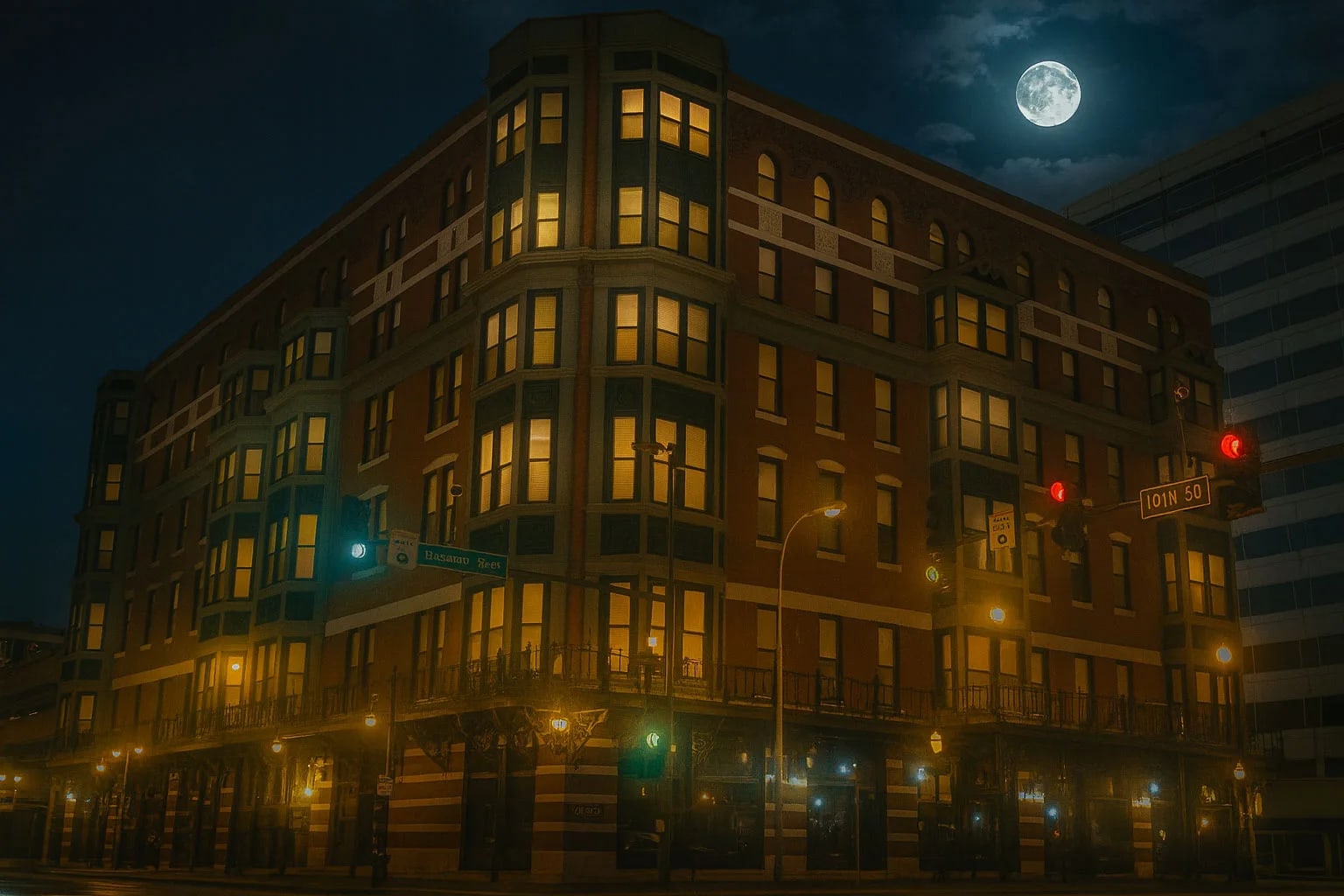
In the heart of downtown Kansas City, where Broadway meets 10th Street, once stood one of the most magnificent hotels west of the Mississippi - the Coates Hotel. For over a century, this grand establishment played host to presidents, captains of industry, celebrities, and countless ordinary travelers seeking the finest accommodations Kansas City had to offer.
But the Coates Hotel was more than just a luxury hotel. It was a witness to history, a repository of countless human dramas, and ultimately, a collector of souls. Within its walls, people celebrated their greatest triumphs and suffered their darkest moments. Some guests who entered the Coates never left - at least, not in the conventional sense.
The building that housed the original Coates Hotel no longer stands, having been demolished in 1978 after years of decline. But those who knew the hotel, who worked there or stayed there in its final decades, carried stories of strange occurrences - phantom guests in period clothing, unexplained sounds, cold spots that moved through hallways, and an overwhelming sense that the hotel's history had left an indelible mark on the space itself.
Even today, visitors to the site report unusual experiences. The land seems to hold onto the memories of what once stood there, as if the hotel's century-plus of accumulated history cannot be so easily erased. The spirits of the Coates Hotel, it seems, have nowhere else to go.
This is the story of one of Kansas City's most storied hotels and the ghosts that refuse to let it be forgotten.
The History of the Coates Hotel
The Coates Hotel's history spans more than a century, from the chaos of the Civil War era to the urban renewal of the 1970s. Understanding this rich and often turbulent history helps explain why the hotel accumulated so many restless spirits.
Colonel Kersey Coates and Kansas City's Early Days
The story of the Coates Hotel begins with Colonel Kersey Coates, one of Kansas City's founding fathers and most influential citizens. Born in Pennsylvania in 1823, Coates arrived in Kansas City in 1857 and quickly recognized the young town's potential as a gateway to the West.
Coates was a man of vision and ambition. He invested heavily in Kansas City real estate, helped establish the city's first railroad connections, and worked tirelessly to promote Kansas City as a commercial center. During the Civil War, Coates was a committed Unionist, and his efforts helped keep Kansas City aligned with the North despite the city's location on the border of slave and free states.
After the war, Coates turned his attention to building a grand hotel that would put Kansas City on the map. At the time, Kansas City was a rough frontier town, known more for its stockyards and its lawlessness than for civilization and culture. Coates envisioned a hotel that would rival the finest establishments in Eastern cities, a symbol of Kansas City's ambitions and potential.
The First Coates Hotel
The first Coates House Hotel opened in 1868 at the corner of Broadway and 10th Street. It was, by frontier standards, a marvel of luxury. The four-story brick building featured modern amenities like indoor plumbing and gas lighting, luxuries that many Kansas Citians had never experienced.
The hotel quickly became the center of Kansas City's social and political life. Visiting dignitaries stayed at the Coates. Business deals were struck in its lobby. Political meetings and society events filled its ballrooms. For Kansas City's elite, the Coates Hotel was the place to see and be seen.
But the first Coates Hotel was not destined to last. On January 28, 1873, fire broke out in the building. Despite efforts to contain it, the flames spread rapidly through the wooden interior. The hotel was destroyed, though remarkably, no lives were lost in the blaze.
Colonel Coates, undeterred, immediately began planning an even grander replacement.
The Grand Coates Hotel
The second Coates Hotel, completed in 1874, was larger and more magnificent than its predecessor. The new building featured six stories of elegant rooms, elaborate public spaces, and all the modern conveniences of the era. It was designed to be fireproof, with iron and brick construction replacing the wood that had doomed the first hotel.
This second Coates Hotel would become one of the most famous hotels in the American West. Presidents Grover Cleveland, William McKinley, and Theodore Roosevelt all stayed at the Coates during their visits to Kansas City. Cattle barons, railroad tycoons, and mining magnates made the hotel their Kansas City headquarters. The hotel's restaurant and bar became legendary, and its ballroom hosted the most important social events in the city.
The hotel also played a role in some of the darker chapters of Kansas City history. During the turbulent years of the late nineteenth century, when Kansas City was known as one of the most corrupt and violent cities in America, the Coates Hotel witnessed its share of scandal and tragedy. Political bosses met in its private rooms to carve up the city. Gamblers and confidence men worked the lobby. And more than a few guests met untimely ends within its walls.
Deaths and Tragedies at the Coates
Like most grand hotels of its era, the Coates accumulated a grim tally of deaths over its long history. Some were natural - elderly guests who passed away in their sleep, travelers who succumbed to illness far from home. Others were violent - suicides driven by despair, murders committed in fits of passion or cold calculation.
One of the most famous tragedies occurred in 1880 when a prominent businessman was found dead in his room under mysterious circumstances. Though officially ruled a suicide, rumors persisted that he had been murdered by business rivals. His ghost, some say, never left the hotel.
In 1891, a young woman threw herself from an upper-floor window after receiving word that her fiancé had been killed in an accident. Witnesses reported seeing her apparition at the window for years afterward, a pale figure looking out over the city she could no longer be part of.
The hotel also saw its share of violence during Kansas City's notoriously lawless era. Gunfights occasionally erupted in the lobby or bar. At least one guest was shot dead in his room by an unknown assailant who was never caught. The killer walked out through the crowded lobby and disappeared into the city, leaving behind a mystery that was never solved.
These deaths, and countless others less documented, left their mark on the hotel. Staff members began reporting strange occurrences - sounds in empty rooms, figures glimpsed in hallways, the feeling of being watched. The Coates Hotel, some whispered, was becoming haunted.
Decline and Demolition
The twentieth century was not kind to the Coates Hotel. As Kansas City grew and changed, the hotel's location became less fashionable. Newer hotels with more modern amenities drew away the elite clientele. The Coates, once the finest address in Kansas City, began a long, slow decline.
By mid-century, the grand hotel had become a shadow of its former self. The elegant furnishings were worn and dated. The once-prestigious address now attracted a more transient clientele. The building itself, despite its fireproof construction, was showing its age, requiring constant maintenance that the diminishing revenues could barely support.
In its final years, the Coates Hotel was a melancholy place, a reminder of glories past. Staff members from this era would later recount the strange experiences that seemed to increase as the building declined - as if the spirits of the hotel's past were becoming more active as the end approached.
The Coates Hotel closed its doors for the final time in 1978. Despite protests from preservationists who recognized its historical significance, the building was demolished shortly thereafter. The site was cleared, leaving nothing but memories - and, some say, the spirits who had called the hotel home.
The Ghosts of the Coates Hotel
Throughout its long history, the Coates Hotel accumulated numerous reports of paranormal activity. Staff members, guests, and visitors reported experiences that ranged from the subtle to the terrifying. Even after the building's demolition, strange occurrences continue to be reported at the site.
The Woman in the Window
The most famous ghost of the Coates Hotel was the woman who threw herself from an upper floor in 1891. Her spirit was seen countless times over the following decades, always at the same window, always looking out over the city with an expression of profound sadness.
Witnesses described her as a young woman in late Victorian dress, her appearance matching the era in which she died. She seemed unaware of those who observed her, lost in her own grief. Some witnesses reported seeing her standing at the window, while others claimed to have seen her fall - a terrifying replay of her final moments.
Staff members learned to avoid looking at that particular window, especially at night. Guests assigned to nearby rooms sometimes requested to be moved after experiencing an overwhelming sense of sadness they couldn't explain.
Even after the hotel was demolished, some visitors to the site report feeling a profound melancholy, particularly when looking up at where the window would have been. A few have claimed to see a misty figure in the air, as if the woman's spirit continues her eternal vigil even without walls to contain her.
The Murdered Businessman
The mysterious death of a prominent businessman in 1880 spawned one of the hotel's most persistent hauntings. Whether he died by his own hand or was murdered, his spirit seemed unable to rest.
Guests staying in the room where he died reported disturbing experiences - the sound of pacing footsteps, the feeling of being watched, objects moving on their own. Some reported seeing a man in period business attire standing by the window or sitting at the desk, only to have the figure vanish when they looked directly at it.
The ghost seemed particularly active late at night. Guests reported being awakened by sounds of distress - gasps, moans, and what sounded like a struggle. When they turned on the lights, the room was empty, but the atmosphere was charged with tension and fear.
Staff members assigned to clean that room often reported equipment malfunctions, items disappearing and reappearing, and an overwhelming sense of dread that made them hurry through their work.
The Phantom Guests
Throughout the hotel, staff and guests reported encounters with figures in period dress who seemed to be guests from the hotel's past. These phantom guests appeared solid and real at first glance, only revealing their supernatural nature through their clothing, their behavior, or their tendency to vanish.
A particularly common sighting was a distinguished gentleman in late 19th-century formal wear who was seen in the lobby and public areas. He carried himself with the bearing of someone important and was often observed as if conducting business or waiting for an appointment. When approached, he would simply fade away or walk through a wall.
Other phantom guests were seen in hallways, apparently going to or from their rooms. Staff members sometimes received requests from these figures - requests for towels, for room service, for assistance - only to have the guest vanish before the request could be fulfilled. Checking the room in question would reveal it empty or occupied by someone else entirely.
These phantom guests seemed to be going through the routines of their stays, unaware that decades or even a century had passed. They existed in their own time, occasionally intersecting with the present in moments of confusion and wonder.
The Violent Spirits
Not all the ghosts of the Coates Hotel were passive or benign. Some seemed to carry the violence of their deaths into the afterlife.
In areas of the hotel where violent incidents had occurred, staff and guests reported aggressive paranormal activity. Objects were thrown, doors were slammed, and some witnesses reported being pushed or struck by unseen forces. These incidents were particularly common in and around the bar, where more than one fatal altercation had taken place over the years.
One staff member reported being shoved from behind while walking through a corridor, hard enough to send her stumbling. When she turned, no one was there, but she felt an intense hostility radiating from the empty space. She refused to work in that area alone afterward.
Guests occasionally reported waking to find pressure on their chests, as if someone were pressing down on them. Others felt hands around their throats or experienced sudden sharp pains with no physical cause. These violent encounters were rare but terrifying, leaving witnesses shaken and eager to leave.
Residual Hauntings and Sounds
Beyond the specific spirits, the Coates Hotel was filled with residual paranormal activity - echoes of the past that replayed without apparent consciousness or purpose.
The sounds of the hotel's heyday could often be heard in its declining years. Staff members working alone late at night reported hearing the sounds of a bustling hotel - conversations, footsteps, music, the clinking of glasses - even when the building was nearly empty. These sounds seemed to come from everywhere and nowhere, impossible to locate.
In the ballroom, phantom music was heard on numerous occasions - the sounds of orchestras and dance bands from decades past. Some witnesses reported glimpsing figures dancing across the empty floor, couples in formal attire moving through steps that had been out of fashion for generations.
The smell of cigar smoke was often reported in areas where smoking had been prohibited for years. The scent of perfume from another era would waft through corridors. These sensory experiences suggested that the hotel had absorbed impressions from its long history, playing them back at random moments.
The Haunting Continues
Though the Coates Hotel was demolished over four decades ago, paranormal activity continues to be reported at the site. Visitors to the area where the hotel once stood report strange sensations - feelings of being watched, sudden temperature drops, and an indefinable sense that something important happened here.
Some visitors have reported seeing figures that seem out of place - people in period clothing who vanish when approached. Others have captured anomalies in photographs - orbs, mists, and what appear to be partial figures where no one should be.
Paranormal researchers who have studied the site suggest that particularly intense hauntings can persist even after the physical structure is gone. The land itself, they theorize, can hold onto emotional imprints, replaying them for sensitive individuals who pass through.
The ghosts of the Coates Hotel, it seems, have found their eternal home. Whether the building stands or not, they remain, echoes of Kansas City's past that refuse to fade.
Visiting the Coates Hotel Site Today
The original Coates Hotel building no longer stands. It was demolished in 1978, and the site has since been developed. However, the general area where the hotel stood remains part of downtown Kansas City's historic core.
Visitors interested in the Coates Hotel's history can explore the surrounding area, which retains much of its historic character. The neighborhood where the hotel stood saw some of Kansas City's most dramatic history, from the lawless frontier days through the political machine era.
Those seeking paranormal experiences may find that the site still carries echoes of its past. Visiting at night, when downtown is quieter, may increase the chances of experiencing something unusual. Some investigators recommend taking photographs and recording audio, as anomalies have been captured even at the site of demolished buildings.
The history of the Coates Hotel can also be explored at the Kansas City Public Library and the Missouri Valley Special Collections, which hold photographs, newspaper accounts, and other materials related to the hotel and its colorful past.
While the grand hotel itself is gone, its story - and perhaps its spirits - remain part of Kansas City's heritage. The Coates Hotel may have been demolished, but it has never truly disappeared.