The Story Most People Don't Hear
Gettysburg is one of the most visited historic sites in America. Millions of people walk the battlefield every year. They read the plaques. They photograph the monuments. They listen to park rangers explain troop movements with laser pointers and laminated maps. And then they go home believing they understand what happened here.
Most of them do not.
The version of Gettysburg that survives in textbooks, documentaries, and guided bus tours is a version that has been carefully constructed over more than 160 years — a version that emphasizes strategy, courage, sacrifice, and the pivotal importance of the battle to the outcome of the Civil War. All of that is true. But it is the frame, not the painting.
The painting is chaos. The painting is nineteen-year-old boys screaming for their mothers while they bled to death in a wheat field. The painting is a stray bullet passing through two doors and killing a twenty-year-old woman who was baking bread. The painting is the smell — the ungodly, inescapable smell of tens of thousands of dead and dying men decomposing in the July sun while the townspeople of Gettysburg tried to go on living.
What really happened at Gettysburg was not heroic in the way that word is usually meant. It was brutal, confused, and profoundly human — which is to say, profoundly messy, painful, and unresolved. And it is that unresolved quality — the sheer volume of suffering that was never processed, never mourned properly, never given closure — that has left its mark on this place in ways that visitors continue to feel today.
For a deeper exploration of why Gettysburg is so haunted, start there. This article is about what happened — the real, dark history that fuels those hauntings.
Before the Battle — A Town About to Break
In late June 1863, Gettysburg was a quiet crossroads town of approximately 2,400 people in rural Pennsylvania. It had a college, a seminary, a dozen churches, and the unremarkable rhythm of a farming community that lived by the seasons. Its residents were shoemakers, merchants, farmers, students, and families who had no reason to believe their town was about to become the site of the largest battle ever fought on American soil.
But the armies were coming.
Confederate forces under General Robert E. Lee had crossed into Pennsylvania — a bold, risky invasion of Northern territory designed to force a decisive engagement and break the Union's will to continue the war. The Army of the Potomac, under the newly appointed General George Meade, was moving to intercept. Neither commander had chosen Gettysburg. Neither intended to fight there. The battle happened because the roads converged on this town, and the armies converged on the roads.
In the days before the fighting began, the people of Gettysburg watched the approach of war with a mixture of dread and disbelief. Confederate soldiers moved through the area, requisitioning supplies — which meant taking whatever they wanted. Livestock disappeared. Stores were emptied. The African American residents of the town, terrified of being captured and sold into slavery, fled north. The remaining civilians boarded windows, stockpiled food, and waited.
Nothing they did prepared them for what was about to happen.
Day 1 — Confusion, Panic, and Sudden Death
The Battle of Gettysburg began on the morning of July 1, 1863, almost by accident. Confederate infantry advancing toward town encountered Union cavalry on the Chambersburg Pike, and what started as a skirmish escalated with terrifying speed as both sides rushed reinforcements to the field.
The first day of fighting was defined by confusion. Units arrived piecemeal, fed into the battle before they understood the terrain or the disposition of the enemy. Officers were killed before they could issue orders. Soldiers found themselves fighting in orchards, fields, and streets they had never seen before, against an enemy they could barely see through the smoke.
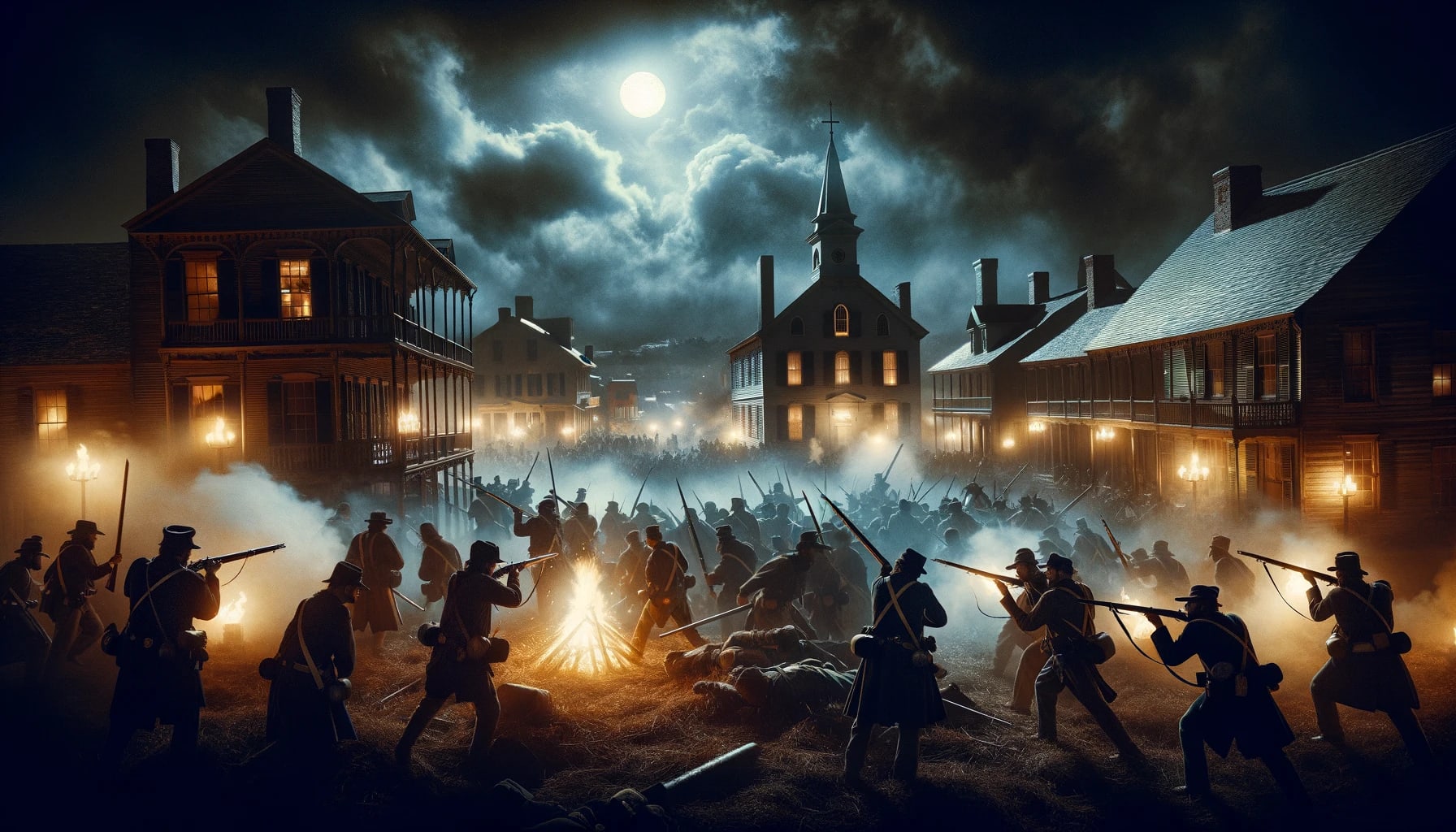
By the afternoon, Union forces had been driven back through the town of Gettysburg itself. The retreat was not orderly. It was a panicked rout through streets choked with soldiers, horses, wagons, and civilians who had no idea which way was safe. Men were shot in backyards, in alleys, between buildings. Residents hid in cellars and listened to the fighting rage above them — the crack of rifles, the screams of wounded men, the crash of artillery hitting brick and wood.
More than 9,000 soldiers became casualties on the first day alone. By nightfall, the dead lay in the streets of the town. Wounded soldiers crawled into doorways, collapsed in gardens, dragged themselves toward any structure that might offer shelter. The residents of Gettysburg emerged from their cellars to find their community transformed into a battlefield — and the battle had only just begun.
Day 2 — The Violence Intensifies
The second day of fighting, July 2, was worse.
With both armies now fully deployed — approximately 165,000 men facing each other across ridges and valleys south of town — the battle became a coordinated slaughter. Confederate forces launched a series of assaults against the Union left flank that produced some of the most vicious fighting of the entire Civil War.
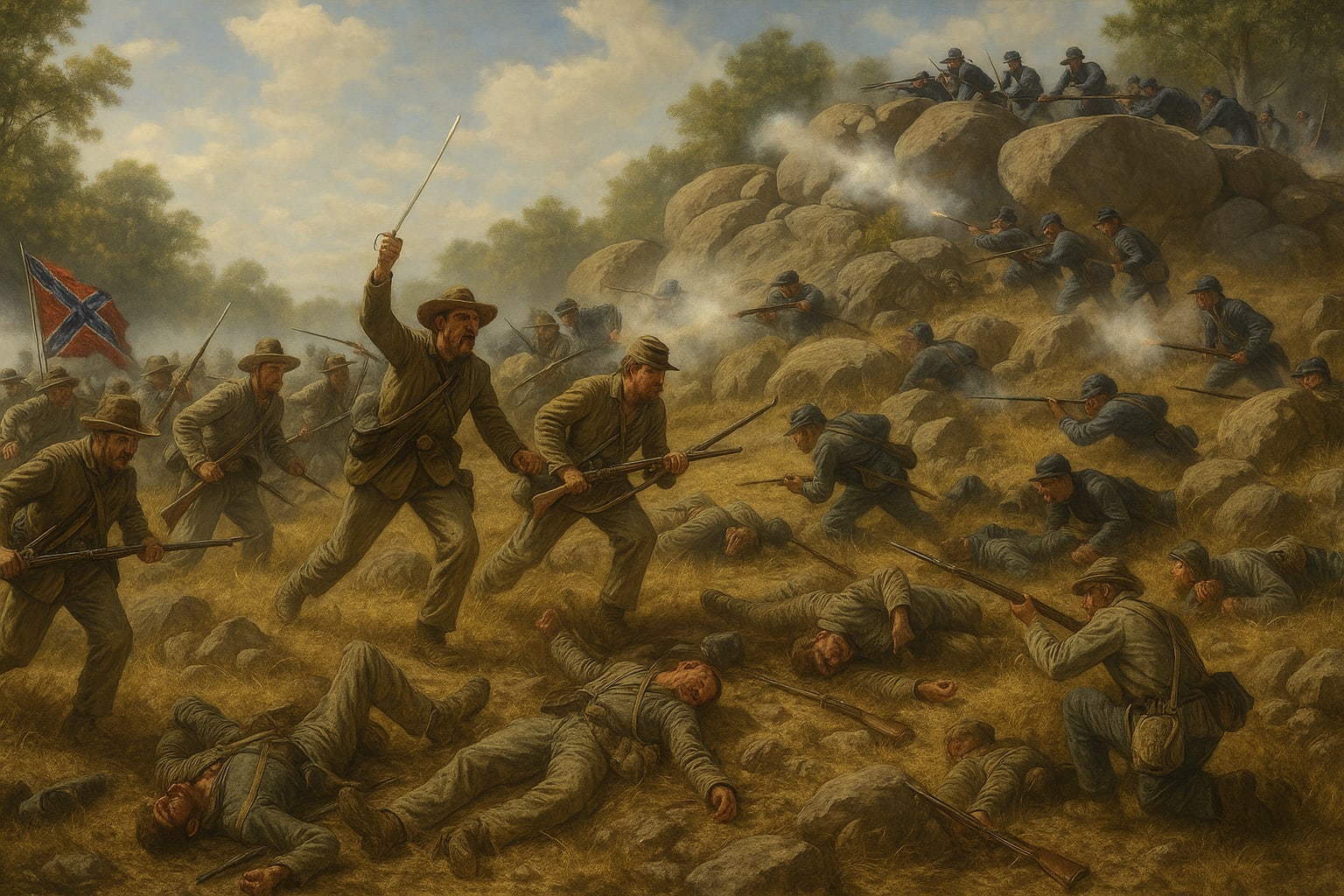
At Little Round Top, the 20th Maine Infantry fought hand to hand against repeated Confederate assaults on a rocky, wooded hillside. When they ran out of ammunition, they fixed bayonets and charged downhill into the enemy — a desperate act that saved the Union flank but left the hillside carpeted with dead and wounded men tangled among the boulders and trees.
[INSERT HAUNTED LOCATION CARD: Little Round Top]
At Devil's Den, Confederate and Union soldiers fought among massive boulders at point-blank range. The terrain created natural killing grounds — narrow gaps between rocks where men were trapped and shot, crevices where the wounded fell and could not be reached, elevated positions where sharpshooters picked off anyone who moved. The casualties at Devil's Den were staggering, and the bodies remained among the boulders for days, inaccessible and decomposing in the heat.
[INSERT HAUNTED LOCATION CARD: Devil's Den]
In the Wheatfield, control of a twenty-acre farm changed hands six times over the course of the afternoon. Each assault and counterassault left more dead and wounded on the ground. By evening, the wheat was flattened, soaked with blood, and covered with bodies stacked two and three deep in places. Soldiers who survived the fighting described walking across the field and being unable to take a step without treading on a corpse.
The second day produced approximately 20,000 casualties. Twenty thousand men killed, wounded, or missing in a single day of fighting across a landscape you can drive through in fifteen minutes.
Day 3 — The Breaking Point
On the afternoon of July 3, 1863, General Lee ordered the assault that would become the defining moment of the battle — and one of the most catastrophic military decisions in American history.
Approximately 12,500 Confederate soldiers formed a line nearly a mile wide along Seminary Ridge and began marching across open ground toward the Union position on Cemetery Ridge. The distance was roughly three-quarters of a mile. There was no cover. No trees. No folds in the terrain to hide behind. Just open, gently rising farmland, and at the far end, a stone wall lined with Union infantry and artillery.
The march began in eerie silence. Then the Union guns opened fire.
Artillery shells tore through the advancing lines, cutting gaps that closed as the men behind stepped forward to fill them. As the Confederates drew closer, canister shot — essentially turning cannons into giant shotguns — shredded the front ranks. Men fell by the dozens, by the hundreds, with each volley. The survivors kept walking.
When the first Confederates reached the stone wall, the fighting became hand to hand. Men clubbed each other with rifle butts, stabbed with bayonets, grabbed each other by the throat. The breakthrough lasted minutes before the Union counterattack drove the survivors back across the field they had just crossed — now littered with their dead and wounded comrades.
Pickett's Charge, as it came to be known, lasted less than an hour. The casualties were catastrophic. Entire regiments were annihilated. Of the roughly 12,500 men who stepped off from Seminary Ridge, fewer than half returned. The field between the ridges was covered with the dead, the dying, and the wounded who had no way to reach help.
The Battle of Gettysburg was effectively over. But the horror was just beginning.
The Aftermath — Where the Real Horror Begins
This is the part that most accounts of Gettysburg rush past. The battle ended on the evening of July 3. The armies remained in position through July 4, watching each other warily. On the night of July 4, Lee's army began its retreat south in a driving rainstorm. Meade's army, battered and exhausted, did not pursue immediately.
What they left behind was a nightmare that defies adequate description.
More than 51,000 soldiers had been killed, wounded, captured, or gone missing in three days. The dead lay everywhere — in the fields, in the orchards, along the roads, in the yards of private homes, among the boulders of Devil's Den, on the slopes of Little Round Top, across the open ground of Pickett's Charge. They lay in every position that death had found them — facedown in the dirt, draped over stone walls, curled into the fetal position in ditches they had dug with their bare hands.
And then the July heat went to work.
Decomposition began within hours. By July 5, the smell was overpowering. By July 6, it was unbearable. Contemporary accounts describe a stench so intense that people miles from the battlefield could not eat. Residents who had remained in their homes during the fighting now found themselves unable to open their windows. Horses and mules — thousands of which had also been killed — bloated and burst in the sun. The ground itself seemed to be rotting.
The townspeople of Gettysburg — 2,400 civilians who had just survived three days of battle — were left to deal with the dead. There were not enough burial details. There were not enough shovels. There was not enough time. Bodies were buried where they fell, in graves so shallow that the next rain exposed them. Some were not buried at all for days. Animals — dogs, pigs, birds — fed on the remains. Soldiers who had marched to Gettysburg believing they were fighting for something found their final rest being torn apart by scavengers in a Pennsylvania farm field.
This is the Gettysburg aftermath. This is the part that the plaques do not describe and the bus tours do not linger on. This is what really happened here.
Improvised Hospitals and Amputations
The approximately 21,000 wounded soldiers who survived the battle needed medical attention that the town of Gettysburg was catastrophically unequipped to provide.
Every building large enough to hold a man became a hospital. Churches, barns, homes, the college, the seminary, hotels, shops — all of them were commandeered and filled with wounded soldiers laid on floors, on pews, on dining tables, on bare ground. Blood soaked through floorboards and pooled in cellars. The sounds of suffering — screaming, moaning, begging — were continuous, day and night, for weeks.
Surgeons worked around the clock, but the primary surgical procedure available to them was amputation. A shattered arm or leg, in 1863, meant one thing: it came off. Surgeons performed amputations by the hundreds, often without anesthesia — there was not enough to go around. Soldiers bit down on leather straps or wooden sticks, or simply screamed, while a surgeon sawed through bone. The procedure took minutes. The piles of amputated limbs outside improvised operating rooms grew to waist height.
The Farnsworth House, which had been occupied by Confederate sharpshooters during the battle, became one of these improvised hospitals. Wounded soldiers were carried through the same doorways where sharpshooters had taken their positions. The suffering that occurred within the house — the surgeries, the deaths, the slow deterioration of men who could not be saved — has left a mark that visitors report feeling to this day.
[INSERT HAUNTED LOCATION CARD: Farnsworth House]
The Jennie Wade House carries a different but equally devastating story. Jennie Wade, the only civilian killed during the battle, was struck by a stray bullet on the morning of July 3 while baking bread for Union soldiers. She was twenty years old. Her death is a reminder that the dark history of Gettysburg was not confined to the battlefield. It reached into kitchens, into living rooms, into the ordinary lives of people who had done nothing to invite it.
[INSERT HAUNTED LOCATION CARD: Jennie Wade House]
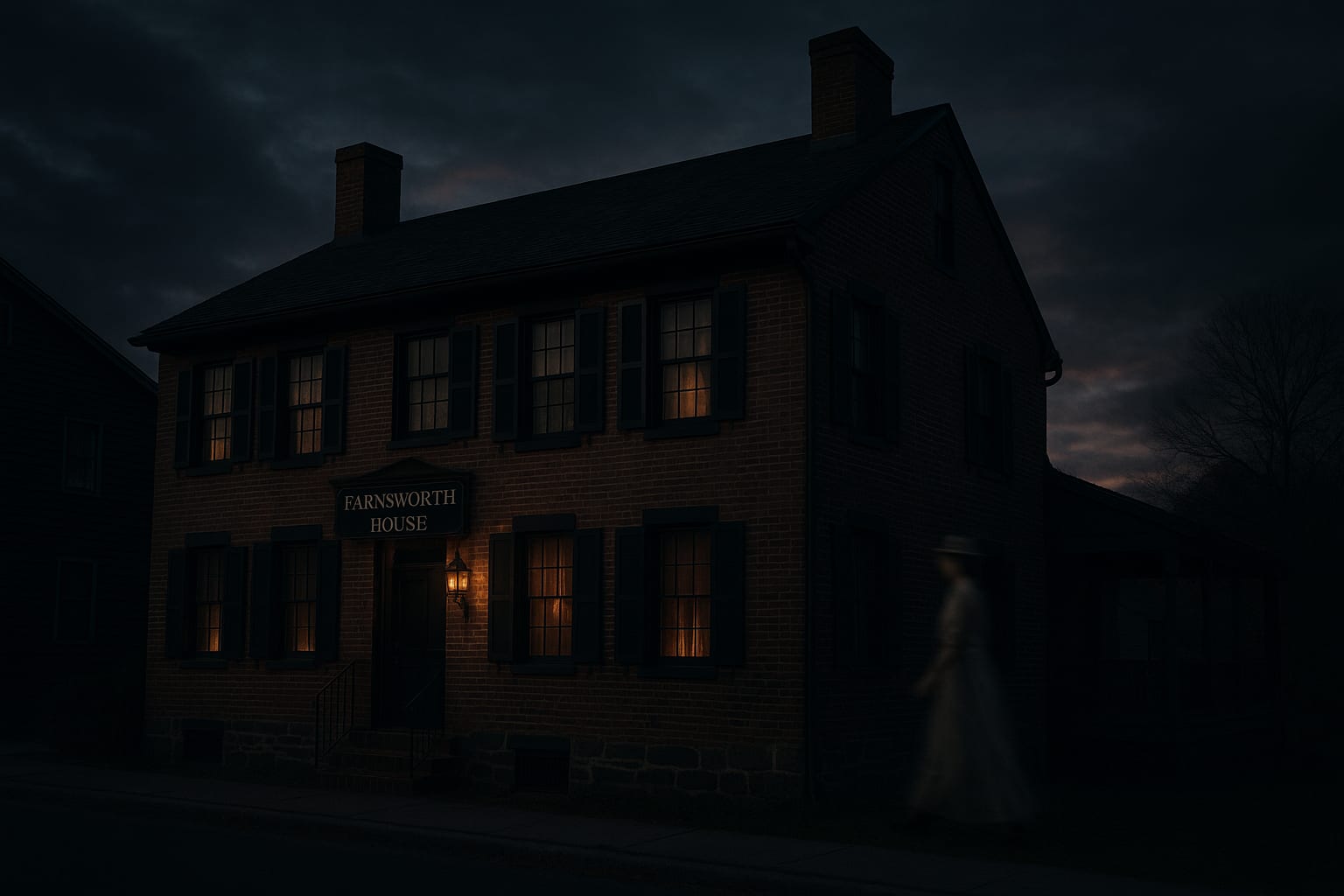
The Haunted Farnsworth House
This 1810 house bears over 100 bullet holes from Confederate sharpshooters. After the battle, it served as a field hospital. Guests report footsteps, cold spots, and the apparition of a Confederate soldier.
Read More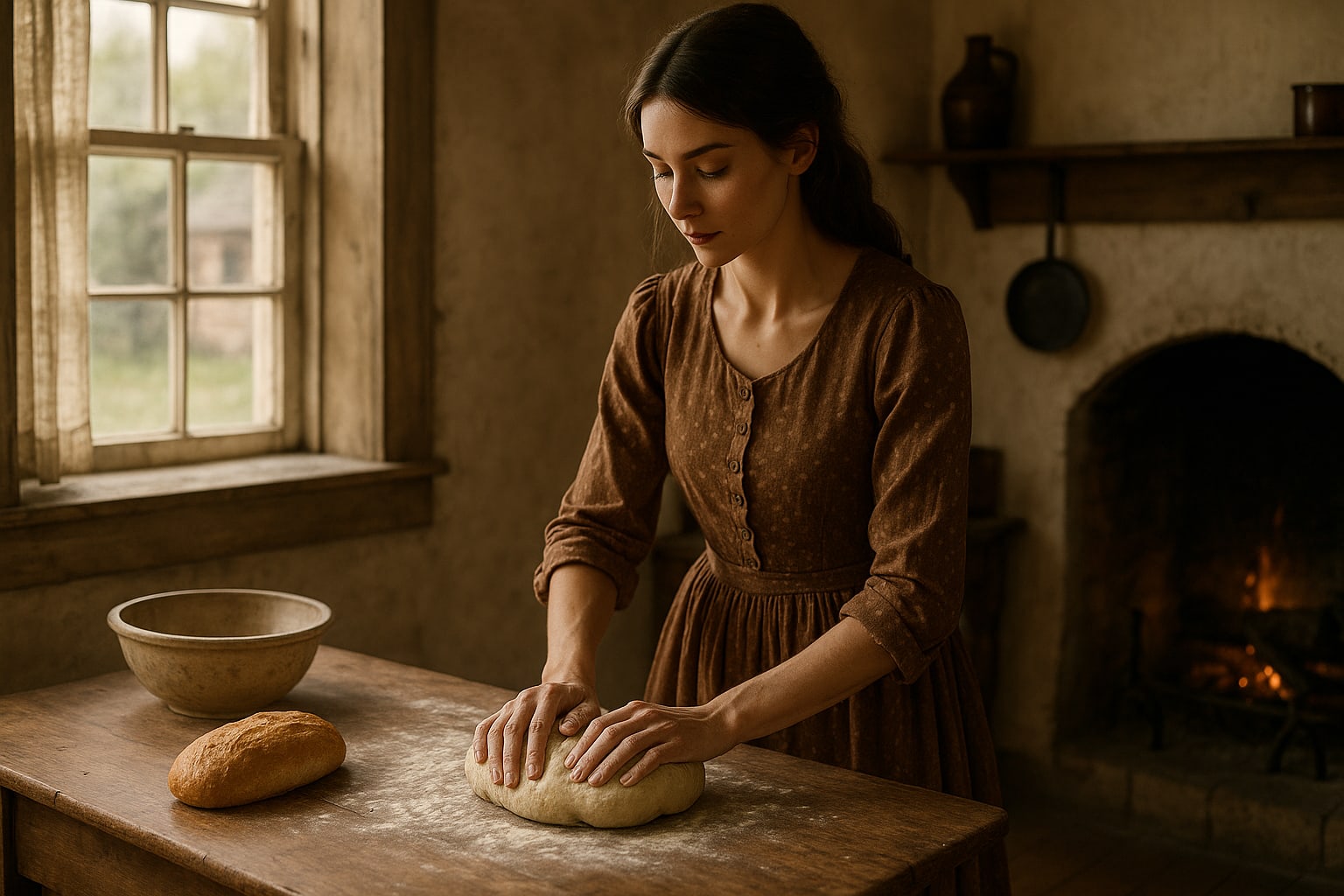
The Ghost of Jennie Wade
The only civilian killed during the Battle of Gettysburg, struck by a stray bullet while baking bread. Visitors report the smell of fresh bread, a woman's humming, and the sensation of invisible hands.
Read MoreCivilians in the Middle of Hell
The civilians of Gettysburg are the forgotten victims of the battle.
For three days, families sheltered in basements and cellars while the fighting raged above them. They listened to artillery shells strike their homes. They felt the concussion of cannon fire shake their foundations. They heard men dying in their yards, on their porches, in their hallways.
When they emerged after the battle, they found a world that no longer resembled the one they had known. Their fences were gone — torn apart for firewood or barricades. Their crops were destroyed — trampled by armies and soaked with blood. Their livestock had been slaughtered or stolen. Their homes were damaged, some beyond repair. And everywhere — in every direction, as far as they could see — were the dead.
Children witnessed things that no child should ever see. They saw bodies. They saw amputations. They saw soldiers dying slowly in rooms where they had once played. The psychological trauma inflicted on the civilian population of Gettysburg has never been fully accounted for. There were no counselors, no therapists, no support networks. The people of Gettysburg absorbed the horror and carried it forward, passing the weight of it through generations.
Some families left and never returned. Others stayed and rebuilt, but the town they rebuilt was not the town they had known. It was a town that had been baptized in blood, and it would never entirely wash clean.
Burial Efforts — And What Was Left Behind
The burial of the Gettysburg dead was one of the most overwhelming logistical challenges of the Civil War.
In the immediate aftermath of the battle, burial was haphazard and desperate. Soldiers were buried where they fell — in shallow trenches, in ditches, in mass graves dug by exhausted work details. Confederate dead, in particular, were buried with minimal effort and no identification. Many were placed in trenches and covered with a thin layer of soil that was insufficient to contain the smell or prevent disturbance by animals.
In November 1863, the Soldiers' National Cemetery was dedicated — the occasion for President Lincoln's Gettysburg Address. The project of exhuming Union dead from their scattered field burials and reinterring them in the new cemetery was an enormous undertaking that continued for months. The work was gruesome. Remains that had been in the ground for four months had to be located, exhumed, identified when possible, and transported to the cemetery. Many bodies had decomposed beyond recognition. Many could not be identified at all.
Confederate dead were not included in the National Cemetery. Their remains were left in their field graves for years. Beginning in the 1870s, Southern states organized efforts to exhume and transport Confederate remains to cemeteries in the South, but these efforts were incomplete. An unknown number of Confederate soldiers remain in unmarked graves on the Gettysburg battlefield to this day.
Not everyone was properly buried. Not everyone was found. The dark history of Gettysburg includes the uncomfortable truth that the ground beneath the monuments and the walking paths and the manicured lawns still holds the remains of men who were never recovered — men who died in confusion and pain, were buried in haste or not at all, and whose names were lost permanently to the chaos of war.
Why This History Still Lingers
Paranormal researchers have spent decades trying to understand why certain locations produce more reports of unexplained activity than others. The theories vary, but they converge on a set of conditions that Gettysburg satisfies more completely than almost any other site in America.
Sudden, violent death on a massive scale. More than 51,000 soldiers became casualties in three days. The speed and intensity of the dying created a concentration of trauma that is virtually unmatched in American history.
Death without closure. Thousands of soldiers died without knowing the outcome of the battle. Thousands more died without being identified, without having their families notified, without a proper burial or a marked grave. The unfinished quality of these deaths — the absence of resolution — is exactly the condition that paranormal researchers associate with lingering spiritual presence.
Prolonged suffering. The men who died at Gettysburg did not die quickly, in many cases. They died over hours, over days, in improvised hospitals where the best available treatment was amputation without anesthesia. The duration and intensity of their suffering is a dimension of the dark history that adds to the site's paranormal profile.
Civilian trauma. The suffering was not confined to soldiers. The civilians of Gettysburg were traumatized on a scale that left permanent marks on the community. Their grief, their horror, their inability to process what they had witnessed — all of it became part of the emotional fabric of the place.
This is why Gettysburg is not just a battlefield. It is a place saturated with unresolved human experience — fear, pain, confusion, grief — compressed into a landscape so small that you can stand in the center of it and see the edges. For a full exploration of the paranormal dimension, read our guide to why Gettysburg is so haunted. The dark history you have just read is the foundation of everything that has been reported here since.
The Sanitized Version vs. The Real Story
Tim Nealon grew up in the towns and farmland surrounding Gettysburg. The battlefield was not a distant historic site — it was the landscape of his childhood. He visited it dozens of times before he was old enough to drive. He read the books, memorized the troop movements, and absorbed the narrative that the National Park Service and the educational system presented: a story of strategic importance, military leadership, and the high-water mark of the Confederacy.
But the more Tim learned, the more he realized how much had been left out.
The version of Gettysburg that most people encounter — whether in school, in documentaries, or on a visit to the park — is a version that has been cleaned up for public consumption. The gore has been removed. The smell has been left out. The screaming has been silenced. The civilians have been pushed to the margins. What remains is a story that is accurate in its facts but dishonest in its emotional weight — a story that presents the battle as something that can be understood from a safe distance, processed neatly, and filed away.
Tim knew better. Growing up near Gettysburg, he knew the stories that the locals told — stories about the fields and the buildings and the roads that did not appear in any textbook. He knew that the battle's aftermath was not a chapter that ended cleanly but a wound that the town carried for generations. And he knew that the paranormal activity reported at Gettysburg was not separate from the history — it was a direct consequence of it.
That understanding — that the real story of Gettysburg is darker, more human, and more important than the sanitized version — is what drives the Ghost City Tours approach to this town. The stories told on our tours are not comfortable. They are not designed to make visitors feel good about the past. They are designed to tell the truth about what happened here, because the people who suffered and died at Gettysburg deserve that truth, even when it is difficult to hear.
Experiencing the Real Gettysburg Today
You can stand on the ground where Pickett's Charge took place and feel the distance for yourself. Three-quarters of a mile of open field, gently rising toward a stone wall that you can see from where you are standing. No cover. No escape. Twelve thousand five hundred men walked that distance into concentrated gunfire, and the ones who made it to the wall fought hand to hand for minutes before being driven back across the bodies of their friends.
You can walk among the boulders at Devil's Den and understand, viscerally, how the terrain created killing grounds. You can stand on Little Round Top and look down the slope that the 20th Maine charged with fixed bayonets. You can visit the haunted locations of Gettysburg — the buildings that served as hospitals, the homes where civilians sheltered, the streets where wounded soldiers dragged themselves toward any door that might open.
This is not just learning history. This is experiencing it — physically, spatially, emotionally. The ground at Gettysburg is not neutral. It carries what happened here in ways that visitors can feel, even when they cannot fully explain what they are feeling. The heaviness in the air at Devil's Den. The sadness that settles over you on Cemetery Ridge at sunset. The unmistakable sensation, reported by thousands of visitors over more than a century, that you are not alone in places where you appear to be completely alone.
Gettysburg does not just remember its history. It holds it — in the soil, in the stone, in the walls of buildings that absorbed the suffering of thousands and have never fully let it go.
The Adults-Only Experience — Blood on the Battlefield Tour
This is not the version for school groups.
The Blood on the Battlefield Ghost Tour is Ghost City Tours' adults-only experience in Gettysburg — a 90-minute walking tour designed for people who want the real story, not the sanitized version. Ages 16 and up. Nightly at 9:00 PM. Rated 4.9 stars by hundreds of guests who came looking for something more than what the standard Gettysburg experience offers.
The stories told on this tour are grounded in the dark history you have just read. The chaos of the first day's fighting. The brutality of hand-to-hand combat at Devil's Den. The horror of the improvised hospitals. The aftermath that turned a quiet farming town into an open-air morgue. The civilian suffering that most tours never mention. And the paranormal activity that has been reported at these locations for more than 160 years — activity that our guides have witnessed firsthand.
The guides who lead the Blood on the Battlefield Tour are historians and paranormal researchers who have spent years studying the Battle of Gettysburg and its aftermath. They know the stories because they have researched them in primary sources — letters, diaries, official reports, and contemporary accounts that preserve the raw, unfiltered reality of what happened here. And they know the hauntings because they have experienced them — the shadow figures, the temperature drops, the sounds that have no source, the moments when the boundary between past and present dissolves.
This tour exists because the real story of Gettysburg deserves to be told. Not the version that has been smoothed down for general audiences. Not the version that skips the gore and the grief and the smell. The version that honors the dead by refusing to pretend that their suffering was anything less than what it was.
If you want the truth about what happened at Gettysburg — and what is still happening here — this is the experience.
Why This Tour Exists
Most tours in Gettysburg are built for the widest possible audience. They are family-friendly. They are careful with details. They emphasize bravery over horror, strategy over suffering, outcomes over human cost. There is a place for those tours — Ghost City Tours offers excellent family-friendly experiences as well.
But there is also a place for something more.
People come to Gettysburg from across the country and around the world because they want to understand what happened here. Many of them arrive already knowing the basic narrative — they have read the books, seen the films, studied the battle in school. What they are looking for is the experience that a book cannot provide: the sensation of standing on the ground, walking the streets, and hearing the stories in the places where they happened, told by people who know them deeply and tell them honestly.
Ghost City Tours created the Blood on the Battlefield Tour because the real story of Gettysburg deserves an experience built specifically for it — one that does not shy away from the darkness, that respects the intelligence and emotional capacity of its audience, and that treats the suffering of the people who lived and died here with the gravity it demands.
The dark history of Gettysburg is not entertainment. It is the foundation of everything this town is — its identity, its atmosphere, its hauntings. And the only way to truly understand it is to walk the ground after dark, in the company of someone who knows what happened on every corner, behind every door, and beneath every monument.
Frequently Asked Questions
What is the dark history of Gettysburg?
The dark history of Gettysburg refers to the brutal, often overlooked reality of the Battle of Gettysburg and its aftermath. Over three days in July 1863, more than 51,000 soldiers were killed, wounded, or went missing. The aftermath included bodies left to decompose in July heat for days, mass graves with unidentified remains, improvised hospitals where amputations were performed without anesthesia, and a civilian population traumatized by the violence that engulfed their town. Much of this history is sanitized or omitted from standard educational accounts.
How bad was the Battle of Gettysburg?
The Battle of Gettysburg was one of the bloodiest engagements in American history, producing approximately 51,000 total casualties in just three days. Soldiers fought hand to hand among boulders at Devil's Den, charged across open fields into concentrated artillery fire during Pickett's Charge, and died in improvised hospitals throughout the town. The fighting was chaotic, brutal, and terrifying for soldiers and civilians alike. The aftermath — decomposing bodies, mass burials, and a shattered community — was arguably worse than the battle itself.
What happened to the bodies after Gettysburg?
In the immediate aftermath, soldiers were buried where they fell in shallow graves, many without identification. The July heat accelerated decomposition before burial could be completed. Animals fed on exposed remains. In November 1863, the Soldiers' National Cemetery was established and Union dead were exhumed and reinterred over the following months. Confederate dead were left in field graves for years before Southern states organized partial recovery efforts in the 1870s. An unknown number of soldiers remain in unmarked graves on the battlefield to this day.
Is Gettysburg more than just a battlefield?
Yes. While the battlefield is the centerpiece, the town of Gettysburg itself was deeply affected by the battle. Private homes, churches, and public buildings were converted into hospitals. Civilians witnessed and participated in the care of wounded soldiers for weeks after the fighting. The Jennie Wade House, the Farnsworth House, the Gettysburg Hotel, and dozens of other town buildings have their own dark histories from the battle and its aftermath. Gettysburg's haunted reputation extends well beyond the battlefield into the town itself.
What is the Blood on the Battlefield Tour?
The Blood on the Battlefield Tour is Ghost City Tours' adults-only (ages 16+) ghost tour in Gettysburg. It is a 90-minute walking experience that explores the unfiltered dark history of the battle and its aftermath, including the brutal fighting, the improvised hospitals, the civilian suffering, and the paranormal activity reported at these locations for over 160 years. It runs nightly at 9:00 PM and is led by guides who are historians and paranormal researchers. Rated 4.9 stars. Learn more at ghostcitytours.com/gettysburg/blood-battlefield-tour/.
A Place That Remembers Everything
Gettysburg is not just remembered. It remembers.
The fields remember the weight of the men who fell on them. The buildings remember the blood that soaked through their floors. The roads remember the sound of wagons carrying the wounded and the dead. The air itself, on certain evenings, seems to carry a heaviness that has nothing to do with humidity and everything to do with what happened here in the first three days of July 1863.
The dark history of Gettysburg is not a story that ended. It is a story that was interrupted — violently, suddenly, and on a scale that overwhelmed every human system designed to process it. The dead were not mourned properly. The wounded were not treated adequately. The civilians were not supported. The trauma was not resolved. It was simply absorbed — by the ground, by the buildings, by the people who stayed and rebuilt — and it has been expressing itself ever since, in the stories, the sensations, and the sightings that have made Gettysburg the most haunted battlefield in America.
You can read about it. You can study it. But you cannot fully understand it until you stand on the ground where it happened, after the sun has gone down and the tourists have left, and you feel what this place carries.
Gettysburg does not let go of its history. And its history does not let go of the people who come here to find it.
Experience it for yourself with Ghost City Tours in Gettysburg. And if you want the unfiltered version — the version that most people never hear — join us on the Blood on the Battlefield Tour.