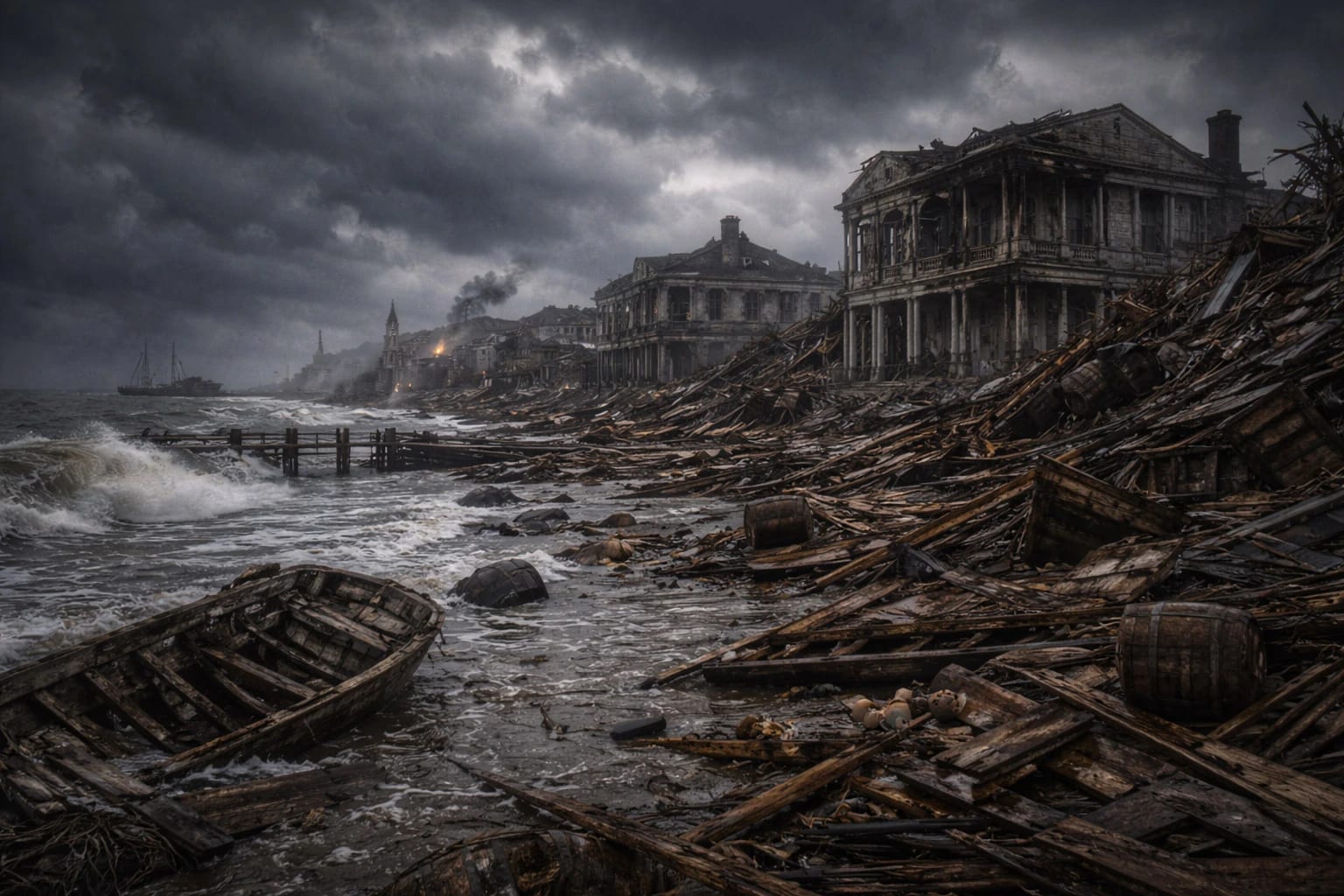
How Powerful Was the Storm?
The hurricane that struck Galveston Island on September 8, 1900, is estimated to have been a Category 4 storm on the modern Saffir-Simpson scale, with sustained winds of approximately 145 miles per hour. No anemometer on the island survived the storm intact, so exact wind speed measurements do not exist. What is known with certainty is that the storm was powerful enough to destroy virtually everything in its path.
The storm surge was the primary killer. Water levels rose between 8 and 15 feet above normal tide levels, and Galveston Island's highest natural elevation was just 8.7 feet above sea level. By the evening of September 8, the entire island was underwater. There was no high ground. There was no escape.
Galveston had no effective early warning system. The U.S. Weather Bureau, under the direction of Willis Moore, had dismissed reports from Cuban meteorologists who had been tracking the storm's path across the Caribbean. Isaac Cline, the Bureau's chief meteorologist in Galveston, did attempt to warn residents on the morning of September 8, riding horseback along the beach to urge people to move to higher ground. But by the time the severity of the storm became apparent, it was too late. The bridges connecting the island to the mainland were destroyed by midday, and the rising water trapped the entire population.
More than 3,600 homes were completely destroyed. The storm pushed a massive wall of debris — splintered wood, brick, iron, and human bodies — across the island like a grinding machine. Entire city blocks were reduced to nothing. The economic heart of the city, the commercial district along the Strand, suffered catastrophic structural damage. Churches, schools, hospitals, and the homes of Galveston's wealthiest families were torn apart or flooded beyond recognition.
The destruction was not selective. It took the homes of the rich and the poor alike. It destroyed the mansions on Broadway Avenue and the workers' cottages near the waterfront. It collapsed the commercial buildings on the Strand and the fishing shacks along the beach. The storm did not discriminate, and neither did the death toll.
How Many People Died in the Galveston Hurricane?
The death toll from the 1900 Galveston Hurricane is estimated between 8,000 and 12,000 people. The exact number will never be established because the storm's destruction was so complete that it eliminated the means of counting. Entire families were killed with no surviving relatives to report them missing. Property records, birth certificates, and other documents that might have helped identify victims were destroyed in the flooding. Many of the dead were immigrants — laborers, dock workers, and their families — whose names had never been formally recorded in city records.
The deaths occurred primarily during the evening and night of September 8. As the storm surge rose, people took shelter in the strongest buildings they could find. When those buildings collapsed or were overwhelmed by water, the occupants drowned, were crushed by debris, or were swept out to sea. Some survived by clinging to floating wreckage for hours in the dark, battered by wind and waves, watching others drown around them.
The scenes that greeted survivors at dawn on September 9 were beyond comprehension. Bodies were everywhere — tangled in debris, floating in receding floodwater, half-buried in sand and wreckage. The dead included infants, elderly residents, entire households. In some neighborhoods, there were more dead than living. The smell of decomposition began almost immediately in the September heat.
Survivor accounts, published in newspapers across the country in the days and weeks that followed, describe the emotional devastation in terms that remain difficult to read more than a century later. Fathers searching through wreckage for the bodies of their children. Mothers discovering that every member of their family had drowned in the house next door. Neighbors recognizing the bodies of people they had spoken to just hours before the storm hit.
The 1900 Galveston Hurricane killed more people than any other natural disaster in United States history. By comparison, Hurricane Katrina in 2005 killed approximately 1,800 people. The 1906 San Francisco earthquake killed an estimated 3,000. The Galveston storm's death toll exceeds both of those disasters combined, and it occurred on a single barrier island on the Texas Gulf Coast in a single night.
What Happened to the Children of the Island?
The most devastating single loss of life during the 1900 Hurricane occurred at St. Mary's Orphanage, operated by the Sisters of Charity of the Incarnate Word. The orphanage consisted of two buildings located on the beach at the western end of Galveston Island, housing 93 children ranging in age from infants to early adolescents.
As the storm intensified on the afternoon of September 8, the ten nuns caring for the children recognized that the buildings would not survive the rising water. In a desperate attempt to keep the children safe, the Sisters used clothesline rope to tie groups of six to eight children to themselves, reasoning that if the buildings collapsed or the water swept them away, the children would at least remain attached to an adult.
The buildings collapsed under the storm surge. All 93 children died. All 10 of the Sisters of Charity died. Only three boys survived — William Murney, Frank Madera, and Albert Campbell — by clinging to a floating uprooted tree after the ropes binding them to their caretaker broke free. The boys drifted through the storm for hours before washing ashore on the mainland.
In the days after the storm, recovery crews found the bodies of the nuns with children still tied to them by the clothesline. The image of these women, who chose to bind their own fate to the children rather than save themselves, became one of the most enduring and heartbreaking stories of the 1900 Hurricane.
St. Mary's Orphanage was never rebuilt. The site where it once stood, on the beachfront near what is now the western end of the Seawall, carries no formal marker commensurate with the scale of the tragedy. But the story has never been forgotten.
Why Is the Orphanage Story Central to Galveston's Haunting Lore?
The loss of 93 children in a single night occupies a unique place in Galveston's haunted history, and understanding why requires looking beyond the supernatural.
Child death carries a specific emotional weight in virtually every culture. The death of a child is experienced as a violation of the natural order — children are supposed to outlive the adults who care for them. When children die suddenly, violently, and in large numbers, the psychological impact on the surviving community is profound and lasting. The grief does not resolve in the way that grief for elderly or adult dead sometimes can. It persists. It is retold. It becomes part of the community's identity.
Residents and visitors to the area near the former orphanage site have reported hearing children's voices carried on the wind, particularly during storms. Others have described phantom crying, small figures visible briefly near the waterline, and an overwhelming sense of sadness that arrives without obvious cause. Whether these experiences are paranormal phenomena or the psychological effect of standing in a place with an extraordinarily tragic history, they are reported consistently and have been for generations.
The orphanage story is also central to Galveston's haunted reputation because it is so thoroughly documented. The names of the nuns are known. The survival accounts of the three boys were recorded in detail. The clothesline detail — the ropes that bound the living to the dying — is not legend. It was observed by recovery crews and reported in contemporary accounts. This level of historical specificity gives the story a weight that invented ghost tales cannot match.
The story of St. Mary's Orphanage is not told on our tours for shock value. It is told because it happened, because the people who died deserve to be remembered, and because the story is inseparable from any honest account of haunted Galveston.
Were There Mass Graves in Galveston?
Yes. The scale of death after the 1900 Hurricane created a burial crisis that overwhelmed every resource the city had.
In the first days after the storm, the city organized work crews to collect bodies from the wreckage. Decomposition in the September heat began almost immediately, and the threat of epidemic disease from thousands of exposed corpses was urgent. The initial plan was burial at sea. Bodies were loaded onto barges, taken several miles into the Gulf of Mexico, weighted with stones or iron, and dumped overboard.
The Gulf returned them. Within days, bodies began washing back onto the beaches of Galveston Island, bloated and further decomposed. The sea burial approach was abandoned.
Galveston then turned to mass cremation. Funeral pyres were constructed at locations across the island using debris from the storm itself — the same shattered wood that had been homes, churches, and businesses became fuel for burning the dead. The pyres burned for weeks. The smoke hung over the island and was reported to be visible and smellable from the mainland. Residents were offered whiskey rations to endure the work of handling and burning the dead, and some accounts describe workers who could not continue despite the alcohol.
Where cremation was not feasible, bodies were buried in mass trenches. These graves were dug quickly, without ceremony, and in many cases without any attempt to identify the dead. The locations of these mass burials were not always formally recorded. In the years following the storm, when the city undertook the massive engineering project of raising its grade level by up to 17 feet, many of these mass graves were buried even deeper beneath imported fill sand.
The result is that parts of modern Galveston are built directly on top of unmarked graves from the 1900 Hurricane. Construction and excavation projects have periodically uncovered human remains, a grim reminder that the dead of the storm are still beneath the surface of the city.
Could Improper Burial Contribute to Haunting Legends?
Across virtually every culture and spiritual tradition, the treatment of the dead after death is considered essential for spiritual rest. Proper burial rites — whether burial, cremation with ceremony, or other culturally specific practices — are understood as necessary for the dead to transition peacefully from the world of the living. When these rites are denied, disrupted, or performed improperly, the resulting folklore is remarkably consistent: the dead do not rest.
The 1900 Hurricane created precisely this condition on a massive scale. Thousands of bodies were burned on open-air pyres without identification, prayer, or individual ceremony. Thousands more were dumped at sea without funeral rites. Others were buried in unmarked trenches and then buried again beneath seventeen feet of fill sand during the grade-raising project. The dead of the 1900 storm were, in the most literal sense, denied the burial practices that Galveston's deeply religious Victorian-era community considered sacred.
This is not a supernatural claim. It is a cultural observation. When a community experiences mass death followed by improper burial, the community's grief is compounded by guilt and spiritual anxiety. The stories that emerge from this combination — stories of the dead appearing at the sites where they were improperly buried, of voices heard near mass graves, of restless presences in buildings where bodies were stored before disposal — follow a pattern that is documented in the folklore of every civilization that has experienced comparable tragedy.
Galveston's haunted cemeteries, including Old City Cemetery and Broadway Cemetery, and the reports of paranormal activity in the Strand District and along the beachfront, fit this pattern with precision. The dead were not properly buried. The living never fully resolved their grief. And the stories that emerged have persisted for more than a century.
Why Didn't Galveston Disappear After the Storm?
Many assumed that the 1900 Hurricane would be the end of Galveston as a major city. The destruction was so complete, the death toll so staggering, that abandoning the island seemed like the rational response. It did not happen.
Instead, Galveston undertook one of the most ambitious engineering projects in American history. The city constructed a massive concrete seawall along the Gulf-facing shore, initially 3.3 miles long and 17 feet high, designed to absorb the force of future storm surges. The seawall was later extended to over 10 miles and remains in place today.
Even more remarkably, the city raised its own grade level. Over a period of years, buildings were jacked up on stilts and sand was pumped in beneath them, raising the elevation of the city by as much as 17 feet in some areas. The project required moving millions of cubic yards of fill material and was, at the time, one of the largest civil engineering undertakings ever attempted in the United States.
But the storm did fundamentally alter Galveston's trajectory. Before 1900, Galveston was the largest and wealthiest city in Texas, its port handling more cotton exports than any other in the country. After the storm, investment shifted to Houston, which had the advantage of being inland and connected to the newly constructed Houston Ship Channel. Galveston never recovered its position as the dominant economic force on the Texas Gulf Coast.
What remained was a city rebuilt on top of its own dead, with a seawall as a permanent monument to the storm that nearly destroyed it, and a population that carried the memory of September 8, 1900, as a defining element of its identity.
Trauma That Doesn't Leave a Place
The psychological concept of multi-generational trauma describes the way extreme experiences are transmitted from survivors to their descendants, not just through stories but through behavior, anxiety, and cultural practices. Galveston is a case study in this phenomenon.
The survivors of the 1900 Hurricane did not have access to psychological counseling, grief therapy, or any of the support systems that modern disaster survivors receive. They processed their trauma the only way available to them: through family oral history, church memorials, and the daily reality of living in a city rebuilt on the sites where their loved ones had died. Children grew up hearing their parents describe the night of the storm. Those children told their own children. The stories were not abstract history. They were family inheritance.
This generational transmission of grief is one of the most important factors in Galveston's enduring haunted reputation. The ghost stories are not separate from the community's memory. They are an expression of it. When a Galveston resident reports hearing unexplained sounds in a building that survived the storm, or feeling an inexplicable presence near a site where bodies were recovered, they are participating in a tradition of remembrance that stretches back to the morning of September 9, 1900.
Unresolved grief shapes ghost stories because ghost stories are, at their most fundamental level, stories about the dead who have not been properly mourned. The 8,000 to 12,000 people who died in the Galveston Hurricane were not properly mourned by Victorian standards. Many were never identified. Many were never individually buried. The grief that their deaths produced has been carried by this island's community for more than 125 years, and the ghost stories that express that grief show no signs of fading.
This is what separates Galveston's haunted history from cities that manufacture paranormal reputations for commercial purposes. The hauntings here are not invented. They are the natural consequence of a community that experienced unimaginable loss and has never fully let it go.
Reported Apparitions in Storm-Related Locations
The ghost stories tied to the 1900 Hurricane are concentrated at specific locations across Galveston Island, and the reports follow consistent patterns that have been documented for over a century.
Bishop's Palace, the grand Victorian mansion built by Colonel Walter Gresham in 1892, survived the hurricane and served as a refuge for hundreds of storm survivors. People crowded into the upper floors as the water rose, and the building became a temporary shelter where the living, the injured, and the dying occupied the same rooms. Visitors today report cold spots in the upper hallways, the sound of footsteps in empty rooms, shadow figures visible briefly in peripheral vision, and the apparition of a man in Victorian clothing believed to be Colonel Gresham himself.
Moody Mansion, home to one of Galveston's wealthiest families, also survived the storm. The mansion's association with the Moody family's long and sometimes tragic history has generated reports of unexplained activity including doors opening and closing without cause, objects moving from their established positions, and voices in rooms that are confirmed to be empty.
The Tremont House Hotel, which was destroyed by the hurricane and later rebuilt, is one of the Strand District's most prominent haunted locations. Guests have reported waterlogged footprints appearing in dry hallways, the smell of seawater in interior rooms far from any window, and brief sightings of figures in period clothing who vanish when approached.
The Strand District itself, Galveston's historic commercial center, suffered catastrophic damage in the storm. The commercial buildings that were rebuilt or repaired in the years following the hurricane have generated decades of paranormal reports, including unexplained sounds during storms, apparitions in upper-story windows, and a general atmospheric heaviness that visitors frequently describe independently of one another.
Galveston's cemeteries, including Old City Cemetery and Evergreen Cemetery, where many storm victims were buried, are sites of persistent paranormal reports including orbs, shadow figures, unexplained temperature drops, and the sound of voices when no one else is present.
Why Do So Many Galveston Ghost Stories Reference the Hurricane?
The 1900 Hurricane is not just one chapter in Galveston's history. It is the defining event of the city's existence. Before the storm, Galveston was the richest city in Texas and one of the most important ports in the United States. After the storm, it was a devastated island that would never regain its former status. The hurricane is the dividing line in Galveston's history — everything is either before the storm or after it.
This centrality explains why the hurricane dominates Galveston's ghost stories. The storm killed more people in a single night than any other event in the island's history, by an enormous margin. The trauma it produced was universal — it touched every family, every neighborhood, every institution on the island. And the physical reminders of the storm are everywhere. The seawall is a monument to it. The raised grade level is a consequence of it. The mansions that survived it are celebrated specifically because they survived. The cemeteries contain its dead.
When Galveston residents and visitors report paranormal experiences, the hurricane provides the most readily available and emotionally resonant explanation. A cold spot in Bishop's Palace is attributed to storm refugees. A phantom child's voice near the beach is connected to St. Mary's Orphanage. The smell of seawater in the Tremont House evokes the storm surge.
The hurricane embedded itself into the spiritual landscape of Galveston Island the way it embedded itself into the physical landscape. And just as the city was literally built on top of its dead, the ghost stories of Galveston are built on the foundation of what happened on September 8, 1900.
Can You Visit Sites Connected to the 1900 Hurricane?
Many of the most significant hurricane-related sites in Galveston are accessible to the public, and the most comprehensive way to experience them is through a guided ghost tour that provides the historical context these locations deserve.
The Ghosts of Galveston Tour takes guests to locations directly connected to the hurricane's destruction and the ghost stories that followed. The tour walks through the historic districts where the worst of the damage occurred, past mansions that sheltered refugees, along streets where bodies were recovered, and through areas where mass graves were later discovered. The guides provide historically researched accounts of what happened at each location, connecting the documented events of September 8, 1900, to the paranormal reports that have persisted ever since.
The Galveston Haunted Pub Crawl visits historic Strand District bars and buildings tied to storm-era tragedies and the lingering legends attributed to those who perished. The pub crawl combines haunted history with the experience of visiting some of Galveston's most atmospheric historic establishments.
Outside of guided tours, Bishop's Palace operates as a museum with regular public hours. Moody Mansion and Ashton Villa also offer tours. The Hotel Galvez, built in 1911 as a symbol of Galveston's recovery, welcomes overnight guests in rooms associated with paranormal reports. Galveston's historic cemeteries are open during daylight hours.
All of Ghost City Tours' Galveston experiences are historically researched, respectful of the tragedy, educational, and immersive. The 1900 Hurricane is not entertainment. It is history, and we treat it accordingly.
Are the Hurricane Ghost Stories Based on Real History?
The 1900 Galveston Hurricane is one of the most thoroughly documented natural disasters in American history, and the ghost stories connected to it are grounded in that documentation.
Death toll estimates of 8,000 to 12,000 are derived from census records, municipal reports, military assessments conducted by U.S. Army personnel sent to assist in recovery, and the compiled testimony of survivors. The destruction of St. Mary's Orphanage is documented in the records of the Sisters of Charity of the Incarnate Word, in survivor interviews with the three boys who lived, and in recovery crew reports that described finding nuns with children still tied to them. The mass cremations are documented in newspaper accounts from the Galveston Daily News and wire service reports distributed nationally. The burial crisis, the bodies returned by the sea, and the mass graves are all part of the official historical record.
The storm itself is documented in U.S. Weather Bureau records, ship logs from vessels that encountered the hurricane in the Gulf of Mexico, and Isaac Cline's own published account of the storm's approach and devastation. Structural damage is recorded in insurance claims, city engineering reports, and the photographic record compiled in the storm's aftermath.
Ghost City Tours builds its storytelling on this documentary evidence. We do not fabricate ghost stories. We do not exaggerate death tolls. We do not attribute supernatural events to locations where no documented historical basis exists. The real history of the 1900 Galveston Hurricane is powerful enough. Our responsibility is to tell it honestly, with respect for the dead and for the community that has carried this history for more than a century.
Why the 1900 Hurricane Still Shapes Galveston Today
The 1900 Hurricane did not just change Galveston's buildings, economy, and population. It changed the fundamental character of the city.
The seawall, completed in stages beginning in 1902, is a constant physical reminder that Galveston exists in defiance of the forces that nearly destroyed it. The raised grade level means that residents walk on ground that was literally built on top of the old city — and on top of the dead who were buried in the old city. The mansions that survived the storm are celebrated not just for their architecture but for their survival. The cemeteries hold the dead of the storm alongside the dead of every other era, but it is the storm dead that visitors ask about most.
Annual remembrance of the hurricane is woven into Galveston's civic culture. The anniversary of September 8 is observed with a gravity that reflects the scale of the loss. Family stories about the storm are passed down with the same care that other communities reserve for their founding myths. The hurricane is not something that happened to Galveston. It is something that Galveston carries.
Some believe the storm didn't just change the city's skyline — it changed its spiritual landscape. The reports of apparitions, unexplained sounds, and lingering presences that persist across the island are, for many Galveston residents and visitors, evidence that the 8,000 to 12,000 people who died on September 8, 1900, have not entirely departed. Whether one interprets these reports as supernatural phenomena, as psychological responses to standing in places of extraordinary tragedy, or as the natural expression of a community's unresolved grief, they are an inseparable part of what Galveston is today.
The storm made the seawall necessary. It made the grade-raising necessary. And it made the ghost stories inevitable. They are all part of the same history.
Frequently Asked Questions
How many people died in the Galveston Hurricane of 1900?
The Galveston Hurricane of September 8, 1900, killed between 8,000 and 12,000 people. The exact number will never be known because entire families were wiped out with no surviving relatives to report them missing, and thousands of bodies were never recovered. The storm destroyed more than 3,600 homes and left roughly two-thirds of the island's 37,000 residents homeless. It remains the deadliest natural disaster in United States history.
Was it really the deadliest natural disaster in U.S. history?
Yes. The 1900 Galveston Hurricane is the deadliest natural disaster in United States history. Its estimated death toll of 8,000 to 12,000 people exceeds that of any other hurricane, earthquake, tornado, or flood in the nation's recorded history. By comparison, Hurricane Katrina in 2005 killed approximately 1,800 people, and the 1906 San Francisco earthquake killed an estimated 3,000.
Are there mass graves in Galveston from the storm?
Yes. Thousands of bodies were initially dumped at sea but washed back ashore. The city then used mass cremation on funeral pyres and burial in mass trenches. When Galveston later raised its grade level by up to 17 feet, many of these mass graves were buried beneath fill sand. Construction projects still occasionally uncover human remains from the 1900 storm.
Is St. Mary's Orphanage haunted?
The site of St. Mary's Orphanage is one of Galveston's most emotionally significant haunted locations. On the night of the storm, 93 children and 10 nuns perished when the building collapsed. The nuns had tied children to themselves with clothesline. Visitors to the area report hearing children's voices, phantom crying, and seeing small figures near the water. The story is central to Galveston's haunting lore.
Which Galveston ghost tours talk about the 1900 hurricane?
The 1900 Hurricane is a central topic on Ghost City Tours' Galveston experiences. The Ghosts of Galveston Tour visits locations directly connected to the storm's destruction and ghost stories. The Galveston Haunted Pub Crawl also visits historic Strand District buildings tied to storm-era tragedies. Both tours provide historically researched context connecting the paranormal reports to the events of September 8, 1900.
Can you visit hurricane-related haunted sites in Galveston?
Yes. Bishop's Palace operates as a museum. Moody Mansion and Ashton Villa offer tours. The Hotel Galvez welcomes overnight guests. Historic cemeteries are open during daylight hours. The most comprehensive way to experience these sites is through a guided ghost tour that provides historical context.
Experience the History Behind the Hauntings
The 1900 Galveston Hurricane was the deadliest natural disaster in United States history, and its impact on Galveston Island has never fully receded. The dead are still beneath the city. The mansions that sheltered the survivors still stand. The seawall that was built to prevent another catastrophe is a daily reminder that this island exists because the people who survived chose to stay and rebuild on top of everything they had lost.
The ghost stories that persist across Galveston are not entertainment. They are the island's memory, expressed through the experiences of the people who live here and the visitors who walk through the places where the worst of it happened. Ghost City Tours is committed to telling these stories with the historical accuracy and the respect for the dead that they demand.
Join us on the Ghosts of Galveston Tour to visit locations directly connected to the 1900 Hurricane, or experience the Galveston Haunted Pub Crawl to explore the Strand District's storm-era history. The ghosts of September 8, 1900, are still here. Their stories are waiting to be heard.