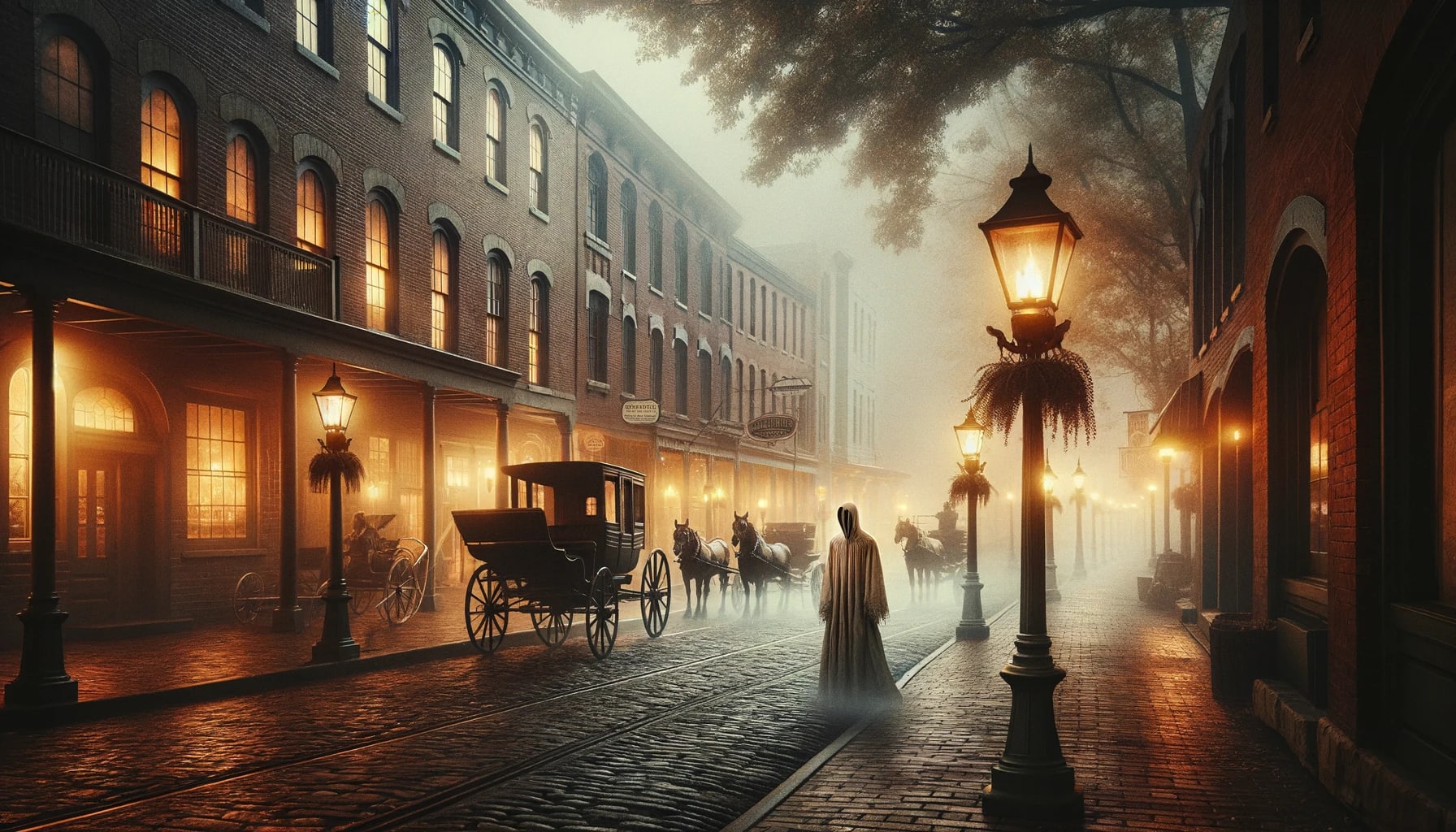
The Haunted History of Lookout Mountain
Few places in the country combine natural atmosphere and history the way Lookout Mountain does. The mountain is dramatic on its own terms — a long, narrow ridge that drops sharply on its northern face, creating cliffs and promontories that overlook the Tennessee River and the city that grew up along its banks. The terrain is steep, wooded, and frequently wrapped in cloud cover that can appear without warning and transform the landscape from panoramic clarity to dense, disorienting fog within minutes.
The Civil War came to Lookout Mountain in November 1863, and the battle that was fought here — in the fog, on the slopes, with visibility measured in yards rather than miles — became one of the most visually iconic engagements of the war. It also became one of the most haunting. The combination of violent death, extreme terrain, and an environment that naturally distorts perception has made Lookout Mountain a place where the boundary between past and present feels thinner than it should — where the fog that obscured the battlefield in 1863 still rolls in today, and where visitors report experiences that the elevation and the mist and the history do not fully explain.
Lookout Mountain is a central piece of Chattanooga's haunted history — and one of the key reasons Chattanooga is considered one of the most haunted cities in the South.
The Battle Above the Clouds
The Battle of Lookout Mountain was fought on November 24, 1863, as part of the broader Chattanooga Campaign — the series of engagements that broke the Confederate siege of the city and opened the way for Sherman's March to the Sea the following year.
Chattanooga had been under Confederate control since the Union defeat at Chickamauga two months earlier. Confederate General Braxton Bragg positioned his army on the high ground surrounding the city — Missionary Ridge to the east and Lookout Mountain to the southwest — effectively trapping the Union Army of the Cumberland in the valley below. The Union forces were starving. Supply lines had been cut. The situation was desperate.
When reinforcements arrived under Generals Grant, Sherman, and Hooker, the plan to break the siege required taking the high ground. Major General Joseph Hooker was assigned Lookout Mountain. His forces — approximately 10,000 men — began their assault on the morning of November 24, climbing the steep, wooded slopes from the west and south.
The fighting that followed was shaped entirely by the terrain. The slopes were steep enough that soldiers climbed using trees and rocks for handholds. The woods were dense, limiting visibility and making coordinated movement nearly impossible. And then the fog moved in.
A heavy cloud bank settled over the upper slopes of the mountain during the afternoon, reducing visibility to near zero. The fighting continued in the fog — men shooting at muzzle flashes, advancing toward sounds, stumbling over terrain they could not see and into positions they could not identify. Officers lost contact with their units. Units lost contact with each other. The battle became a series of isolated, desperate engagements fought by soldiers who were, in the most literal sense, fighting blind.
The fog gave the battle its name. Observers in the valley below could see nothing of the fighting — only the flashes of gunfire illuminating the clouds from within, like lightning in a storm that happened to be producing the sound of musketry instead of thunder. They called it the Battle Above the Clouds, and the name stuck — romantic, evocative, and entirely accurate in its description of a battle fought in conditions that no commander had planned for and no soldier had trained to endure.
By nightfall, the Confederate position on Lookout Mountain had been broken. The Union controlled the summit. The siege of Chattanooga was beginning to crack. But the cost of the day's fighting — measured in bodies left on the slopes and in the woods, in men wounded and unable to move through the fog to find help, in soldiers who became separated from their units and were never accounted for — was absorbed by the mountain itself.
Why Lookout Mountain Became a Place of Lasting Memory
Not all battlefields carry the same atmospheric weight. Some — even those with significant casualties — settle into their roles as historical sites without generating the persistent reports of unusual experiences that places like Lookout Mountain produce. The difference lies in the specific conditions of the fighting and the character of the landscape.
Lookout Mountain was disorienting. The soldiers who fought here were not operating on familiar terrain — they were climbing a mountainside in fog, firing at enemies they could hear but not see, navigating a landscape that actively worked against their ability to understand where they were and what was happening around them. The psychological impact of this disorientation — the fear of the unseen, the confusion of fighting in conditions that stripped away every familiar reference point — was qualitatively different from the experience of soldiers fighting on open ground.
The elevation contributes something as well. High places carry a different quality of silence than low places. Sound behaves differently on a mountain — it carries farther in some directions and is absorbed completely in others, creating pockets of quiet that feel unnatural and stretches of distance across which voices and sounds arrive with startling clarity. Soldiers fighting on Lookout Mountain would have experienced this — hearing shouts and gunfire from directions they could not identify, unable to distinguish between sounds that were close and sounds that were far, surrounded by an acoustic environment as disorienting as the fog.
The combination of sudden violence, extreme terrain, impaired visibility, and acoustic distortion created conditions that researchers believe are particularly conducive to what they call environmental imprinting — the idea that locations can retain the emotional and sensory residue of events that occurred within them. Lookout Mountain did not simply witness a battle. It shaped the battle, channeled the fighting through its terrain and its weather, and absorbed the emotional intensity of men fighting for their lives in conditions that made every aspect of the experience more extreme.
The Role of Fog, Elevation, and Perception
The fog on Lookout Mountain is not a historical artifact. It is an ongoing atmospheric condition — a feature of the mountain's geography and elevation that produces low cloud cover on a regular basis, particularly in the early morning and late afternoon. The same fog that gave the Battle Above the Clouds its name still rolls across the slopes today, and it transforms the landscape in ways that are relevant to both history and present-day experience.
In fog, the mountain changes. Distances become impossible to judge. Trees that are twenty feet away look identical to trees that are a hundred feet away. The trails that are clear and navigable in good visibility become paths into uncertainty, each turn revealing not more landscape but more fog — more of the same gray absence that replaces the world beyond arm's reach. Sounds arrive from unexpected directions or fail to arrive at all. The mountain goes quiet in ways that feel deliberate rather than natural, as though the fog has brought a silence with it that does not belong to the mountain alone.
This matters because the conditions that visitors experience on foggy days are essentially the conditions that soldiers experienced during the battle. The disorientation is real. The altered perception is real. The sense that the mountain is concealing something — that there is activity just beyond the edge of visibility, movement in the fog that resolves into nothing when you move toward it — is reported by visitors who have no knowledge of the battle and no expectation of encountering anything unusual.
Some of what people experience on Lookout Mountain may be tied to the same conditions that shaped the battle itself — an environment that naturally distorts perception, compresses distance, and creates the impression of presence where no presence can be confirmed. Whether that impression is a function of the fog alone or of something the fog is concealing is a question the mountain has answered differently for different visitors over the past 160 years.
Reported Hauntings on Lookout Mountain
The reports from Lookout Mountain share a quality that distinguishes them from the reports at Chickamauga or other Civil War sites in the area. They are visual, atmospheric, and deeply tied to the environment — as though the mountain itself is participating in whatever is being experienced.
The most common reports involve figures seen in the fog. Visitors describe shapes at the edge of visibility — forms that resolve briefly into the silhouette of a person before dissolving back into the mist. These sightings are fleeting and impossible to confirm. The figures do not stand still long enough to be studied. They appear at the periphery of vision, in the space between the trees, at distances that the fog makes impossible to measure accurately. Visitors who move toward them find nothing — no person, no evidence of passage, no explanation for what they saw.
Sounds are reported with regularity, and they take advantage of the mountain's unusual acoustics. Visitors describe hearing voices — not shouting, not screaming, but speaking at a conversational level — carrying across distances that should not support the transmission of speech. The voices arrive clearly, as though the speaker is nearby, and then vanish abruptly, as though a door has been closed between the listener and the source. The crack of gunfire has been reported on mornings when the fog is heaviest — single shots, isolated and sharp, echoing off the slopes in patterns that do not correspond to any identifiable source.
The most consistently reported experience is the feeling of being watched. Visitors on the trails — particularly the trails that follow the slopes where the heaviest fighting occurred — describe the sensation of attention focused on them from within the woods. Not hostile. Not threatening. But deliberate — the quality of being observed by something that is aware of your presence and is choosing to watch rather than approach. This sensation is reported most frequently in foggy conditions, when the woods close in and the visibility drops and the mountain becomes the kind of place where anything could be standing ten feet away without being seen.
Park staff tend to describe these experiences in measured terms. They acknowledge that the mountain has an atmosphere that shifts — that certain areas feel different at certain times, that the fog creates conditions where ordinary perception becomes unreliable, and that visitors consistently report experiences that cannot be attributed to wildlife, weather, or imagination alone.
Point Park and the Battlefield Remnants
Point Park occupies the northern tip of Lookout Mountain — the promontory that overlooks the Tennessee River and the city of Chattanooga spread out in the valley below. The park preserves a section of the battlefield, including the terrain where some of the fiercest fighting occurred on November 24, 1863.
The park is small — roughly sixteen acres — but the concentration of history within its boundaries is dense. Cannons are positioned along the bluff where artillery was placed during the battle. Monuments mark unit positions. The New York Peace Memorial stands at the entrance, a monument dedicated to reconciliation between the Union and Confederate veterans who fought here. And the terrain itself — the steep slopes, the rock outcroppings, the trees that have grown over the ground where soldiers fell — is preserved in a condition that brings the visitor into physical proximity with the battle in a way that few Civil War sites can match.
Walking through Point Park is a sensory experience that works on multiple levels. The view from the bluff is extraordinary — one of the most dramatic overlooks in the Southeast, with the river curving below and the city stretching toward Missionary Ridge in the distance. But the ground beneath your feet is battlefield ground. The soldiers who fought for control of this promontory climbed the same slopes you climbed to reach it. The rocks you lean against for photographs are the same rocks they used for cover. The soil has absorbed what it absorbed, and the monuments acknowledge a history that the landscape itself remembers without assistance.
Visitors who linger at Point Park — who stay past the peak visiting hours, who walk the trails in the late afternoon when the shadows lengthen and the fog begins to gather in the valley below — report a shift in the atmosphere that mirrors the shift between history and haunting. The park becomes quieter than a park should be. The overlook, which during the day feels exhilarating, begins to feel exposed — as though standing on the bluff is not just scenic but conspicuous, as though something below or behind you has noted your presence on the same ground where men fought and died to hold this exact position.
Why Lookout Mountain Still Feels Haunted
Lookout Mountain occupies a different space in the spectrum of haunted places than a conventional battlefield or a historic building. Its power comes not from a single dramatic event or a famous ghost but from the convergence of factors that make it a place where ordinary experience becomes unreliable.
The fog is real. It is an atmospheric condition produced by the mountain's elevation and geography, and it transforms the landscape in ways that affect perception, distance judgment, and emotional response. The history is real. Men fought and died on these slopes in conditions of extreme disorientation and fear. The terrain is real — steep, wooded, and preserved in a condition that has changed little since 1863. And the reports are real — consistent, spanning decades, coming from visitors who describe experiences that the fog and the history and the terrain do not fully account for.
Whether the mountain is haunted in the traditional sense — whether the spirits of Civil War soldiers remain on the slopes where they fought and died — is a question that Lookout Mountain does not answer directly. What it offers instead is an experience. The experience of standing in fog that was present during a battle. The experience of walking terrain that soldiers climbed under fire. The experience of hearing sounds that should not be there and seeing shapes that should not exist and feeling, with a certainty that has nothing to do with belief, that you are not alone on a mountain where thousands of men once killed and died.
Whether it is the landscape, the history, or something else entirely, Lookout Mountain has a way of making the past feel close. Uncomfortably, undeniably close.
Visiting Lookout Mountain Today
Lookout Mountain is located approximately six miles southwest of downtown Chattanooga, accessible by car via a winding road that climbs the northern face of the mountain. Point Park, the primary battlefield preservation site, is managed by the National Park Service and charges a small admission fee.
The mountain offers several attractions beyond the battlefield — including Rock City, Ruby Falls, and the Incline Railway, one of the steepest passenger railways in the world. But for visitors interested in the mountain's haunted history, the battlefield sites and the trails that traverse the slopes where the fighting occurred are the essential experience.
For the most atmospheric visit, arrive early in the morning — before the tourist traffic builds and before the fog, if present, has burned off. Foggy mornings on Lookout Mountain are not unusual, and they provide the closest approximation to the conditions that soldiers experienced during the Battle Above the Clouds. The combination of reduced visibility, muted sound, and the knowledge that you are walking the same terrain where men fought blind creates an experience that is unlike any other battlefield visit in the country.
Late afternoon offers a different quality. The light on the western face of the mountain turns gold as the sun drops, and the shadows lengthen across the slopes in patterns that transform the terrain. The overlook at Point Park provides sunset views that are among the most striking in the Southeast — views that soldiers on both sides would have recognized, because the mountains and the river have not changed.
Lookout Mountain deserves time. It is not a location that reveals itself in a quick stop. Walk the trails. Stand at the overlook. Let the fog come in if the fog is coming. And pay attention to the spaces between the trees and the silence between the sounds. The mountain has been holding something for 160 years, and it shares it most readily with visitors who are willing to be still long enough to notice.
Explore More of Chattanooga's Haunted History
Lookout Mountain is one of the most visually striking places connected to Chattanooga's past, but it is only part of the story. Across the city, that same combination of history, movement, and layered environments continues to shape the places people experience today.
The Read House Hotel has been hosting guests since the Civil War era. Ross's Landing at the riverfront carries the grief of the Trail of Tears and the chaos of military staging. The Chattanooga Choo Choo concentrated a century of arrivals and departures in a single terminal. And Underground Chattanooga preserves an older version of the city beneath the streets — sealed, dark, and reportedly not empty.
The war that was fought on Lookout Mountain did not stay on the mountain. It passed through Chattanooga, occupied it, reshaped it, and left behind a weight that the city has carried ever since. To understand the full scope of what makes Chattanooga so haunted, you have to see the city from the mountain and then walk its streets — and notice that the feeling on the slopes is the same feeling in the valley below.

Lookout Mountain — site of the Battle Above the Clouds