What Does It Mean for a Place to Be Haunted?
Before we explore what makes Williamsburg haunted, it is worth asking what we mean by that word.
Paranormal researchers generally distinguish between two broad categories of haunting. A residual haunting is the apparent replaying of past events — sounds, images, or sensations that repeat in a location as though the energy of the original experience has been recorded into the environment. A residual haunting does not involve interaction. It is a loop, playing back under conditions that are not fully understood.
An intelligent haunting is different. It involves apparent awareness — a presence that seems to respond to the living, to react to changes in the environment, to communicate. Intelligent hauntings are rarer, more complex, and more difficult to explain.
Both types of haunting share a common theoretical foundation: the idea that intense emotional experiences — particularly those involving fear, grief, pain, or death — can leave a lasting imprint on a physical location. The more intense the emotion, the stronger the imprint. The more concentrated the experience, the more likely the location is to produce reports of unexplained phenomena.
This framework matters because it helps explain why some places are more haunted than others. Not every old building is haunted. Not every battlefield produces ghost stories. The places that do tend to share certain characteristics: a history of intense human suffering, a physical environment that has been preserved rather than demolished, and a concentration of emotional experience that is unusually dense.
Williamsburg has all of these characteristics. In abundance.
Ghost City Tours approaches these questions with the seriousness they deserve. Our guides are trained in history first. The stories we tell are tied to real events, real people, and real documented accounts — not fabricated narratives designed to produce cheap scares. Not all ghost stories are equal. The ones worth telling are the ones grounded in truth.
Williamsburg Is Not a Replica — It's the Real Thing
Most American cities have buried their colonial past beneath layers of development. The original buildings were torn down. The streets were regraded and widened. The foundations were paved over. Whatever colonial history existed was replaced by the demands of a growing nation.
Williamsburg is the exception.
In the 1920s and 1930s, a massive restoration effort — funded primarily by John D. Rockefeller Jr. — set out to preserve and restore Colonial Williamsburg to its 18th-century appearance. Original buildings that had survived were meticulously restored. Buildings that had been lost were reconstructed on their original foundations using period techniques and materials. The street layout, the lot lines, the spatial relationships between structures — all of it was preserved or faithfully recreated.
The result is a city where the physical environment of the 18th century is not imagined — it is present. When you walk down Duke of Gloucester Street, you are walking the same path that colonists, soldiers, enslaved people, and revolutionaries walked. The buildings you pass are standing on the same ground, in the same configurations, oriented toward the same streets. The spatial experience of colonial Williamsburg is, to a remarkable degree, the spatial experience of the original city.
This matters for understanding why Williamsburg is so haunted. Paranormal researchers have long noted that locations where the original physical environment has been preserved tend to produce more reports of unexplained activity than locations where the environment has been significantly altered. The theory is that the physical structure of a place acts as a kind of container for the emotional energy it has absorbed — and when that container is preserved intact, the energy remains accessible.
Other cities rebuilt over their past. Williamsburg kept it. And in keeping it, Williamsburg kept something that most cities lost — a direct, physical, unbroken connection to the people who lived, suffered, and died within these walls.
Death Was Not Rare — It Was Routine
Modern visitors to Williamsburg sometimes struggle to grasp how different daily life was in the 18th century — particularly when it came to death.
Death was not an unusual event in colonial Williamsburg. It was a constant presence. It was expected. It was, for most families, a regular occurrence that punctuated the rhythms of daily life with a frequency that would be considered catastrophic by modern standards.
Disease was the primary killer. Smallpox, typhoid, dysentery, malaria, yellow fever, and a host of other illnesses moved through the colonial population with devastating regularity. Medical knowledge was rudimentary. Treatments were often as dangerous as the diseases themselves — bloodletting, purging, and the administration of toxic substances were standard practice. Children were particularly vulnerable. It was not uncommon for a family to lose multiple children before adulthood.
Childbirth killed women at rates that are difficult to comprehend today. Infections that would be trivially treated with modern antibiotics were death sentences. Injuries sustained in daily labor — farming, construction, blacksmithing — could become fatal with terrifying speed.
The result was a population that lived with death as a constant companion. Grief was not an occasional visitor — it was a permanent resident. Families mourned, buried their dead in churchyards and private plots, and carried forward with the knowledge that the next loss could come at any time.
This baseline of constant, normalized death created the foundation for what Williamsburg would become. Paranormal researchers believe that environments saturated with grief, fear, and loss over extended periods develop a kind of emotional density — a cumulative weight that builds over generations. Williamsburg had been accumulating that weight for decades before the Revolution added an entirely new layer of trauma.
Justice Was Public — and Often Brutal
Colonial justice was not administered behind closed doors. It was performed in public, in front of crowds, as a deliberate exercise in social control.
The stocks and pillory — wooden restraining devices that immobilized offenders in public view — were positioned at the center of town, where maximum humiliation could be achieved. Offenders were locked in place for hours, sometimes days, exposed to the weather, denied food and water, and subjected to the abuse of passersby. The experience was not merely uncomfortable. It was degrading, painful, and for some offenders, fatal.
Public whippings were common. Branding was practiced. Ears were nailed to the pillory and then cut free. These punishments were carried out in the open, in the presence of men, women, and children who were expected to watch — and to learn the consequences of stepping outside the boundaries of acceptable behavior.
Executions were public spectacles. Hangings drew crowds. The condemned were paraded through the streets, displayed on the gallows, and left hanging as a warning. The emotional intensity of these events — the fear of the condemned, the shock of the crowd, the grim pageantry of death administered by the state — concentrated enormous emotional energy in specific locations.
The Williamsburg Gaol — the colonial jail — was a place of particular suffering. Conditions were brutal. Disease spread rapidly in the cramped, unsanitary cells. Inmates who were not executed often died of illness, starvation, or exposure. The gaol concentrated human misery in a confined space for decades, creating exactly the kind of environment that paranormal theory associates with lasting spiritual imprints.
Environments charged with fear tend to hold onto it. The places where colonial justice was administered in Williamsburg have been associated with reports of unexplained activity for generations — sounds of distress in empty buildings, the sensation of being watched, and the unmistakable feeling that the suffering that occurred in these places has not entirely dissipated.
A City on the Edge of Revolution
In the years leading up to the American Revolution, Williamsburg was the political capital of Virginia — one of the largest and most important of the thirteen colonies. It was here that Patrick Henry delivered his famous "Give me liberty, or give me death" speech. It was here that the Virginia House of Burgesses debated independence, taxation, and the future of a colony that was rapidly becoming a nation.
The political tension in Williamsburg during this period was extraordinary. Loyalties were divided. Families split between those who supported independence and those who remained loyal to the Crown. Friendships dissolved. Business partnerships collapsed. The social fabric of the community was torn apart by a conflict that forced everyone to choose a side — knowing that choosing wrong could mean imprisonment, exile, or death.
The fear was not abstract. British authority was real, and British punishment for treason was severe. Citizens who spoke openly in favor of independence risked their lives. Citizens who remained loyal to the Crown faced social ostracism and, as the Revolution progressed, the very real possibility of mob violence.
This was not just physical trauma. It was prolonged psychological stress — years of uncertainty, fear, and divided loyalty that permeated every household and every public space in the city. The emotional intensity of the Revolutionary period in Williamsburg was immense, and it layered onto a city that had already accumulated generations of grief, punishment, and death.
The Governor's Palace — the seat of British authority in Virginia — became the physical embodiment of this tension. Built to project the power and permanence of royal governance, the Palace became a symbol of everything the Revolution sought to overthrow. The power struggles that played out within its walls — between governors and burgesses, between Crown authority and colonial self-determination — left marks that have not entirely faded. Visitors to the Governor's Palace have reported unexplained phenomena for decades, including the sound of footsteps in empty rooms, doors that open and close on their own, and the persistent sensation of being observed.

The Public Hospital of 1773 — Where the Mind Was Misunderstood
The Public Hospital of 1773 holds a unique and deeply unsettling place in Williamsburg's history. It was the first public institution in British North America dedicated to the treatment of mental illness — a designation that, in the 18th century, meant something very different from what it means today.
Patients were not treated. They were confined. The prevailing medical understanding of mental illness in the 1770s held that the mentally ill were fundamentally different from other people — dangerous, unpredictable, and beyond the reach of reason. Treatment consisted of isolation, restraint, and methods that would today be recognized as torture: cold water immersion, forced bleeding, extended periods of darkness, and physical punishment intended to "shock" the patient back to sanity.
The patients of the Public Hospital lived in conditions of extraordinary suffering. They were confined to small cells, often in chains. They were denied basic comforts. They were isolated from their families and from the outside world. Many of them died within the institution — confused, frightened, and alone, in a place that was supposed to help them.
The emotional intensity of the Public Hospital is difficult to overstate. This was a place where human beings experienced profound fear, confusion, and suffering over extended periods, in an environment specifically designed to contain and isolate them. Paranormal researchers consider locations like this — places of prolonged, concentrated suffering — to be among the most likely to produce lasting spiritual imprints.
Visitors and investigators have reported a range of unexplained phenomena at and near the hospital site — sounds of distress, cold spots, and the overwhelming sensation of sadness that seems to emanate from the location itself. It is one of the most emotionally intense locations in Williamsburg.
[INSERT HAUNTED LOCATION CARD: Public Hospital of 1773]

Taverns Like the Raleigh Tavern — Where Stories Collide
Colonial taverns were not simply places to eat and drink. They were the social nerve centers of 18th-century life — places where travelers arrived exhausted, sick, and carrying news from distant places. They were where deals were struck, arguments escalated, and political conspiracies were hatched. They were where strangers slept in shared rooms, where illness spread through close quarters, and where the emotional currents of an entire community converged.
The Raleigh Tavern was one of the most important public houses in colonial Williamsburg. It hosted meetings of the Virginia House of Burgesses when the governor dissolved the assembly. It was where political leaders gathered to organize resistance to British taxation. It was a place of intense intellectual energy, heated argument, and the kind of high-stakes decision-making that shaped the course of American history.
But the Raleigh Tavern was also a place of more ordinary human drama. Travelers arrived ill and died in upstairs rooms. Fights broke out among patrons whose disputes had nothing to do with politics. Enslaved people worked in conditions of forced labor, their suffering invisible to the men debating liberty in the rooms above.
The concentration of human experience in taverns like the Raleigh — the overlapping layers of conflict, illness, exhaustion, grief, political tension, and the constant turnover of people passing through — created what paranormal researchers call energy intersections: locations where the emotional density is unusually high because so many different human stories converge in a single physical space.
King's Arms Tavern and Chowning's Tavern are among the colonial-era taverns in Williamsburg where visitors and staff have reported unexplained phenomena — voices in empty rooms, the sensation of being watched, and encounters with figures in period clothing who vanish when approached.
[INSERT HAUNTED LOCATION CARD: King's Arms Tavern]
[INSERT HAUNTED LOCATION CARD: Chowning's Tavern]
The Ghosts of King's Arms Tavern
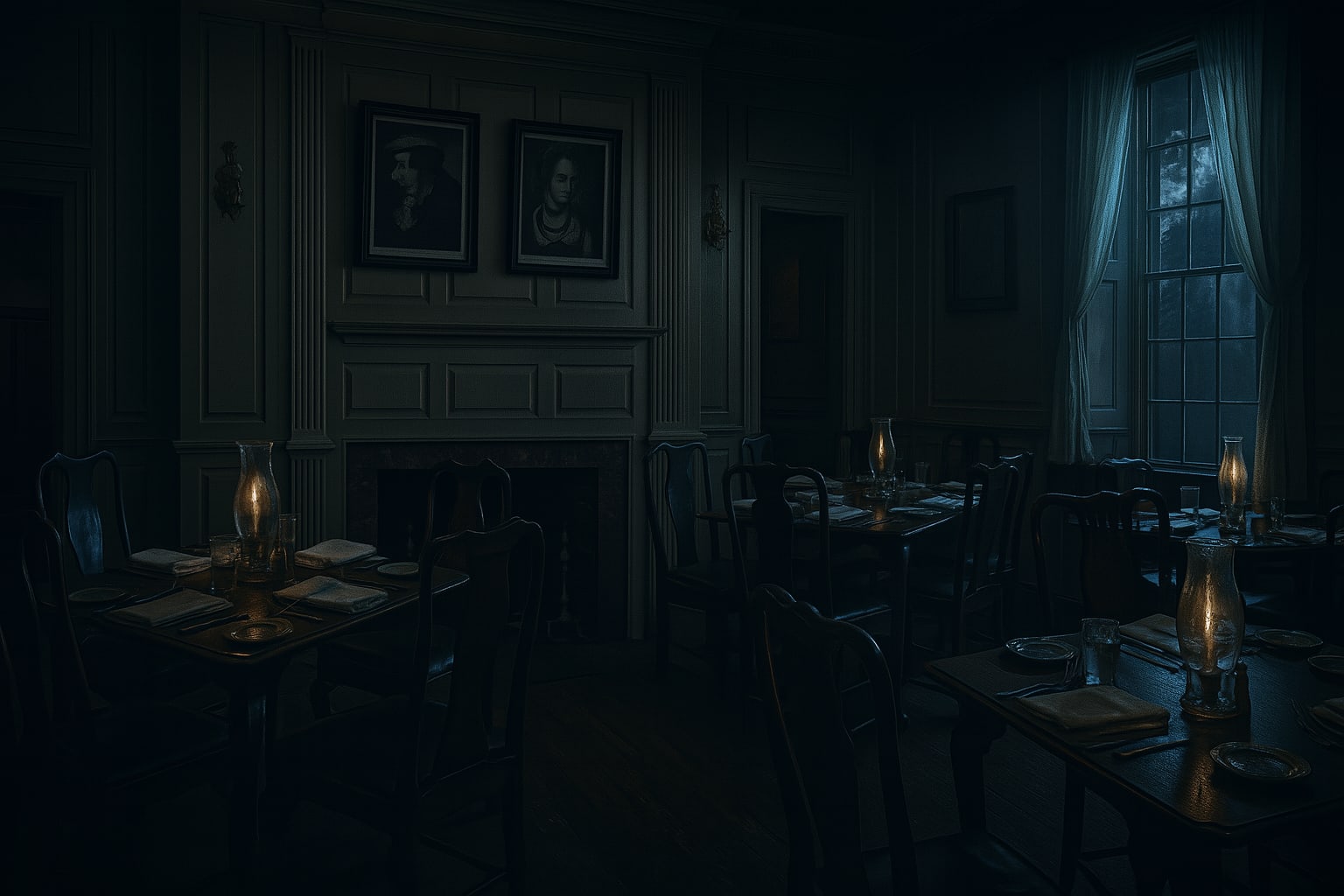
This 1772 tavern for the gentry hosts the spirits of colonial Virginia's elite, with visitors and staff reporting voices in empty rooms and encounters with figures in period clothing.
Read More
The Ghosts of Chowning's Tavern
This 1766 tavern serves spirits of both kinds, with colonial ghosts who refuse to leave and unexplained phenomena reported by staff and visitors for decades.
Read More
The Haunted Raleigh Tavern
Where the American Revolution was quietly planned. The political intensity, intellectual conflict, and human emotion concentrated here created a different kind of haunting — built on urgency, not violence.
Read MoreChurches and Cemeteries — Where the Living and Dead Intersect
In colonial Williamsburg, the boundary between the living and the dead was not a metaphor. It was a physical reality.
Bruton Parish Church, established in 1674, sits at the center of the colonial city. Its churchyard contains the remains of generations of Williamsburg residents — some marked by weathered headstones, others buried in plots that have long since lost their markers. The dead were not segregated to the outskirts of town. They were buried in the heart of it, in churchyards that the living walked through daily on their way to worship, to market, and to the ordinary business of life.
Colonial burial practices reinforced this proximity. Bodies were interred in shallow graves, sometimes stacked in family plots that were used and reused over generations. The dead were close to the surface, close to the living, and — in the spiritual understanding of the time — close to the world they had departed.
The colonial relationship with death was fundamentally different from our own. The dead were not hidden away. They were acknowledged, visited, and in some cases, feared. Ghost stories in colonial Virginia were common and taken seriously. The belief that the dead could return — could linger in the places where they had lived and died — was not fringe superstition. It was a widely held component of the cultural worldview.
Bruton Parish Church and its surrounding grounds have been the subject of paranormal reports for generations. Visitors have described apparitions in the churchyard, the sound of hymns carried on still air, and the sensation of walking through pockets of cold that seem to move among the headstones. The church represents the intersection of spiritual belief, physical proximity to the dead, and centuries of accumulated grief — a combination that makes it one of the most atmospherically charged locations in Williamsburg.
For a deeper look at the history, hauntings, and quiet experiences reported at Bruton Parish Church — and why so many of those experiences go unspoken — we have written a full exploration of what makes this sacred space so significant to Williamsburg's haunted landscape.

Homes Like the Peyton Randolph House — Where Life Turned Dark
The most haunted locations in any city are often private homes — places where the full spectrum of human experience played out within walls that contained and concentrated that experience over decades or centuries.
The Peyton Randolph House is one of the most investigated and most active paranormal locations in Williamsburg. Built in 1715, the house was home to one of the most prominent families in colonial Virginia. Peyton Randolph served as the first president of the Continental Congress. The house hosted Revolutionary leaders, political strategy sessions, and the kind of high-stakes social gatherings that defined the colonial elite.
But the house also witnessed personal tragedy. Family members died within its walls. Enslaved people lived and labored in conditions of forced servitude. The domestic life of the Peyton Randolph House, like the domestic life of every colonial household, was shadowed by grief, loss, and the constant proximity of death.
The house has been the subject of paranormal reports that are unusually vivid and consistent. Visitors have described full-bodied apparitions, the sound of voices in conversation when the building is empty, objects moving on their own, and the sensation of a physical presence in rooms that are demonstrably unoccupied. Paranormal investigators have documented EMF anomalies, temperature fluctuations, and EVP recordings that have made the Peyton Randolph House one of the most studied haunted locations in Virginia.
[INSERT HAUNTED LOCATION CARD: Peyton Randolph House]

When the Modern World Fades Away
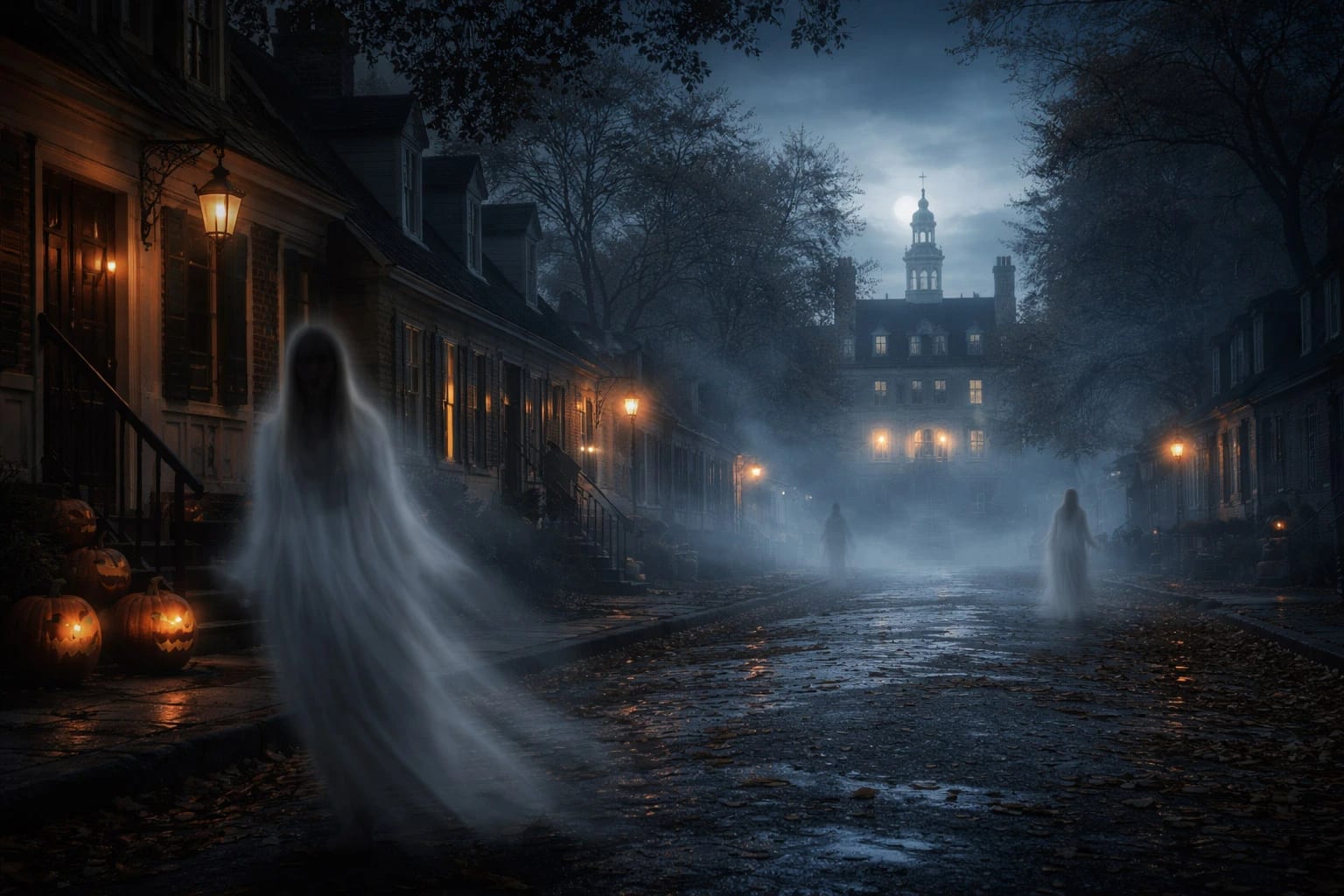
There is a quality to Williamsburg at night that is unlike any other city in America.
Colonial Williamsburg does not have modern streetlights on its historic streets. After dark, the illumination comes from lanterns, candles in windows, and whatever ambient light filters in from the surrounding modern world. The result is a darkness that is startlingly complete — a darkness that strips away the visual noise of the 21st century and replaces it with something much older, much quieter, and much more disorienting.
The streets are empty. The buildings are closed. The sounds of the modern world — traffic, music, the hum of air conditioning — recede to the point of inaudibility. What remains is silence of a kind that most Americans never experience: a silence punctuated only by footsteps, wind, and the occasional creak of a wooden structure settling in the night air.
This is not an accident of urban planning. It is a consequence of preservation. Because Williamsburg preserved the physical environment of the 18th century, it also preserved the sensory environment — the darkness, the quiet, the absence of modern stimulation that defined nighttime in the colonial era.
Paranormal researchers and psychologists both note that environments with reduced sensory input tend to heighten awareness. When the noise and light of modern life are removed, perception sharpens. Subtle sounds become audible. Peripheral vision becomes more active. The threshold for noticing something unusual drops dramatically.
Williamsburg at night creates exactly these conditions. The darkness, the silence, the authenticity of the physical environment — all of it combines to produce a setting where the boundary between the present and the past feels thinner than it does anywhere else. Whether what people experience in this setting is paranormal, psychological, or some combination of both, the experiences are real, they are consistent, and they are reported with a frequency that sets Williamsburg apart from cities that have long since buried their colonial past under concrete and neon.
What People Actually Experience
The paranormal phenomena reported in Williamsburg span the full range of what investigators have documented across haunted locations worldwide.
Residual hauntings — the apparent replaying of past events — are the most commonly reported type of experience. Visitors describe hearing footsteps on empty streets, the sound of horses on cobblestones when no horses are present, muffled conversations in buildings that are closed and locked, and the distant sound of music played on instruments that have not been heard in Williamsburg for centuries.
Intelligent hauntings — encounters that involve apparent interaction — are reported less frequently but with striking consistency. Visitors describe being spoken to by figures who vanish when addressed. Guides report hearing responses to questions posed in empty rooms. Guests on tours have felt taps on the shoulder, tugs on clothing, and the unmistakable sensation of a hand placed on theirs — all from sources that are not physically present.
Full-bodied apparitions — figures that appear solid and detailed enough to be mistaken for living people — have been reported at several locations, most notably the Peyton Randolph House and the area surrounding the Governor's Palace. These figures are typically described as wearing period clothing, moving with purpose, and disappearing abruptly when the observer attempts to engage with them.
Shadow figures — dark, humanoid shapes that move through the environment without resolving into identifiable forms — are reported along the historic streets, in the churchyard at Bruton Parish, and in the areas surrounding the colonial taverns.
Auditory phenomena — sounds without identifiable sources — are the single most common type of report. The sounds described are remarkably consistent across decades of reports: footsteps, voices, the clatter of hooves, the creak of doors, and on occasion, sounds of distress — weeping, cries for help, and the low murmur of what sounds like prayer.
Why the Stories Matter — And Who Tells Them
Williamsburg's ghost stories are not just entertainment. They are, at their best, a form of history — a way of connecting with the human experiences that shaped this place and that continue to resonate within it. But not all ghost stories are created equal, and the difference between a story that honors the history and a story that exploits it is significant.
Some ghost stories are researched. They are grounded in documented events, verified against the historical record, and told with the gravity and accuracy that real human suffering demands. These stories do not need to be embellished because the truth is more powerful than anything a storyteller could invent.
Other ghost stories are invented. They are created to fill gaps in a tour route, to produce a scare at a convenient moment, or to hold the attention of an audience that has been conditioned to expect dramatic revelations every few minutes. These stories may be entertaining, but they are dishonest — and in a place like Williamsburg, where the real history is so rich and so painful, dishonesty is a form of disrespect.
The danger of entertainment-first ghost tours is not just that they misinform their guests. It is that they crowd out the real stories — the ones that deserve to be told, the ones that connect living visitors to the actual experiences of the people who lived and died in these buildings, on these streets, in this city.
Ghost City Tours was built on a different philosophy. Our guides are trained in history first. Every story we tell is tied to real events, real people, and real documented accounts. The goal is not just to scare — although Williamsburg has more than enough genuinely unsettling history to produce that effect — but to connect. To give our guests an experience that leaves them knowing something true about this place and the people who shaped it.
We do not fabricate stories. We do not sensationalize suffering. We tell what actually happened — and we let the history speak for itself. For a deeper exploration of all the haunted locations in Williamsburg, our comprehensive guide documents the real history and reported activity at every site.
Why Williamsburg Continues to Produce Ghost Stories
The question is not whether Williamsburg is haunted. The volume, consistency, and historical correlation of the reports make that question almost beside the point. The more interesting question is why Williamsburg continues to produce new reports, year after year, generation after generation.
The answer lies in the convergence of four factors that Williamsburg possesses in unusual combination.
Historical density. Williamsburg has been continuously occupied since the late 17th century. More than three centuries of human experience — including disease, death, punishment, war, slavery, and the full range of domestic tragedy — have been concentrated in a geographic area that is remarkably compact. The density of historical experience per square foot in Colonial Williamsburg is among the highest in the country.
Emotional intensity. The experiences that defined life in colonial Williamsburg were not mundane. They were extreme — public executions, epidemic disease, revolutionary terror, the daily brutality of slavery, and a proximity to death that the modern mind struggles to comprehend. The emotional intensity of these experiences is exactly the kind of energy that paranormal theory associates with lasting spiritual imprints.
Environmental preservation. Unlike cities that demolished their colonial past, Williamsburg preserved it. The original buildings, the street layouts, the spatial relationships — all of it remains. This preservation creates a physical environment that is, according to paranormal theory, uniquely capable of retaining and expressing the emotional energy it has absorbed.
Psychological openness. The sensory environment of Colonial Williamsburg at night — the darkness, the quiet, the authenticity of the surroundings — creates conditions in which visitors are more likely to notice subtle phenomena. Whether this is because the conditions allow genuine paranormal experiences to manifest or because they heighten psychological receptivity to ambiguous stimuli is a question that each visitor must answer for themselves.
Separating Fact from Fiction
Williamsburg is haunted. The evidence — accumulated over centuries of reports from visitors, residents, historians, and investigators — is substantial enough to warrant serious attention.
But not every story told about Williamsburg's ghosts is true.
Some stories have been embellished over generations of retelling. Details have been added, context has been lost, and quiet, genuine experiences have been inflated into dramatic narratives that bear little resemblance to the original reports. Some stories have been invented entirely — created to serve the commercial interests of tourism rather than the historical record.
Just because a place is haunted does not mean every story about it is true.
This distinction matters because the real stories of Williamsburg — the ones grounded in documented history, supported by repeated independent reports, and consistent over time — are more powerful and more meaningful than any fiction. When fabricated stories circulate alongside legitimate accounts, they dilute the credibility of the genuine reports and disrespect the real history that produced them.
The framework for evaluating a ghost story is straightforward: Is it historically grounded? Are there multiple independent reports? Is it consistent over time? Does it respect the documented record? Stories that satisfy these criteria deserve serious attention. Stories that do not should be viewed with the skepticism they have earned.
Experience the Real Williamsburg — If You Dare
Williamsburg is one of those rare places where the past is not something you read about — it is something you walk through, stand in, and feel around you. The colonial streets, the original buildings, the churchyards where the dead have rested for three centuries — all of it is here, preserved with a care and a completeness that is unmatched in America.
And after dark, when the modern world retreats and the colonial city emerges from the shadows, Williamsburg becomes something else entirely — a place where the boundary between past and present thins to the point of transparency, and where the experiences that people have been reporting for centuries continue to occur with a frequency and a consistency that demand attention.
Ghost City Tours in Williamsburg offers nightly walking experiences through the most haunted streets and locations in the colonial city. Our guides are historians, researchers, and storytellers who bring the real Williamsburg to life — not the sanitized, comfortable version, but the true version, grounded in documented history and told with the respect and rigor that this extraordinary city deserves.
Whether you are a history enthusiast, a paranormal investigator, or simply someone who wants to experience one of the most authentically haunted cities in America, Williamsburg is waiting — patient, quiet, and very much alive with the echoes of its past.
Come walk these streets after dark. The real version is better than anything anyone could invent.


