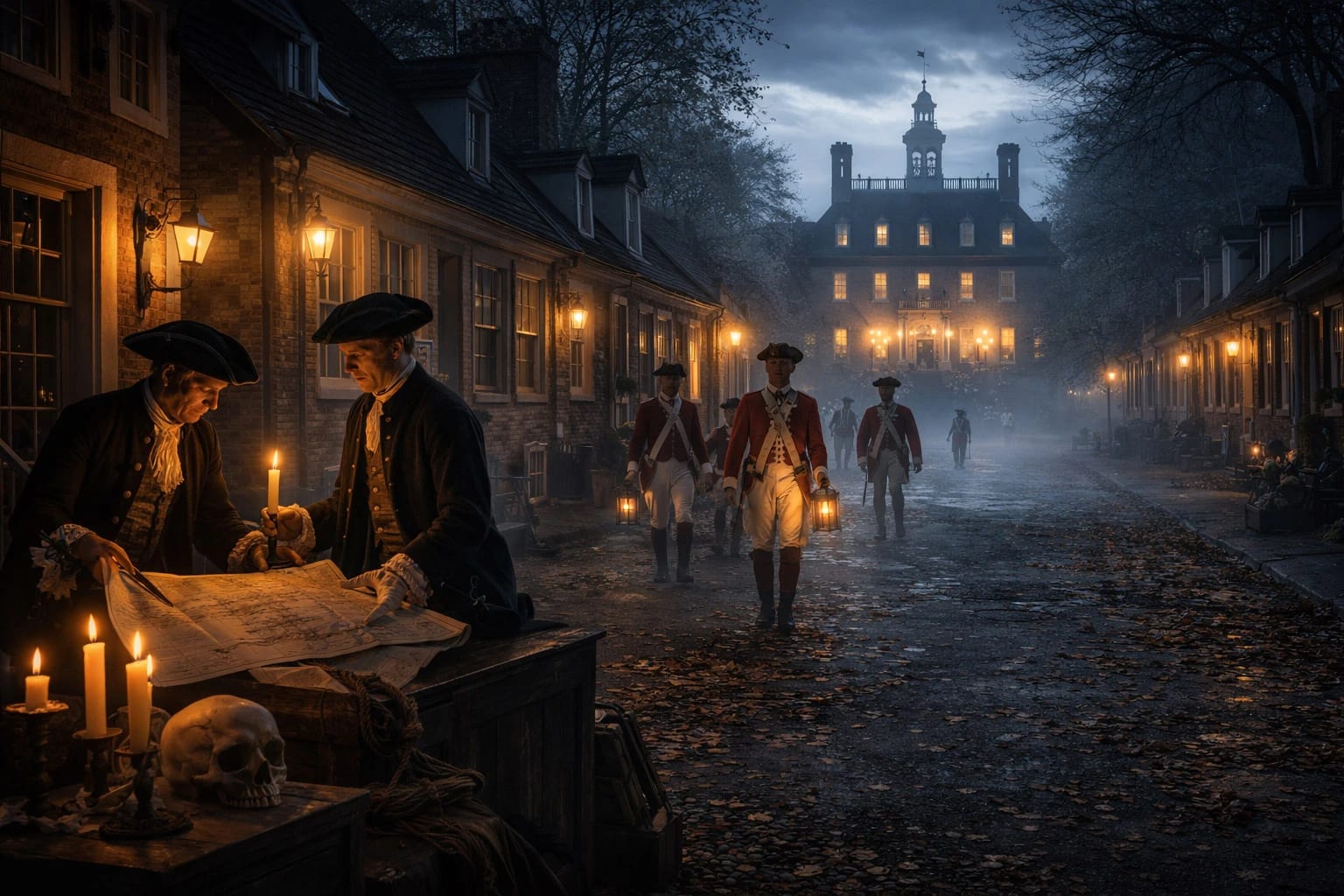
Why Colonial-Era Hauntings Feel Different From Modern Ghost Stories
There is a quality to colonial hauntings that distinguishes them from the ghost stories that emerge from more recent settings. The difference is not just age. It is character.
Modern ghost stories tend to be tied to singular events — a murder in a hotel room, an accident on a highway, a tragedy in a building that has since been demolished and rebuilt. The environment around the event has changed. The neighborhood has evolved. The physical context of the original experience has been fragmented by decades of development, renovation, and the constant churn of modern life.
Colonial hauntings are different. They emerge from an era when life was slower, more intimate, and more physically concentrated. People were born, lived, worked, suffered, and died within a few hundred feet of each other. The boundaries between public and private life were thinner. The boundaries between life and death were thinner still. Disease moved through households. Punishment was administered in public view. Death occurred in the room where the family ate dinner.
The result is a type of haunting that feels more personal, more layered, and more deeply embedded in the physical environment than the isolated ghost stories of the modern era. Colonial hauntings are not fragments. They are ecosystems — interconnected networks of human experience that were concentrated in a small geographic area over the course of generations.
Ghost City Tours approaches these hauntings with a focus on historical causation — not just what is seen or heard, but why it happens. Understanding the conditions of colonial life is essential to understanding why Williamsburg's ghosts behave the way they do, why they appear where they appear, and why they have persisted for centuries in a way that random hauntings do not.
In the 1700s, Death Was a Constant Companion
The colonial experience of death was fundamentally different from our own — not because people died more often (although they did), but because death was woven into the fabric of daily life in ways that the modern world has carefully engineered out of existence.

Disease Could Kill Without Warning
Smallpox, dysentery, typhoid, malaria, and a catalog of infections that would be trivially treated today were death sentences in 18th-century Williamsburg. There were no antibiotics. There were no vaccines for most diseases until late in the century. Medical treatment consisted largely of bloodletting, purging, and the administration of substances that were frequently toxic.
Disease did not discriminate. It moved through households indiscriminately — taking a child one week, a parent the next, a servant the week after that. Entire families could be devastated in a matter of days. The emotional result was a population living under constant threat — a baseline of fear, grief, and unpredictability that saturated the domestic environment with a level of emotional intensity that is difficult for the modern mind to fully appreciate.
Paranormal researchers have long noted that environments saturated with fear and grief over extended periods tend to produce the strongest and most persistent reports of unexplained activity. Colonial Williamsburg was saturated with both, continuously, for generations.
People Died Inside Their Homes
There were no hospitals in the modern sense. When someone fell ill, they were treated at home — in the same bed where they slept, in the same room where the family gathered, within earshot of children who could hear every sound of suffering.
Death did not happen in a sterile, institutional setting separated from daily life. It happened in the kitchen. In the parlor. In the bedroom directly above the room where the rest of the family was trying to carry on. The intimacy of colonial death — the physical proximity of the dying to the living — created a concentration of emotional energy within private homes that paranormal theory identifies as one of the strongest predictors of lasting spiritual imprints.
The Peyton Randolph House is one of the most vivid examples of this phenomenon. Built in 1715 and home to one of colonial Virginia's most prominent families, the house witnessed multiple deaths within its walls — from illness, from age, and from the quiet accumulation of domestic tragedy that defined colonial life. The paranormal activity reported at the Peyton Randolph House is among the most intense in Williamsburg: full-bodied apparitions, disembodied voices, objects moving without explanation, and the persistent sensation of a presence that occupies the house alongside the living.
[INSERT HAUNTED LOCATION CARD: Peyton Randolph House]
Homes retain personal energy more than public spaces. The grief, the fear, the love, the loss — all of it was concentrated within walls that still stand today, holding what was left behind.
Infant Mortality and Family Loss
The death of a child in colonial Williamsburg was not a rare tragedy. It was a common experience — so common that families expected it, prepared for it, and lived with a weight of anticipatory grief that modern parents can barely imagine.
Child mortality rates in the colonial era were devastating. As many as one in four children died before their fifth birthday. Families who raised six or eight children might bury two or three of them before adulthood. The grief was not a single event. It was a cycle — repeated, anticipated, and never fully resolved.
These cycles of loss created what paranormal researchers describe as deep emotional imprint environments — locations where the same type of intense emotional experience was repeated so many times, over so many years, that the cumulative energy became embedded in the physical structure of the home itself. The colonial homes of Williamsburg are, by this measure, among the most emotionally dense residential structures in America.
Punishment, Fear, and Public Spectacle
Colonial justice was not private. It was performed in public, by design, as an exercise in collective fear.
The stocks and pillory stood at the center of town. Offenders were locked in place for hours, sometimes days — exposed to weather, denied food, and subjected to the contempt and abuse of the community. Public whippings were common. Branding was practiced. Executions drew crowds — men, women, and children gathered to watch the condemned die, their presence required not by curiosity but by social expectation.
The emotional intensity of these events was shared collectively. Hundreds of people witnessed the same act of suffering at the same time, in the same place. The fear, the revulsion, the morbid fascination, the relief that it was not them — all of it concentrated in a single location, repeated across decades of colonial governance.
Paranormal researchers describe this as mass psychological imprinting — events where the emotional intensity is amplified by the number of people experiencing it simultaneously. A private death leaves a private imprint. A public execution, witnessed by hundreds, leaves something proportionally larger.
The Williamsburg Gaol — the colonial jail — concentrated individual suffering over an even longer timeline. Prisoners were held in brutal conditions: cramped cells, minimal sanitation, inadequate food, and the constant presence of disease. Many inmates died before they ever reached trial. The gaol was a place of prolonged, concentrated human misery — exactly the type of environment that produces the most persistent reports of paranormal activity.
Visitors to the gaol site have reported sounds of distress, cold spots, and the sensation of being watched — experiences consistent with what investigators would expect from a location that concentrated so much suffering within such a confined space.
Williamsburg at the Center of a Nation About to Break
The American Revolution did not begin on a battlefield. It began in rooms like the ones that still stand in Williamsburg — in the Capitol building where the House of Burgesses debated independence, in the taverns where political conspiracies were hatched, and in the homes where families were torn apart by loyalties that could no longer coexist.

Divided Loyalties
Williamsburg in the 1770s was a city at war with itself. Neighbors who had shared meals, conducted business, and raised their children together found themselves on opposite sides of a conflict that demanded total commitment. Loyalists — those who remained faithful to the Crown — faced social ostracism, property confiscation, and the threat of mob violence. Patriots — those who advocated for independence — risked execution for treason if the Revolution failed.
The psychological toll of this division was immense. Every conversation was a potential betrayal. Every friendship was suspect. The social fabric of the community — the trust, the familiarity, the sense of shared identity that had held colonial Williamsburg together for decades — was shredded by a conflict that forced every person to choose a side and live with the consequences.
Fear of Violence
The Revolution brought to Williamsburg a level of existential uncertainty that the city had never experienced. The outcome was genuinely unknown. The possibility of British military action — arrest, imprisonment, execution — was real and present. Citizens who had lived their entire lives under the protection of the Crown now found themselves in open rebellion against it, with no guarantee that they would survive the consequences.
The Governor's Palace — the seat of royal authority in Virginia — became the physical embodiment of this tension. Built to project power and permanence, the Palace became a symbol of everything the Revolution sought to overthrow. The power struggles that unfolded within and around the Palace — between royal governors and colonial legislators, between Crown authority and the rising tide of self-determination — concentrated political fear and ideological conflict in a single, architecturally imposing structure.
Visitors to the Governor's Palace grounds have reported unexplained phenomena for decades — footsteps in empty rooms, doors that open and close without cause, and the persistent sensation of being observed by something that is not visible. The residual energy from decades of political conflict and the fear that accompanied it appears to have left its mark on the site.
Taverns Were Where Lives Collided
Colonial taverns were the social infrastructure of 18th-century life — and they were places where an extraordinary density of human experience was concentrated under a single roof.
The Ghosts of King's Arms Tavern
This 1772 tavern for the gentry hosts the spirits of colonial Virginia's elite, with visitors and staff reporting voices in empty rooms and encounters with figures in period clothing.
Read More
The Ghosts of Chowning's Tavern
This 1766 tavern serves spirits of both kinds, with colonial ghosts who refuse to leave and unexplained phenomena reported by staff and visitors for decades.
Read More
The Haunted Raleigh Tavern
Where the American Revolution was quietly planned. The political intensity, intellectual conflict, and human emotion concentrated here created a different kind of haunting — built on urgency, not violence.
Read MoreTravelers Brought Stories, Illness, and Conflict
The journey to Williamsburg in the 1700s was not a commute. It was an ordeal. Travelers arrived exhausted, often ill, carrying news from distant places and the physical toll of days or weeks on roads that were little more than rutted paths through wilderness. Some arrived sick and never left. They died in upstairs rooms, far from home, their names recorded in ledgers and then forgotten.
The constant turnover of travelers meant that taverns absorbed an unusually wide range of human experience — joy, despair, illness, conflict, celebration, and death — from an unusually diverse population. Each person who passed through left something behind: a conversation, a dispute, a fever, a final breath. The accumulation of these experiences over decades of continuous operation created locations of remarkable emotional density.
Taverns Were Centers of Political Discussion
The Raleigh Tavern was not just a place to eat and drink. It was where the Virginia House of Burgesses convened when the royal governor dissolved the assembly. It was where political leaders — including Thomas Jefferson, Patrick Henry, and George Washington — gathered to organize resistance to British taxation and plan the steps that would lead to revolution.
The intensity of these discussions — debates about liberty, treason, war, and the future of a colony that was on the verge of becoming a nation — added a layer of emotional energy to the tavern environment that went far beyond ordinary social interaction. The stakes were existential. The fear was real. And the passions that drove these conversations left their mark on a building that concentrated political fervor and personal risk in equal measure.
King's Arms Tavern and Chowning's Tavern are among the colonial-era establishments in Williamsburg where visitors and staff have reported unexplained phenomena — voices in empty dining rooms, the sensation of being watched, and fleeting glimpses of figures in period clothing.
[INSERT HAUNTED LOCATION CARD: King's Arms Tavern]
[INSERT HAUNTED LOCATION CARD: Chowning's Tavern]
When the Mind Was Feared and Isolated
The Public Hospital of 1773 was the first public institution in British North America dedicated to the treatment of mental illness. In the 18th century, that meant confinement, restraint, and methods that amounted to torture.

Early Mental Health Treatment Was Primitive
The patients of the Public Hospital were not understood. They were feared. Colonial society regarded mental illness as a form of moral failure, demonic possession, or irreversible corruption of the mind. Treatment reflected that understanding: patients were isolated from their families, confined to small cells, often shackled, and subjected to cold water immersion, forced bleeding, and extended periods of darkness designed to "restore" them to sanity.
The cruelty was not born of malice, in most cases. It was born of ignorance — a complete absence of understanding about the nature of mental illness and the needs of those who suffered from it. But the result was the same: human beings experiencing profound fear, confusion, and pain over extended periods, in an environment specifically designed to contain and isolate them from the world.
Emotional Suffering Without Explanation
What makes the Public Hospital particularly significant from a paranormal perspective is the nature of the suffering that occurred there. The patients did not understand what was happening to them. They did not understand why they had been taken from their families. They did not understand the treatments being administered. Their suffering was compounded by confusion and abandonment — emotional states that paranormal researchers associate with some of the most intense and persistent types of intelligent hauntings.
The hospital site has been the subject of reports that suggest exactly this type of activity: sounds of distress, the sensation of overwhelming sadness, and encounters that seem to involve awareness — a presence that responds to the living, that seems to seek contact or understanding.
[INSERT HAUNTED LOCATION CARD: Public Hospital of 1773]
Faith Didn't Remove Fear of Death — It Framed It
The colonial relationship with death was shaped by religious belief — but that belief did not provide the comfort that modern observers might assume.

Burial Grounds Were Close to Daily Life
The dead in colonial Williamsburg were not buried in remote cemeteries on the outskirts of town. They were buried in churchyards at the center of the community — in the same grounds where the living gathered for worship, socialized after services, and conducted the ordinary business of daily life.
Bruton Parish Church, established in 1674, sits at the heart of the colonial city. Its churchyard has been a burial ground for more than three centuries. The graves are close to the surface, close to the walkways, and close to the building itself. The dead and the living occupy the same space — separated by a few feet of earth and the thinnest of boundaries.
Visitors to Bruton Parish and its surrounding grounds have described apparitions among the headstones, the sound of hymns carried on still air, and the sensation of walking through pockets of cold that seem to move through the churchyard with purpose. The proximity of the dead to the living — a physical reality of colonial life that has been preserved intact — appears to contribute to the paranormal activity reported in this area.
What makes Bruton Parish particularly notable is how rarely these experiences are discussed openly. For a full exploration of the quiet hauntings of Williamsburg's oldest active church — and why sacred spaces produce a kind of paranormal report that people are reluctant to share — we have dedicated an entire article to this remarkable building.
Spiritual Beliefs About the Afterlife
Colonial Virginians believed in judgment. They believed in heaven and hell. And they feared — with a depth that shaped their daily behavior — that their eternal fate hung in the balance of every decision they made during their mortal lives.
This fear did not diminish the terror of death. If anything, it amplified it. Dying meant facing judgment. Dying unprepared — without confession, without prayer, without the assurance of salvation — was a prospect that haunted the colonial mind with an intensity that modern secular society finds difficult to comprehend.
The result was a population whose relationship with death was saturated with spiritual anxiety — a form of emotional energy that paranormal researchers consider uniquely potent. Fear of death combined with fear of divine judgment created an emotional environment of extraordinary intensity, concentrated in the churches, the churchyards, and the homes where families prayed for the souls of the dying and mourned for those who had departed without certainty of salvation.
Williamsburg Never Replaced Its Past — It Preserved It
This is the factor that makes Williamsburg unique among American cities — and it is the factor that best explains why colonial-era hauntings persist here with an intensity that has not diminished over time.
Most cities erased their colonial past. They tore down the original buildings, regraded the streets, paved over the foundations, and replaced the 18th century with the demands of the 19th, 20th, and 21st centuries. Whatever emotional energy had accumulated in the colonial structures was dispersed when those structures were destroyed.
Williamsburg did the opposite. It preserved the original buildings. It maintained the street layouts. It kept the spatial relationships — the proximity of homes to churches, of taverns to government buildings, of burial grounds to living spaces — intact. The physical container that held three centuries of accumulated human experience was never broken.
Paranormal researchers theorize that when the physical environment is preserved, the emotional energy it contains remains accessible — still resonating within the walls, the floors, and the foundations that absorbed it. When the environment is destroyed, the energy dissipates. Williamsburg's extraordinary act of preservation did not just save architecture. It saved atmosphere. It saved memory. And it saved whatever it is that visitors feel when they walk these streets after dark and sense, unmistakably, that they are not alone.
Unlike other cities that rebuilt over their past, Williamsburg kept it. Nothing wiped the slate clean. And for a full exploration of the forces that created this environment, read our guide to why Williamsburg is so haunted.
Why People Still See and Hear Things Today
The paranormal experiences reported in Colonial Williamsburg are not relics of a superstitious past. They are ongoing — documented by visitors, residents, guides, and investigators in the present day.
The explanation, to the extent that one exists, lies in the convergence of three factors:
Environmental authenticity. The physical environment of Colonial Williamsburg is, to a remarkable degree, the physical environment of the 18th century. The buildings are original or faithfully reconstructed. The streets follow the colonial layout. The sensory experience at night — the darkness, the quiet, the absence of modern stimulation — replicates the conditions under which the original experiences occurred. If the physical environment acts as a container for emotional energy, Williamsburg's container is intact.
Emotional history. Three centuries of disease, death, punishment, war, slavery, and domestic tragedy have left an accumulation of emotional energy that is, by any measure, extraordinary. The density of suffering per square foot in Colonial Williamsburg is among the highest of any preserved historic site in America.
Psychological openness. The sensory conditions of Colonial Williamsburg at night — the darkness, the silence, the authenticity — create a state of heightened awareness in which visitors are more likely to notice subtle phenomena. Whether this heightened awareness allows people to perceive genuine paranormal activity or simply makes them more sensitive to ambiguous stimuli is a question that remains open. What is not in question is that the experiences are real — they are reported consistently, by credible witnesses, in patterns that have been building for centuries.
The Stories Matter — But Only If They're True
Colonial Williamsburg's ghost stories are among the most compelling in America — when they are grounded in actual history. The problem is that not all of them are.
Not All Colonial Ghost Stories Are Accurate
Some of Williamsburg's ghost stories are rooted in documented history — tied to real people, real events, and real locations with verifiable connections to the experiences being described. These stories have been told and retold over generations, and their core details have remained consistent because they are anchored in fact.
Other stories have drifted. Details have been added. Historical claims have gone unverified. A genuine experience has been embellished into something more dramatic, more frightening, and less honest. The result is a landscape of ghost lore in which the authentic and the invented exist side by side, and where the average visitor has no reliable way to tell the difference.
The Problem With Some Ghost Tours
The entertainment-first approach to ghost tours — prioritizing audience reaction over historical accuracy — is particularly damaging in a place like Williamsburg, where the real history is so rich and so painful that fabrication is not just unnecessary but insulting.
When a tour guide invents a ghost story for a location that has no documented paranormal history, they are not just misleading their audience. They are crowding out the real stories — the ones tied to documented suffering, to real people, to events that actually shaped this city and the lives within it. The fabricated story takes the space that should belong to the truth.
How Ghost City Tours Approaches Colonial Hauntings
Ghost City Tours was built on the conviction that the real stories are better than anything we could invent. Our guides are trained in history first — in the documented record of colonial Williamsburg, the people who lived here, and the events that shaped this city over three centuries.
Every story we tell is tied to real events and real documented accounts. When we describe a haunting, we can tell you who lived in that building, what happened there, and why the location has been associated with paranormal activity. Our guides are interpreters — not performers. They connect the history to the hauntings, and they do so with the accuracy and respect that this extraordinary city demands.
For a comprehensive guide to all of the haunted locations in Williamsburg, explore our full resource.
Separating Williamsburg's Real Hauntings From Fiction
Colonial Williamsburg is genuinely haunted. The evidence — accumulated over centuries of reports, corroborated by historical research, and consistent across generations of independent witnesses — is substantial enough to warrant serious attention from anyone willing to approach the subject with intellectual honesty.
But genuine does not mean universal. Not every building in Williamsburg is haunted. Not every story told about it is true. And not every ghost tour that operates here treats the history with the respect it deserves.
The colonial ghosts of Williamsburg are not random. They are the product of specific historical conditions — disease, death, punishment, war, slavery, and preservation — that created an environment of extraordinary emotional density and then kept that environment intact for more than three centuries. Understanding those conditions is the first step toward understanding the hauntings. And understanding the hauntings is the first step toward experiencing Williamsburg the way it deserves to be experienced — not as a collection of ghost stories, but as a place where the past is still present, still speaking, and still waiting to be heard.
Ghost City Tours in Williamsburg offers nightly walking experiences through the most historically and paranormally significant locations in the colonial city. Our guides bring the real Williamsburg to life — grounded in documented history, told with respect, and delivered by people who understand that the best ghost stories are the ones that are true.
Come walk these streets. The 18th century is still here.


