Humble Beginnings
Abraham Lincoln was born on February 12, 1809, in a one-room log cabin in Hardin County, Kentucky. His family was poor. His mother, Nancy Hanks Lincoln, died when he was nine years old — a loss that shaped him profoundly and left a wound that contemporaries said never fully healed.
Lincoln's childhood was defined by frontier hardship — manual labor, minimal formal education, and the constant instability of a family that moved repeatedly in search of better land and better prospects. He grew up in Indiana and Illinois, working as a rail-splitter, a flatboatman, a store clerk, and a postmaster before finding his way to the law.
His education was largely self-directed. Lincoln read voraciously — borrowing books, studying by firelight, teaching himself the law from Blackstone's Commentaries. His mind was extraordinary — analytical, logical, capable of holding complexity without simplifying it — and it was forged not in privilege but in deprivation. Everything Lincoln became, he made himself.
This matters for understanding the haunting. Lincoln was not born to power. He arrived at it through decades of struggle, self-improvement, and a moral seriousness that set him apart from the politicians of his era. The man who would carry the weight of the Civil War was a man who understood suffering personally — who had experienced loss, poverty, and the particular loneliness of being intellectually isolated in a world that did not always understand what he was trying to say.
A Mind Built for Leadership
Lincoln's law career in Springfield, Illinois, established him as one of the most formidable legal minds in the state. He was a skilled debater — patient, precise, and capable of reducing complex arguments to their essential elements in ways that made jurors and judges feel he was speaking directly to them.
But it was his moral compass that distinguished him from his contemporaries. Lincoln's opposition to slavery was not political posturing. It was a deeply held conviction that grew stronger as the national debate intensified. His debates with Stephen Douglas in 1858 — seven public contests that drew national attention — established him as a figure of national importance and laid the groundwork for his presidential campaign two years later.
Lincoln entered politics not because he craved power but because he believed the country was heading toward a crisis that required leadership grounded in principle rather than convenience. That conviction — the belief that he had a responsibility to act — would define his presidency, his suffering, and ultimately, the persistence of his presence in the city where he served and died.
A Nation on the Brink
Lincoln's election in November 1860 was the spark that ignited a crisis that had been building for decades. Before he even took office, seven Southern states had seceded from the Union. By the time he was inaugurated in March 1861, the Confederate States of America had formed a rival government, and the country Lincoln had been elected to lead was disintegrating.
Lincoln arrived in Washington DC under armed guard. There were credible assassination threats. The city itself was tense, divided, and uncertain about its own safety — situated between the slaveholding states of Virginia and Maryland, surrounded by populations whose loyalties were far from settled.
The Washington DC that Lincoln entered was not the confident seat of power it would later become. It was a city under pressure — militarized, fearful, and bracing for a conflict whose scale and duration no one could predict. The streets were filled with soldiers. The unfinished Capitol dome — still under construction — stood against the sky as a symbol of a nation that was itself incomplete.
Washington DC as a City Under Pressure
For four years, Lincoln governed from a city that was functionally a war zone. Forts ringed the capital. Confederate troops were camped within miles of the White House. The sound of artillery from nearby battles could be heard from the Executive Mansion's windows.
The stress of governing under these conditions was immense — not just the strategic burden of directing the war, but the personal burden of living in a city where the enemy was close enough to threaten the capital itself. Lincoln walked these streets knowing that the Confederate Army could, at any moment, attempt to capture the city he was trying to save.
This sustained pressure — years of it, without respite — is part of the dark history of Washington DC that most visitors never fully appreciate. The city absorbed Lincoln's stress as he absorbed the nation's. And that absorption, according to those who have experienced his presence in the decades since, appears to have been permanent.
Leading a Nation Through War
The Civil War killed more than 600,000 Americans — more than all other American wars combined at the time. Lincoln bore personal responsibility for the Union's prosecution of that war, and the weight of that responsibility was visible to everyone who knew him.
The Personal Cost of Leadership
Lincoln aged visibly during the war. Photographs taken at the beginning and end of his presidency show a man who had been physically transformed by the burden he carried. His face grew gaunt. His eyes deepened. The lines on his face multiplied and hardened. Contemporaries described a sadness that seemed to radiate from him — not the temporary sadness of a bad day, but a permanent, structural melancholy that had become part of who he was.
He slept poorly. He paced the halls of the White House at night, unable to find rest while men were dying on battlefields he had ordered them to. He read the casualty reports personally. He visited the hospitals — walking among the wounded, sitting at bedsides, looking into the faces of men who had been broken by orders that bore his signature.
Lincoln did not shield himself from the consequences of his decisions. He absorbed them. Every death was a weight he added to the burden he was already carrying. Every letter from a grieving family was a personal indictment that he accepted without deflection. The psychological toll was enormous — and it was concentrated, day after day, year after year, within the walls of the White House.
The Death of Willie Lincoln
In February 1862, while the war was in its first terrible year, Lincoln's son Willie died of typhoid fever in the White House. He was eleven years old.
The death shattered Lincoln. He retreated to his office and wept. He returned to Willie's room repeatedly in the days that followed, looking at the body of his son, unable to accept what had happened. Mary Todd Lincoln's grief was even more profound — she was consumed by it, unable to function, and eventually began holding séances in the White House in an attempt to communicate with Willie's spirit.
The loss of Willie added a dimension of personal anguish to the already crushing weight of the presidency. Lincoln was not just a leader losing a war and sending men to die. He was a father who had buried a child in the same building where he was trying to hold a nation together. The intersection of public duty and private devastation — concentrated in a single building, in a single man — created an emotional intensity that paranormal researchers consider virtually unprecedented.
This is where the haunting begins to make sense. Lincoln's connection to the White House was not just professional. It was personal — bound up with the most painful experience of his life, layered on top of the most consequential political burden any president has ever carried. If emotional intensity produces spiritual imprints, Lincoln's imprint on the White House is the deepest in its history.
Living in a House Full of Pressure
The White House during Lincoln's presidency was not the serene, controlled environment that modern visitors imagine. It was a building under siege — politically, emotionally, and at times physically.
Lincoln paced its halls at night. Staff reported hearing his footsteps in the early morning hours — the slow, heavy tread of a man who could not sleep because the weight of what he carried would not let him rest. He sat alone in rooms where the gas lamps burned low, reading dispatches from the front, composing letters to generals, and wrestling with decisions that would determine the fate of the nation.
The White House absorbed Lincoln's emotional state the way a sponge absorbs water. His grief for Willie. His anguish over the war. His isolation from a wife whose own grief had made her unreachable. His knowledge — carried silently, never fully shared — that the decisions he was making were imperfect, that men were dying because of choices he had made, and that there was no one alive who could tell him with certainty that he was making the right ones.
War updates arrived daily. Each one brought a new count of the dead, a new list of the wounded, a new calculation of the cost of continuing the fight. Lincoln read them all. He did not delegate the grief. He owned it.
[INSERT HAUNTED LOCATION CARD: White House]
A Night That Changed the Nation Forever
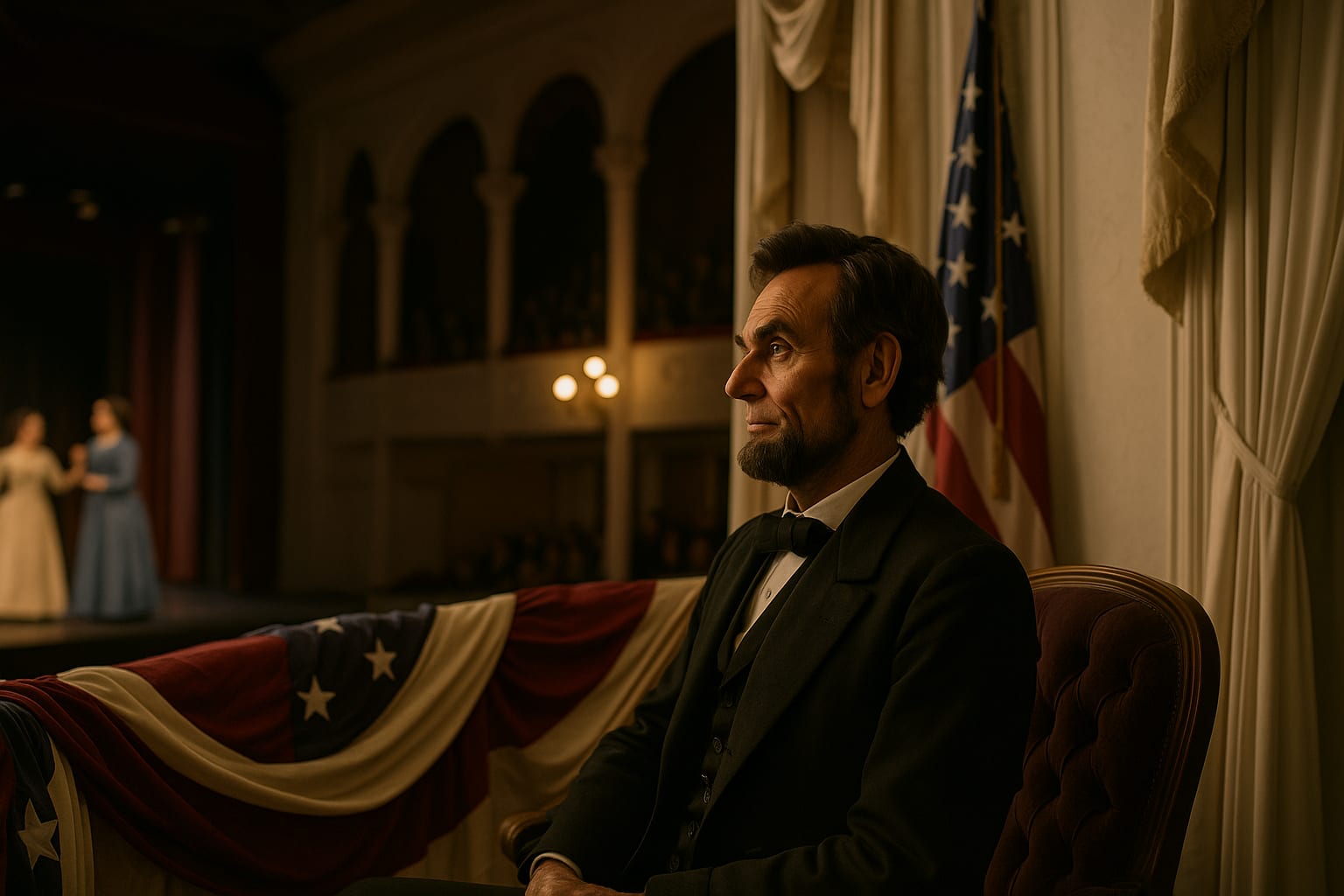
On the evening of April 14, 1865 — five days after Robert E. Lee's surrender at Appomattox effectively ended the Civil War — President Lincoln and his wife attended a performance of Our American Cousin at Ford's Theatre.
Lincoln was in good spirits. The war was over. The Union was preserved. For the first time in four years, the weight that had crushed him seemed to lift — just slightly, just enough to accept an invitation to the theatre, to sit in a box above the stage, and to try, for a single evening, to be something other than a wartime president.
The Moment of the Shot
At approximately 10:15 PM, John Wilkes Booth — an actor, a Confederate sympathizer, and a man who believed he was saving the South — entered the presidential box from behind. He raised a .44-caliber Derringer pistol and fired a single shot into the back of Lincoln's head.
The president slumped forward. Mary Todd Lincoln screamed. Booth leaped from the box to the stage — breaking his leg on landing — and shouted what witnesses variously reported as "Sic semper tyrannis" before fleeing through the back of the theatre.
The audience froze. Then chaos erupted. Screaming. People rushing toward the exits. Others surging toward the presidential box. A doctor in the audience was brought to Lincoln's side and determined almost immediately that the wound was mortal.
The emotional shock of that moment — the collective horror of hundreds of people witnessing the murder of their president — was compressed into a single building in a single instant. Ford's Theatre has carried the imprint of that moment ever since.
[INSERT HAUNTED LOCATION CARD: Ford's Theatre]
The Death of Lincoln
Lincoln was carried across the street to the Petersen House — a boarding house where he was laid diagonally across a bed that was too short for his tall frame. Doctors, cabinet members, and family gathered in the small room. Mary Todd Lincoln collapsed in grief.
Lincoln never regained consciousness. His breathing was labored, irregular, and grew weaker through the night. The men in the room — some of the most powerful people in the country — could do nothing but watch.
At 7:22 AM on April 15, 1865, Abraham Lincoln died. Secretary of War Edwin Stanton, standing at the bedside, is reported to have said: "Now he belongs to the ages."
The nation's response was a grief so enormous that it defies adequate description. Flags were lowered. Businesses closed. Strangers wept in the streets. The man who had held the country together through four years of war — who had carried its burden personally, visibly, and without complaint — was gone. And the country he had saved did not know how to continue without him.
A Nation in Mourning
Lincoln's funeral was one of the most extraordinary events in American history. His body lay in state in the White House, then in the Capitol Rotunda, before being placed aboard a funeral train that traveled 1,654 miles from Washington DC to Springfield, Illinois — retracing the route Lincoln had taken to Washington as president-elect four years earlier.
The train stopped in cities along the route, and at each stop, thousands of people gathered to view the coffin and pay their respects. An estimated one million Americans saw Lincoln's body during the two-week journey. Millions more lined the railroad tracks as the train passed, standing in silence as the funeral car moved through their towns and fields.
Lincoln's death was not just personal. It was collective — a national trauma experienced simultaneously by millions of people who had never met him but who understood, instinctively, that the man who had held the country together was irreplaceable. The grief was so widespread and so intense that it became, in effect, a shared emotional event of a magnitude that the country had never experienced.
This matters for understanding the haunting. Lincoln's death was not a private event. It was a public catastrophe that affected an entire nation. The emotional energy generated by his assassination and its aftermath was concentrated most intensely in the places where it happened — the White House, Ford's Theatre, the streets of Washington — but it radiated outward, touching every corner of the country.
The persistence of Lincoln's ghost may be connected to this collective dimension. He is not just one man's spirit. He is the focal point of a nation's grief — a presence that represents not only his own unfinished business but the unresolved emotions of millions of people who mourned him.
The President Who Never Left
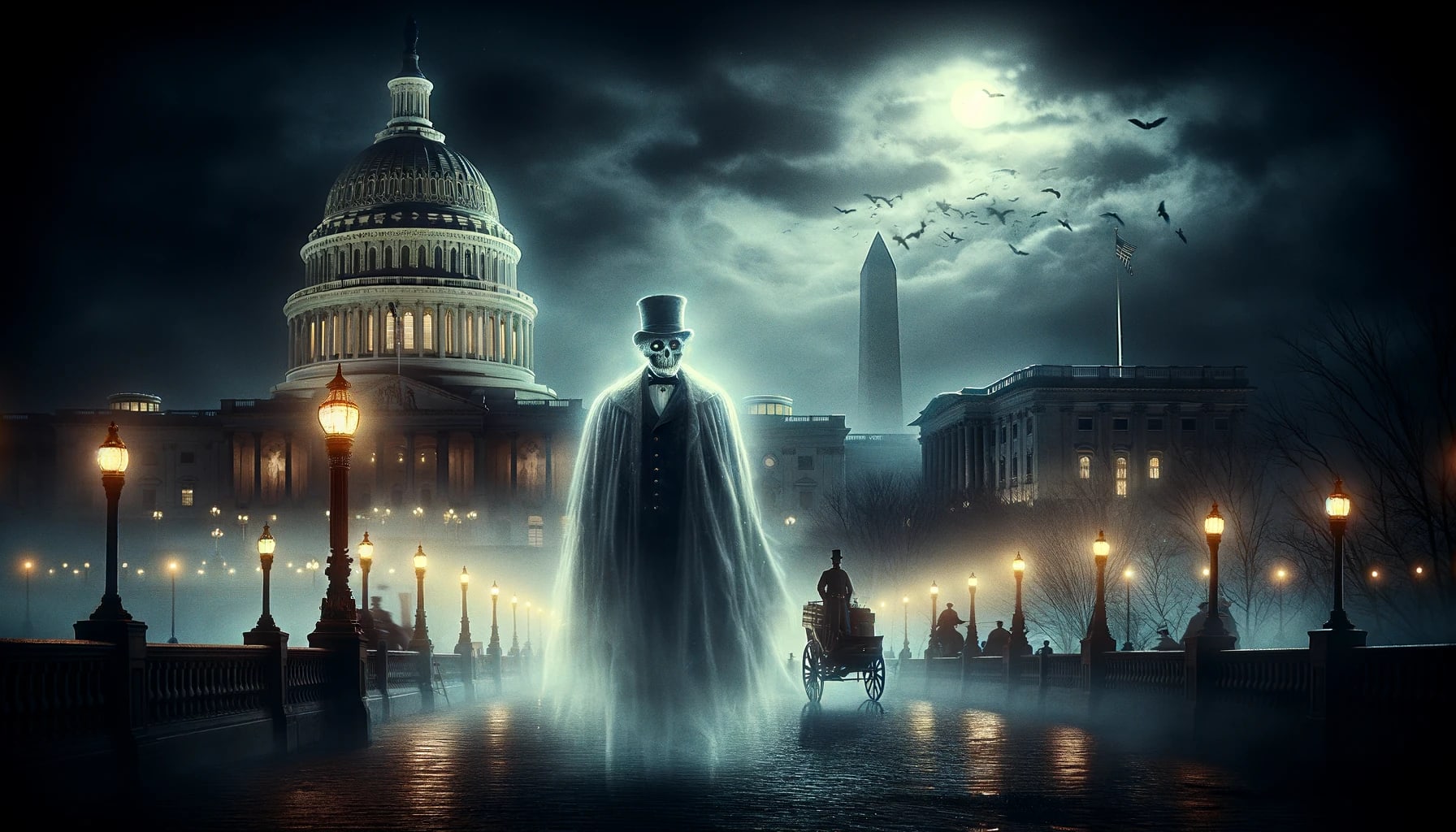
Reports of Lincoln's ghost began almost immediately after his death. White House staff in the years following the assassination described hearing footsteps in the second-floor hallway — the same hallway where Lincoln had paced during the war years. Doors opened and closed on their own. Cold spots appeared in rooms where no drafts existed. The sensation of being watched — of sharing a space with someone who was not visible — was reported with increasing frequency as the decades passed.
Why Lincoln?
Paranormal researchers have explored why Lincoln's ghost is so persistent — why, of all the presidents who have lived and died in Washington DC, his presence is the one most frequently reported.
The answer lies in the convergence of factors that made Lincoln's emotional experience uniquely intense:
Emotional burden. No president has carried a heavier weight. The Civil War killed more Americans than any other conflict, and Lincoln bore personal responsibility for the Union's prosecution of it. The grief, the guilt, the exhaustion of four years of wartime leadership left an emotional imprint of extraordinary depth.
Unfinished work. Lincoln was assassinated five days after the war ended — before the work of reconstruction, which he had been planning for months, could begin. The incompleteness of his mission — the sense that there was more to do, that the work was not yet done — is exactly the condition that paranormal theory associates with spirits that remain tied to a location.
Deep connection to the White House. Lincoln's relationship with the building was not just professional. He lost a child within its walls. He paced its hallways through sleepless nights. He absorbed its atmosphere for four years of continuous crisis. His connection to the White House was visceral, personal, and saturated with the most intense emotional experiences of his life.
Sightings Inside the White House
The roster of witnesses who have reported Lincoln's ghost in the White House is extraordinary — not because of its length, but because of the credibility of the people on it.
First Lady Grace Coolidge described seeing Lincoln's figure standing at a window in the Oval Office, looking out toward the Potomac with an expression of deep sadness. The sighting was clear enough for her to identify the figure with certainty.
Queen Wilhelmina of the Netherlands, staying as a guest at the White House during World War II, reported answering a knock at her bedroom door late at night. She opened the door to find the full-bodied apparition of Abraham Lincoln standing in the hallway — tall, gaunt, dressed in a frock coat. The experience reportedly caused her to faint.
Winston Churchill, also a wartime guest, was known to refuse to sleep in the Lincoln Bedroom after an experience he acknowledged but declined to discuss in detail. Eleanor Roosevelt did not report seeing Lincoln, but she described feeling his presence in the room where she worked — a sensation strong enough that she adjusted her working habits around it.
Theodore Roosevelt, Harry Truman, and Dwight Eisenhower all acknowledged strange experiences in the White House that they associated with Lincoln's presence. White House staff across multiple administrations — butlers, maids, security personnel — have reported footsteps, cold spots, and the sound of a door opening and closing in the Lincoln Bedroom when it was unoccupied.
The consistency of these reports is remarkable. Presidents, first ladies, foreign heads of state, and working staff — people with no connection to each other, spanning decades, occupying different political positions and holding different attitudes toward the paranormal — have described the same figure, in the same locations, with the same details. This is not folklore. This is a documented pattern of reported experiences from some of the most credible witnesses in the world.
Witnesses Include Presidents and First Ladies
The significance of the witness list cannot be overstated. These are not anonymous tourists or sensation-seekers. They are heads of state, military leaders, and career professionals who had nothing to gain — and a great deal of credibility to lose — by reporting paranormal experiences.
The fact that multiple presidents acknowledged Lincoln's presence in the White House — in some cases publicly, in others through private comments recorded by aides and family members — lends the Lincoln haunting a level of credibility that is virtually unique in the paranormal field. No other ghost in America has been witnessed by such a concentration of powerful, skeptical, and publicly accountable individuals.
Lincoln's Presence Beyond the White House
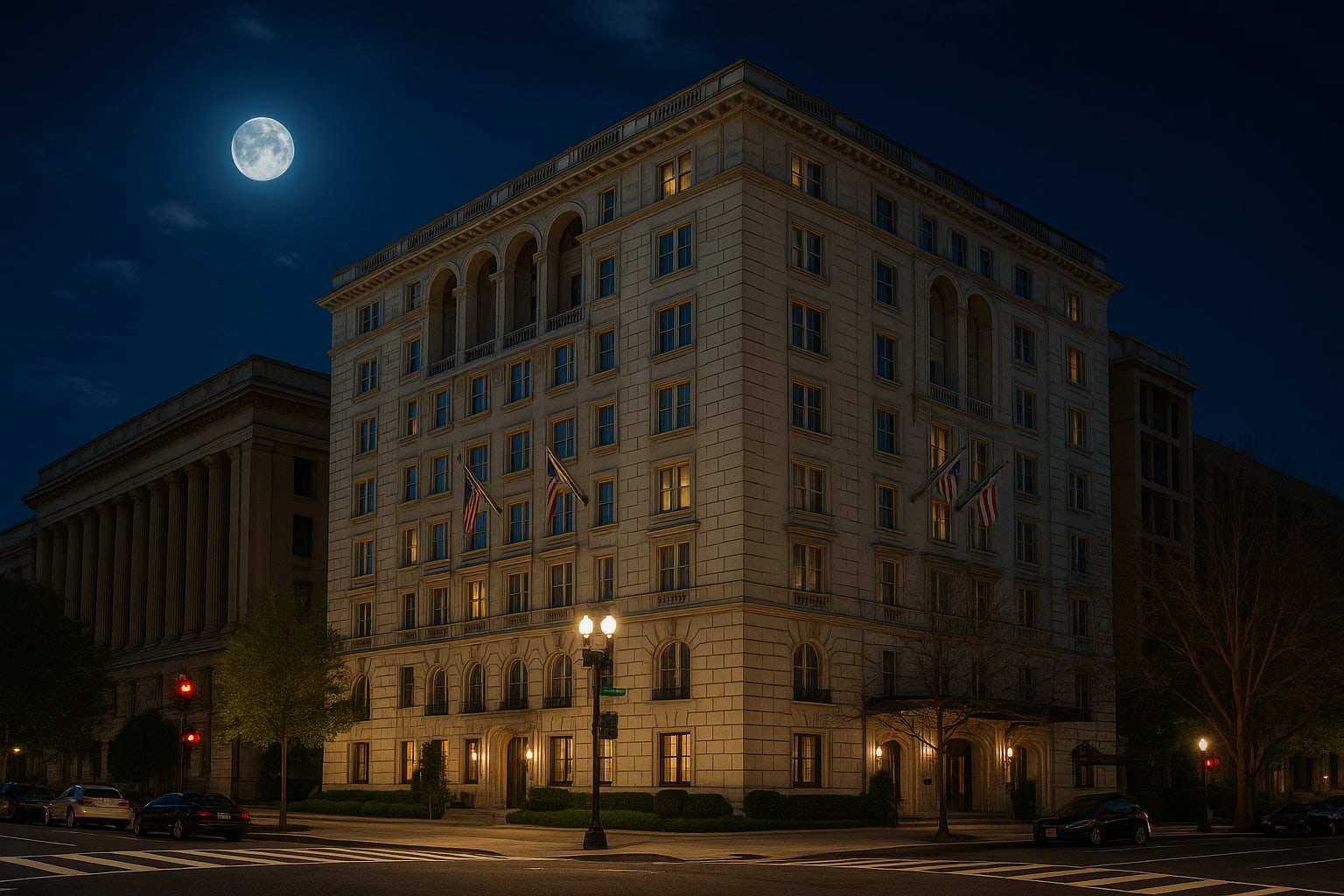
The Hay-Adams Hotel stands on Lafayette Square, directly across from the White House, on the site where two of Lincoln's closest associates once lived. John Hay served as Lincoln's personal secretary throughout the war — one of the few people who saw Lincoln daily, who witnessed the toll the war was taking, and who understood the depth of the burden the president carried.
The Hay-Adams connection to Lincoln is not incidental. It is direct and deeply personal. The site absorbed the emotional experiences of people who were intimately connected to Lincoln's presidency — who carried their own versions of his grief, his stress, and his sense of responsibility.
Guests at the Hay-Adams have reported experiences that include knocking on doors with no one present, a woman's voice in empty hallways, and the sensation of a presence in rooms that should be unoccupied. The most persistent reports involve Clover Adams, Henry Adams's wife, but the hotel's proximity to the White House and its direct connection to Lincoln's inner circle have led some investigators to suggest that the site's paranormal activity may be connected to a broader field of emotional energy centered on Lincoln himself.
[INSERT HAUNTED LOCATION CARD: Hay-Adams Hotel]
A Spirit Tied to the City Itself
Lincoln's ghost is not confined to the White House, or to Ford's Theatre, or to any single building. His presence has been reported throughout Washington DC — in the streets he walked, near the hospitals he visited, in the areas surrounding the government buildings where he made the decisions that defined his presidency.
This geographic breadth is unusual. Most reported hauntings are tied to a specific location — the room where someone died, the building where something happened. Lincoln's haunting appears to be tied not to a place but to a purpose — to the unfinished work of a president who was killed before he could complete the task he had dedicated his life to.
Lincoln came to Washington to preserve the Union. He spent four years in a city that was itself under siege, making decisions that cost hundreds of thousands of lives. He buried his son in this city. He was murdered in this city. And he never left.
The persistence of his presence — reported across decades, in multiple locations, by witnesses whose credibility is beyond question — suggests something that goes beyond a simple residual haunting. This is not a loop replaying the same moment endlessly. This is a presence that moves through the city, that appears in different locations, that seems — according to those who have encountered it — to be aware.
Whether that awareness is genuine or whether it is the projection of living observers onto a complex pattern of residual phenomena is a question that remains open. What is not open to question is that Lincoln's ghost is the most documented, most credible, and most enduring haunting in American history.
The Weight He Carried
Understanding why Lincoln's ghost endures requires understanding what he endured.
He was a self-made man who rose from frontier poverty to the most powerful office in the world — and then spent four years watching that power translate into mass death. He sent hundreds of thousands of men to war and received the casualty reports as personal indictments. He lost a child in the same building where he was trying to hold a nation together. He lived under constant threat of assassination — a threat that was ultimately realized, on a night when he had finally allowed himself to believe the worst was over.
The weight Lincoln carried was not just political. It was existential. He was responsible for the survival of a democratic experiment that he believed was the last, best hope for self-governance on earth. The stakes were not just national — they were civilizational. And he carried that weight with a solemnity, a sadness, and a personal absorption that contemporaries described as almost physical.
A president who could not walk away from his responsibilities. A leader whose sense of duty was so profound that it consumed him from the inside. A man whose emotional connection to the nation he served was so deep that his presence appears to have survived his death.
If any figure would still linger in Washington DC, it would be Lincoln.
Fact, Witness, and Legend
The Lincoln haunting is supported by a body of evidence that is unusual in the paranormal field — not because it constitutes scientific proof, but because the quality of the witnesses is unmatched.
Multiple presidents. Multiple first ladies. Foreign heads of state. Career White House staff spanning more than a century. The reports are consistent in their details: a tall, gaunt figure in a frock coat, seen near windows or in hallways, typically on the second floor, always carrying an expression of profound sadness.
The skeptical explanation — that these reports are the product of expectation, suggestion, and the psychological weight of living in a building that is itself a national symbol — is reasonable. The White House is a place where people expect to encounter the extraordinary. The knowledge that Lincoln lived, suffered, and died here could predispose visitors and residents to interpret ambiguous sensory experiences as ghostly encounters.
But the consistency of the reports — their detail, their specificity, their alignment across decades of independent witnesses who did not know about each other's experiences — makes the expectation hypothesis difficult to apply universally. Some of these witnesses were skeptics. Some had no particular interest in the paranormal. Some, like Churchill, were known for a rigorous pragmatism that makes their reluctance to discuss their experiences more telling than any dramatic retelling would be.
The Lincoln haunting sits at the intersection of documented history and reported experience — grounded enough to take seriously, ambiguous enough to require each person to form their own conclusion. Ghost City Tours presents these accounts as what they are: credible reports from credible witnesses, tied to the most documented and emotionally intense presidency in American history.
Walking in His Footsteps
Lincoln's Washington is still here. The White House where he paced through sleepless nights. Ford's Theatre where he was shot. The streets he walked between the Executive Mansion and the War Department, checking for dispatches from the front. The hospitals he visited, where he sat at the bedsides of wounded soldiers and absorbed their suffering as his own.
Walking these locations at night — standing where Lincoln stood, seeing the city as he saw it in the gas-lit darkness of the 1860s — is an experience that brings the history to a visceral, immediate life that no book or documentary can replicate.
Ghost City Tours in Washington DC offers three experiences that explore Lincoln's Washington and the broader haunted history of the nation's capital:
The Ghosts of Washington DC Tour — A family-friendly, 90-minute walking tour that includes Lincoln's story among Washington's most famous hauntings. Nightly at 9:00 PM, $29.99.
The Dark Nights in DC Ghost Tour — An adults-only (16+) experience that explores the darker dimensions of Lincoln's presidency, the assassination, and the paranormal activity reported at the locations tied to his story. Nightly at 9:00 PM, $34.99.
The Washington DC Haunted Pub Crawl — A 2-hour social experience (21+) that combines DC's haunted history with its nightlife. Nightly at 8:00 PM, $34.99.
The stories come alive when you stand where they happened. Lincoln's ghost has been waiting in this city for more than 160 years. He is, by all accounts, a patient presence. He will be there when you arrive.
To visit the locations most closely tied to Lincoln's spirit — from the memorial that bears his name to the White House where he still walks — follow our guided route through DC's most haunted sites after dark.