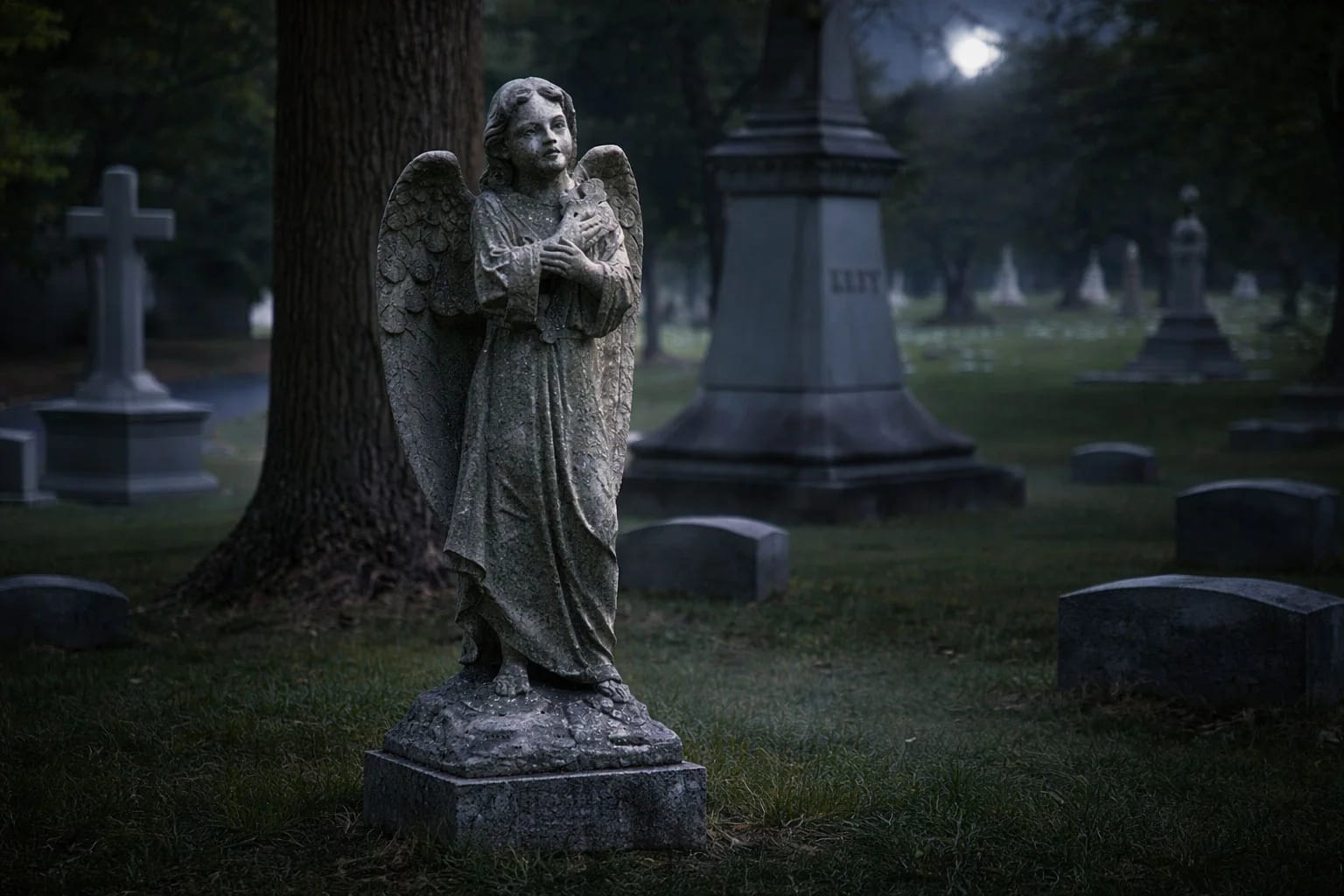
The Celtic crosses of Calvary Cemetery stretch toward the sky like stone prayers, marking the final resting places of St. Louis's Catholic faithful. This 470-acre burial ground in north St. Louis has served the Catholic community since 1854, receiving the bodies of immigrants, industrialists, religious figures, and ordinary believers who sought burial in consecrated ground.
Calvary Cemetery is more than a burial ground - it's a repository of St. Louis's Catholic heritage, a monument to the waves of immigrants who built the city, and according to many visitors, one of the most spiritually active locations in Missouri. Among its weathered headstones and elaborate monuments, the spirits of the dead are said to walk, pray, and seek the eternal rest that eludes them.
The cemetery's population includes Tennessee Williams, the playwright whose works explored the darker corners of the human soul; Dred Scott, the enslaved man whose Supreme Court case brought the nation closer to Civil War; and William Tecumseh Sherman's family members, though the general himself chose burial elsewhere. These famous names share the sacred ground with hundreds of thousands of ordinary Catholics - Irish fleeing famine, Germans seeking opportunity, and generations of St. Louisans who lived and died in the faith.
Visitors to Calvary have reported apparitions walking among the graves, unexplained lights hovering over monuments, and the sounds of Latin prayers drifting through empty sections. The cemetery's Catholic nature adds an additional dimension to its hauntings - here, the spirits may not simply be residual energy but souls in purgatory, awaiting the prayers of the living to help them complete their journey to heaven.
The History of Calvary Cemetery
Calvary Cemetery was established in 1854 by the Archdiocese of St. Louis to serve the growing Catholic population that was overwhelming existing parish cemeteries. The name 'Calvary' refers to the hill outside Jerusalem where Jesus was crucified, underscoring the cemetery's sacred purpose.
The Catholic Immigration
By the mid-nineteenth century, St. Louis was experiencing massive immigration, much of it Catholic. Irish fleeing the Great Famine, Germans seeking political and economic freedom, and other European Catholics poured into the city, transforming it into one of America's most Catholic metropolitan areas.
These immigrants brought their dead with them - not literally, but through generations of family members who would eventually need burial in consecrated ground. The existing parish cemeteries were quickly overwhelmed, and church leaders recognized the need for a large, permanent Catholic cemetery.
The Archdiocese acquired a substantial tract of land north of the city, adjacent to the Protestant Bellefontaine Cemetery. The proximity to Bellefontaine was intentional - it placed Catholic dead near Protestant dead, reflecting the diversity of St. Louis while maintaining the separation that both communities considered appropriate.
Calvary Cemetery opened in 1854 and quickly became the primary burial ground for St. Louis Catholics. Its consecrated ground offered the faithful the assurance that their bodies would rest in sacred soil, awaiting resurrection.
Design and Development
Calvary Cemetery was designed in the rural cemetery style popular in the era, with winding roads, landscaped grounds, and provisions for elaborate monuments. But as a Catholic cemetery, it also incorporated elements of religious significance.
Crosses dominated the landscape from the beginning - Celtic crosses honoring Irish immigrants, Latin crosses marking German graves, and the crucifix that stood at the cemetery's spiritual center. Statues of saints, the Virgin Mary, and angels offered intercession for the dead and comfort for the living.
The cemetery was organized into sections that often reflected ethnic origins or parish affiliations. Irish sections featured Celtic motifs; German sections displayed Gothic elements; and Italian sections incorporated Mediterranean styles. This organization created distinct neighborhoods within the cemetery, each with its own character.
Over time, Calvary grew to encompass 470 acres and over 300,000 interments, making it the largest Catholic cemetery in St. Louis and one of the largest in the Midwest. Its population reflects the full scope of Catholic St. Louis - from princes of the Church to the poorest immigrants, from famous names to the forgotten.
Notable Interments
Calvary Cemetery contains the remains of many notable individuals:
Tennessee Williams (1911-1983): The Pulitzer Prize-winning playwright, author of A Streetcar Named Desire and The Glass Menagerie, requested burial in St. Louis despite his complicated relationship with his hometown.
Dred Scott (c. 1799-1858): The enslaved man whose lawsuit for freedom resulted in the infamous Supreme Court decision that declared African Americans could not be citizens. Scott died shortly after finally gaining his freedom.
William Clark Kennerly and other members of the William Clark family: Relatives of the famous explorer rest at Calvary, though Clark himself is buried at Bellefontaine.
Archbishop Peter Richard Kenrick (1806-1896): The influential prelate who led the St. Louis Archdiocese for over forty years and shaped Catholic life in the region.
Kate Chopin (1850-1904): The author of The Awakening and other works that explored women's lives and sexuality with unprecedented frankness.
These famous interments join hundreds of thousands of others whose stories are less well-known but no less important to the spiritual fabric of the cemetery.
Tragedy and Unrest
Like all old cemeteries, Calvary contains its share of tragic stories that may contribute to paranormal activity:
Cholera Victims: Epidemics swept through St. Louis repeatedly in the nineteenth century, and Catholic victims were buried at Calvary in large numbers. These mass deaths, often striking immigrant communities hardest, left profound grief in their wake.
Famine Refugees: Many of Calvary's earliest Irish burials were refugees from the Great Famine who survived the coffin ships and the journey to St. Louis, only to succumb to disease, poverty, or the simple exhaustion of their ordeal.
Unbaptized Children: Catholic teaching of the era held that unbaptized infants could not enter heaven. These children were often buried in separate sections, their souls' fate a matter of profound grief for Catholic parents. Modern Catholic teaching has evolved, but the sorrow of those early burials may persist.
Civil War Dead: Soldiers from both sides who died in St. Louis hospitals or nearby battles rest at Calvary, their conflicts unresolved even in death.
Suicides and Sudden Deaths: Those who died without receiving Last Rites, including suicide victims and accident victims, faced uncertainty about their eternal fate under traditional Catholic teaching. This spiritual anxiety may contribute to restless spirits.
The Ghosts of Calvary Cemetery
Calvary Cemetery's haunted reputation distinguishes it from other St. Louis cemeteries through its Catholic character. The phenomena reported here often seem connected to Catholic beliefs about death, purgatory, and the intercession of the living for the dead.
The Praying Spirits
One of the most commonly reported phenomena at Calvary is the sighting of figures who appear to be praying. These apparitions kneel before graves, stand with bowed heads, or walk while holding rosary beads.
Witnesses describe these figures as translucent or shadowy, dressed in clothing from various eras. They appear absorbed in prayer, oblivious to living observers. When approached, they typically fade from view.
Catholic theology offers an explanation for these spirits that differs from standard ghost lore. According to traditional teaching, souls in purgatory can be aided by the prayers of the living. Perhaps these praying spirits are souls who died without sufficient prayer support, returning to the cemetery to seek intercession from visitors.
Alternatively, they may be the faithful dead continuing the devotional practices they maintained in life - eternal worshippers who find peace in the rhythms of prayer.
The Irish Section Ghosts
The sections of Calvary dedicated to Irish immigrants are particularly active, perhaps reflecting the trauma of the famine generation and the profound faith that sustained them.
Visitors to these sections have reported hearing Irish music - traditional melodies played on fiddle or whistle, emerging from nowhere and fading as suddenly as they appeared. Others have heard the sound of keening - the traditional Irish mourning wail - echoing among the Celtic crosses.
Apparitions in these sections often appear in period clothing from the mid-to-late nineteenth century. Some are described as emaciated or ill-looking, perhaps reflecting the condition of famine survivors when they arrived in America.
The Irish sections also report an unusual number of religious visions - figures interpreted as the Virgin Mary, saints, or angels appearing among the graves. Whether these are genuine spiritual visitations, the ghosts of the dead, or something else entirely remains a matter of faith and interpretation.
The Tennessee Williams Connection
Since Tennessee Williams's burial at Calvary in 1983, some visitors have reported unusual experiences near his grave. The playwright, whose works explored themes of death, desire, and decay, seems to have added his own spirit to the cemetery's population.
Witnesses describe feeling an intense creative presence near the grave, experiencing sudden inspiration or emotional intensity. Some have reported seeing a figure matching Williams's description - a slight man with a mustache, sometimes smoking a cigarette.
Whether Williams's ghost actually haunts his grave or whether visitors are experiencing a form of suggestion influenced by his famous works is unclear. What is clear is that his burial has made his gravesite a pilgrimage destination for fans and has added to Calvary's mystique.
The Children's Section
Like Bellefontaine, Calvary has sections dedicated to children, and these areas report significant paranormal activity. But the Catholic context adds particular poignancy to these hauntings.
Visitors hear children crying or laughing among the small graves. Some report seeing small figures playing, while others describe children who seem lost or searching for something - perhaps the baptism they never received, perhaps their parents, perhaps simply peace.
The historical controversy over unbaptized infants' eternal fate weighs heavily on these sections. Some visitors report feeling overwhelming guilt or sadness, emotions that seem to emanate from the grounds themselves rather than from their own hearts.
Modern Catholic teaching has softened the earlier position on unbaptized infants, emphasizing God's mercy and the hope of salvation. But centuries of different teaching may have left spiritual marks that persist even as theology evolves.
Other Phenomena
Calvary Cemetery experiences various paranormal phenomena beyond specific apparitions:
Latin Prayers: Visitors report hearing prayers in Latin - the language of the Catholic Mass before Vatican II - drifting through the cemetery. These prayers sometimes seem to respond to events, intensifying when visitors arrive or when the atmosphere feels particularly charged.
Incense Scent: The smell of incense appears throughout the cemetery without any visible source. This sacred scent, associated with Catholic worship, suggests a spiritual presence that transcends the physical.
Lights Near Graves: Unexplained lights hover over certain graves, particularly at dusk. These lights are described as candle-like flames that move independently and seem to mark particular burial sites.
Bell Sounds: Cemetery visitors sometimes hear bells tolling when no bells are being rung. Church bells traditionally announced deaths and called the faithful to pray for departed souls.
Cold Spots and Temperature Drops: Areas of intense cold appear throughout the cemetery, often in locations with no apparent draft or explanation.
Emotional Waves: Many visitors report being overwhelmed by emotions that don't seem to be their own - grief, peace, anxiety, hope. The cemetery seems to transmit the emotional states of its residents to sensitive visitors.
Paranormal Investigations at Calvary
Calvary Cemetery has attracted paranormal investigators interested in its Catholic character and extensive haunted reputation. The cemetery's religious nature adds complexity to investigations, raising questions about the relationship between faith and the paranormal.
Investigation Considerations: Catholic theology offers its own framework for understanding the phenomena reported at Calvary. Are the spirits ghosts in the traditional sense, or souls in purgatory? Are the prayers heard residual hauntings or active intercessions? Investigators must grapple with these questions.
Documented Evidence:
- EVP recordings have captured prayers in Latin, Irish phrases, and responses to questions
- Photographs show orbs, mists, and occasional figures near monuments
- EMF detectors register anomalies, particularly in the older sections
- Temperature readings show unexplained cold spots
- Video footage has captured moving lights and shadow figures
Researcher Observations: Investigators at Calvary often report unusual personal experiences - feelings of being prayed for, sensations of peace or absolution, and encounters that feel more spiritual than paranormal in the traditional sense.
Respect for Sacred Ground: Paranormal investigators at Calvary must balance their research interests with respect for the cemetery's religious significance. The grounds are consecrated, the dead are the faithful, and the living visitors include mourners and worshippers.
Visiting Calvary Cemetery Today
Calvary Cemetery remains an active Catholic burial ground, welcoming visitors who wish to pay respects, research genealogy, appreciate the historic monuments, or experience its spiritual atmosphere.
Visitor Information:
- Location: 5239 West Florissant Avenue, St. Louis, MO 63115
- Hours: Daily from 8:00 AM to 5:00 PM (hours may vary seasonally)
- Admission: Free
- Office: On-site office can assist with locating graves and providing information
What to See:
- The grave of Tennessee Williams, marked with a simple headstone
- The monument of Dred Scott, commemorating his struggle for freedom
- Celtic crosses and Gothic monuments in the Irish and German sections
- The cemetery's beautiful landscape and historic chapel
For Paranormal Seekers:
- Visit during the late afternoon when activity reportedly increases
- The Irish sections and children's areas are particularly noted for activity
- Be attentive to sounds, scents, and emotional sensations
- Bring a camera but be prepared for equipment issues
- Approach with respect - this is sacred ground to living Catholics
Guidelines:
- Stay on designated paths and roads
- Do not disturb graves, monuments, or religious items
- Be respectful of funeral services and mourners
- No after-hours visits (this is both trespassing and disrespectful)
- Leave nothing behind; take nothing but photographs
- Consider lighting a candle or saying a prayer for the dead - this is appropriate at a Catholic cemetery
Calvary Cemetery offers a window into St. Louis's Catholic heritage and a chance to experience one of the region's most spiritually charged locations. Whether you come as a believer, a skeptic, or simply curious, the dead of Calvary have stories to share with those willing to listen.
