
A City That Never Lets Go
Walk through the streets of St. Augustine after dark and you will feel it almost immediately — a quality in the air that is difficult to name but impossible to ignore. The cobblestone lanes narrow as you move deeper into the old quarter. Gas-style lanterns cast uneven light across coquina walls that have stood for centuries. Ocean mist rolls in from the Matanzas River, softening the edges of everything and creating the impression that the city itself is breathing. The sounds of the modern world fade into the background, and something older takes their place. A silence that is not quite empty. A stillness that feels inhabited.
St. Augustine is not merely a city with ghost stories. It is a city built on the raw material of hauntings: centuries of human conflict, sudden death, religious fervor, military occupation, epidemic disease, and survival against extraordinary odds. Founded in 1565 by Spanish explorers — more than four decades before Jamestown and more than half a century before Plymouth Rock — St. Augustine is the oldest continuously inhabited European-established settlement in the United States. That is not a footnote. It is the foundation of everything that makes this city so deeply, persistently haunted.
Other American cities have ghost stories. St. Augustine has layers — geological strata of human experience compressed into a few square miles of coastline, each layer adding its own tragedies, its own unresolved stories, its own reasons for the dead to linger. The city did not just experience history. It absorbed it.
To explore the most haunted places in St. Augustine is to walk through a living archive of grief, conflict, and resilience — a city where the past has never been fully buried because it was never fully resolved.
What Makes a City Haunted?
Before diving into the specific history of St. Augustine, it is worth asking a broader question: what makes any city haunted? Why do some places accumulate ghost stories the way others accumulate landmarks or restaurants?
Paranormal researchers and cultural historians have proposed what might be called the Haunting Equation — a set of conditions that, when combined, seem to reliably produce locations with high concentrations of reported paranormal activity. The formula is deceptively simple: Time plus Trauma plus Density plus Preservation equals Hauntings.
Time matters because older places have had more opportunities for tragic events to occur within their boundaries. Every generation that lives and dies in a city adds another layer of emotional residue. Trauma matters because sudden, violent, or unjust deaths — murders, battles, executions, epidemics — are believed to leave stronger imprints than peaceful ones. Density matters because concentrated populations mean concentrated experiences — a single city block inhabited for centuries accumulates more human drama than a suburban development built ten years ago.
And preservation matters most of all. Cities that demolish their old buildings and pave over their cemeteries effectively erase the physical vessels that hold these stories. But cities that preserve their historic structures — that keep the original streets, the original walls, the original burial grounds — maintain a physical continuity with the past that allows whatever energy those places hold to remain intact.
St. Augustine checks every box. It is one of the oldest cities in America. Its history is saturated with violence, disease, and sudden death. Its historic core is densely packed with structures that date back centuries. And it has preserved its past to a degree that few American cities can match. The streets have not moved. The buildings have not disappeared. The stories have not faded. If the Haunting Equation holds true, St. Augustine is not just haunted — it is one of the most haunted places in the Western Hemisphere.
Founded in Blood: The Violent Origins of St. Augustine
The founding of St. Augustine was not a peaceful affair. It was an act of war.
In September 1565, Spanish admiral Pedro Menendez de Aviles arrived on the northeast coast of Florida with a fleet of ships and roughly eight hundred soldiers, settlers, and priests. His mission, granted by King Philip II of Spain, was twofold: establish a permanent Spanish settlement in La Florida and eliminate the French Huguenot colony that had been established the previous year at Fort Caroline, roughly forty miles to the north. The French presence in territory that Spain considered its own was an intolerable provocation, and Menendez had been given explicit orders to deal with it.
He did so with devastating efficiency. After establishing his base at a Timucuan village that he renamed San Agustin — choosing the name because he had first sighted land on the feast day of St. Augustine — Menendez marched his forces north through a brutal tropical storm and attacked Fort Caroline at dawn. The French garrison was overwhelmed. Menendez ordered the execution of most male survivors, sparing only those who professed to be Catholic.
The bloodshed did not end there. A group of French survivors from a shipwrecked fleet was discovered on the beaches south of St. Augustine. Menendez confronted them and ordered the execution of those who refused to convert to Catholicism. The inlet where the killings took place became known as Matanzas, the Spanish word for slaughters. The name endures to this day.
The founding of St. Augustine was baptized in blood — the blood of French Protestants killed for their faith, of Timucuan people whose land was seized, and of Spanish soldiers who died in the storms and skirmishes that accompanied the colony's establishment. The violence was not incidental to the founding. It was the founding.
The theory of residual haunting suggests that traumatic events leave a psychic imprint on the locations where they occur — an echo that replays under certain conditions. If this theory holds any truth, then the ground beneath St. Augustine was marked by trauma from the very first days of its existence.
Betrayal, religious persecution, mass execution, and the displacement of indigenous peoples — these are the building blocks of a haunted city. And they were laid down before St. Augustine was even a year old.
A City Under Siege: War, Occupation, and Endless Conflict
If St. Augustine's founding was violent, the centuries that followed were no less turbulent. Few cities in North America have changed hands as many times, endured as many military threats, or lived under as constant a state of siege as St. Augustine.
For nearly two hundred years under Spanish rule, St. Augustine existed as a military outpost on the edge of an empire — perpetually underfunded, chronically understaffed, and surrounded by enemies. English colonists to the north viewed the Spanish settlement as both a territorial rival and a haven for escaped enslaved people. Pirates and privateers raided the coast regularly, and in 1586, Sir Francis Drake burned St. Augustine to the ground.
The construction of the Castillo de San Marcos, begun in 1672, was a direct response to these constant threats. Built from coquina — a local shellstone that absorbed cannonball impacts rather than shattering — the Castillo served as the city's last line of defense during the British siege of 1702, when English forces burned the city but failed to breach its walls. The population survived, huddled inside the fortress for weeks while their homes and churches burned around them.
The Castillo also served as a prison, its dungeons holding captives under conditions that were grim even by the standards of the era. Soldiers who deserted, prisoners of war, and political enemies were confined in dark, airless chambers. Some never emerged. There are accounts of prisoners being sealed inside rooms that were then bricked over — left to die in darkness, their bodies entombed within the walls.
In 1763, Spain ceded Florida to Britain in exchange for Havana, and St. Augustine entered a twenty-year period of British rule that brought its own upheavals. When Spain regained control in 1783, the cycle of displacement repeated. The United States finally acquired Florida in 1821, but even under American rule, St. Augustine remained a site of conflict. The Seminole Wars brought violence to the region, and the Castillo de San Marcos was repurposed as a military prison for captured Seminole and Apache leaders, adding yet another layer of suffering to a fortress already saturated with it.
The ghosts reported at the Castillo de San Marcos reflect this history. Visitors have reported hearing Spanish voices within empty chambers, seeing shadowy figures on the gun deck at night, and experiencing overwhelming feelings of despair in the former dungeons. The Castillo holds all of their stories within its coquina walls, and those stories are not finished being told.
Death Was Everywhere: Disease, Starvation, and Survival
War and siege were not the only killers in St. Augustine. Disease was a constant companion from the city's earliest years, and it killed with an indifference that made even the brutality of military conflict seem personal by comparison.
Yellow fever was the city's most feared epidemic disease. The mosquito-borne illness struck repeatedly throughout the 17th, 18th, and 19th centuries, killing settlers, soldiers, and enslaved people in waves. The symptoms were horrific — high fever, jaundice, internal bleeding, and the infamous black vomit that signaled the body was shutting down. There was no cure and no understanding of how the disease spread. When yellow fever arrived, the only options were to flee, to pray, or to die.
Smallpox was equally devastating, particularly to the indigenous Timucuan population. The Timucua, who had inhabited the region for thousands of years, were decimated by European diseases. Their population, estimated at around 200,000 at contact, was reduced to near extinction within two centuries. The Spanish missions became death traps where disease spread rapidly through crowded, unsanitary conditions.
Starvation was another persistent threat. St. Augustine was never a prosperous city. Its economy depended on supply ships from Spain and Cuba, and when those ships were delayed — by storms, by war, by bureaucratic neglect — the population suffered. Death from malnutrition and related illnesses was common, particularly among the poor, the enslaved, and the indigenous laborers forced to work on Spanish construction projects.
The dead had to go somewhere, and in a city as small and densely packed as colonial St. Augustine, burial space was always at a premium. Churches buried their dead beneath their floors. Mass graves were dug during epidemics when individual burials became impossible. Over the centuries, many of these burial sites were paved over, built upon, or simply forgotten. Archaeologists working in St. Augustine have repeatedly discovered human remains in unexpected locations — beneath streets, beneath buildings, beneath parking lots — confirming what historians had long suspected: the ground beneath St. Augustine is layered with the dead.
Residual hauntings — spectral phenomena believed to be replays of past emotional events — are frequently reported in areas where mass death occurred. In St. Augustine, the concentration of death from disease, starvation, and deprivation was so intense that it would be more surprising if these areas were not generating reports of paranormal activity.
Religion, Ritual, and the Supernatural
The Catholic Church was not merely a religious institution in colonial St. Augustine — it was the organizing principle of daily life, the moral authority that governed behavior, and the framework through which residents understood birth, death, and everything in between. From the city's founding in 1565, Catholicism was woven into the fabric of St. Augustine so completely that the boundary between sacred and secular was essentially nonexistent.
Catholic theology taught that the soul survived the body, that the dead could intercede on behalf of the living, and that certain souls trapped in purgatory existed in a state of suffering. Death was not an ending but a transition, and the dead were not gone but simply elsewhere.
The missions established throughout northeastern Florida were designed to convert the indigenous Timucuan population, often by force. Timucuan spiritual practices — their ceremonies, their burial customs, their understanding of the dead — were suppressed and replaced with Catholic rituals. The result was spiritual tension: indigenous beliefs that refused to die completely, overlaid with Catholic practices embraced with varying degrees of sincerity.
Churches in colonial St. Augustine served as burial sites, with prominent parishioners interred beneath the floors and the rest in adjacent churchyards. Churches were literally built on top of the dead — places of worship where the living knelt to pray inches above the bones of their ancestors. It is perhaps not surprising that churches and former church sites are among the most frequently reported locations of paranormal activity.
In St. Augustine, the theological framework always allowed for the possibility that the dead might not rest quietly — that souls in purgatory might make their presence known, and that the boundary between the living and the dead was thinner than most people cared to admit.
The Oldest Streets in America: Why Preservation Matters
Most American cities bear little physical resemblance to what they looked like a hundred years ago, let alone two hundred or three hundred. The relentless cycle of demolition and construction has erased the physical past of most cities so thoroughly that standing in downtown Atlanta or Phoenix or Houston, you would have no way of knowing what those places looked like even a generation ago.
St. Augustine is different. Profoundly different.
The streets of St. Augustine's historic district still follow the layout established by the Spanish in the 16th and 17th centuries. St. George Street runs along essentially the same path it has followed for more than four hundred years. The Castillo de San Marcos still dominates the waterfront, exactly where it was built in 1672. The City Gates still mark the northern entrance to the old city. The coquina walls that line many of the streets are made from the same shellstone that the Spanish quarried from Anastasia Island centuries ago.
This level of preservation has a direct bearing on why St. Augustine is so haunted. Paranormal researchers have long noted that hauntings concentrate in areas where physical structures have remained intact over long periods. Whatever energy a traumatic event leaves on a location is tied to the physical fabric of that place. When structures are demolished, the connection is severed. When they are preserved, it endures.
In St. Augustine, the connection between past and present has never been severed. The streets where soldiers marched, where prisoners were led to execution, where plague victims were carried to their graves — those streets are still walked by thousands of people every day.
Many cities erase their past to make room for the future. St. Augustine lives inside its past. The ghosts of St. Augustine, if they exist, have never been displaced. Their homes are still standing. Their streets are still open. Their stories are still unfolding in the same physical spaces where they began, centuries ago.
The Most Haunted Places in St. Augustine
St. Augustine's haunted reputation is not built on vague legends or anonymous anecdotes. It is grounded in specific locations — places with documented histories of tragedy and well-established records of paranormal reports that span decades and, in some cases, centuries. These are not places where someone once heard a strange noise and told a friend about it. They are places where hundreds of independent witnesses have reported remarkably consistent experiences, creating a body of evidence that, whatever its ultimate explanation, cannot be easily dismissed.
What follows is an overview of the most haunted locations in the city — places where the history is darkest, the reports are most frequent, and the experiences are most compelling.
St. Augustine Lighthouse
The St. Augustine Lighthouse rises 165 feet above Anastasia Island, its black and white spiral stripes visible for miles. The lighthouse's haunted reputation centers on the tragic deaths of the daughters of Hezekiah Pity, the superintendent overseeing construction of the current tower in the 1870s. The girls drowned when a supply cart they were playing on broke free and rolled into the ocean. Visitors and staff have reported seeing apparitions of young girls, hearing laughter and footsteps in the empty tower, and capturing unexplained images on cameras. The lighthouse is widely regarded as one of the most actively haunted sites in Florida.
Castillo de San Marcos
The Castillo de San Marcos is not only St. Augustine's most iconic landmark — it is also one of its most haunted. More than three centuries of military use, imprisonment, and siege have left the fortress saturated with traumatic energy. Reports of ghostly soldiers on the gun deck, disembodied voices echoing through empty chambers, and an oppressive atmosphere in the former dungeon rooms have been documented for decades. Stories of prisoners sealed alive within the coquina walls only add to the fortress's haunted reputation.
St. Francis Inn
The St. Francis Inn, built in 1791, is one of the oldest continuously operating inns in the United States. The spirit most frequently reported is known as Lily, believed to be the ghost of a young woman who died under tragic circumstances connected to a forbidden romance. Guests have reported objects moving on their own, lights turning on and off, the sensation of someone sitting on the edge of the bed, and sightings of a young woman in period clothing who appears briefly before vanishing.
Tolomato Cemetery
Tolomato Cemetery is one of the oldest burial grounds in St. Augustine, with burials dating to the colonial period. The cemetery takes its name from the Tolomato mission, which served the indigenous population before being repurposed as a Catholic burial site. Visitors have reported seeing apparitions among the headstones, hearing whispered prayers in Spanish, and experiencing sudden drops in temperature confined to specific areas within the cemetery walls.
Huguenot Cemetery
The Huguenot Cemetery, located just outside the old City Gates, was established in the early 19th century as a Protestant burial ground during yellow fever epidemics. Many interred there died quickly, painfully, and far from home. Visitors have reported seeing a woman in white wandering among the graves, hearing unexplained sounds after dark, and photographing strange lights that were not visible to the naked eye.
These are only the most prominent of St. Augustine's haunted locations. See the full list of haunted places in St. Augustine for a comprehensive guide to every documented haunted site in the city.
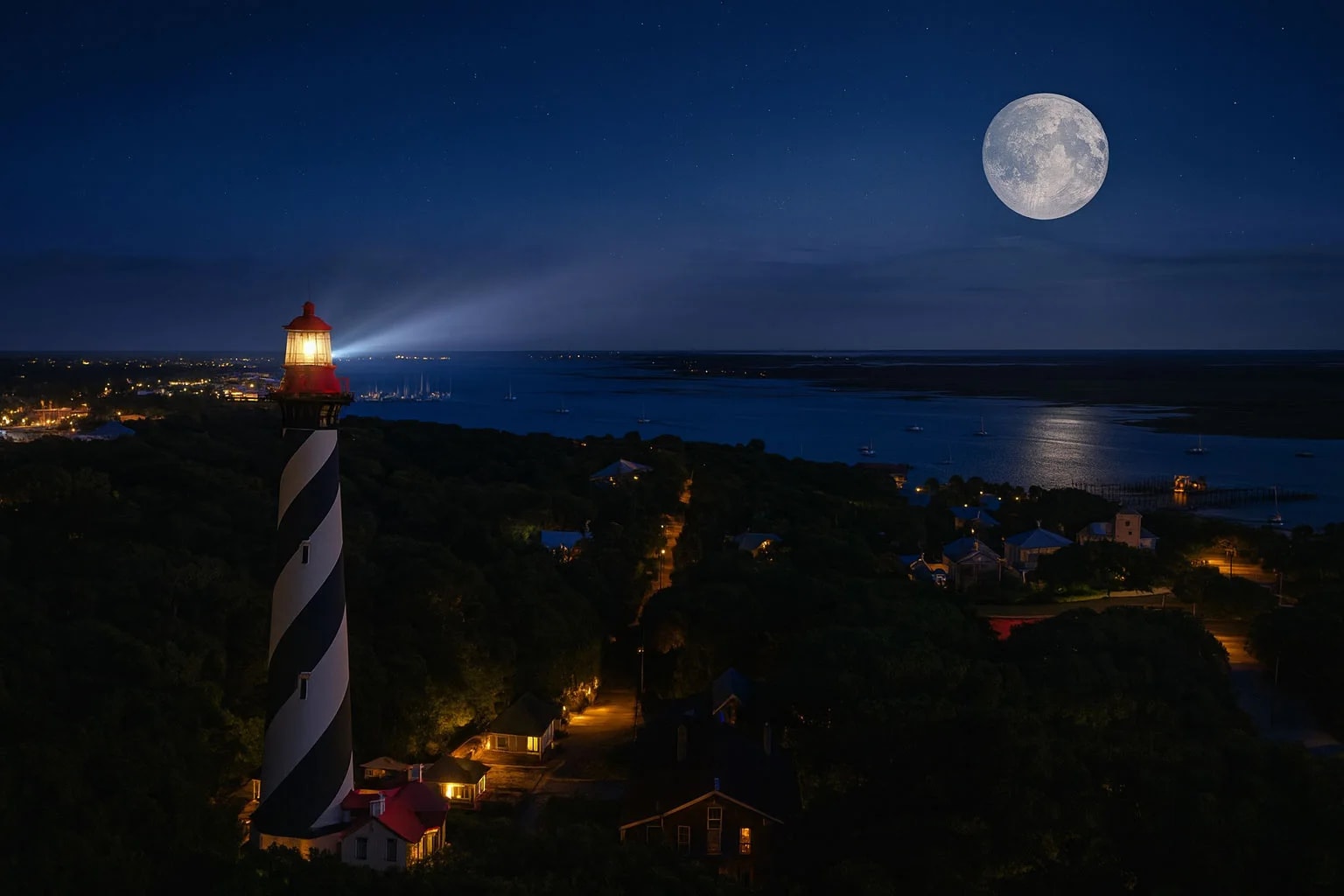
St. Augustine Lighthouse
The 165-foot lighthouse on Anastasia Island is one of the most actively haunted sites in Florida. The tragic drowning of two young girls during construction has left a lasting spiritual presence, with reports of apparitions, laughter, and unexplained footsteps.
Read More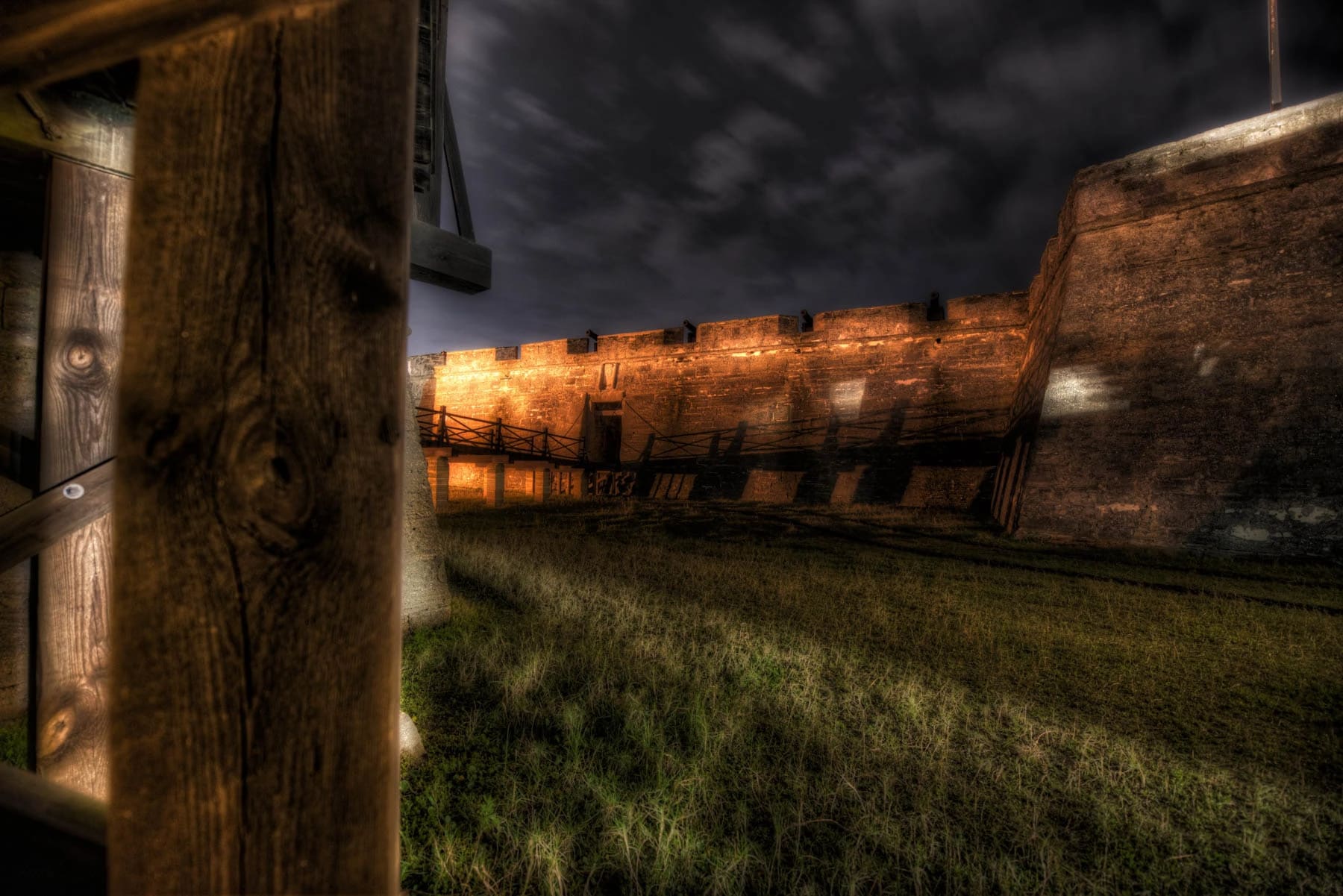
Castillo de San Marcos
More than three centuries of military use, imprisonment, and siege have made the Castillo one of the most haunted fortresses in America. Reports include ghostly soldiers, disembodied voices, and an oppressive atmosphere in the former dungeons.
Read More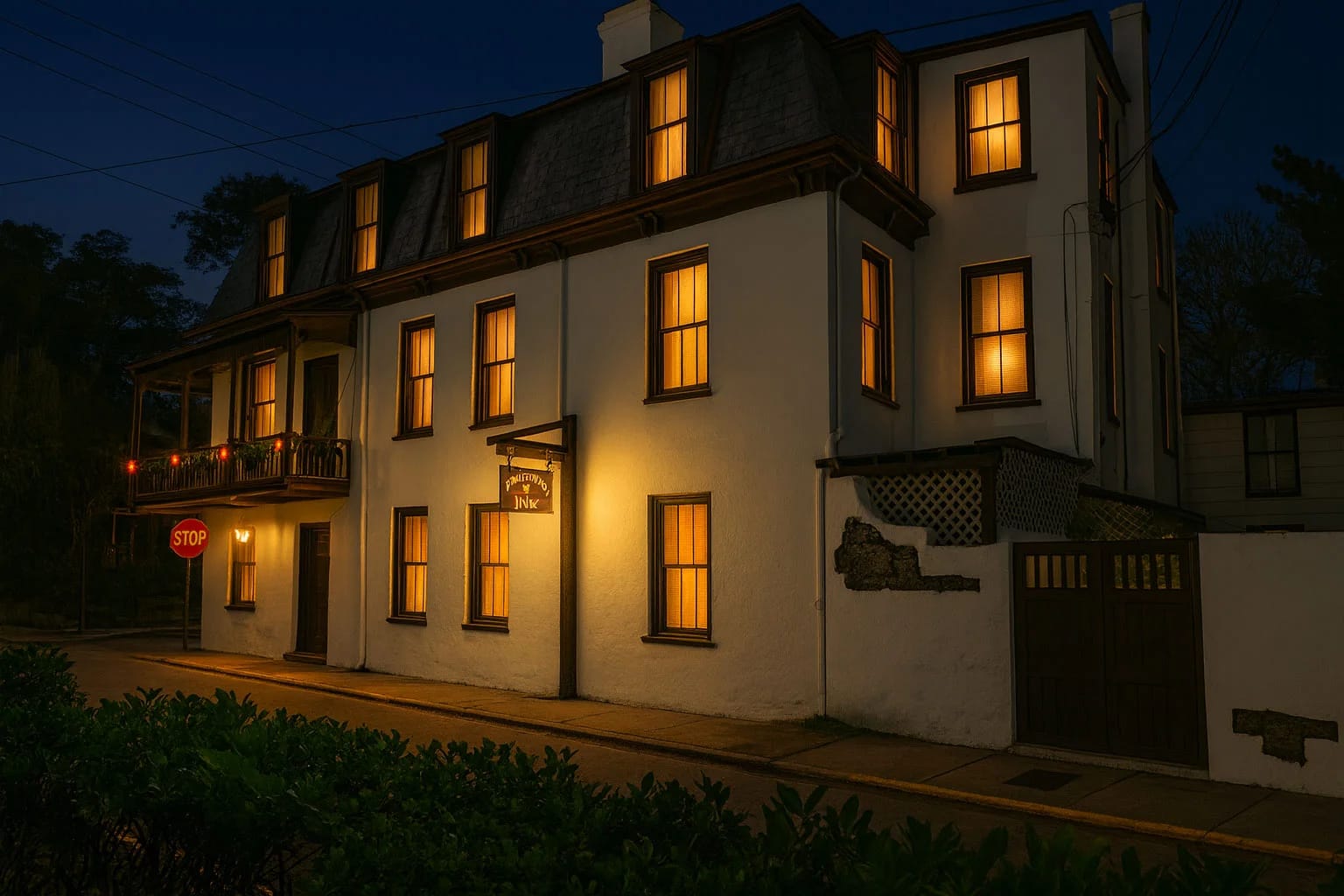
St. Francis Inn
Built in 1791, the St. Francis Inn is home to the ghost of Lily, a young woman who died under tragic circumstances. Guests report objects moving, lights flickering, and the sensation of someone sitting on the bed.
Read More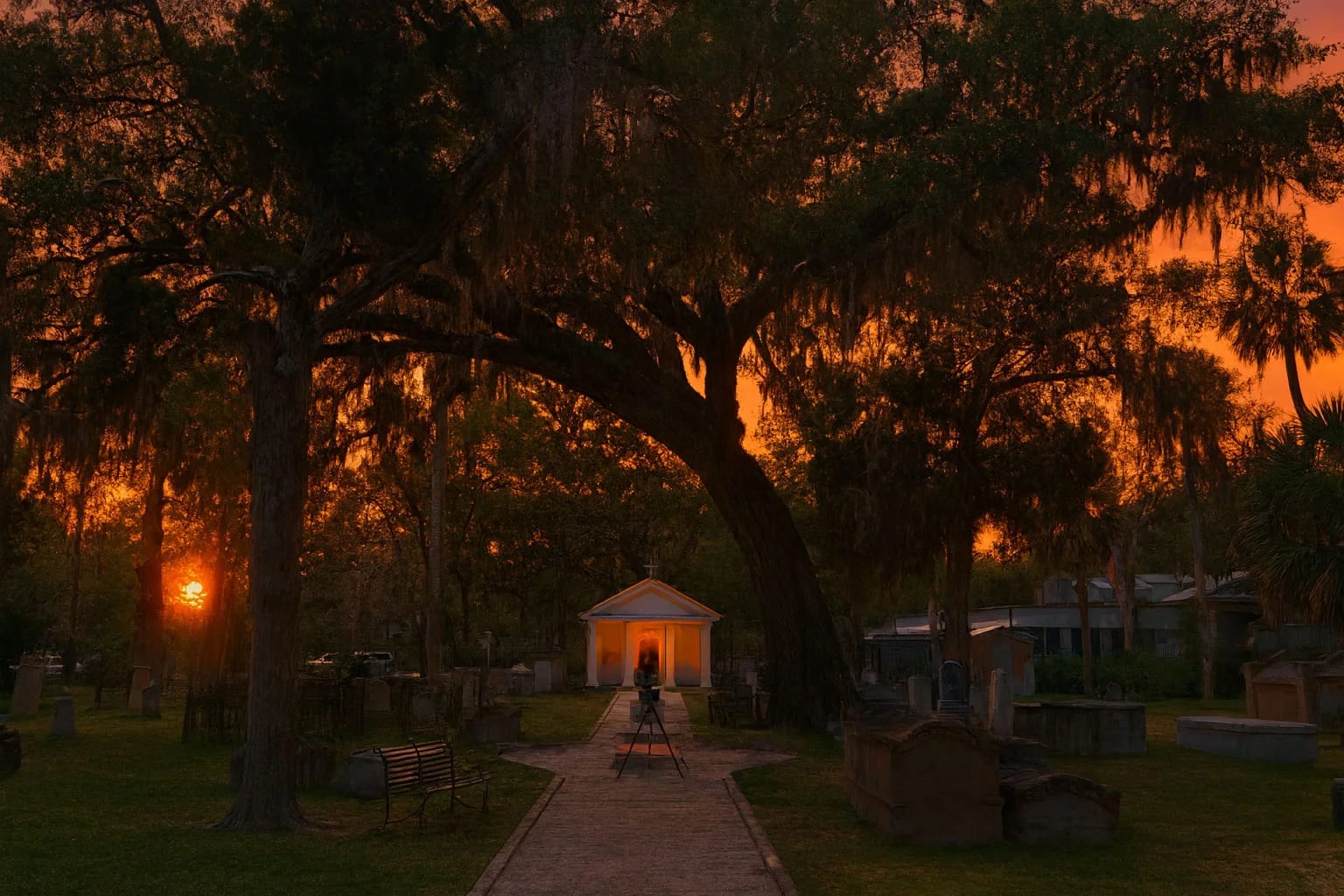
Tolomato Cemetery
One of St. Augustine's oldest burial grounds, with burials dating to the colonial period. Visitors report apparitions, whispered prayers in Spanish, and sudden temperature drops within the cemetery walls.
Read More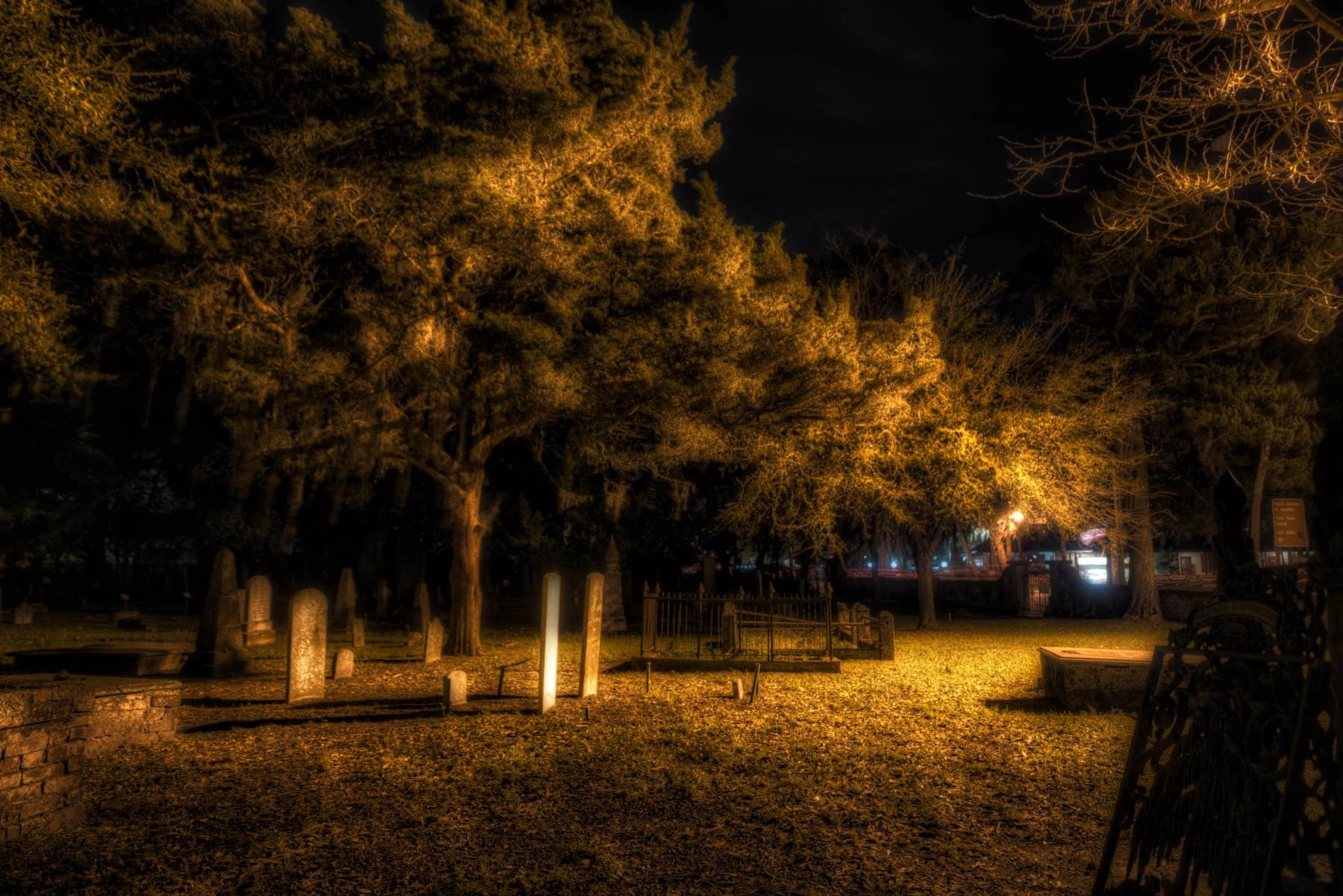
Huguenot Cemetery
Established during yellow fever outbreaks, this Protestant cemetery near the City Gates is haunted by the spirits of epidemic victims. A woman in white is the most frequently reported apparition.
Read MoreWhy St. Augustine Feels Different From Other Haunted Cities
The United States has no shortage of cities that claim to be haunted. Savannah, with its moss-draped squares and antebellum mansions, cultivates an atmosphere of elegant melancholy that makes its ghost stories feel like chapters from a Southern gothic novel. New Orleans, with its above-ground cemeteries, its voodoo traditions, and its raucous embrace of the macabre, treats the supernatural as another ingredient in the city's chaotic, intoxicating cultural gumbo. Charleston, with its pastel-colored row houses and its history of enslaved labor, wraps its hauntings in a veneer of tragic refinement that is distinctly Lowcountry.
St. Augustine is different from all of them. Not better or worse — different. And the difference matters.
What sets St. Augustine apart is not just age, though its age is significant. St. Augustine was established fifty-five years before Plymouth Rock, forty-two years before Jamestown, and more than a century before Charleston, Savannah, or New Orleans existed. By the time those cities were founded, St. Augustine had already survived multiple sieges, changed hands between empires, and accumulated ghost stories that were already generations old.
Savannah's hauntings feel refined — the spirits of generals and socialites drifting through elegant squares. New Orleans treats its ghosts with flamboyant irreverence, mixing the supernatural with jazz funerals and cocktail culture. Charleston's hauntings carry the weight of plantation history and aristocratic decline.
St. Augustine's hauntings are more primal than any of these. They are the ghosts of a frontier outpost where survival was never guaranteed — soldiers who died defending a fortress that was never truly safe, prisoners sealed inside walls and left to suffocate, indigenous people whose entire civilization was erased, epidemic victims buried in mass graves that were paved over and forgotten. There is nothing elegant about these hauntings. They are raw, foundational, and deeply unsettling.
St. Augustine was not built on ghosts. It was built on the will to survive, and the ghosts are what survival left behind.
Real Experiences: What People Report Seeing Today
The ghost stories of St. Augustine are not confined to history books or tour guide scripts. New reports of paranormal encounters emerge from the city with a regularity that is remarkable, coming from visitors, residents, and professionals who often have no prior interest in the paranormal and no reason to fabricate their experiences.
The types of phenomena reported across the city fall into several consistent categories. Shadow figures — dark, human-shaped silhouettes that appear briefly in doorways, corridors, and cemetery grounds before vanishing — are among the most common. Witnesses describe seeing distinct, three-dimensional forms that move with apparent purpose before disappearing in ways that defy physical explanation.
Disembodied voices are reported with striking frequency, particularly around the Castillo de San Marcos, Tolomato Cemetery, and the historic buildings along St. George Street. Witnesses describe hearing conversations in Spanish and whispered words that seem to come from directly beside them. These reports are especially compelling when they come from visitors who do not speak Spanish.
Full-bodied apparitions — transparent or semi-transparent human figures that appear for several seconds before fading — are less common but reported often enough to constitute a recognizable pattern. The most frequently described apparitions include soldiers in Spanish colonial uniforms, women in period dress, and children who appear briefly before vanishing. These have been reported by guests at the St. Francis Inn, by visitors to the lighthouse, and by pedestrians walking through the historic district after dark.
Unexplained physical sensations round out the most common reports. Sudden drops in temperature are described so frequently that they have become almost expected at certain locations. The feeling of being watched — an intense, localized awareness of an unseen presence — is reported by visitors who were otherwise relaxed and had no expectation of a paranormal experience.
Ghost City Tours guides experience these phenomena alongside their guests on a regular basis, sharing their own firsthand accounts while allowing guests to interpret their experiences on their own terms. Over the years, Ghost City Tours has accumulated hundreds of guest reports that corroborate the documented history of paranormal activity in the city, adding contemporary evidence to a tradition of ghost sightings that stretches back centuries.
Experience the Hauntings Yourself
Reading about St. Augustine's ghosts is one thing. Standing on the same cobblestone streets where soldiers bled, where prisoners were marched to confinement, where epidemic victims were carried to mass graves — that is something else entirely.
Ghost City Tours in St. Augustine offers immersive walking tours through the heart of the city's most haunted districts, guided by storytellers who have spent years researching the documented history behind every location. These are not scripted performances designed to produce cheap scares. They are historically grounded experiences that treat the city's past with the seriousness it deserves.
The tours move through gas-lit streets, past cemeteries where the dead of four centuries rest uneasily, alongside fortress walls that have absorbed more human suffering than most buildings in America. Guides share accounts drawn from historical records, from their own experiences, and from the growing archive of guest reports that confirm the city's haunted reputation is not fading — if anything, it is growing stronger.
The best way to understand why St. Augustine is haunted is not to read about it. It is to walk its streets at night, to feel the weight of its history pressing in from every direction, and to discover for yourself whether the stories are true. The city has been waiting more than four hundred years to show you what it remembers.
Is St. Augustine the Most Haunted City in America?
It is a question that comes up constantly in discussions of the paranormal, and it is one that deserves a thoughtful answer rather than a marketing slogan.
The case for St. Augustine as the most haunted city in America is strong — arguably the strongest of any city in the country. No other city can match its combination of age, violent history, and physical preservation. St. Augustine has been continuously inhabited for more than 460 years, experiencing warfare, siege, occupation by multiple foreign powers, religious persecution, epidemic disease, and mass death. The physical spaces where these events occurred are still standing, still accessible, and still generating reports of paranormal activity.
Savannah, often cited as the most haunted city in the South, was not founded until 1733 — 168 years after St. Augustine. New Orleans was established in 1718. Charleston dates to 1670. Each of these cities has a legitimate haunted pedigree, but none has the sheer depth of history that St. Augustine possesses.
That said, the title of "most haunted city" is inherently subjective. Hauntings cannot be quantified with the precision of census data. Different cities produce different types of paranormal activity, and comparing them is a bit like comparing genres of music — each has its own character, its own intensity, and its own appeal.
What can be said with confidence is this: if the most haunted city in America is the one with the longest history of documented conflict, the highest concentration of preserved historic structures, and the most consistent record of reported paranormal activity spanning centuries rather than decades, then St. Augustine's claim is very difficult to argue against.
Final Thoughts: A City That Remembers Everything
St. Augustine has been accumulating stories for more than four and a half centuries. Stories of conquest and survival, of faith and persecution, of epidemic death and desperate endurance. Stories of soldiers who marched through streets that are still walkable today, of prisoners confined in fortress walls that are still standing, of children buried in cemeteries still enclosed by the same stone walls built around them generations ago.
Other cities move on. They demolish the old, build the new, and allow the past to fade into footnotes. St. Augustine does not do this. The city holds onto everything — every wall, every street, every story. The past is not behind you here. It is around you, beneath your feet, in the coquina walls and the salt air that rolls in from the Matanzas River.
St. Augustine is haunted because it has earned the right to be. No American city has endured more, preserved more, or remembered more. The ghosts that walk its streets are not intruders. They are residents of the oldest kind, bound to a city that has never learned how to forget.
In St. Augustine, history does not fade. It lingers.
Frequently Asked Questions
Why is St. Augustine considered haunted?
St. Augustine is considered haunted because of its extraordinary combination of age, violent history, and physical preservation. Founded in 1565, it is the oldest continuously inhabited European-established settlement in the United States. Over more than four centuries, the city has experienced warfare, military siege, religious persecution, epidemic disease, mass death, and the displacement of indigenous peoples. The physical structures where these events occurred are still standing, and reports of paranormal activity at these locations have been documented for generations.
What is the most haunted place in St. Augustine?
The Castillo de San Marcos and the St. Augustine Lighthouse are the two most frequently cited haunted locations in the city. The Castillo, built in 1672, has over three centuries of military use, imprisonment, and siege behind its paranormal reputation. The Lighthouse, where two young girls drowned during construction in the 1870s, has been the site of consistent apparition sightings, unexplained sounds, and anomalous readings documented by multiple paranormal investigation teams.
Are there real ghost sightings in St. Augustine?
Yes. Ghost sightings in St. Augustine are reported by visitors, residents, tour guests, and paranormal investigators on a regular basis. Common reports include shadow figures in the historic district, disembodied voices speaking Spanish at the Castillo de San Marcos, full-bodied apparitions at the St. Francis Inn and St. Augustine Lighthouse, and unexplained cold spots and sensations at Tolomato and Huguenot Cemeteries. These reports come from independent witnesses with no connection to the paranormal community.
Is St. Augustine older than Savannah or New Orleans?
Yes, significantly. St. Augustine was founded in 1565, making it more than 150 years older than New Orleans (founded 1718) and nearly 170 years older than Savannah (founded 1733). St. Augustine is the oldest continuously inhabited European-established settlement in the United States, predating even Jamestown (1607) and Plymouth (1620).
Can you take ghost tours in St. Augustine?
Yes. Ghost City Tours offers multiple ghost tour experiences in St. Augustine, including walking tours through the historic district's most haunted locations. Tours are led by knowledgeable guides who combine historical research with compelling storytelling, covering locations such as the Castillo de San Marcos, Tolomato Cemetery, the St. Francis Inn, and many other documented haunted sites.
Is Castillo de San Marcos haunted?
The Castillo de San Marcos is widely considered one of the most haunted locations in St. Augustine and in Florida. Built in 1672, the fortress served as a military stronghold, a prison, and a last refuge during sieges for over three centuries. Visitors have reported hearing voices in Spanish, seeing shadowy figures on the gun deck, and experiencing overwhelming feelings of despair in the former dungeon chambers. Stories of prisoners sealed alive within the coquina walls add to the fortress's deeply haunted reputation.
What haunted cemeteries are in St. Augustine?
St. Augustine is home to two of the most haunted cemeteries in Florida. Tolomato Cemetery, one of the oldest burial grounds in the city with burials dating to the colonial era, is known for apparitions and whispered prayers in Spanish. Huguenot Cemetery, established in the early 19th century during yellow fever epidemics, is known for the apparition of a woman in white and unexplained lights photographed among the graves. Both cemeteries are located in the historic district and are regular stops on Ghost City Tours walking experiences.


