Savannah's Execution History
Savannah's relationship with public death began almost as soon as the colony was established. James Oglethorpe founded the city in 1733 as a utopian experiment, but the reality of colonial life demanded harsh justice from the start. Within a year of Savannah's founding, the colony had its first murder and its first execution.
The victim was William Wise, an abusive cattle farmer. The accused were Alice Riley and Richard White, indentured servants who drowned Wise in a bucket of water on March 1, 1734. White was hanged quickly. Riley, discovered to be pregnant, was kept alive long enough to deliver her child. The infant died shortly after birth. Riley was then hanged in what is now Wright Square, making her the first woman executed in the colony of Georgia.
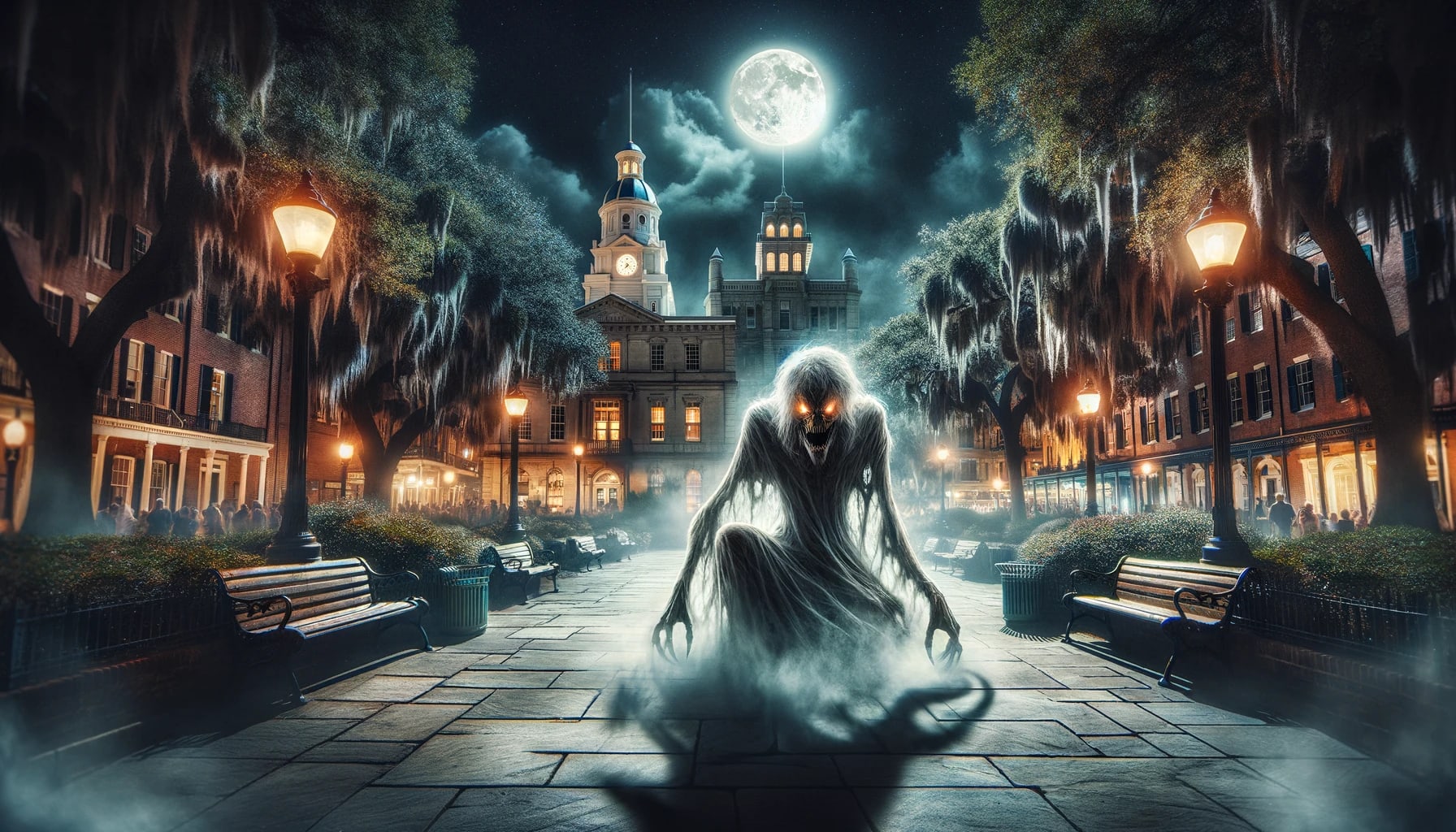
Wright Square earned the name "The Hanging Square," and it kept that reputation for generations. Public executions drew crowds well into the 19th century. The square sits at the intersection of Bull and York Streets, surrounded by live oaks draped in Spanish moss that locals say grows unnaturally thick near the hanging site. Whether that's botany or something else depends on who you ask.
The pattern continued throughout Savannah's history. As the city grew, so did its appetite for capital punishment. The colonial authorities, the British during occupation, the Confederates during the Civil War, and the postwar justice system all used execution as a tool of order. Many of those executions happened in public spaces that visitors walk through every day without knowing what the ground beneath them witnessed.
The Old Chatham County Jail
If Savannah's squares were where justice was performed, the Old Chatham County Jail was where it festered. Built in the early 19th century to house the growing city's criminals, the jail became one of the most feared institutions in the coastal South. Conditions were brutal even by the standards of the era. Overcrowding was constant, sanitation was an afterthought, and the jail's proximity to Savannah's swampy lowlands meant that disease moved through the cells with devastating regularity.
Yellow fever was the worst of it. When epidemics swept through Savannah, as they did repeatedly throughout the 1800s, prisoners had no means of escape or protection. They died in their cells while the city outside struggled to bury its own dead fast enough. The jail's death toll during these outbreaks was never properly documented, which tells you something about how much the authorities cared about the people inside.
But disease wasn't the only killer. The jail housed prisoners awaiting execution, and hangings were carried out on the premises or in nearby public spaces. The condemned spent their final days in cells that were designed to break the spirit long before the noose did its work. Reports from the period describe inmates driven mad by confinement, by the screaming of other prisoners, and by the knowledge of what awaited them.
The building changed hands and purposes over the decades, but the energy of the place has proved harder to repurpose than the bricks. Subsequent occupants have reported sounds with no source: footsteps in empty hallways, voices pleading from behind walls that no longer contain cells, and a persistent, oppressive weight that settles over anyone who stays too long. Paranormal investigators who have studied the site describe it as one of the most active locations in Savannah, which is saying something in a city with over 250 documented hauntings.
Savannah's Most Violent Crimes
Every city has its violent history. What makes Savannah's different is how concentrated it is. The Historic District is compact, barely a square mile, and within that space, centuries of violence have layered on top of each other like geological strata. Walk a few blocks in any direction and you'll pass sites of murders, duels, lynchings, and crimes that the city has never fully reckoned with.
The slave trade accounts for much of this violence, though it's rarely framed that way in the tourist brochures. Savannah operated one of the largest slave markets in the American South. The buying and selling of human beings was an everyday occurrence on the waterfront and in the squares, and the cruelty inflicted on enslaved people, in full public view, constituted the most sustained campaign of violence the city ever saw. The trauma of that history saturates Savannah's oldest buildings and public spaces in ways that go beyond metaphor.
Then there are the individual crimes that punctuate the historical record like gunshots. The shooting of Danny Hansford by antiques dealer Jim Williams at the Mercer-Williams House in 1981 became the centerpiece of Midnight in the Garden of Good and Evil, but it was hardly an anomaly. Savannah's history is studded with acts of violence that seem disproportionate to the city's genteel reputation. Duels were commonplace among the planter class. Barroom killings were frequent on the waterfront. And the post-Reconstruction era brought a wave of racial violence that the city has only recently begun to address publicly.
What makes this relevant to Savannah's hauntings is a principle that paranormal researchers and storytellers alike have observed for centuries: violent death tends to leave a mark. Whether you interpret that mark as spiritual energy, psychological residue, or historical memory embedded in physical space, the pattern holds. Savannah's most violent locations are, almost without exception, its most haunted.
The Sorrel-Weed House: Tragedy and Terror
The Sorrel-Weed House stands on the northwest corner of Madison Square, and from the outside, it looks like exactly what it is: one of the finest examples of Greek Revival and Regency architecture in Savannah. Built in the 1840s for Francis Sorrel, a wealthy shipping merchant, the house was a monument to prosperity and social standing. What happened inside it was something else entirely.
The story that has made the Sorrel-Weed House one of the most investigated haunted locations in America centers on two deaths that occurred in rapid succession. Francis Sorrel's wife, Matilda, fell or jumped from the second-story balcony overlooking the courtyard. The circumstances of her death were never fully explained, though the prevailing account suggests she discovered her husband's affair with Molly, an enslaved woman who worked in the household. Days after Matilda's death, Molly was found hanged in the carriage house behind the main residence.
Whether Molly's death was suicide or something far darker has been debated for over a century and a half. The official record is sparse, deliberately so, as the deaths of enslaved people rarely warranted thorough documentation in antebellum Savannah. What is known is that two women died violently in this house within days of each other, both connected to the same man, and neither death received the investigation it deserved.
The paranormal activity reported at the Sorrel-Weed House is among the most intense in Savannah. Visitors and investigators have documented cold spots in the carriage house that drop temperatures by 20 degrees or more, even in the heat of a Georgia summer. EVP recordings have captured what sound like a woman's voice, sometimes weeping, sometimes speaking words that are just below the threshold of comprehension. Shadow figures have been photographed in the courtyard where Matilda fell. And in the carriage house where Molly died, people report a feeling of profound sadness that seems to come from the walls themselves.
The Sorrel-Weed House is disturbing not because of jump scares or theatrical staging. It's disturbing because the suffering that happened here was real, it was unjust, and it has never been resolved. The house still stands. The stories still circulate. And the women at the center of them still have not received anything resembling peace.
The Marshall House and Civil War Amputations
The Marshall House Hotel at 123 East Broughton Street is one of Savannah's oldest hotels, built in 1851 by Mary Marshall. Today it operates as a boutique hotel with a sterling reputation and a secret that was literally buried in its walls.
During the Civil War, the Marshall House was commandeered as a Union hospital. The building that had hosted Savannah's social elite became an operating theater for battlefield medicine, which in the 1860s meant one thing above all others: amputation. Surgeons worked around the clock, removing shattered limbs from soldiers wounded in the sieges and skirmishes around the city. Anesthesia was unreliable. Antiseptic technique was nonexistent. The screaming, by all accounts, was constant.
The hotel also served as a hospital during not one but two yellow fever epidemics that ravaged Savannah, turning its guest rooms into fever wards where patients died by the dozen. The combination of war wounds and epidemic disease meant that an extraordinary amount of suffering and death was concentrated in this single building over a span of just a few decades.
Then, in the late 1990s, during a major renovation, workers made a discovery that confirmed what the ghosts had been trying to say all along. Beneath the floorboards, they found human remains: amputated limbs from the Civil War era, buried where they fell because there was nowhere else to put them. Arms, legs, and bone fragments that had been sealed under the floor for over 130 years.
The Marshall House has been the subject of paranormal investigation ever since. Guests in Room 414 report a persistent, unidentifiable odor that no amount of cleaning can remove. Throughout the hotel, visitors hear the sound of children's footsteps, rolling marbles, and bouncing rubber balls, sounds attributed to the orphaned children who sheltered in the building during the epidemics. Apparitions of Civil War soldiers, some missing limbs, have been reported in the hallways and guest rooms. And the figure of a man in 19th-century clothing has been seen sitting at a desk, writing, sometimes identified as Joel Chandler Harris, the author of the Uncle Remus stories, who was a frequent guest.
What makes the Marshall House uniquely disturbing is the specificity of its horrors. This is not a place where something vague and spooky supposedly happened. This is a building where surgeons sawed through bone while conscious men screamed, where children watched their parents die of fever, and where the physical evidence of that suffering was found under the floor where hotel guests sleep today.
True Stories of Savannah Spirits That Won't Rest
The locations above are the anchors, but Savannah's disturbing hauntings extend across the entire Historic District in ways that resist easy categorization.
Colonial Park Cemetery, Savannah's oldest surviving burial ground, holds more than 10,000 bodies beneath its surface, though fewer than 1,000 grave markers remain. The discrepancy is not an accident. Mass graves from yellow fever epidemics account for many of the unmarked dead. Others were displaced when the city expanded, their remains moved, lost, or simply built over. The cemetery was desecrated during the Civil War by Union soldiers who altered dates on headstones and vandalized monuments. Paranormal activity here is so frequent and so varied, from shadow figures to unexplained mists to disembodied voices, that it has become almost routine.
The tunnels beneath Factors Walk along the riverfront tell their own story. These passages, which connected the cotton warehouses to the waterfront, were also used during the slave trade and later served as improvised morgues during epidemic outbreaks. People who enter the tunnels today report the sensation of being watched, sudden drops in temperature, and sounds that echo from deeper inside the passages than anyone wants to go.
Then there are the secret cemeteries, burial grounds hidden throughout the city that were lost to development, covered over, and forgotten. Construction projects in Savannah regularly unearth human remains in unexpected places, a reminder that the city is built, in the most literal sense, on top of its dead. These discoveries are so common that they barely make the news anymore, but each one represents a person whose resting place was disturbed, whose story was erased, and whose presence, if you believe the reports, has never fully departed.
Savannah's spirits don't rest because Savannah never gave them reason to. The city preserved its buildings but not always the memory of what happened inside them. The ghosts are the memory. Together, these layers of unresolved history go a long way toward explaining why Savannah is considered the most haunted city in America.
Experience Savannah's Dark Side
The stories in this article are not the ones you'll hear on a family-friendly walking tour, and they shouldn't be. These are histories that demand a certain willingness to confront uncomfortable truths about what happened in this city and what it left behind.
The Dead of Night Tour was created specifically for this purpose. Running Friday and Saturday nights at 9:00 PM and 10:00 PM, it's a 90-minute, adults-only experience (16+) that takes you to locations including Colonial Park Cemetery, Wright Square, the secret cemeteries, and the Six Pence Pub. The guides who lead this tour are trained not just in the facts but in how to tell stories that do justice to the people who lived and died in these places.
This is not a tour that trades in cheap thrills. It's a tour that trusts its audience to handle the truth, and the truth about Savannah's darkest chapters is more disturbing than any fiction could be.
Browse all ghost tours in Savannah or learn more about Savannah's haunted locations.