Savannah's Quiet Cemetery with a Haunted Reputation
Greenwich Cemetery is one of Savannah's historic burial grounds, located outside the busy downtown Historic District in the quieter neighborhoods to the east of the city center. Unlike Colonial Park Cemetery or Bonaventure Cemetery, which draw large numbers of tourists year-round, Greenwich Cemetery is a place most visitors to Savannah never see. It does not appear on postcards or in travel guides, and it does not have the famous statuary or literary connections that make other Savannah cemeteries nationally known.
But Greenwich Cemetery has something else — a long history of community burials stretching back more than a century, a quiet and secluded atmosphere that feels removed from the modern city, and a reputation for ghost stories and unexplained encounters that has grown steadily among those who know the grounds well. Visitors who have walked the cemetery's pathways have occasionally reported strange experiences — shadowy figures glimpsed among the headstones, unexplained sounds drifting through the trees, and an atmosphere that feels heavier than the surrounding neighborhood can account for.
This article explores the history of Greenwich Cemetery, the individuals buried within its grounds, and the ghost stories that have become attached to this quiet corner of haunted Savannah. Whether these stories are the product of the cemetery's powerful atmosphere or evidence of something more enduring is a question that visitors to Greenwich Cemetery must answer for themselves.
The History of Greenwich Cemetery
Greenwich Cemetery's history is closely tied to the growth of Savannah itself. As the city expanded beyond its original colonial boundaries during the late 19th and early 20th centuries, new burial grounds were needed to serve the growing population. Greenwich Cemetery was established in the early 1900s as a municipal cemetery, created to accommodate the communities developing east and south of the Historic District.
Creation of the Cemetery
By the turn of the 20th century, Savannah's older cemeteries — Colonial Park Cemetery, Laurel Grove Cemetery, and Bonaventure Cemetery — were either closed to new burials or approaching capacity. The city's population was growing, new neighborhoods were being built, and there was a practical need for additional burial space that could serve residents who lived outside the historic core.
Greenwich Cemetery was developed as a municipal cemetery to meet this need. The site was chosen for its location along Greenwich Road, accessible to the surrounding residential communities but set apart enough from the bustle of daily life to provide the quiet and dignity expected of a burial ground. The cemetery was laid out with wide pathways, designated family plot sections, and space for both individual graves and larger family monuments.
Growth and Expansion
Over the following decades, Greenwich Cemetery grew steadily as the surrounding communities expanded. New sections were added to accommodate increasing demand, and the cemetery evolved from a small neighborhood burial ground into a substantial municipal cemetery serving a wide cross-section of Savannah's population.
Family plots were established by local families who chose Greenwich as the resting place for multiple generations. These plots, marked by matching headstones or surrounded by low iron fences, give certain sections of the cemetery a sense of continuity — a visual record of families who lived, worked, and died in the neighborhoods surrounding the burial ground. The cemetery became a place where the community's history was preserved not in archives or museums, but in the names and dates carved into stone.
Role in Savannah's History
Greenwich Cemetery reflects a side of Savannah's history that is often overshadowed by the city's more famous landmarks. While tourists flock to the Historic District, the squares, and the riverfront, cemeteries like Greenwich quietly preserve the stories of the ordinary people who built the city — the workers, the shopkeepers, the veterans, the parents and children whose lives made up the daily fabric of Savannah. Their headstones tell stories of long lives and short ones, of families that thrived and families that were cut short by illness or accident.
The cemetery also reflects the changing burial traditions of the 20th century. Earlier sections feature more ornate Victorian-influenced monuments, while later sections trend toward the simpler, more uniform headstone styles that became common in American cemeteries during the mid-20th century. Walking through Greenwich Cemetery from one end to the other is, in a sense, walking through a century of American attitudes toward death, mourning, and remembrance.
Architecture and Landscape of Greenwich Cemetery
Greenwich Cemetery does not have the dramatic Victorian statuary of Bonaventure Cemetery or the ancient colonial headstones of Colonial Park Cemetery. Its beauty is quieter and more understated — the beauty of a place that has been shaped by time, nature, and the steady accumulation of generations of human care.
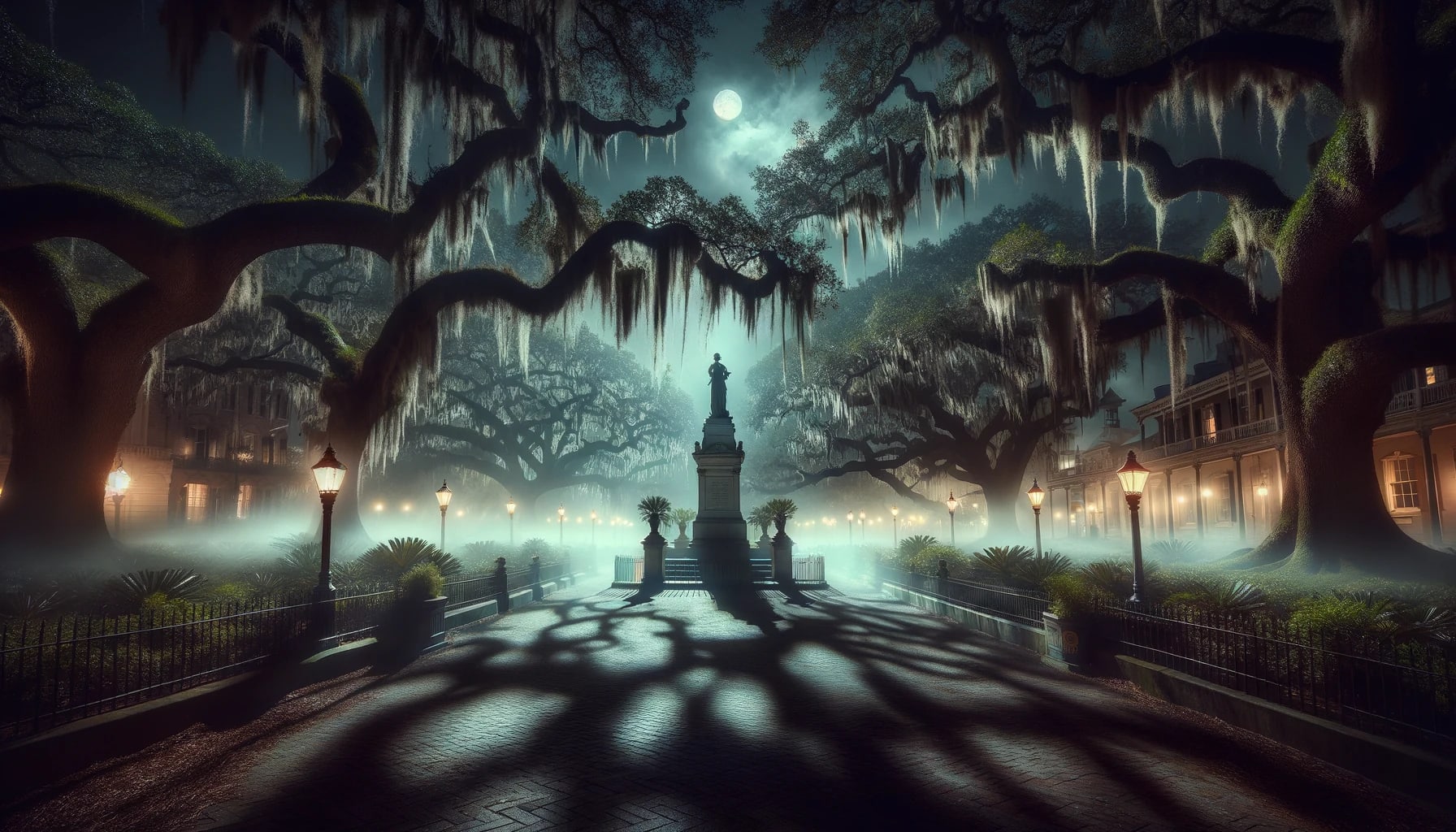
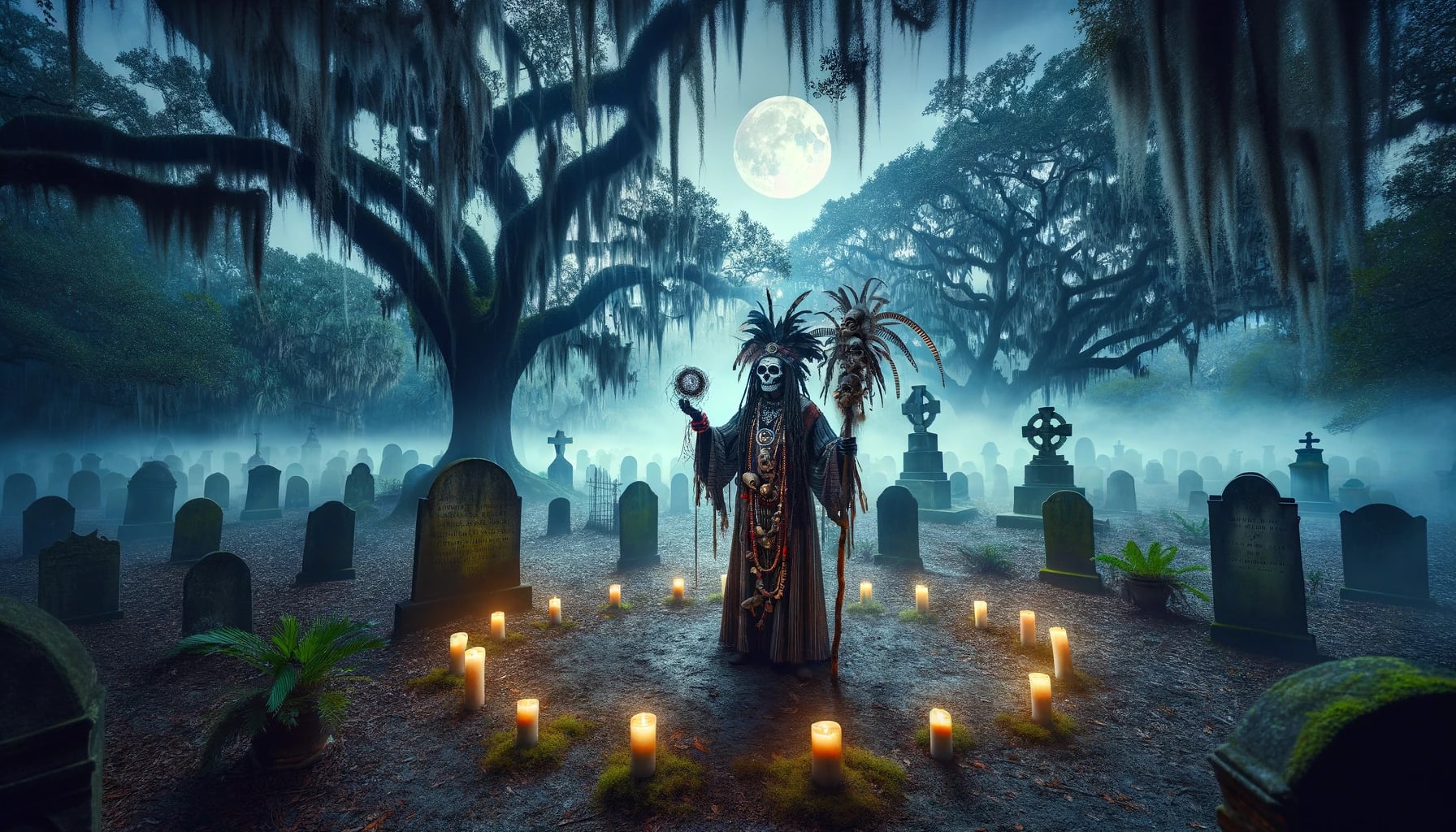
The grounds are lined with mature trees — live oaks, magnolias, and pines — that provide shade over the burial plots and create a canopy that filters the sunlight into shifting patterns across the headstones. Spanish moss hangs from many of the oaks, adding the distinctly Southern atmosphere that characterizes so many of Savannah's outdoor spaces. In the older sections of the cemetery, the trees have grown large enough to create enclosed, almost room-like spaces beneath their branches, areas where the light is dim even at midday and the air feels noticeably cooler than the open ground nearby.
The headstones and monuments vary widely in style and condition. Some are simple granite markers bearing only a name and two dates. Others are more elaborate — carved angels, crosses, open books, and draped urns that reflect the mourning traditions of the early to mid-20th century. In some sections, family plots are enclosed by low stone walls or iron railings, creating small, defined spaces within the larger grounds.
This landscape creates a quiet and reflective atmosphere that deepens as the day progresses. In the late afternoon and early evening, when the light turns golden and the shadows stretch long across the ground, Greenwich Cemetery takes on a quality that many visitors describe as both peaceful and unsettling. It is this atmosphere — the combination of age, quiet, natural beauty, and the ever-present awareness of the dead resting just below the surface — that contributes to the cemetery's reputation for ghost stories.
Notable Burials in Greenwich Cemetery
Greenwich Cemetery holds the remains of generations of Savannah residents whose lives, taken together, tell the story of the city's growth and development during the 20th century. While the cemetery may not contain the graves of nationally famous figures, its burials are significant for what they reveal about the community that created and maintained the cemetery.
Community Leaders
Among those buried at Greenwich Cemetery are local business owners, civic leaders, and community organizers who shaped the neighborhoods surrounding the cemetery during the early and mid-20th century. These were the people who opened the stores, built the churches, served on the city councils, and organized the social institutions that held their communities together. Their graves are often marked by larger monuments or family plots that reflect their standing within the community.
Military Veterans
Greenwich Cemetery is the final resting place of numerous military veterans who served in conflicts ranging from World War I through the Vietnam War and beyond. Many of their graves are marked with small American flags or military medallions that identify their branch of service and the conflict in which they served. These veteran burials are a reminder that Savannah's military history extends far beyond the Revolutionary War and the Civil War — that men and women from this city served and sacrificed in every major conflict of the 20th century.
Savannah Families
Perhaps the most significant feature of Greenwich Cemetery's burials is the multi-generational family plots that span decades. Walking through these sections, you can trace the history of individual families across three or four generations — grandparents, parents, children, and sometimes grandchildren, all resting together in the same plot. These family sections are a powerful reminder that cemeteries are not simply collections of individual graves but repositories of family memory and continuity.
Cemeteries often preserve the social history of a city in ways that other institutions cannot. The names on the headstones, the dates they span, the relationships they record — all of these details create a portrait of a community that is both intimate and comprehensive. Greenwich Cemetery is, in this sense, a living archive of the people who made Savannah what it is today.
Ghost Stories Associated with Greenwich Cemetery
Greenwich Cemetery has accumulated a body of ghost stories and reported encounters over the years that, while quieter and less publicized than those associated with Savannah's more famous cemeteries, are notable for their consistency and their grounding in the experiences of local residents and visitors.
The most common reports involve shadowy figures seen among the graves. Visitors have described seeing what appeared to be a person standing near a headstone or walking slowly along one of the cemetery's pathways, only to find the area completely empty when they drew closer. These figures are typically described as dark and indistinct — human in shape but lacking clear features or details. They are most often seen in the older sections of the cemetery, where the trees are tallest and the light is dimmest, and they tend to appear in the late afternoon or early evening when the shadows are longest.
Unexplained movement near monuments has also been reported. Visitors have described seeing motion at the periphery of their vision — a shifting or swaying near one of the larger headstones or family monuments — that disappears the moment they turn to look directly. This type of report is consistent across many of Savannah's haunted locations and is particularly common in cemeteries, where the combination of stone monuments and shifting natural light can create visual effects that are difficult to explain.
Sudden cold spots are another recurring element in the reports from Greenwich Cemetery. Visitors have described walking through areas where the temperature dropped sharply and without explanation — a localized chill that lasted only a few seconds before the surrounding warmth returned. These cold spots seem to occur at random, without any obvious connection to wind patterns, shade, or other environmental factors.
Strange sounds have also been reported, though less frequently. Visitors have described hearing faint rustling or whispering sounds in sections of the cemetery where no one else was present. The sounds are never loud or distinct enough to identify clearly, but they create an impression of activity in an otherwise still and quiet place.
It is important to present these stories for what they are: local folklore and reported experiences that have accumulated over time. The people who share these accounts are not seeking attention or promoting the cemetery as a paranormal destination. They are simply describing what they experienced in a place that, for whatever reason, seems to produce encounters that are difficult to explain.
Why Cemeteries Often Become Associated with Ghost Stories
Cemeteries are among the most common settings for ghost stories across virtually every culture and time period. This is not a coincidence. Several factors — cultural, psychological, and environmental — contribute to the association between burial grounds and the supernatural.
At the most fundamental level, cemeteries are places of mourning and remembrance. They exist because people have died, and they are maintained so that the living can honor and remember the dead. This purpose gives cemeteries an emotional weight that most other public spaces do not carry. When you walk through a cemetery, you are walking among the remains of people who lived, loved, suffered, and died — and the awareness of that proximity to death shapes how the mind interprets the environment.
Centuries of accumulated emotional experiences also play a role. Cemeteries that have been in use for generations have been the setting for countless acts of grief, from the raw anguish of fresh loss to the quiet sadness of annual visits to a loved one's grave. Some researchers believe that places where strong emotions have been felt repeatedly over long periods develop a kind of residual atmosphere that sensitive individuals can perceive.
Environmental factors are equally important. Old cemeteries, with their mature trees, heavy shade, uneven terrain, and aging stone monuments, create visual and auditory conditions that the brain can easily misinterpret. The play of light and shadow through tree branches, the rustle of wind through Spanish moss, the unexpected appearance of a stone figure glimpsed through the foliage — all of these elements contribute to an environment where the line between the real and the imagined can blur.
Greenwich Cemetery contains all of these elements: a long history, layers of accumulated grief and remembrance, mature trees and shifting shadows, and the quiet isolation that separates it from the noise of modern life. Whether its ghost stories are the natural product of these conditions or evidence of something beyond explanation is a question that remains open.
Important Information About Visiting Greenwich Cemetery
Visitors who are interested in Greenwich Cemetery should be aware of several important details before planning a visit.
Ghost City Tours does not conduct ghost tours inside Greenwich Cemetery or any other Savannah cemetery. No tour companies are permitted to operate ghost tours inside Savannah's cemeteries. This policy exists for several important reasons.
First, cemeteries are active memorial spaces. Families continue to visit the graves of their loved ones, and the presence of ghost tour groups could be disruptive and disrespectful to those who come to mourn and remember. Second, Savannah's cemeteries have specific operating hours and close at designated times each day. These closures are enforced to protect the grounds, the monuments, and the privacy of the cemetery. Third, the monuments and headstones in historic cemeteries are often fragile and irreplaceable, and limiting foot traffic — especially after dark — helps preserve them for future generations.
Visitors who wish to explore Greenwich Cemetery are welcome to do so during regular operating hours. The cemetery is a public municipal space, and walking the grounds during daylight hours is a perfectly appropriate way to experience its history and atmosphere. Visitors should treat the grounds with respect, stay on designated pathways where possible, and avoid touching or leaning on monuments.
For those who are drawn to the ghost stories associated with Greenwich Cemetery, the best approach is to visit during the day, take time to explore the grounds, read the inscriptions on the headstones, and appreciate the atmosphere for what it is — a place where more than a century of Savannah's history rests just beneath the surface.
Exploring Savannah's Haunted Cemeteries
Greenwich Cemetery is one of several historic burial grounds in Savannah that have become associated with ghost stories and paranormal legends. The city's long and often turbulent history — from its colonial founding in 1733 through yellow fever epidemics, the Civil War, and centuries of growth and change — has produced a remarkable concentration of cemeteries, each with its own character, its own history, and its own stories.
Colonial Park Cemetery, the oldest identifiable burial ground in the city, sits in the heart of the Historic District and has been a source of ghost stories for generations. Bonaventure Cemetery, with its famous monuments and literary connections, draws visitors from around the world. Laurel Grove Cemetery holds the graves of Civil War soldiers and prominent Savannah families. And beneath the city's streets lie forgotten burial grounds that most visitors never know existed.
Visitors interested in the ghost lore surrounding Savannah's cemeteries can explore these and other historic burial grounds through our haunted cemeteries of Savannah collection. Each cemetery has its own stories to tell, and together they paint a picture of a city whose relationship with its dead is unlike anywhere else in America.
Discover Savannah's Haunted History
While cemeteries cannot host ghost tours after dark, Savannah's Historic District contains dozens of locations tied to ghost stories, unexplained encounters, and centuries of haunted history. The city's squares, its historic homes, its restaurants and taverns, and its atmospheric streets all carry stories of the supernatural that have been passed down through generations.
Ghost City Tours in Savannah offers several guided ghost tours that explore the most haunted corners of the Historic District after nightfall. These tours take guests through the streets where Savannah's ghost stories originated, past the buildings where unexplained events have been reported for decades, and into the atmosphere that makes Savannah one of the most haunted cities in the United States.
For visitors who have spent time exploring Greenwich Cemetery or any of Savannah's other historic burial grounds, an evening ghost tour through the Historic District is the ideal way to continue the experience. The daytime quiet of the cemetery and the nighttime energy of the haunted streets complement each other, offering two very different perspectives on a city where the past is never far from the surface.
We encourage visitors to explore Savannah's haunted history through the city's many historic locations. Whether you begin with a walk through a century-old cemetery or a nighttime tour through the gas-lit streets, the stories you encounter will stay with you long after you leave.
A Cemetery That Holds Its Community's Memory
Greenwich Cemetery has served the people of Savannah for more than a century. It has provided a resting place for community leaders, military veterans, and generations of ordinary families whose lives made up the daily fabric of the city. It has grown and evolved alongside the neighborhoods that surround it, absorbing the history of the community it serves and preserving it in stone.
The ghost stories associated with Greenwich Cemetery are part of its broader legacy — not because they overshadow the cemetery's history, but because they add another layer to a place that already carries more than a century of human memory. Whether the shadowy figures and strange sounds reported by visitors are the echoes of the past, the products of a powerful atmosphere, or something that defies easy explanation is a question that Greenwich Cemetery does not answer. It simply holds its stories, as it has always done, and waits for visitors to discover them.
If you are drawn to the quieter corners of Savannah's haunted history, Greenwich Cemetery offers an experience very different from the city's more famous landmarks. It is a place where the past feels close, where the atmosphere invites reflection, and where the line between history and mystery grows thin beneath the shade of the old oaks. We invite you to explore more of Savannah's haunted locations and discover for yourself why this city's relationship with its ghosts runs so deep. Locations like this one are central to understanding what makes Savannah the most haunted city in America.