Savannah's Most Beautiful — and Most Haunted — Park
Forsyth Park is the most famous park in Savannah's Historic District. Spanning roughly 30 acres at the southern end of the city's historic core, the park is known for its iconic fountain, its canopy of Spanish moss-covered oak trees, and its wide walking paths that draw thousands of visitors every year. It is one of the most photographed locations in the entire city, a place where couples get engaged, where families spend lazy Sunday afternoons, and where tourists stop to take in the beauty of one of America's most enchanting cities.
But Forsyth Park carries something beneath its surface that most daytime visitors never notice. The park has a long history connected to war, tragedy, and death — and for decades, visitors have reported strange experiences after dark. Shadowy figures that move between the trees. Footsteps on empty pathways. Cold spots that appear without warning on warm Savannah nights.
Ghost City Tours guides often pass through Forsyth Park after finishing tours downtown, walking home through the quiet paths when the rest of the city has gone to sleep. More than a few of them have reported seeing shadowy figures moving through the trees when the park is otherwise empty — figures that disappear the moment they are noticed. In Savannah, the most beautiful locations sometimes hide the most unsettling stories, and Forsyth Park is no exception.
The History of Forsyth Park
To understand why Forsyth Park feels the way it does at night, it helps to understand how the park came to exist and what has taken place on its grounds over the past two centuries.
Early Savannah Expansion
When James Oglethorpe founded Savannah in 1733, the city occupied a small bluff overlooking the Savannah River. For more than a century, the city slowly expanded southward, square by square, following Oglethorpe's famous grid plan. By the 1840s, Savannah's population was growing rapidly, and city leaders recognized the need for a large public green space at the southern boundary of the expanding city.
The land that would become Forsyth Park was set aside in 1840. Initially, the park covered roughly 10 acres, occupying what had been open land on the outskirts of the city. The park was designed as a formal public space — a place for Savannah's residents to walk, gather, and escape the density of the growing city. It was modeled after the grand public parks of European cities, with wide paths, open lawns, and carefully planted trees.
Naming of the Park
The park was named after John Forsyth, the 33rd Governor of Georgia and later the United States Secretary of State under Presidents Andrew Jackson and Martin Van Buren. Forsyth was one of the most influential political figures in Georgia's early history, and naming the park after him reflected his significance to the state. Though Forsyth himself had little direct connection to the park's creation, the name honored his legacy and his role in shaping Georgia's political identity during a critical period of the state's growth.
Expansion of the Park
By the 1850s, the park had been expanded significantly, growing to roughly 30 acres — the size it remains today. The expansion added the southern portion of the park, which included additional walking paths, open green space, and the planting of the live oak trees that now define the park's character. Those trees, draped in Spanish moss, have grown over the past century and a half into the towering canopy that gives Forsyth Park its distinctive atmosphere — beautiful during the day, and deeply atmospheric once the sun goes down.
The expanded park quickly became the center of civic life in Savannah. Residents gathered there for celebrations, public speeches, and community events. It was a place where the city came together, and its importance to Savannah's identity has only grown over time.
Military History
Forsyth Park also served a military purpose during some of the most turbulent years in American history. In the years leading up to and during the Civil War, the park's open fields were used for military drills and training exercises. Confederate soldiers mustered and trained on the same lawns where families now picnic and children play. During the Civil War itself, the park and the surrounding area saw encampments of soldiers — first Confederate, and later Union troops following General William Tecumseh Sherman's capture of Savannah in December 1864.
This military history is important because locations tied to wartime — places where soldiers trained, camped, suffered, and sometimes died — are frequently associated with ghost stories. The ground beneath Forsyth Park has absorbed more than a century and a half of human conflict, and many believe that history has left a mark that goes beyond what can be seen in the daylight.
The Famous Forsyth Park Fountain
No discussion of Forsyth Park is complete without mentioning its most famous feature: the Forsyth Park Fountain. Installed in 1858, the fountain stands at the northern end of the park and has become the single most recognizable symbol of Savannah. It appears on postcards, travel guides, and Instagram feeds more than almost any other landmark in the city.
The fountain was inspired by similar designs found in public squares in Paris, and its elegant, tiered design reflects the European influence that shaped much of Savannah's architecture and public spaces during the 19th century. The fountain was restored in 1988 and again in subsequent years, and it continues to draw visitors from around the world who come to photograph it, especially when it is lit up at night or dyed green for St. Patrick's Day.
But the fountain has its own place in Forsyth Park's haunted reputation. Many ghost tour guests stop near the fountain when walking through the park at night, drawn by its beauty and its soft glow against the darkness of the surrounding trees. Over the years, visitors have occasionally reported seeing unusual figures appearing in nighttime photographs taken near the fountain — shapes and shadows that were not visible to the naked eye when the photo was taken. Whether these are tricks of light, long exposures capturing movement, or something else entirely is a question that each visitor must answer for themselves.
What is certain is that the fountain, beautiful as it is, sits at the heart of a park with a long and complicated history — and that the area around it feels different once the crowds have gone home and the park falls quiet.
Civil War Ghosts of Forsyth Park
Savannah's relationship with the Civil War is central to understanding its haunted reputation, and Forsyth Park is one of the locations where that history feels closest to the surface.
When General Sherman arrived in Savannah in December 1864, completing his famous March to the Sea, the city was occupied by Union forces. Soldiers from both sides had already spent years in and around Savannah's public spaces, and Forsyth Park was no exception. Confederate troops had used the park's open grounds for drills and musters earlier in the war, and Union soldiers occupied many of the city's public spaces during the occupation that followed.
The presence of so many soldiers — men far from home, many of whom were sick, wounded, or dying — left a mark on Savannah that many believe persists to this day. Ghost stories connected to Civil War soldiers are among the most common reports in haunted Savannah, and Forsyth Park generates its share.
Visitors have reported seeing apparitions resembling soldiers walking among the trees, particularly in the southern portion of the park where the ground is less manicured and the oak canopy is thickest. The figures are typically described as moving slowly and deliberately, as if on patrol or walking guard duty. They appear briefly and then seem to dissolve into the shadows between the trees.
Other reports describe the sound of footsteps — heavy, deliberate footsteps — on the park's pathways when no one else is present. The sound seems to come from just behind the listener, as if someone is following a few paces back, but when the listener turns to look, the pathway is empty.
Some Ghost City Tours guides who walk home through the park after finishing their evening tours have reported similar experiences. On more than one occasion, guides have described hearing distinct footsteps behind them on the park's gravel paths — footsteps that stopped the moment they stopped walking and resumed the moment they started again. Each time, the path behind them was completely empty.
Shadow Figures Beneath the Oak Trees
Among the most frequently reported paranormal experiences in Forsyth Park are sightings of shadow figures beneath the park's massive live oak trees. These reports have come from visitors, residents, and Ghost City Tours guides over a period of many years, and they share enough common details to form a consistent pattern.
The shadow figures are typically described as dark, human-shaped forms that move between the trees at the edges of the park's walkways. They are most often seen at night, when the park is quiet and the streetlights cast long shadows through the moss-draped branches. Witnesses describe the figures as appearing briefly — sometimes for only a second or two — before disappearing into the deeper shadows beneath the canopy.
What makes these sightings notable is their consistency. The figures are almost always described as dark and indistinct, without clear facial features or clothing details. They move smoothly and silently, without the sound of footsteps or the rustling of leaves. They are most commonly seen at the periphery of vision — noticed in the corner of the eye and gone by the time the witness turns to look directly.
Several Ghost City Tours guides who regularly pass through Forsyth Park late at night have reported seeing these shadow figures on multiple occasions. The sightings typically occur when the park is quiet and nearly empty, usually well after midnight when the last of the evening's visitors have gone home. The guides describe the experience as unsettling but not threatening — a sense that someone or something is present in the park that should not be there.
The live oak trees themselves contribute to the atmosphere. Some of the oaks in Forsyth Park are well over a century old, with massive trunks and branches that extend outward in every direction, creating a dense canopy that blocks out much of the moonlight and streetlight. The Spanish moss that hangs from every branch adds another layer of shadow and movement, swaying gently in the breeze and creating shapes that the mind can easily interpret as something more than what they are.
Ghost Sightings Reported by Visitors
It is not only guides and long-time Savannah residents who report unusual experiences in Forsyth Park. Over the years, visitors from out of town have shared their own encounters — experiences that they often describe as unexpected and difficult to explain.
One of the more common reports involves figures sitting on park benches. Visitors walking through the park at night have described seeing what appeared to be a person sitting alone on a bench, only to find the bench completely empty when they drew closer. The figure simply was not there when they arrived at the spot where they had clearly seen someone sitting just moments before.
Other visitors have described sudden cold spots — areas within the park where the temperature drops sharply and without explanation, even on warm Savannah evenings. These cold spots seem to appear and disappear at random, lasting only a few seconds before the surrounding warmth returns. Some visitors have described the cold as feeling different from a natural breeze — more localized, more sudden, and accompanied by a feeling of unease that is difficult to articulate.
Strange sounds are also reported with some regularity. Visitors have described hearing faint whispers or distant voices when no one else is nearby, sounds that seem to come from just beyond the tree line or from somewhere deeper within the park. The voices are never distinct enough to make out specific words, but the impression of someone speaking — or several people speaking quietly — is strong enough to make listeners stop and search for the source.
Guests on Ghost City Tours have occasionally reported seeing strange movement near the park when passing it during nighttime tours through the Historic District. While the tours themselves do not typically enter the park, the proximity of certain tour routes to Forsyth Park means that guests sometimes catch glimpses of the park's interior — and what they see there is not always easy to explain.
Points of Interest Within Forsyth Park
Forsyth Park is more than just open green space. The park contains several features that contribute to its historical significance and its haunted reputation.
The Forsyth Fountain
As discussed above, the fountain installed in 1858 is the park's most famous feature. Its Parisian-inspired design and prominent placement at the north end of the park make it the first thing most visitors see when they enter. The fountain has been photographed millions of times and remains the most iconic symbol of Savannah. At night, the fountain takes on a different character — quieter, more isolated, and surrounded by the shadows of the park's ancient trees.
The Confederate Memorial
Located in the center of the park, the Confederate Memorial was erected in 1875 to honor the Confederate soldiers who fought and died during the Civil War. The monument features a bronze figure of a Confederate soldier standing atop a tall stone pedestal, facing north. Whatever one's views on the monument's place in modern Savannah, its presence is a tangible reminder that the park has deep connections to the Civil War — connections that many believe contribute to the paranormal activity reported within the park's boundaries.
Walking Paths and Oak Canopy
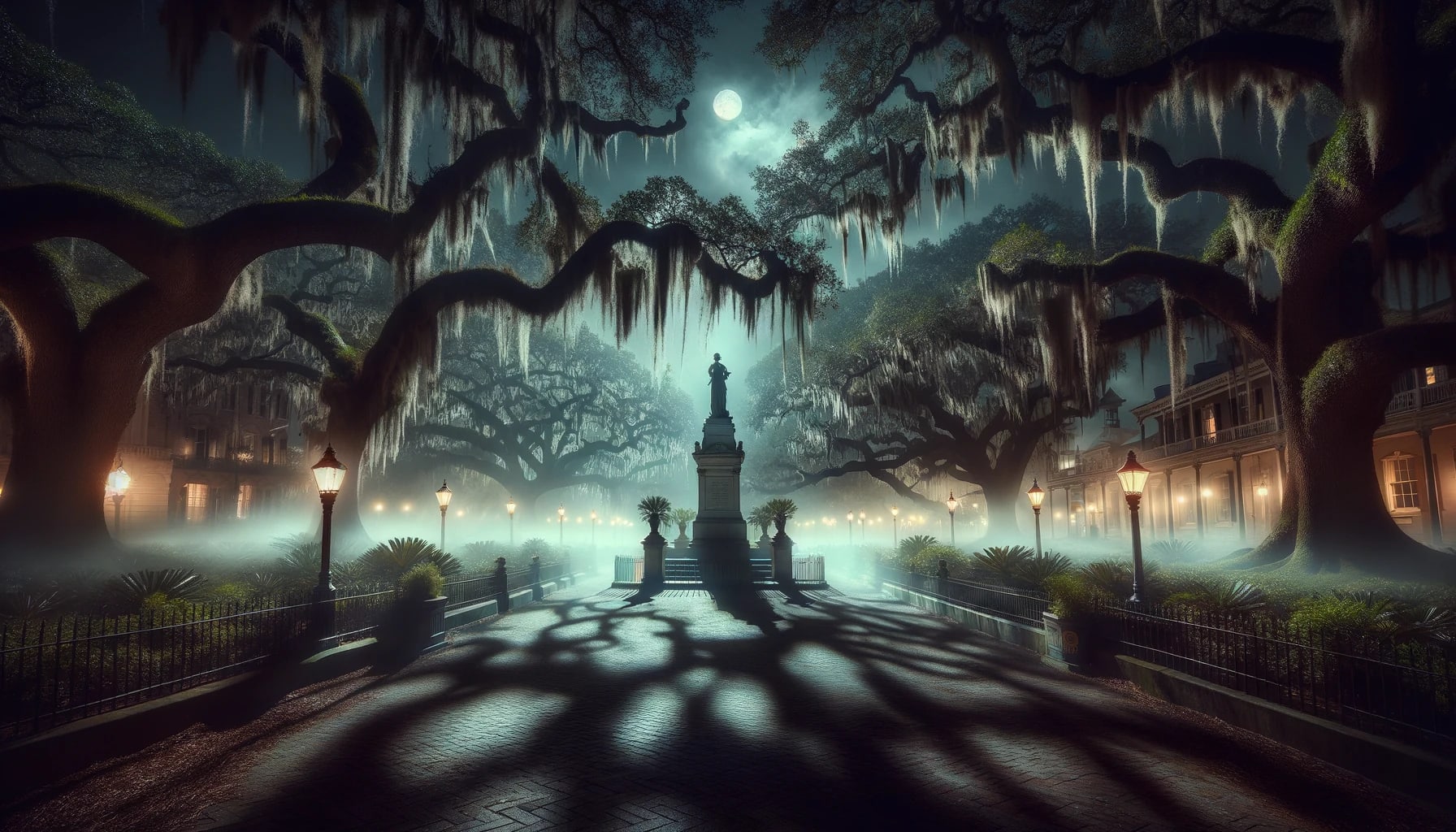
The park's walking paths wind beneath a canopy of live oak trees draped in Spanish moss. During the day, these paths are filled with joggers, dog walkers, and tourists. At night, they take on an entirely different feeling. The dim lighting, the heavy moss overhead, and the quiet that settles over the park after dark create an atmosphere that is both beautiful and deeply eerie. The oak trees filter the light from the surrounding streets, casting the paths in deep shadow and creating an environment where the imagination — and perhaps something more — can run freely.
Public Gatherings and Events
Forsyth Park has hosted festivals, celebrations, concerts, and civic gatherings for more than 175 years. The park's central location and large open spaces make it a natural gathering point for the community. From farmer's markets to outdoor concerts, the park has been a place where Savannah comes together. Some researchers who study the paranormal suggest that places with centuries of intense human activity — places where strong emotions have been felt by thousands of people over many generations — tend to accumulate a kind of residual energy. Whether or not one accepts that theory, there is no denying that Forsyth Park has been the backdrop for more human experience than almost any other location in Savannah.
Why Forsyth Park Feels Haunted
Even skeptics who visit Forsyth Park after dark often comment on the park's atmosphere. There is something about the place at night that feels different from a typical city park, and several factors contribute to that feeling.
The ancient live oak trees are a major factor. Some of the oaks in Forsyth Park are estimated to be 150 years old or more, with massive trunks and sprawling branches that create a dense, layered canopy overhead. The Spanish moss that hangs from every branch moves constantly in the breeze, creating shifting shapes and shadows that the brain naturally tries to interpret as something recognizable — often as human figures.
The lighting in the park is deliberately soft and understated, which preserves the park's beauty but also leaves large areas in near-darkness. The contrast between the softly lit paths and the dark spaces between the trees creates an environment where movement at the edges of vision is common and difficult to explain.
Savannah's historic architecture surrounding the park adds another layer. The Victorian homes and antebellum mansions that line the streets around Forsyth Park are themselves steeped in history, and the cumulative effect of being surrounded by so much visible history creates a feeling of being connected to the past that is difficult to shake — especially at night, when the modern world fades away and the park looks much as it did a century ago.
All of these environmental factors combine to create the atmosphere that makes Forsyth Park one of the most talked-about haunted locations in Savannah. Whether the experiences reported there are the result of these environmental conditions, genuine paranormal activity, or some combination of both is a question that remains unanswered. For a deeper look at the forces behind the city's supernatural reputation, read about why Savannah is the most haunted city in America.
Experiencing Forsyth Park on a Savannah Ghost Tour
Visitors who want to explore Savannah's haunted history will find that many of the city's most compelling ghost stories are connected to locations in and around Forsyth Park and the surrounding Historic District. While the park itself is an open public space that anyone can walk through at any time, experiencing it as part of a broader exploration of haunted Savannah adds context and depth to the experience.
Ghost City Tours operates several ghost tours in Savannah that take guests through the heart of the Historic District, exploring the stories behind the city's most haunted locations. The Grave Tales Tour focuses on Savannah's burial grounds and the spirits that refuse to leave them. The Dead of Night Tour takes guests deeper into the city's darkest stories, exploring the crimes, tragedies, and hauntings that have earned Savannah its reputation as one of the most haunted cities in America. And the Beyond Good and Evil Tour explores the thin line between good and evil that runs through so much of Savannah's history.
Ghost City Tours guides know Forsyth Park well because many of them pass by it nightly after finishing tours, walking home through the quiet park when the rest of the city has gone to sleep. Some of these guides have shared stories of seeing unexplained shadowy figures beneath the trees when walking home late at night — figures that appear at the edge of the path and vanish before they can be studied closely. These are not stories the guides tell on tour. They are personal experiences, shared among colleagues, that reinforce what so many others have reported over the years.
If you are visiting Savannah and want to experience the city's haunted history for yourself, we encourage you to book a ghost tour and then take a walk through Forsyth Park afterward. The contrast between the lively tour experience and the quiet stillness of the park at night is something you will not soon forget.
Visiting Forsyth Park Today
Forsyth Park remains one of Savannah's most beloved public spaces. The park is open to the public year-round and is free to visit at any time of day or night. During the day, the park is alive with activity — joggers circle the perimeter path, families gather on the wide lawns, and tourists line up to photograph the famous fountain. The Saturday farmer's market draws locals and visitors alike, and the park's open green spaces host festivals and community events throughout the year.
But Forsyth Park takes on a very different character once darkness falls. The crowds thin out, the sounds of the city fade, and the park settles into a quiet that feels very different from the energy of the daytime. The oak trees, so beautiful and welcoming under the afternoon sun, become towering dark shapes with branches that reach in every direction. The Spanish moss sways in the breeze, and the soft lighting along the paths creates pools of light separated by stretches of deep shadow.
It is in these quiet nighttime hours that Forsyth Park reveals its other side — the side that has generated decades of ghost stories, unexplained sightings, and the uneasy feeling that you are not quite alone on the path. Whether you are a believer in the paranormal or a committed skeptic, a nighttime walk through Forsyth Park is an experience that stays with you.
A Park That Holds Its Secrets
Forsyth Park has stood at the heart of Savannah for nearly two centuries. It has witnessed the expansion of a city, the drilling of soldiers preparing for war, the occupation of a conquering army, and the slow passage of generations of Savannah residents who have walked its paths, gathered on its lawns, and built their lives in its shadow. The park has absorbed all of this history, and many believe it holds onto more of it than the visible monuments and plaques suggest.
The ghost stories of Forsyth Park are not dramatic tales of screaming specters or violent hauntings. They are quieter than that — shadow figures glimpsed beneath the oaks, footsteps heard on empty paths, cold spots that appear and vanish without explanation. They are the kind of stories that make you pause, look over your shoulder, and wonder whether what you saw was real or imagined.
Savannah's most beautiful locations sometimes hide its most mysterious stories, and Forsyth Park is perhaps the best example of that truth. If you are drawn to the haunted side of Savannah, we invite you to explore the city's haunted history through a guided ghost tour and then take a quiet walk through Forsyth Park on your own. Stand beneath the oak trees. Listen to the silence. And decide for yourself whether you are truly alone.