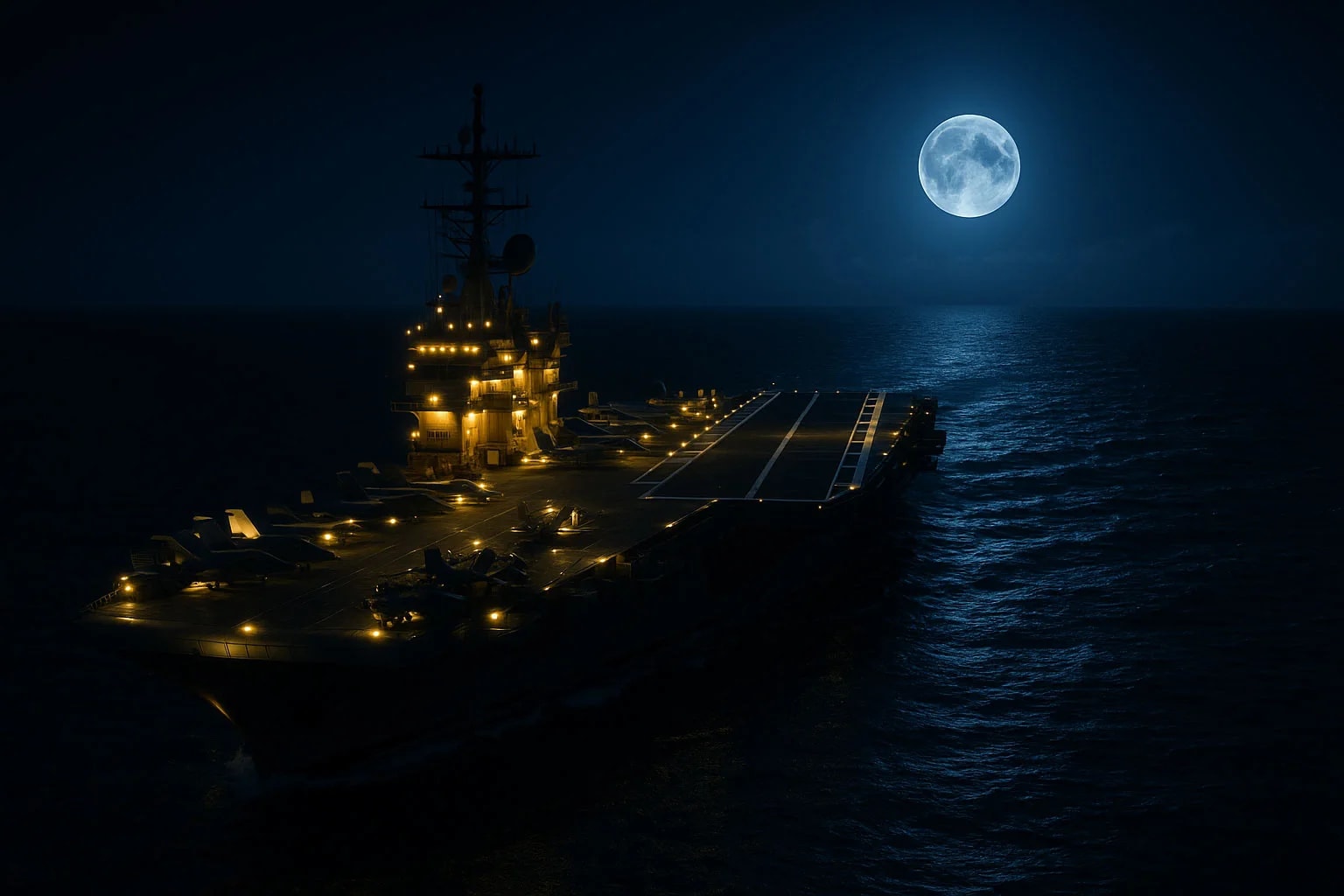
The USS Hornet sits quietly in the waters off Alameda, her massive grey hull a monument to American naval power and sacrifice. At 872 feet long and displacing 41,000 tons, she is an imposing presence - an Essex-class aircraft carrier that once launched fighters and bombers against the Japanese Empire and later plucked Apollo astronauts from the Pacific Ocean. But for all her impressive statistics and heroic history, it is what cannot be measured that draws many visitors to the Hornet today.
The USS Hornet is haunted. Deeply, persistently, undeniably haunted.
Over the course of her 27 years of active service, more than 300 men died aboard the Hornet. Some fell in combat, struck down by Japanese fire during the fierce battles of the Pacific War. Others died in the countless accidents that occur aboard an aircraft carrier - crushed by machinery, swept overboard, killed in flight deck mishaps. And a disturbing number took their own lives, unable to bear the psychological toll of war and the isolation of months at sea.
These men - young sailors, pilots, officers, and enlisted men from across America - gave their lives in service to their country. And according to countless witnesses, many of them have never left the ship. They walk the passageways, climb the ladders, and stand watch on the flight deck just as they did in life. They appear to visitors, speak to overnight guests, and make their presence known in ways that leave even the most hardened skeptics shaken.
The USS Hornet Museum embraces its haunted reputation. The ship hosts regular paranormal investigations, overnight ghost hunting events, and has been featured on numerous television programs exploring the supernatural. Museum staff, volunteers, and visitors have accumulated decades worth of experiences that point to one inescapable conclusion: aboard the Hornet, the dead have not departed.
The History of the USS Hornet
To understand the haunting of the USS Hornet, one must first understand the ship's extraordinary history. The Hornet (CV-12) was the eighth ship to bear that proud name in the U.S. Navy, and she was built to avenge her predecessor, the USS Hornet (CV-8), which was sunk at the Battle of Santa Cruz in October 1942.
Construction and Commissioning
The keel of what would become the USS Hornet was laid down at Newport News Shipbuilding in Virginia on August 3, 1942 - just three weeks before the original Hornet was lost. The new carrier was originally to be named USS Kearsarge, but in honor of the fallen ship, she was renamed Hornet before her launch.
Construction proceeded at a wartime pace, and the new Hornet was launched on August 30, 1943. She was commissioned into active service on November 29, 1943, with Captain Miles R. Browning in command. From the moment of her commissioning, the Hornet was destined for the most dangerous waters of the Pacific War.
The Hornet was an Essex-class aircraft carrier, the workhorses of the American Pacific Fleet. She could carry approximately 90 aircraft and had a crew of over 3,000 men. Her size made her a floating city, complete with hospitals, machine shops, bakeries, and all the infrastructure needed to support prolonged operations far from any port.
World War II Service: The Pacific Campaign
The Hornet arrived in the Pacific theater in early 1944 and immediately began combat operations. Over the next year and a half, she would participate in some of the most brutal fighting of the war, earning nine battle stars for her service.
The Marianas Campaign (June-August 1944): The Hornet's aircraft struck Japanese positions across the Mariana Islands, supporting the invasions of Saipan, Tinian, and Guam. During the Battle of the Philippine Sea in June 1944 - known as 'The Great Marianas Turkey Shoot' - Hornet's pilots helped destroy over 400 Japanese aircraft in two days, effectively breaking the back of Japanese naval aviation.
The Philippines Campaign (October 1944-January 1945): The Hornet participated in the liberation of the Philippines, launching strikes against Japanese positions on Luzon and supporting the landings at Leyte Gulf. The ship was in constant danger from Japanese kamikaze attacks, and her crew witnessed the terrifying spectacle of suicide planes diving at American ships throughout the fleet.
Iwo Jima and Okinawa (February-June 1945): The Hornet supported the bloody invasions of Iwo Jima and Okinawa, launching strikes against Japanese defenses and providing air cover for the Marines fighting ashore. The kamikaze threat was at its peak during this period, and the ship remained at general quarters for days at a time.
Strikes on Japan (July-August 1945): In the war's final months, the Hornet launched strikes directly against the Japanese home islands, attacking airfields, factories, and military installations. Her pilots were among the first American aviators to attack Tokyo since the Doolittle Raid of 1942.
Throughout this period, the Hornet lost men to combat, accidents, and the psychological strain of prolonged operations. Flight deck operations were particularly dangerous - a moment's inattention could mean being struck by a propeller, sucked into a jet intake, or swept overboard by the ship's motion. The ship's medical staff treated wounds that ranged from minor injuries to catastrophic trauma, and not all their patients survived.
The Cold War Era and Vietnam
After World War II, the Hornet was decommissioned briefly before being modernized and recommissioned in 1953. She received an angled flight deck, enclosed hurricane bow, and other improvements that allowed her to operate the new generation of jet aircraft.
During the Cold War, the Hornet served as an attack carrier in the Pacific Fleet, conducting operations that ranged from training exercises to shows of force during international crises. She was deployed to the Western Pacific multiple times and was on station during several tense confrontations with Communist forces.
When the Vietnam War escalated in the mid-1960s, the Hornet was there. She conducted combat operations off the coast of Vietnam, launching strikes against North Vietnamese targets and supporting ground forces in the South. The ship's pilots flew dangerous missions over heavily defended territory, and some did not return.
The psychological toll of the Vietnam War was severe. Unlike World War II, where the enemy's evil was clear and public support was strong, Vietnam was a morally ambiguous conflict that divided the nation. Sailors returning from deployment faced hostility and indifference rather than gratitude. For some, the burden became too great to bear.
Apollo 11 and Apollo 12 Recovery
The Hornet's most celebrated peacetime mission came in 1969 when she was designated as the primary recovery ship for NASA's Apollo program. On July 24, 1969, the Hornet recovered the Apollo 11 astronauts - Neil Armstrong, Buzz Aldrin, and Michael Collins - after their historic mission to the moon. President Richard Nixon was aboard the Hornet to welcome the astronauts home.
Four months later, on November 24, 1969, the Hornet performed the same duty for Apollo 12, recovering astronauts Pete Conrad, Alan Bean, and Richard Gordon. These two missions represented the pinnacle of American achievement in the Space Age, and the Hornet played a crucial role in bringing the astronauts safely home.
The Apollo recoveries gave the Hornet a unique place in history, connecting her to humanity's greatest exploration achievement. But they also meant that the ship's final years of service were marked by a strange dichotomy - the same vessel that had rained destruction on enemy targets was now rescuing explorers who had walked on another world.
Decommissioning and Museum Ship
The USS Hornet was decommissioned on June 26, 1970, after 27 years of service. She was placed in reserve and eventually struck from the Naval Vessel Register. For years, her fate was uncertain - many Essex-class carriers were scrapped during this period, their steel melted down and their histories erased.
But the Hornet was saved. In 1998, the ship was donated to the Aircraft Carrier Hornet Foundation and towed to Alameda, California, where she opened as the USS Hornet Sea, Air & Space Museum. The museum preserves the ship as a memorial to all who served aboard her and educates visitors about naval aviation history and the space program.
It was during the museum era that the ship's haunted reputation truly emerged. Staff working alone in the ship's vast interior began reporting strange experiences. Visitors felt presences in empty compartments. Overnight guests awoke to find figures standing over their bunks. And the stories kept accumulating, year after year, until it became impossible to dismiss them as imagination or coincidence.
Deaths Aboard the Hornet
The exact number of men who died aboard the USS Hornet is difficult to determine with precision, but estimates place the figure at over 300 during her years of service. These deaths occurred from multiple causes:
Combat Deaths: During World War II, the Hornet lost men to Japanese attacks, both from enemy aircraft and from anti-aircraft fire while conducting strikes on enemy positions. Pilots were shot down over enemy territory, and some were never recovered.
Flight Deck Accidents: Aircraft carrier flight decks are among the most dangerous workplaces on Earth. Men were killed by spinning propellers, crushed by aircraft, blown overboard by jet exhaust, and struck by ordnance. One moment of inattention could be fatal.
Mechanical Accidents: In the ship's engineering spaces, men died from steam leaks, electrical accidents, and machinery failures. The Hornet's massive engines and complex systems required constant maintenance, and accidents were an ever-present risk.
Falls and Drowning: Men fell from high places on the ship, sometimes into the sea. In the chaos of flight operations or rough weather, rescue was not always possible. The Pacific Ocean claimed many sailors who went overboard.
Suicides: Perhaps the most tragic deaths aboard the Hornet were the suicides. The psychological toll of war, combined with the isolation of months at sea and the separation from loved ones, drove some sailors to take their own lives. These men often chose remote areas of the ship for their final act - the catwalks, the lower decks, the compartments where they could be alone with their despair.
Each of these deaths left a mark on the ship. Each man who died had shipmates who mourned him, officers who wrote letters to his family, and a bunk that sat empty afterward. The cumulative weight of all this loss has, according to many who have experienced the ship, created an environment where the dead continue to make their presence known.
The Ghosts of the USS Hornet
The USS Hornet is not haunted by a single ghost or even a handful of spirits. She is haunted by what feels like an entire crew - dozens, perhaps hundreds, of spectral sailors who continue to walk her passageways, stand their watches, and carry out the duties they performed in life. The activity is so widespread and so consistent that the Hornet is regularly cited as one of the most haunted locations in America.
The Officer in Dress Whites
One of the most frequently reported apparitions on the Hornet is a naval officer in dress whites. He appears throughout the ship, but is most often seen on the bridge and in the officers' quarters. Witnesses describe a man of medium height and build, wearing the formal white uniform of a commissioned officer. His rank insignia is difficult to make out, but his bearing and manner suggest someone accustomed to command.
The officer never speaks, but he acknowledges witnesses with a nod before walking away and disappearing around corners or through bulkheads. Those who have encountered him describe a sense of calm professionalism - as if he is simply going about his duties and sees nothing unusual in still being aboard the ship decades after his death.
Museum staff have speculated that this ghost may be one of the ship's commanding officers or executive officers, someone so dedicated to his ship that he cannot bring himself to leave her. Others believe he may be an officer killed during flight operations or combat, still trying to reach his duty station.
The Sailor in the Engine Room
The Hornet's massive engine rooms - hot, loud, and claustrophobic spaces deep in the ship's hull - are reportedly haunted by the ghost of a young enlisted sailor. He appears as a young man in dungarees and a white T-shirt, the working uniform of an engineering rating. His face is often described as troubled or sad, and witnesses report feeling an overwhelming sense of melancholy in his presence.
This ghost is seen near the steam pipes and boilers, areas where fatal accidents would have been common. Some believe he is the spirit of a man killed in a steam line rupture or mechanical accident - an all-too-common occurrence in the era before modern safety systems. Others believe he may be one of the many sailors who took their own lives in the ship's lower compartments, choosing the hot, noisy engine spaces as the place to end their suffering.
Engineers and volunteers who work in the engine room report hearing footsteps on the metal gratings when no one else is present, tools that move on their own, and the distinct feeling of being watched. One volunteer reported seeing the young sailor standing near a steam valve, only to have him vanish when the volunteer called out to him.
The Flight Deck Phantoms
The flight deck, site of so many fatal accidents, is understandably active with paranormal phenomena. Visitors and staff have reported seeing figures in flight gear walking across the deck, only to vanish when approached. Others have heard the sounds of aircraft engines, propellers, and the distinctive sounds of flight operations - the shouted commands, the roar of planes launching - when the deck is empty and silent.
One particularly disturbing report involves a figure seen walking toward the edge of the flight deck and stepping off into empty air. Multiple witnesses have reported this apparition, always at night, always following the same path. The figure is described as a young man in flight gear who walks with purpose toward the deck edge, then simply disappears. Some believe this may be the ghost of a pilot who was blown overboard during operations, forever repeating his final moments.
The catwalks along the edge of the flight deck are also active. These narrow walkways were sometimes used by sailors seeking privacy - including those contemplating suicide. Staff have reported seeing figures on the catwalks after hours and hearing what sounds like footsteps and soft crying from areas where no living person is present.
The Sick Bay Spirits
The ship's medical facilities, where so many sailors were treated for injuries and illnesses - and where many died despite the best efforts of the medical staff - are among the most haunted areas of the ship. The sick bay and operating rooms are frequently the site of paranormal activity.
Visitors report seeing figures lying on the examination tables, only to find the tables empty when they look directly at them. Others have heard moaning, crying, and what sounds like medical equipment operating when the bay is empty. One volunteer reported seeing what appeared to be a full medical team working on a patient, complete with doctors and nurses in period uniforms, which vanished when she entered the room.
The ship's morgue, located below the waterline, is rarely opened to the public due to its intensely haunted reputation. Staff who have entered the morgue report immediate feelings of dread and the overwhelming sensation of being surrounded by unseen presences. Equipment malfunctions are common, and some staff members refuse to enter the space alone.
A Ghost City Tours Manager's Encounter
The hauntings aboard the USS Hornet are not merely legends passed down through the years - they continue to be experienced by visitors today, including members of our own Ghost City Tours team.
One of our managers visited the Hornet to explore the ship and research its paranormal history. What happened during that visit left a lasting impression and confirmed everything we had heard about the ship's supernatural activity.
'I was walking through one of the lower decks, somewhere near the enlisted berthing areas. It was mid-afternoon, and there were only a handful of other visitors on the ship - none of them anywhere near me at the time. As I came around a corner, I saw a sailor standing in the passageway about thirty feet ahead of me.
'He was wearing a white sailor's uniform - the kind you see in old photographs from the 1940s or 1950s. He was young, maybe early twenties, with dark hair. He was just standing there, looking at me. Not threatening, not scary - just... there. Like he was waiting for something or someone.
'I stopped walking. I think I said something like "Hello" or "Excuse me." He didn't respond. He just kept looking at me for another few seconds, then turned and walked through a doorway into one of the berthing compartments.
'I followed him. I don't know why - maybe I thought he was a reenactor or museum staff in costume. But when I got to that doorway and looked into the compartment, it was completely empty. There were bunks, storage lockers, the whole setup - but no sailor. No one at all.
'There was only one way in or out of that compartment, and I was standing in it. He couldn't have gotten past me. He just... wasn't there anymore.
'I stood there for a long time, trying to make sense of what I had seen. The hair on my arms was standing up. The compartment felt wrong somehow - heavy, like the air itself was pressing down on me. I could feel something watching me, even though I couldn't see anyone.
'I've worked in the paranormal tourism industry for years. I've visited dozens of haunted locations. But that moment on the Hornet was the most vivid, undeniable encounter I've ever had. That sailor was as real as you or me - until he wasn't.'
This account reflects what countless visitors to the Hornet have experienced: encounters with spirits that seem completely solid and real, only to vanish in ways that defy explanation.
Other Commonly Reported Phenomena
Beyond the specific apparitions, the USS Hornet experiences a wide range of paranormal activity throughout the ship:
Footsteps: The sound of footsteps on metal decks is reported constantly, even in areas where no living person is walking. The footsteps often follow distinctive patterns - running, marching, or the deliberate pace of someone on watch.
Voices and Conversations: Visitors report hearing voices, sometimes as indistinct murmuring and other times as clear conversations. The voices seem to come from empty compartments or from around corners. When investigated, no source is found.
The Klaxon: The ship's general quarters alarm, which would have sent the crew racing to battle stations, is sometimes heard despite being disconnected. The sound is unmistakable - a harsh, urgent blast that still triggers an instinctive response in anyone who hears it.
Cold Spots: Intense, localized drops in temperature are reported throughout the ship, often in association with other phenomena. These cold spots move through the ship and sometimes seem to follow or approach visitors.
Physical Contact: Some visitors report being touched by invisible hands - a tap on the shoulder, a brush against the arm, or a firm grip that holds them in place before releasing. These contacts are rarely frightening, but they leave no doubt that something unseen is present.
Equipment Malfunctions: Electronic equipment, particularly cameras and recording devices, frequently malfunctions aboard the Hornet. Batteries drain unexpectedly, cameras fail to capture images, and audio recorders pick up sounds that weren't audible at the time of recording.
Shadow Figures: Dark, humanoid shapes are seen throughout the ship, moving through passageways or standing in corners. These shadows are often seen in peripheral vision and disappear when looked at directly.
Paranormal Investigations
The USS Hornet has been investigated by numerous paranormal research organizations and has been featured on several television programs exploring haunted locations. The ship's museum actively hosts paranormal investigation events, allowing researchers and ghost hunters access to the vessel for overnight investigations.
EVP Recordings: Electronic voice phenomena captured aboard the Hornet include voices saying 'Get out,' 'Help me,' 'Battle stations,' and what appear to be names and military terminology. One particularly clear recording captured what sounds like an officer giving orders, followed by the sounds of running feet.
Thermal Imaging: Investigations using thermal cameras have documented heat signatures in the shape of human figures in empty compartments. These figures move through the ship and sometimes appear to interact with investigators before dissipating.
EMF Readings: Electromagnetic field detectors register significant spikes in areas associated with paranormal activity. The engine rooms, sick bay, and berthing areas consistently produce higher readings than other parts of the ship.
Photography and Video: Numerous photographs and video recordings have captured anomalies aboard the Hornet, including apparent apparitions, unexplained mists, and light phenomena. Analysis has ruled out camera artifacts and natural explanations for many of these images.
Psychic Readings: Mediums who have visited the Hornet report contact with multiple spirits, ranging from officers to enlisted men to pilots. The spirits reportedly communicate a range of emotions - some are at peace with their fate, while others seem confused or distressed. Several mediums have independently identified the same locations as being particularly active, adding credibility to their readings.
Overnight Experiences: The museum hosts overnight ghost hunting events where participants can spend the night aboard the ship. These events have produced numerous reports of apparitions, voices, and physical phenomena. Participants have reported waking to find figures standing over their bunks, hearing conversations in adjacent compartments that prove to be empty, and experiencing intense emotional states that don't seem to be their own.
The volume and consistency of evidence from the Hornet is remarkable even by the standards of famously haunted locations. Whatever is happening aboard this ship, it continues to occur with regularity, making the Hornet one of the best-documented hauntings in America.
Visiting the USS Hornet Today
The USS Hornet Sea, Air & Space Museum is open to the public and offers both regular museum visits and special paranormal-themed events. Whether you're interested in naval history, the space program, or the supernatural, the Hornet offers a unique and memorable experience.
Location: The USS Hornet is moored at 707 W Hornet Avenue in Alameda, California, just across the bay from San Francisco. The ship is accessible by car, and parking is available at the museum.
Regular Museum Hours: The museum offers daytime tours that allow visitors to explore much of the ship, including the flight deck, hangar deck, officers' quarters, and various compartments throughout the vessel. Docents, many of them military veterans, provide information about the ship's history and operations.
Ghost Tours and Paranormal Events: The Hornet offers special ghost tours and overnight paranormal investigation events. These programs provide access to areas of the ship not open during regular hours and allow participants to explore the vessel after dark when paranormal activity is most commonly reported.
Overnight Programs: For the most immersive experience, consider booking an overnight stay aboard the Hornet. Participants sleep in actual crew berthing compartments and have access to the ship throughout the night. Many of the most dramatic paranormal encounters have occurred during these overnight events.
What to Expect: The Hornet is a large ship, and exploring her takes time. Wear comfortable shoes and be prepared to climb ladders and navigate through tight passageways. The ship can be hot in summer and cold in winter, so dress appropriately.
Tips for Ghost Hunters:
- Bring fully charged cameras and extra batteries. Electronic equipment often drains quickly aboard the Hornet.
- Visit the lower decks, particularly the engine rooms and berthing areas, where activity is most commonly reported.
- Pay attention to the sick bay and the areas around the flight deck catwalks.
- If you sense a presence or see something unusual, remain calm. The spirits aboard the Hornet seem to respond to respectful behavior.
- Consider participating in one of the museum's organized paranormal events for the best chance of experiencing something unusual.
Respecting the Fallen: Remember that the Hornet is not just a haunted attraction - she is a memorial to the men who served and died aboard her. Over 300 sailors lost their lives on this ship, and their sacrifice deserves respect. Approach your visit with solemnity, and you may find that the spirits of the Hornet are more willing to make themselves known.
The USS Hornet stands as both a museum of American military and space history and one of the most haunted locations on the West Coast. Her ghosts are not malevolent spirits seeking to terrify - they are the shadows of young men who gave their lives in service to their country and who remain aboard the ship they called home. To walk her decks is to walk among heroes, both living and dead.
