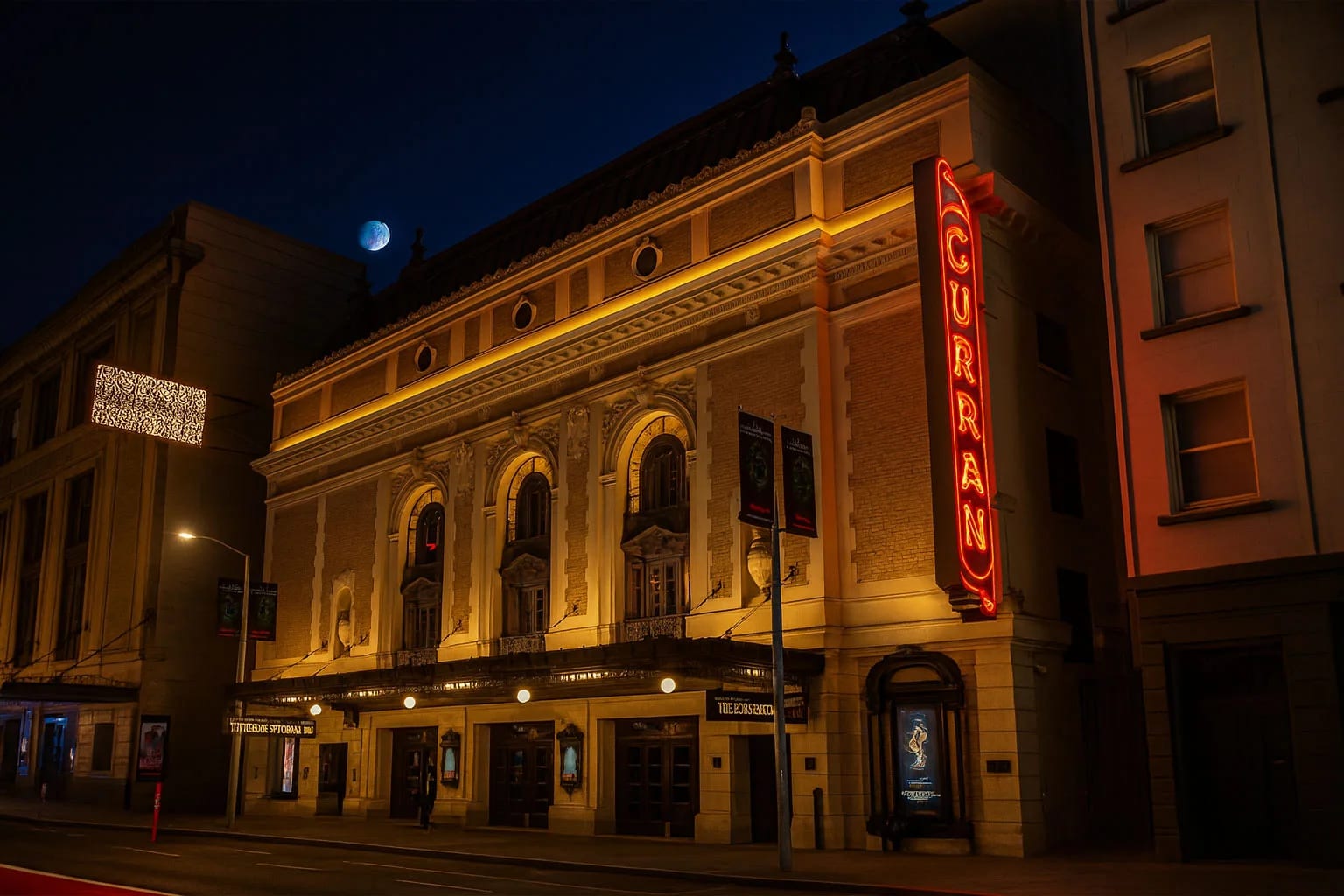
There is a saying in the theater world that old playhouses are always haunted. The Curran Theatre, standing proudly at 445 Geary Street in San Francisco's Theater District, is living proof of this axiom. Since its opening in 1922, this 1,667-seat jewel box of a theater has witnessed triumphs and tragedies, hosted the greatest performers of the 20th and 21st centuries, and accumulated a population of ghosts that rivals any haunted theater in America.
Built by Homer Curran, a successful theatrical producer, the Curran was designed to be San Francisco's premier legitimate theater, capable of hosting the most elaborate Broadway productions. Architect Alfred Henry Jacobs created a French Renaissance Revival masterpiece, with ornate plasterwork, a stunning painted ceiling, and exceptional acoustics that have made it a favorite of performers for over a century.
But a theater is more than bricks and mortar - it is a repository of human emotion. Every night for over 100 years, audiences have gathered in the Curran's red velvet seats to laugh, cry, and be transported by the magic of live performance. Actors have poured their souls into their roles, sometimes dying shortly after their final bows. Stagehands have worked in the shadows, occasionally meeting tragic ends in the theater's mechanical systems. All of this emotional and physical energy has left its mark on the building.
Today, the Curran Theatre is known not just for its world-class productions but for its paranormal activity. Cast members report seeing figures in the wings who vanish when approached. Ushers encounter audience members in period clothing who cannot be found when the house lights come up. Strange sounds echo through the building after hours - applause, laughter, and the distinct voice of actors delivering lines to empty seats. At the Curran, the show truly never ends.
A Century of Drama, On Stage and Off
Homer Curran and the Theater's Origins
Homer Curran was already one of the most successful theatrical producers on the West Coast when he decided to build his own theater. Born in 1885, Curran had risen through the ranks of the entertainment industry, eventually controlling a chain of theaters throughout California. But he dreamed of a flagship venue that would rival the great playhouses of New York and London.
Construction of the Curran Theatre began in 1921 and was completed in 1922 at a cost of approximately $750,000 - a staggering sum for the time. Curran spared no expense, importing materials from across the country and employing the finest craftsmen to create a theater worthy of the world's greatest performers. The result was a masterpiece of theatrical architecture, with perfect sightlines, superb acoustics, and an atmosphere of refined elegance.
The Curran opened on February 10, 1922, with a production of 'The Tavern.' From its first night, the theater was a hit with San Francisco audiences, who packed the house for productions ranging from Shakespeare to contemporary drama. Curran himself continued to oversee the theater until his death in 1952, by which time it had become an integral part of San Francisco's cultural identity.
Homer Curran's devotion to his theater was legendary. He spent countless hours in the building, personally supervising productions and attending to every detail of its operation. Some staff members believe that his devotion continues after death - that his spirit remains in the theater he created, watching over it from the shadows just as he did in life.
The Golden Age of Theater
The 1920s through the 1960s represented the golden age of the Curran Theatre. During this period, virtually every major star of the American theater performed on its stage. The Lunts, Katherine Cornell, Helen Hayes, and countless other legends brought their most famous roles to San Francisco audiences.
This was also a period of tremendous drama behind the scenes. The theater world of this era was notorious for its excess - actors and actresses lived large, burning through marriages, fortunes, and their own health in pursuit of their art. Drug and alcohol addiction were common, and the pressure of performance led some to breakdown.
The Curran witnessed its share of backstage tragedy. Actors collapsed during performances, their bodies giving out under the strain. Others died shortly after their runs ended, as if they had held on just long enough to complete their final performances. Some returned to the theater they loved, their spirits unable to resist the pull of the stage.
The energy of thousands of performances, each one a concentrated burst of human emotion, seeped into the theater's walls. Every laugh, every tear, every standing ovation left its mark. By the mid-20th century, the Curran was not just a theater - it was a vessel filled to overflowing with the psychic residue of decades of drama.
Tragedies and Accidents
Like all old theaters, the Curran has witnessed its share of accidents and tragedies. The complex machinery required to stage elaborate productions creates inherent dangers, and over the decades, several people have been injured or killed within the theater's walls.
The most frequently discussed incident involves a stagehand who fell from the catwalks high above the stage during the 1930s. The exact circumstances of his death are unclear - some accounts describe it as an accident, while others suggest it may have been suicide. What is certain is that a young man died falling from the heights of the Curran Theatre, and many believe his spirit never left.
Other incidents include an actor who suffered a fatal heart attack in his dressing room during intermission, a costume designer who died in a fire in one of the backstage workrooms, and an elderly usher who collapsed and died while showing patrons to their seats. Each of these deaths added to the spiritual energy of the building, contributing to its reputation as one of the most haunted theaters in America.
Perhaps most disturbing are the rumors of suicides connected to the theater. The intense pressure of the theatrical world, combined with the personal demons that many performers struggle with, has reportedly led to at least two suicides by performers who had recently appeared at the Curran. Whether these troubled souls have returned to the scene of their final performances remains a matter of debate.
The Modern Era and Renovation
The Curran Theatre has continued to evolve over the decades, hosting major Broadway tours and premiering new works that would go on to national success. In 2017, the theater underwent a major renovation under the direction of Carole Shorenstein Hays, who had purchased the theater in 1979.
The renovation modernized the theater's systems while preserving its historic character. New seating, improved accessibility, and updated technical equipment brought the Curran into the 21st century. But some things could not be removed by construction crews - the spirits who have called the theater home for decades remained in residence.
Workers on the renovation project reported numerous strange experiences. Tools would go missing only to reappear in impossible locations. Voices were heard in empty areas of the theater. One worker reported seeing a figure in old-fashioned clothing watching him from the balcony, only to find the area completely empty when he went to investigate.
Since the renovation, paranormal activity at the Curran has, if anything, increased. Perhaps the disturbance of construction stirred up spiritual energy that had been dormant. Perhaps the ghosts were simply making their presence known to the new generation of theater staff. Whatever the explanation, the Curran remains as haunted today as it has ever been.
The Ghosts of the Curran Theatre
The Curran Theatre is home to multiple spirits, each with its own story and its own favorite haunts within the building. Together, they create an environment that theater professionals describe as both unsettling and strangely comforting - proof that the magic of theater transcends even death.
The Falling Stagehand
The most famous ghost at the Curran Theatre is the spirit of the stagehand who fell from the catwalks decades ago. He is seen most often in the flies - the area above the stage where scenery is rigged and operated. Workers in this area report seeing a young man in period work clothes standing on the catwalks, sometimes looking down at the stage and sometimes looking directly at the witness.
The Falling Stagehand is also experienced in other ways. Workers report the sensation of being watched while in the fly gallery. Some have felt what they describe as an invisible hand on their shoulder or back, as if someone is warning them to be careful. Others have heard footsteps on the metal catwalks when no one else is present.
Most disturbing are the reports of the fall itself being reenacted. On several occasions, witnesses have reported seeing a figure plummeting from the catwalks toward the stage, only to vanish before impact. The experience is described as viscerally horrifying - the witnesses instinctively cry out or reach for the falling figure, only to realize they have witnessed something that happened generations ago.
Some believe the Falling Stagehand is trying to warn current workers about the dangers of the flies. Others think he is simply trapped in the moment of his death, eternally falling through the space where his life ended. Whatever the explanation, he remains one of the most frequently encountered spirits at the Curran.
The Lady in the Balcony
A woman in 1920s or 1930s attire is frequently seen in the balcony section of the Curran Theatre, always alone and always watching the stage with intense interest. She wears elegant clothing in the style of the theater's early years - a beaded dress, perhaps, or a fur wrap over her shoulders. Her hair is styled in the marcel waves popular in that era.
The Lady in the Balcony never interacts with the living. She does not respond when spoken to, and she does not seem to notice modern audience members who sit near her. Her attention is focused entirely on the stage, watching performances that only she can see. Witnesses report that she sometimes applauds or laughs, reacting to a show that ended decades ago.
Attempts to approach the Lady always fail. She vanishes when witnesses get too close, only to reappear in another section of the balcony. Ushers have learned to accept her presence, recognizing her as one of the theater's permanent residents. Some even greet her when they see her, though they never receive a response.
The identity of the Lady in the Balcony is unknown. Some speculate she was a wealthy patron who attended the theater regularly in its early years, her love of the arts so intense that she could not bear to leave even after death. Others believe she may be the wife or lover of a performer, eternally watching the stage where her beloved once appeared.
The Phantom Actors
Cast members at the Curran Theatre frequently report encountering figures in the wings and backstage areas who appear to be actors in costume. These figures stand in the shadows, seemingly waiting for their cues to enter, but they are not members of the current production. Their costumes belong to shows that played the Curran years or decades earlier.
The Phantom Actors are seen most often during performances, as if drawn by the energy of live theater. They stand in the wings, watching the current cast perform, their faces showing the intense concentration of professionals waiting for their entrances. When approached or addressed, they turn and walk away, disappearing into the darkness of the backstage area.
Some cast members find the presence of the Phantom Actors comforting, interpreting them as the spirits of great performers from the past, come to watch their successors carry on the theatrical tradition. Others find them deeply unsettling, particularly when a Phantom Actor is seen wearing a costume from a production that the living cast member has also performed in.
Acoustic evidence of the Phantom Actors has also been recorded. On quiet nights, when the theater is empty, security guards and cleaning crews have reported hearing voices delivering lines - sometimes from famous plays, sometimes from dialogue they cannot identify. The acoustics of the Curran are so good that these ghostly performances carry clearly through the empty house.
The Dressing Room Presence
The dressing rooms at the Curran Theatre are home to at least one very active spirit. Performers report lights turning on and off, makeup items being moved, and a general sense of being watched while preparing for performances. Some describe feeling a presence standing behind them as they sit at their mirrors, though they see nothing when they turn to look.
The most dramatic manifestations occur in one specific dressing room - the one reportedly used by the actor who died of a heart attack during a performance. Performers assigned to this room report an oppressive atmosphere, sudden drops in temperature, and the distinct smell of theatrical makeup and cigar smoke. Some have reported seeing a figure in the mirror - an older man in formal attire, watching them with an unreadable expression.
The dressing room spirit is not malevolent, but it is intensely present. Performers who use the room report feeling evaluated, as if the ghost is assessing their readiness to take the stage. Some believe the spirit is the deceased actor, ensuring that those who follow him maintain the high standards of professional theater. Others simply try to request a different dressing room.
The Phantom Audience
Perhaps the strangest phenomenon at the Curran Theatre is the Phantom Audience - the sounds of a full house that occur when the theater is empty. Security guards patrolling after hours report hearing applause, laughter, and the murmur of conversation coming from the darkened auditorium. When they enter to investigate, they find nothing but empty seats.
The Phantom Audience is most often heard after particularly successful performances, as if the ghosts of past audiences have been summoned by the energy of a great show. The applause builds from nothing to a thunderous ovation, then fades away over several minutes. Those who have heard it describe the experience as both thrilling and deeply eerie.
On rare occasions, the Phantom Audience has been glimpsed as well as heard. Witnesses report looking into the auditorium and seeing it filled with translucent figures, all dressed in period clothing and all focused on the stage. These visions last only seconds before fading, but they leave no doubt that the Curran's past audiences have not entirely departed.
Homer Curran's Spirit
Staff at the Curran Theatre have long believed that the spirit of Homer Curran himself remains in the building he created. A figure matching his description - a distinguished man in early 20th century formal attire - has been seen in various locations throughout the theater, particularly in the orchestra section where he reportedly had a favorite seat.
Homer Curran's spirit is described as watchful but benevolent. He appears to be inspecting the theater, ensuring that his beloved playhouse is being properly maintained. When major changes are made to the building, his apparition is seen more frequently, as if he is keeping a close eye on what the new owners are doing to his creation.
Some staff members report communicating with Homer Curran's spirit, asking his approval before making changes to the theater. While they admit they never receive a direct response, they describe a sense of either approval or disapproval that seems to come from the building itself. When Curran's spirit seems pleased, things go smoothly. When he seems displeased, equipment malfunctions and problems arise.
Whether this is truly Homer Curran's ghost or simply the accumulated spiritual energy of the theater responding to change, the effect is the same: the Curran Theatre has a will of its own, and wise staff members have learned to respect it.
Experiencing the Curran Theatre Today
The Curran Theatre continues to host world-class theatrical productions, from Broadway tours to premiere engagements of new works. For those interested in the paranormal, a visit to the Curran offers the opportunity to experience one of America's most haunted theaters while enjoying exceptional live entertainment.
Most Haunted Areas:
- The Balcony: Where the Lady in the Balcony is most often seen
- The Wings and Backstage: Home to the Phantom Actors and various unexplained phenomena
- The Fly Gallery and Catwalks: Where the Falling Stagehand continues his eternal vigil
- The Dressing Rooms: Particularly the room associated with the actor who died during a performance
- The Orchestra Section: Where Homer Curran's spirit is most often encountered
Tips for Ghost Hunters:
- Attend an evening performance for the highest chance of paranormal activity
- Request balcony seats if you want to encounter the Lady
- Pay attention to the wings during the performance - you may see more than the official cast
- Stay alert during intermission when the dressing room activity peaks
- Listen carefully at the end of the show - the Phantom Audience sometimes joins the real applause
What to Expect: The Curran Theatre is primarily a working playhouse, not a haunted attraction. Paranormal activity cannot be guaranteed, and ghost hunting during performances is not permitted. However, those who are sensitive to spiritual energy often report feeling something special about the Curran - a sense of history and presence that goes beyond the merely theatrical.
For the best chance of a paranormal experience, attend a critically acclaimed production. The ghosts of the Curran seem to be drawn to great theater, returning to witness performances that match the standards of the theater's golden age. Perhaps they know quality when they see it - even from beyond the grave.
