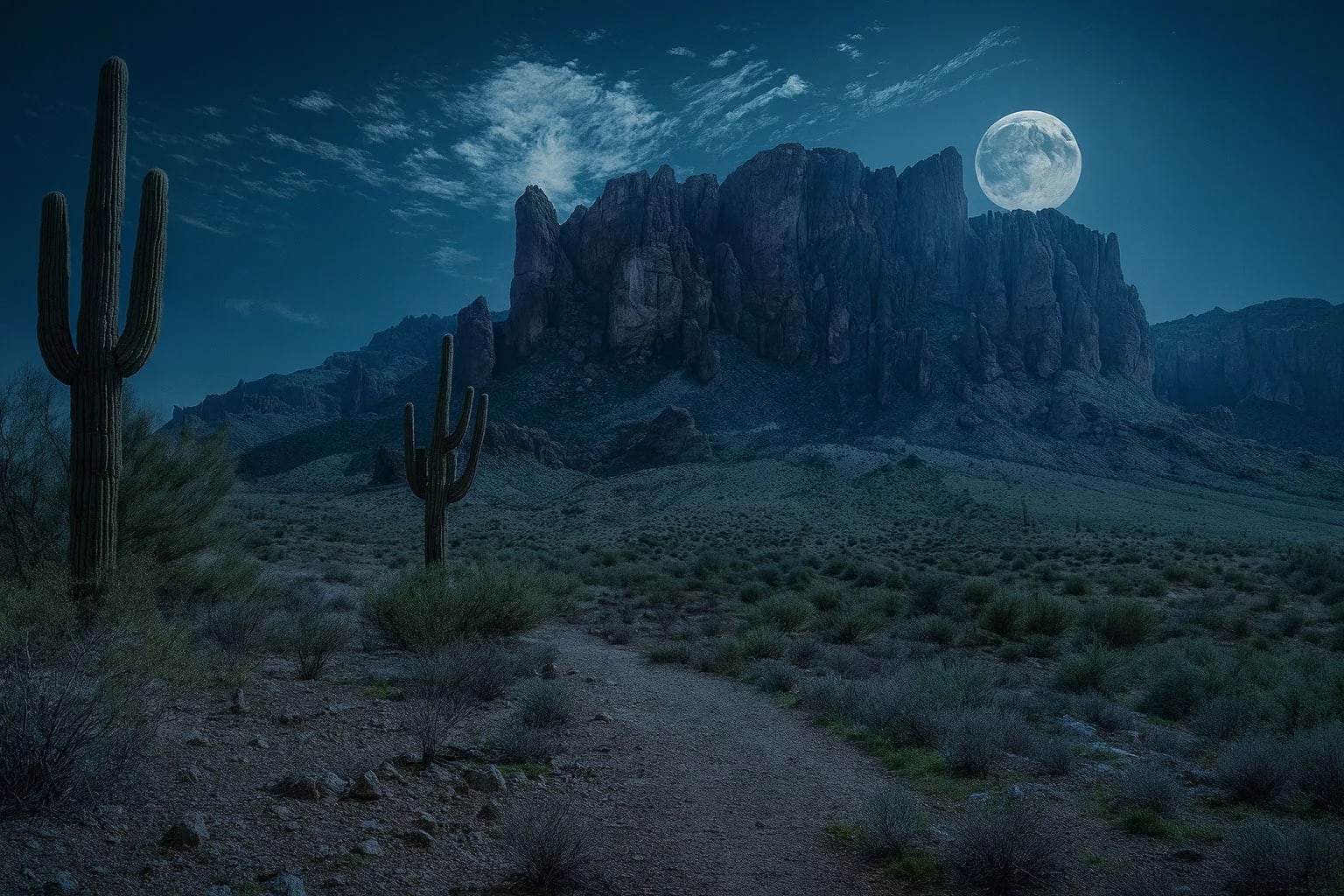
They rise from the desert floor like the serrated spine of some ancient beast, their volcanic peaks catching the first light of dawn and the last rays of sunset in shades of gold and crimson that seem almost supernatural. The Superstition Mountains, located approximately 40 miles east of Phoenix, are among the most visually striking and spiritually charged landscapes in the American Southwest. They are also among the most dangerous and haunted.
The Apache called them the 'Mountains of Foam' or the 'Crooked Top Mountains,' and considered them a gateway to the underworld. They believed powerful Thunder Gods lived within the peaks and that the mountains were guarded by spirits who would destroy any who entered without permission. Spanish conquistadors, hearing tales of golden cities, ventured into these canyons in the 16th century. Many never returned, and those who did spoke of supernatural terrors that turned brave men into gibbering cowards.
In the modern era, the Superstition Mountains are most famous for the legend of the Lost Dutchman's Gold Mine, supposedly discovered by German immigrant Jacob Waltz in the 1870s. Waltz allegedly found a fabulously rich gold deposit hidden somewhere in the mountains but took its location to his grave. Since then, hundreds of treasure hunters have died searching for the mine, their deaths often occurring under mysterious circumstances that locals attribute to the curse protecting the gold.
But the Lost Dutchman legend is just one thread in a tapestry of supernatural lore surrounding these mountains. Hikers report seeing ghostly figures of Spanish soldiers and Apache warriors. Strange lights dance among the peaks at night. Compasses spin wildly and GPS devices fail without explanation. And perhaps most disturbing are the persistent reports of skinwalkers - shape-shifting beings from Navajo legend that have somehow made their home in these cursed peaks.
The Superstition Mountains are not merely haunted in the conventional sense. They are a place where reality itself seems to bend, where time can lose meaning, and where ancient forces still hold dominion over the land.
The History and Legends of the Superstition Mountains
To understand the supernatural reputation of the Superstition Mountains, one must trace the layers of history and legend that have accumulated over thousands of years. Each culture that has encountered these peaks has added to the mythology, creating a complex tapestry of fear, reverence, and mystery.
The Apache and Ancient Peoples
Long before European contact, the Superstition Mountains held profound spiritual significance for the indigenous peoples of the region. The Apache, who came to dominate the area in the centuries before Spanish arrival, considered the mountains sacred and dangerous. According to Apache tradition, the peaks were home to the Thunder God and served as a doorway to the lower world where spirits dwelt.
The Apache warned that anyone who entered the mountains without proper spiritual preparation would face the wrath of the beings who lived there. They told of warriors who ventured into the peaks seeking vision quests and emerged changed - some gifted with power, others driven mad by what they had witnessed. Some never emerged at all, taken by the spirits as payment for their trespass.
Archaeological evidence suggests that the mountains were used for ceremonial purposes for thousands of years before the Apache. Ancient petroglyphs, some dating back 10,000 years, can be found throughout the range. Some researchers believe these images depict supernatural beings and record encounters with entities that still inhabit the mountains.
The Pima and other neighboring tribes also regarded the Superstitions with fear and reverence. They spoke of a great hole somewhere in the mountains that led to the underworld, and of creatures that emerged from this pit to hunt humans who strayed too far into the peaks.
The Spanish Expeditions
When Spanish conquistadors arrived in the region in the 16th century, they heard indigenous tales of gold in the mountains and believed they had found the legendary Seven Cities of Gold that had drawn them north from Mexico. Several expeditions ventured into the Superstitions between 1540 and the early 1800s, seeking the precious metal that would make them wealthy beyond imagination.
Most of these expeditions ended in disaster. Entire parties disappeared without a trace. Those who returned spoke of attacks by unseen forces, of men who went mad during the night, of paths that seemed to change and compasses that pointed in every direction except the right one. The Spanish began to call the range the 'Mountains of the Superstitions' - a name that has endured.
One persistent legend tells of the Peralta family, Mexican miners who allegedly found a rich gold deposit in the mountains in the 1840s. According to the story, the Peraltas were ambushed by Apaches while transporting gold out of the mountains, and the entire party was massacred. The location of their mine died with them - or was deliberately erased by the Apache, who saw the gold as belonging to the spirits.
Some believe the Peralta massacre was not simply a conflict between miners and Native Americans, but an intervention by supernatural forces protecting the sacred mountains. The Apache, according to this interpretation, were merely the instruments of the mountain spirits' vengeance.
The Lost Dutchman's Gold Mine
The most famous legend of the Superstition Mountains centers on Jacob Waltz, a German immigrant who arrived in Arizona in the 1860s. According to the legend, Waltz discovered a fabulously rich gold mine somewhere in the Superstitions, possibly the same mine worked by the Peralta family decades earlier.
Waltz allegedly made multiple trips into the mountains, returning each time with gold ore of exceptional quality. He was secretive about his source, never revealing its location to anyone, and locals who tried to follow him into the mountains either lost his trail or met with accidents that prevented them from continuing.
When Waltz lay dying in Phoenix in 1891, he supposedly shared clues to the mine's location with Julia Thomas, a neighbor who had cared for him in his final days. But the clues were maddeningly vague - references to a weeping eye in the rock, a shadow that pointed to the entrance at a certain time of day, landmarks that could describe a thousand different locations in the vast mountain range.
Since Waltz's death, hundreds of people have searched for the Lost Dutchman's Mine. Many have died in the attempt. Some perished from the harsh desert conditions - heat, dehydration, falls from cliffs. Others died under circumstances that have never been explained. Bodies have been found with their heads removed. Prospectors have vanished without a trace, their camps discovered intact but completely abandoned.
The death toll is so high that locals speak of the 'Superstition Curse' - a supernatural force that protects the gold by destroying anyone who comes too close to finding it. Whether this curse originates from Apache spirits, the ghosts of murdered miners, or something older and darker, no one can say for certain.
Modern Era Deaths and Disappearances
The Superstition Mountains continue to claim lives at an alarming rate. Between hiker deaths, treasure hunter fatalities, and outright disappearances, the mountains are responsible for more unexplained deaths than any comparable area in Arizona.
In 1931, Adolph Ruth, a retired government employee, ventured into the mountains with maps he claimed would lead him to the Lost Dutchman. Six months later, his skull was found with two bullet holes in it. His headless body was discovered nearly a mile away. No suspects were ever identified.
In 1947, treasure hunter James Cravey disappeared in the mountains. His headless skeleton was found months later. Again, no explanation was ever determined.
The pattern of decapitated victims has led some researchers to speculate about a serial killer operating in the mountains, but others point out that the deaths span many decades and share characteristics that are difficult to attribute to any human agency. Some bodies are found in locations that should have been visible to search parties yet somehow went unseen for months.
As recently as 2010, three hikers died in the Superstitions under mysterious circumstances. Experienced outdoorsmen have become disoriented and lost in areas they knew well. Electronic equipment fails. Trails seem to change. The mountains, it appears, do not want to give up their secrets.
The Supernatural Beings of the Superstition Mountains
The Superstition Mountains are not haunted in the conventional sense of the word. There are no Victorian mansions or historic hotels here, no single tragic event that created a localized haunting. Instead, the mountains appear to be home to a variety of supernatural beings and phenomena that have been encountered by humans for thousands of years.
The Ghostly Miners and Treasure Seekers
The most commonly reported apparitions in the Superstitions are the ghosts of those who died searching for gold. These spirits appear as shadowy figures moving through canyons, lights bobbing along ridgelines at night, or fully realized apparitions of men in 19th-century mining attire.
Hikers have reported encountering prospectors who seem lost and confused, asking for directions or water, only to vanish when the hiker looks away for a moment. Others have seen figures working claims that have been abandoned for over a century, their picks rising and falling in eternal repetition of their final days.
One frequently encountered spirit is believed to be Jacob Waltz himself, the 'Lost Dutchman.' He appears as an elderly man with a white beard, dressed in the rough clothing of a frontier prospector. Those who have seen him report that he watches them with what seems like warning or perhaps regret, then disappears into the rock formations.
More disturbing are the ghosts of those who died violently - the headless apparitions that some witnesses have encountered in the more remote canyons. These spirits seem malevolent, approaching hikers with threatening intent before vanishing. Some researchers believe these are the spirits of murder victims, forever seeking vengeance for their deaths.
The Thunder Beings and Apache Spirits
The Apache spoke of Thunder Beings who lived within the mountains - powerful spirits associated with storms, lightning, and the raw power of nature. These beings were not ghosts of the dead but primordial entities that had existed since the creation of the world.
Modern visitors to the Superstitions have reported encounters that seem to match the Apache descriptions of Thunder Beings. Hikers have witnessed balls of lightning that move with apparent intelligence, pursuing them through canyons before disappearing. Others have heard voices speaking in unknown languages during thunderstorms, seemingly coming from inside the mountains themselves.
The spirits of Apache warriors are also frequently encountered. They appear as figures in traditional dress, sometimes on horseback, watching visitors from ridgelines or canyon rims. Unlike many ghosts, these spirits seem fully aware of the living and appear to be guarding the mountains against intruders.
Some hikers have reported being turned back by these guardian spirits - not through physical force, but through an overwhelming sense of dread and warning that made it impossible to continue forward. Those who ignored these warnings often met with accidents or became hopelessly lost.
Skinwalkers and Shape-Shifters
Perhaps the most terrifying reports from the Superstition Mountains involve skinwalkers - shape-shifting beings from Navajo mythology that have been reported throughout the American Southwest. While skinwalkers are traditionally associated with Navajo culture rather than Apache, the Superstitions seem to have attracted these entities as well.
Skinwalkers are said to be humans who have gained supernatural powers through dark rituals, often involving the murder of a family member. They can take the form of animals - typically coyotes, wolves, owls, or crows - but their animal forms are subtly wrong, their movements too human, their eyes reflecting an intelligence that no natural animal possesses.
Hikers in the Superstitions have reported encounters with animals that behaved in deeply unsettling ways. Coyotes that walked on their hind legs. Owls with human-like eyes that followed hikers for miles. Wolves that appeared and disappeared in impossible ways, seeming to teleport from one location to another.
More disturbing are reports of creatures caught mid-transformation - beings that are neither fully human nor fully animal, their forms shifting and unstable. Witnesses describe these encounters as profoundly disturbing, creating a sense of wrongness that haunts them long after they leave the mountains.
The Navajo and other tribes refuse to discuss skinwalkers openly, believing that speaking of them attracts their attention. But locals in Apache Junction and other communities near the Superstitions know that something prowls these mountains - something that is neither human nor animal, neither alive nor dead in any conventional sense.
The Mysterious Lights
Strange lights have been reported in the Superstition Mountains for as long as humans have observed them. The Apache incorporated these lights into their mythology, believing them to be the manifestation of spirit activity. Spanish explorers recorded seeing lights moving through the mountains at night. And modern visitors continue to report these phenomena.
The lights take various forms. Some appear as single orbs, floating through canyons or ascending peaks in ways that defy natural explanation. Others manifest as multiple lights that seem to interact with each other, dancing or chasing one another through the night sky. Still others appear as beams of light emerging from the ground or from cliff faces, as if illuminating something hidden within the rock.
Skeptics attribute these lights to various natural phenomena - bioluminescence, piezoelectric effects from the volcanic rock, or reflections from distant sources. But witnesses consistently describe behavior that suggests intelligence or purpose. The lights seem to react to observers, either approaching curiously or fleeing when spotted. They appear in the same locations year after year, suggesting they are tied to specific sites within the mountains.
Some researchers believe the lights are connected to the legendary gold deposits in the mountains - either marking their location or serving as guardians to drive away treasure seekers. Others think they are the spirits of the dead, visible manifestations of the souls who have perished in the Superstitions over the centuries.
Time Anomalies and Dimensional Rifts
Some of the strangest reports from the Superstition Mountains involve apparent distortions in time and space. Hikers have reported entering canyons in the morning and emerging in the evening, with no memory of the intervening hours. Others have experienced the opposite - what felt like a full day's hike compressed into just an hour or two.
More disturbing are reports of people encountering things that shouldn't exist - Spanish soldiers in full armor marching through canyons, Apache villages that appear and disappear, mining camps from the 1800s complete with living, breathing occupants. These encounters suggest that the Superstitions may contain portals or rifts where different times exist simultaneously.
Researchers who have studied these reports note that they cluster in specific areas of the mountains, suggesting that whatever causes these anomalies is localized rather than random. Some theorize that the unique geology of the Superstitions - volcanic rock with high mineral content, including gold - may create conditions that affect the fabric of reality itself.
Others believe that the mountains exist in a state of spiritual superposition, where the past, present, and future coexist, and where the veil between dimensions is thin enough to allow passage. The ancient peoples who first revered these mountains may have understood something about their nature that modern science has yet to grasp.
Paranormal Investigations and Research
The Superstition Mountains have attracted paranormal researchers, folklorists, and investigators from around the world. The sheer volume of reported phenomena makes the range one of the most studied supernatural locations in North America.
Equipment Anomalies: One consistent finding across multiple investigations is the unreliability of electronic equipment in the mountains. GPS devices lose signal or give wildly inaccurate readings. Cameras malfunction or capture images of things the photographers didn't see. Audio recorders pick up voices and sounds that weren't audible at the time of recording. Some researchers have found that fully charged batteries drain within minutes of entering certain areas.
EVP Recordings: Electronic voice phenomena captured in the Superstitions include voices speaking Spanish, Apache languages, and English. Common phrases include warnings to leave, references to gold, and what appear to be the final words of dying men. One particularly chilling recording captured what sounds like a man pleading for his life, followed by sounds of violence.
Photographic Evidence: Thousands of photographs have been taken in the Superstitions that appear to show anomalous phenomena - orbs, mists, shadowy figures, and in some cases, fully formed apparitions. Analysis of these images has ruled out camera artifacts and natural explanations in many cases, though skeptics remain unconvinced.
Witness Interviews: Researchers have collected hundreds of first-hand accounts from hikers, treasure hunters, rangers, and residents who have experienced supernatural phenomena in the mountains. The consistency of these accounts across decades and among witnesses who had no contact with each other suggests something genuinely anomalous is occurring.
Geological Studies: Some researchers have focused on the unique geology of the Superstitions, theorizing that the volcanic rock, mineral content, and electromagnetic properties of the mountains may contribute to the phenomena. The mountains do exhibit unusual magnetic properties, and some researchers believe this may affect human perception or even create conditions conducive to paranormal activity.
Visiting the Superstition Mountains
The Superstition Mountains are part of the Superstition Wilderness Area and Tonto National Forest, and are open to the public for hiking and exploration. However, anyone planning to visit should understand that these mountains are genuinely dangerous, both in natural and potentially supernatural terms.
Safety Considerations: Before any supernatural concerns, visitors must respect the very real natural dangers of the Superstitions. Summer temperatures can exceed 115°F, and hikers die from heat-related causes every year. The terrain is rugged and unforgiving, with sheer cliffs, unstable rock, and numerous opportunities for falls. Flash floods can transform dry washes into raging torrents with little warning. Always bring more water than you think you'll need, inform someone of your plans, and never hike alone.
Respecting the Land: Remember that these mountains are sacred to indigenous peoples. Whether or not you believe in the supernatural, treat the land with respect. Do not disturb archaeological sites, petroglyphs, or any artifacts you may encounter. The Apache and other tribes consider much of what happens in these mountains to be the result of spiritual forces that respond to human behavior and intentions.
Popular Starting Points: Most visitors access the Superstitions through the Lost Dutchman State Park or the Peralta Trailhead. Both offer well-maintained trails that provide access to the wilderness while keeping less experienced hikers relatively safe. The Peralta Trail to Fremont Saddle offers spectacular views of Weaver's Needle, the distinctive spire that figures prominently in Lost Dutchman legends.
For Paranormal Enthusiasts: Those specifically interested in the supernatural aspects of the Superstitions should consider hiring a local guide familiar with both the terrain and the legends. The most active paranormal areas are often in the more remote sections of the range, which are dangerous for inexperienced hikers. Never attempt to reach remote areas alone, and always turn back if weather conditions deteriorate or if you experience disorientation.
Night Visits: Some of the most dramatic phenomena occur at night, but night hiking in the Superstitions is extremely dangerous and not recommended for anyone unfamiliar with the terrain. If you do venture into the mountains after dark, stay on main trails, bring multiple light sources, and be prepared for experiences that may challenge your understanding of reality.
What to Do If You Encounter Something Unusual: Reports from experienced researchers suggest that maintaining calm is essential when encountering supernatural phenomena in the mountains. Do not challenge or provoke whatever you encounter. If you feel an overwhelming sense that you should leave an area, trust that instinct. If you become disoriented, stop moving, mark your location, and wait for your bearings to return rather than wandering deeper into unfamiliar terrain.
The Superstition Mountains have been claiming lives and defying explanation for thousands of years. They will continue to do so long after we are gone. Approach them with the respect they deserve, and you may emerge with a story that will stay with you for the rest of your life. Approach them carelessly, and you may join the countless others who never returned from their jagged peaks.


