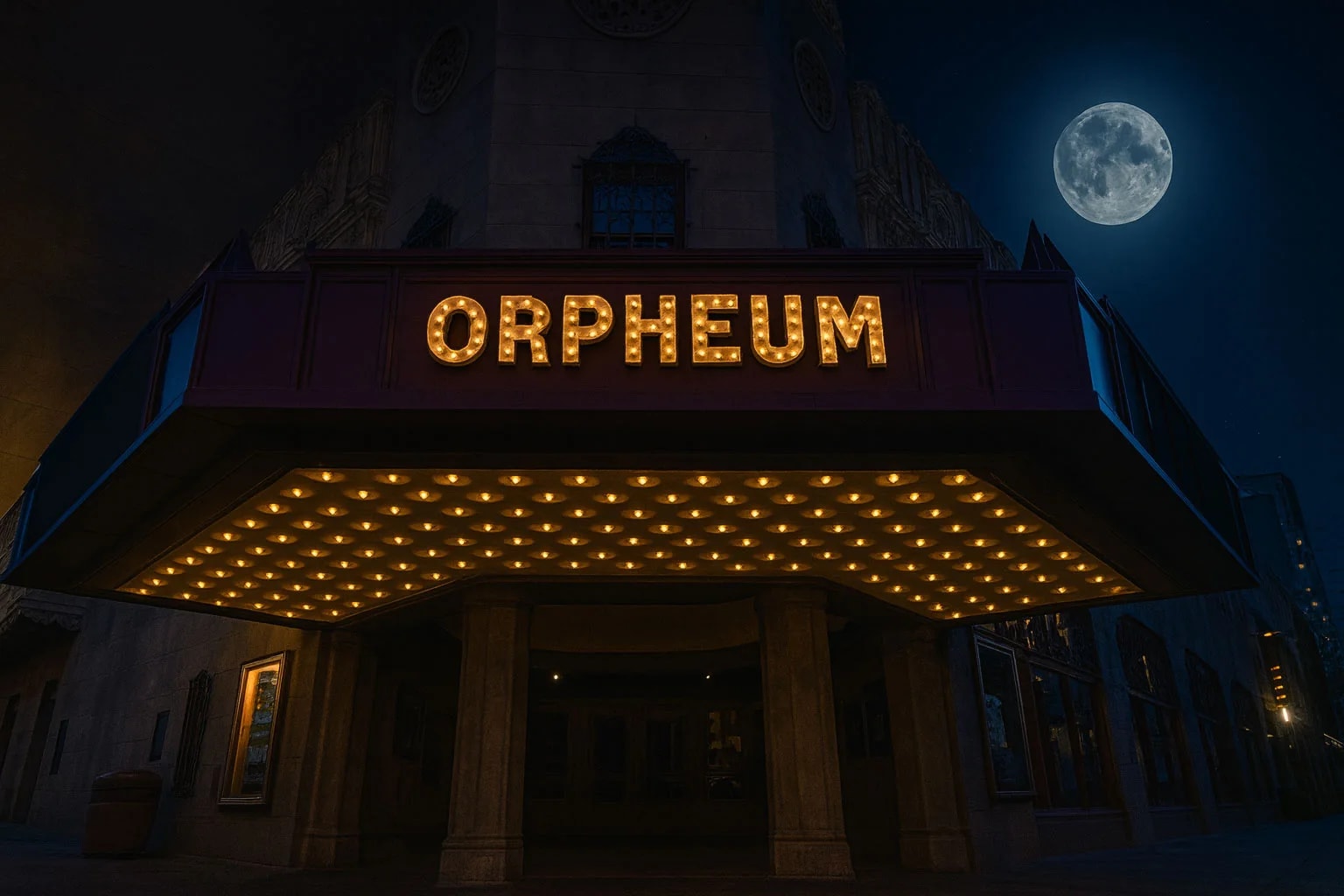
The moment you step through the doors of Phoenix's Orpheum Theatre, you enter a world that time forgot. The ornate Spanish Baroque Revival architecture, the gilded ceiling adorned with hand-painted murals, the crystal chandeliers that cast prismatic light across red velvet seats - everything about the Orpheum speaks of an era when entertainment was an event, when going to the theatre meant dressing in your finest and stepping into a palace of dreams.
But the Orpheum holds more than memories of its glamorous past. This magnificent theatre, which has stood on Adams Street since 1929, is home to spirits who loved the magic of live performance so deeply that they refuse to leave. Stagehands report tools that move on their own. Performers feel invisible hands adjusting their costumes. Audience members glimpse figures in period clothing sitting in seats that security swears were empty moments before. And then there's the woman in white - the Orpheum's most famous ghost - who has been seen watching performances from the balcony for decades.
Theaters have long been considered havens for supernatural activity. The intense emotions experienced within their walls - the triumph and heartbreak of performers, the collective joy and sorrow of audiences, the countless dramas both on and off stage - seem to leave psychic imprints that echo through time. The Orpheum, with its nearly century-long history of continuous operation, has accumulated more emotional energy than most buildings will ever know.
Whether you come to the Orpheum for a Broadway touring production, a concert, or simply to marvel at its architectural splendor, know that you're sharing the space with permanent residents who will never take their final bow.
The History of the Orpheum Theatre
The Orpheum Theatre represents the culmination of a theatrical tradition that transformed American entertainment. To understand the building is to understand the ambition and optimism of late 1920s Phoenix - a desert city determined to prove it belonged among America's great cultural centers.
The Orpheum Circuit and the Vision for Phoenix
The Orpheum was built as part of the Orpheum Circuit, a chain of vaudeville theatres that stretched across the western United States and into Canada. Founded in San Francisco in 1886, the Orpheum Circuit represented the pinnacle of vaudeville entertainment, booking only the finest acts and presenting them in theatres designed to dazzle audiences from the moment they walked through the door.
By the late 1920s, Phoenix was growing rapidly, and civic leaders wanted a theatre that would rival anything in Los Angeles or San Francisco. They hired the architectural firm of Lescher and Mahoney, who designed a Spanish Baroque Revival masterpiece that would cost $750,000 - an enormous sum at the time. The theatre was to be a statement: Phoenix had arrived.
The architects drew inspiration from Spanish colonial and Mexican baroque traditions, appropriate for Arizona's cultural heritage. The facade featured elaborate terra cotta ornamentation, while the interior was a fantasy of gilded plasterwork, hand-painted murals, and imported decorative elements. The ceiling of the main auditorium was designed to resemble a Spanish courtyard open to the night sky, complete with twinkling lights representing stars.
Opening Night and the Golden Age
The Orpheum Theatre opened on January 4, 1929, with a program that included both vaudeville acts and the film 'Chasing Through Europe.' Phoenix society turned out in full force, with the opening night gala attracting dignitaries from across Arizona. The Arizona Republican newspaper declared it 'the most beautiful theatre in the Southwest.'
For the next several years, the Orpheum was Phoenix's premier entertainment venue. Vaudeville acts gave way to motion pictures as the primary attraction, but the theatre continued to host live performances. Some of the greatest entertainers of the era graced its stage: Bob Hope performed at the Orpheum, as did Ginger Rogers, Mae West, and countless other stars of the golden age of Hollywood.
The theatre also served as a gathering place during significant historical moments. When news of Pearl Harbor reached Phoenix on December 7, 1941, many residents heard the announcement while watching a film at the Orpheum. The theatre became a place where the community came together during both celebration and crisis.
The Long Decline
Like many grand theatres of its era, the Orpheum fell victim to changing entertainment patterns in the mid-20th century. Television kept audiences at home, while suburban multiplexes drew moviegoers away from downtown. The Orpheum struggled to remain profitable, cycling through various owners and uses.
By the 1970s, the theatre had fallen into serious disrepair. The ornate plasterwork was crumbling, the murals were fading, and the building had been divided and subdivided for various commercial uses. There was serious talk of demolishing the structure to make way for modern development. Phoenix had largely forgotten its grandest theatre.
But preservation advocates refused to let the Orpheum die. In 1984, the City of Phoenix purchased the building, beginning what would become a 13-year, $14 million restoration project. Artisans were brought in from around the country to restore the original decorative elements. The theatre's Wurlitzer pipe organ, one of only a handful still in operation, was painstakingly repaired. When the Orpheum reopened in 1997, it had been restored to its original 1929 splendor.
Famous Events and Notable Performances
Throughout its history, the Orpheum has been the site of numerous significant events that have contributed to its haunted reputation:
The 1930s Vaudeville Tragedy: Local legend speaks of a young performer who died during a 1930s vaudeville show, either from a fall or from a heart attack on stage. The exact details have been lost to time, but this incident is often cited as the origin of some of the theatre's hauntings.
World War II Memorial Services: During the war years, the Orpheum hosted several memorial services for local servicemen killed in action. These emotionally charged events may have left psychic impressions that persist to this day.
The 1960s and 70s: During the theatre's decline, the building housed various businesses and went through periods of abandonment. Some paranormal researchers believe this neglect disturbed the spirits who had come to call the Orpheum home.
The Restoration: Interestingly, paranormal activity is reported to have increased after the 1997 restoration. Some believe that the renovation 'awakened' dormant spirits who had been quiescent during the building's decline.
The Ghosts of the Orpheum Theatre
The Orpheum Theatre harbors multiple spirits from different eras, each seeming to carry on with the roles they played in life. What makes the Orpheum unique among haunted locations is the sense that its ghosts are not troubled or tormented - they simply love the theatre too much to leave.
The Woman in White
The Orpheum's most famous ghost is a woman dressed in an elegant white gown who appears in the balcony section, usually during performances. She has been described as appearing to be in her 30s or 40s, with dark hair styled in a fashion consistent with the 1930s or 1940s. Her expression is always serene, even joyful, as she watches the show.
The Woman in White is most often seen by audience members who notice her sitting alone in the balcony, seemingly absorbed in the performance. When they look back, her seat is empty. Ushers have investigated countless reports of a woman in the balcony after performances end, only to find the section completely vacant.
Some versions of the legend identify her as a wealthy Phoenix socialite who was a devoted patron of the arts and attended virtually every show at the Orpheum during its early years. She loved the theatre so much that when she died, her spirit returned to continue enjoying performances for eternity. Other accounts suggest she may have been a performer herself - perhaps the young woman who died during the 1930s vaudeville tragedy.
What makes the Woman in White particularly intriguing is that she has been photographed numerous times. During performances, audience members have captured images showing a translucent female figure in the balcony section where no living person was seated. The images are consistent with eyewitness descriptions, showing a woman in a flowing white gown with dark hair.
The Phantom Stagehand
Current stagehands and technicians at the Orpheum frequently report encountering a ghost they call 'the Old Timer' - the spirit of a man in work clothes who appears in the backstage areas, catwalks, and fly system galleries. He is typically described as an older man, perhaps in his 60s, wearing clothing consistent with the 1940s or 1950s era.
The Phantom Stagehand seems to continue his work even in death. Tools that are set down in one location are found elsewhere. Ropes that should be tangled hang neatly coiled. Stage lights sometimes adjust themselves to better illuminate performers. Rather than being frightened by these experiences, many current crew members have come to appreciate their ghostly colleague's help.
One stagehand reported feeling invisible hands help him lift a particularly heavy piece of scenery, making the load suddenly lighter. Another described seeing a figure working on the catwalks above during a late-night technical rehearsal, only to be told that no one else was scheduled to be in the building. The figure vanished when he climbed up to investigate.
The Phantom Stagehand is most active during technical rehearsals and load-ins, when the theatre is preparing for a new show. It's as if he can't resist the opportunity to participate in the work he loved during his living years.
The Performer
Multiple witnesses have reported seeing a figure on the stage when the theatre is supposed to be empty. This apparition appears to be a man in formal evening wear - a tuxedo or perhaps a vaudeville-era suit - and seems to be performing for an invisible audience.
Security guards making late-night rounds have reported hearing applause and then discovering the figure on the stage, arms outstretched in the classic performer's bow. When they call out or approach, the figure vanishes. Some have heard what sounds like singing or the playing of a piano, though the theatre's piano bench sits empty.
This ghost is believed to be one of the vaudeville performers who graced the Orpheum's stage during its early years. Whether he is the performer who allegedly died during a show in the 1930s or simply a spirit who loved performing so much that he continues to do so in death, the Performer seems happy in his eternal role.
Actors who have performed at the Orpheum sometimes report feeling an additional presence on stage with them - not threatening, but supportive, as if a fellow performer is offering encouragement from the wings.
The Children
One of the more poignant hauntings involves the sounds and occasional sightings of children in the theatre. During quiet moments, staff have reported hearing the sounds of children laughing and playing in the lobby area, the balcony, and the mezzanine. These sounds typically occur when the theatre is empty or nearly so.
Witnesses who have seen the ghostly children describe them as dressed in clothing from the 1930s or 1940s era - girls in dresses with bows, boys in short pants and suspenders. They seem to be having the time of their lives, running through the aisles and exploring the ornate decorations of the theatre.
The origin of these child spirits is unclear, but some researchers note that the Orpheum was a popular destination for families during its early years. Children would dress in their finest clothes and accompany their parents for a special night at the theatre. Perhaps some of these children loved the magical experience so much that their spirits return to relive those cherished memories.
Additional Paranormal Activity
Beyond the specific ghosts, the Orpheum exhibits a range of paranormal phenomena throughout the building:
The Moving Seats: Theatre-style seats in certain sections are sometimes found flipped down as if someone has been sitting in them, even though the theatre has been empty and locked. Staff have learned to check these areas as part of their routine, knowing they may find 'occupied' seats.
The Cold Spots: Certain areas of the theatre are known for sudden, inexplicable drops in temperature. The most famous is a spot in the balcony where the Woman in White is most often seen. Visitors report feeling sudden chills that penetrate to the bone.
The Perfume: A distinctive floral perfume is sometimes smelled in the balcony and mezzanine areas, even though no living person wearing such a scent is present. The perfume is described as old-fashioned, consistent with fragrances popular in the 1930s and 1940s.
The Organ: The theatre's Wurlitzer pipe organ has been known to produce sounds when no one is playing it. These aren't random notes, but what appear to be intentional musical phrases, as if a ghostly organist is practicing for a show.
The Lights: Stage lights and house lights sometimes operate independently of their controls, dimming or brightening on their own. Technicians have thoroughly checked the electrical systems without finding any explanation.
Paranormal Investigations
The Orpheum Theatre has attracted the attention of numerous paranormal research groups over the years. While the theatre's management is cautious about publicizing the hauntings, they have permitted investigations during dark periods when no shows are scheduled.
EVP Evidence: Electronic voice phenomena recordings from the theatre have captured what appear to be voices saying things like 'beautiful show,' 'encore,' and 'don't go.' One particularly compelling recording seems to capture a woman saying 'I love this place.'
Photographic Documentation: Beyond the images of the Woman in White, investigators have captured photographs showing orbs and light anomalies throughout the theatre. Motion-sensitive cameras have recorded apparent movement in empty areas.
EMF Readings: The theatre shows significant electromagnetic field fluctuations, particularly in the balcony section and backstage areas. These readings spike during what witnesses describe as moments of paranormal activity.
Thermal Imaging: Thermal cameras have documented cold spots that move through the theatre, maintaining their form as they travel through aisles and up staircases - suggesting intelligent movement rather than random temperature variations.
Staff Testimonies: Perhaps the most compelling evidence comes from the theatre's own employees, many of whom have had experiences they cannot explain. Current and former staff members speak of their encounters with matter-of-fact acceptance, describing the ghosts as simply part of working at the Orpheum.
Experiencing the Orpheum Theatre Today
The Orpheum Theatre continues to operate as a premier performance venue in downtown Phoenix, hosting Broadway touring productions, concerts, comedy shows, and special events. Visitors can experience the theatre's magic - and potentially its ghosts - by attending a performance.
For the best chance of encountering paranormal activity, consider the following:
Request Balcony Seats: The Woman in White is most often seen in the balcony section. While you may not see her, you may feel the sudden chill that accompanies her presence.
Arrive Early and Explore: The lobby and mezzanine areas are actively haunted. Arriving early gives you time to explore these spaces and potentially witness phenomena before the crowd arrives.
Stay Late After Performances: If possible, linger in your seat after the show ends. The Performer is most often seen in the moments when the audience is departing and the theatre transitions to quiet.
Take the Theatre Tour: The Orpheum offers tours that cover both its history and architecture. While not specifically ghost tours, docents are often willing to share stories of paranormal encounters.
Be Respectful: The ghosts of the Orpheum seem to be benevolent spirits who simply love the theatre. Approach any potential encounter with respect rather than fear or provocation.
The Orpheum Theatre stands at 203 West Adams Street in downtown Phoenix. Whether you come for the world-class entertainment, the stunning architecture, or the chance to share space with spirits from the golden age of live performance, the Orpheum offers an experience unlike any other in Arizona.

