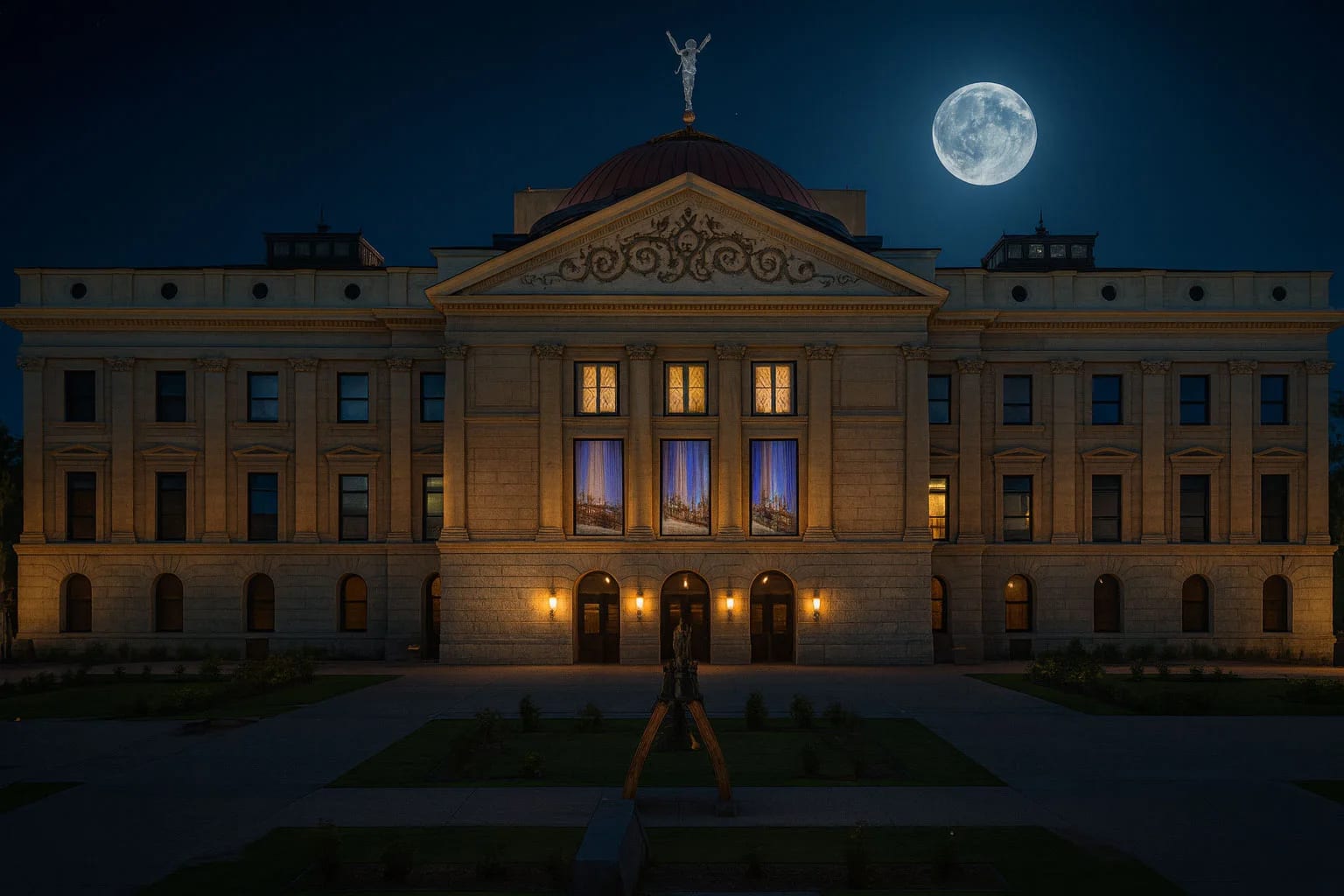
The Arizona State Capitol building rises from the Phoenix landscape with a dignity befitting its role as the symbolic heart of the state. Completed in 1900, twelve years before Arizona achieved statehood, this neoclassical structure has witnessed more than a century of political drama, personal triumph, bitter defeat, and the countless negotiations that shape a state's destiny. It is a building where careers have been made and destroyed, where fortunes have turned on a single vote, and where the weight of public service has worn heavily on those who served.
It is also, by all accounts, one of the most haunted government buildings in the American Southwest.
The halls of the Arizona State Capitol echo with more than the footsteps of current legislators and staff. Security guards working the late shift report hearing voices in empty chambers. Maintenance workers have encountered figures in old-fashioned clothing who vanish when approached. Visitors to the Arizona Capitol Museum have seen apparitions standing before the very exhibits that commemorate their lives. And then there is the matter of the former governor who, according to decades of testimony, simply refused to leave.
Political buildings accumulate emotional energy unlike any other structures. The ambition, the conflict, the passionate debates over Arizona's future - all of this has left an indelible mark on the Capitol. Those who dedicated their lives to public service within these walls seem reluctant to depart, their spirits continuing the work they began in life.
Whether you come to the Capitol as a citizen engaged in the democratic process, a history enthusiast exploring Arizona's past, or a paranormal researcher seeking evidence of the supernatural, know that you walk among ghosts who helped build the Arizona we know today.
The History of the Arizona State Capitol
The Arizona State Capitol's history is inseparable from the history of Arizona itself. The building was conceived during the territorial period and witnessed the state's birth, growth, and transformation across more than a century of change.
Construction and the Territorial Era
In 1898, the Territorial Legislature appropriated $100,000 for the construction of a new capitol building in Phoenix. The territorial capital had been moved multiple times since Arizona became a territory in 1863 - from Prescott to Tucson and back to Prescott before finally settling in Phoenix in 1889. The new capitol would provide a permanent and dignified home for territorial government.
The architectural firm of James Riely Gordon designed the building in the neoclassical style popular for government buildings of the era. Gordon, who had designed courthouses and capitols across the South and Southwest, created a structure that was both imposing and elegant. The building featured a distinctive dome topped with a weather vane shaped like the Arizona territory's symbol - a copper disc (later replaced by a figure known as 'Winged Victory').
Construction began in 1898 using tuff stone from a quarry near Phoenix and granite from the territory's own mountains. The Capitol was completed in 1900 at a cost of $135,744.59 - significantly over the original budget. The territorial legislature moved into the building in early 1901, and for the next twelve years, Arizona's territorial government operated from within its walls.
The copper dome was a deliberate choice, symbolizing Arizona's then-dominant copper mining industry. As the dome has aged and weathered, it has developed its distinctive green patina, though portions have been restored to their original copper color.
Statehood and Growth
On February 14, 1912 - Valentine's Day - Arizona became the 48th state admitted to the Union. President William Howard Taft signed the proclamation, and the Arizona State Capitol became the center of a new state's government. George W.P. Hunt was inaugurated as Arizona's first governor in the building's rotunda, beginning a political career that would span seven non-consecutive terms and leave an indelible mark on the state.
Governor Hunt was a towering figure in early Arizona politics - literally and figuratively. Standing over six feet tall with a distinctive bald head and intense gaze, Hunt championed progressive causes including women's suffrage, labor rights, and prison reform. He was passionate, combative, and utterly devoted to Arizona. Hunt served as governor longer than any other person in state history, and his spirit, according to many witnesses, has never left the Capitol.
As Arizona grew, so did the need for expanded government facilities. The original Capitol building was designed to house all three branches of government, but by the mid-20th century, this arrangement had become untenable. New legislative buildings were constructed to the west of the original structure in the 1960s, and the original Capitol was eventually converted into the Arizona Capitol Museum in 1981.
Notable Governors and Political Figures
The Arizona State Capitol has been home to a remarkable cast of political figures, many of whom are associated with the building's haunted reputation:
George W.P. Hunt (Governor 1912-1919, 1923-1929, 1931-1933): Arizona's first and most frequently elected governor was known for his progressive politics and his devotion to the state. Hunt died in 1934 and was buried in a distinctive white pyramid tomb in Phoenix's Papago Park. Yet many believe his spirit returns to the Capitol, unwilling to abandon the building where he spent so much of his life.
John C. Phillips (Governor 1929-1931): A Republican who served a single term during the onset of the Great Depression, Phillips was known for his dignified bearing and dedication to fiscal responsibility. His ghost is reportedly seen in the former governor's office.
Wesley Bolin (Governor 1977-1978): Bolin served as Arizona's Secretary of State for nearly 30 years before ascending to the governorship upon the resignation of Raul Castro. He died in office just nine months later, reportedly from the strain of the job. Staff members have reported seeing his apparition in the State Capitol.
Territorial Legislators: Before statehood, territorial legislators from across Arizona traveled great distances to serve in Phoenix. Some died during their terms or shortly after, and their spirits are believed to linger in the historic chambers.
The Capitol as Museum
In 1974, the Arizona legislature moved to new buildings to the west of the original Capitol. The historic structure was carefully renovated and reopened in 1981 as the Arizona Capitol Museum, dedicated to preserving and presenting Arizona's governmental history.
The museum restoration was meticulous, returning many spaces to their early 20th-century appearance. The former House and Senate chambers were restored, the governor's office was recreated, and exhibits documenting Arizona's journey from territory to state were installed throughout the building.
Interestingly, museum staff report that paranormal activity increased after the renovation. Some researchers believe that the restoration process 'awakened' spirits who had been dormant, or that the return of period-appropriate furnishings made the ghosts feel more at home. Whatever the explanation, the Arizona Capitol Museum has become known as one of the most actively haunted sites in Phoenix.
The Ghosts of the Arizona State Capitol
The Arizona State Capitol harbors numerous spirits from different eras of the building's history. Unlike many haunted locations where the ghosts seem confused or trapped, the spirits of the Capitol appear to be purposeful, continuing the work they did in life or watching over the building they loved.
The Ghost of Governor Hunt
The most famous ghost of the Arizona State Capitol is George W.P. Hunt, Arizona's first governor. Hunt's devotion to the state was legendary during his lifetime, and it appears that devotion has continued beyond death.
Security guards, museum staff, and late-night workers have reported seeing a tall, bald man in early 20th-century formal wear walking the halls of the Capitol, particularly on the second floor near the restored governor's office. The figure matches historical photographs of Governor Hunt - his distinctive height, his bald head, his formal attire, and his purposeful stride.
The ghost of Governor Hunt is most often seen during times of political significance - election nights, special sessions, and the anniversaries of important events in Arizona history. It's as if the former governor returns to witness the continuation of the democratic process he helped establish.
Witnesses describe the experience of encountering Hunt's ghost as awe-inspiring rather than frightening. He seems to project an aura of authority and dignity, and those who have seen him report feeling as if they're in the presence of someone important. The ghost never speaks but sometimes appears to nod in acknowledgment before fading from view.
One security guard described seeing the figure late one election night, standing near the rotunda and looking up at the dome as if contemplating the weight of public service. 'He seemed satisfied,' the guard reported. 'Like he was checking in to make sure things were running smoothly.'
The Woman in Victorian Dress
A female spirit in Victorian-era clothing has been seen throughout the Capitol, but most frequently in the area that once housed the Territorial Library. She is described as a middle-aged woman with her hair up in a bun, wearing a high-collared dress typical of the late 19th or early 20th century.
The identity of this ghost is uncertain. Some believe she may have been one of the secretaries or clerks who worked in the territorial government before Arizona achieved statehood. Others suggest she could be the wife of an early politician who spent considerable time in the building waiting for her husband.
The Woman in Victorian Dress appears to be engaged in work - she is often seen carrying papers or books, and witnesses report hearing the rustle of pages in empty rooms. She seems to take no notice of modern visitors, going about her eternal tasks as if she were still in her own time.
Museum staff have developed an affection for this ghost, whom they've nicknamed 'the Librarian.' They report that she seems to appear more frequently when the museum's archives are being accessed or when historical documents are on display.
The Legislators' Ghosts
The restored House and Senate chambers are reportedly home to multiple spirits of former legislators. These ghosts are typically seen seated in the historic desks, as if attending an eternal session of the legislature.
Visitors touring the chambers have reported seeing figures in period clothing seated among the empty desks, only to have them vanish when pointed out to tour guides. Others have heard what sounds like debate and discussion coming from the chambers when they should be empty - the murmur of voices, the sound of gavel strikes, occasional raised voices as if arguments are being made.
The legislative ghosts seem particularly active during the current legislature's sessions, even though these take place in the newer buildings. It's as if the spirits of past legislators gather to observe their successors, perhaps offering silent commentary on the issues of the day.
One frequent manifestation involves the smell of cigar smoke in the Senate chamber. In the early days of the legislature, smoking was common during sessions, and the lingering scent of cigars is often detected even though smoking has been banned in the building for decades.
The Night Watchman
Security guards at the Capitol have long spoken of a ghostly colleague - a night watchman from an earlier era who seems to continue his rounds even in death. This spirit appears as an older man in a uniform that doesn't match any current security attire, carrying what appears to be an old-fashioned flashlight or lantern.
The Night Watchman is typically encountered in the basement areas and back hallways of the building, the service areas where security personnel would have conducted their rounds. He walks with purpose, checking doors and windows, seemingly unaware that he is no longer among the living.
Current security staff have reported hearing footsteps in areas they've just cleared, finding doors locked or unlocked contrary to their last check, and occasionally seeing the glow of what appears to be a lantern in darkened corridors. Rather than being frightened by these encounters, most guards have come to accept the Night Watchman as a helpful colleague who continues to protect the building he served in life.
Additional Paranormal Activity
Beyond the specific apparitions, the Capitol experiences a wide range of paranormal phenomena:
The Elevator Anomalies: The Capitol's elevator has been known to operate on its own, traveling to floors where no one has called it. When the doors open, no one is waiting. Security cameras have captured the elevator doors opening and closing as if someone is entering or exiting, though no one is visible.
The Whispered Names: Visitors and staff have reported hearing their names whispered in empty corridors, as if someone just out of sight is trying to get their attention. When they turn to look, no one is there.
The Cold Spots: Certain areas of the Capitol are known for sudden temperature drops that cannot be explained by the HVAC system. The most famous cold spot is located near the restored governor's office, where temperatures can drop 15-20 degrees without warning.
The Moving Objects: Items in the museum displays have been found rearranged overnight, despite the building being locked and alarmed. Historical documents are sometimes found turned to different pages than they were left on, as if someone has been reading them.
The Footsteps in the Dome: The interior of the Capitol dome contains a catwalk used for maintenance. Workers have reported hearing footsteps on the catwalk when no one is up there, and some have seen the shadow of a figure moving around the interior of the dome.
Paranormal Investigations and Accounts
The Arizona State Capitol has been the subject of both formal paranormal investigations and countless informal experiences reported by staff, visitors, and security personnel over the decades.
EVP Recordings: Electronic voice phenomena captured in the Capitol include what appears to be voices discussing legislation, a man's voice saying 'for the people,' and a woman's voice asking 'may I help you?' - as if the building's ghostly clerks continue to serve visitors.
Photographic Evidence: Numerous photographs taken in the Capitol show unexplained phenomena - orbs of light in the legislative chambers, what appear to be figures standing in doorways, and shadows that don't match any visible source. One frequently circulated image appears to show a tall, bald figure standing near the governor's office that was not visible to the photographer at the time.
Security Footage: While the Capitol's security staff are generally reluctant to discuss specifics, there are persistent reports of security cameras capturing unexplained movement, doors opening by themselves, and what appear to be figures walking through walls in areas where doorways once existed.
Staff Testimonies: Current and former museum staff have shared their experiences with paranormal researchers. Common accounts include:
'I've worked here for fifteen years, and I've learned not to question the things I see. The building has residents who were here long before me and will be here long after I'm gone.'
'I was closing up one evening when I heard what sounded like a debate coming from the House chamber. I checked, and no one was there, but I could swear I heard people arguing about railroad rights.'
'Governor Hunt walks these halls. I've seen him twice - once near his office, once in the rotunda. He doesn't seem angry or sad. He just seems like he's checking on things.'
Experiencing the Arizona State Capitol Today
The Arizona Capitol Museum is open to the public and offers visitors the opportunity to explore Arizona's governmental history - and potentially encounter its spectral residents. The museum features exhibits on Arizona's path to statehood, the work of the legislature, and the governors who have served the state.
For those hoping to encounter paranormal activity, consider the following:
Visit During Off-Peak Hours: The museum is generally quieter in the early morning and late afternoon. Staff report that paranormal activity increases when fewer living visitors are present.
Focus on the Second Floor: The restored governor's office and surrounding areas are the most actively haunted locations in the building. Governor Hunt's ghost is most frequently seen in this area.
Explore the Legislative Chambers: The restored House and Senate chambers are reportedly home to the spirits of former legislators. Sit quietly in the galleries and listen for the sounds of eternal debate.
Ask the Staff: Museum docents and security personnel have accumulated years of experiences and observations. Many are willing to share their stories with respectful visitors.
Visit on Significant Dates: Paranormal activity reportedly increases on dates of historical significance - February 14 (statehood anniversary), election days, and the anniversaries of important legislative sessions.
Bring Recording Equipment: Many compelling EVP recordings and photographs have been captured by visitors. Be respectful but prepared to document any experiences you may have.
The Arizona Capitol Museum is located at 1700 West Washington Street in Phoenix, adjacent to the current working capitol complex. Admission is free, and the museum welcomes all visitors who wish to learn about Arizona's history - including the history that refuses to stay in the past.

