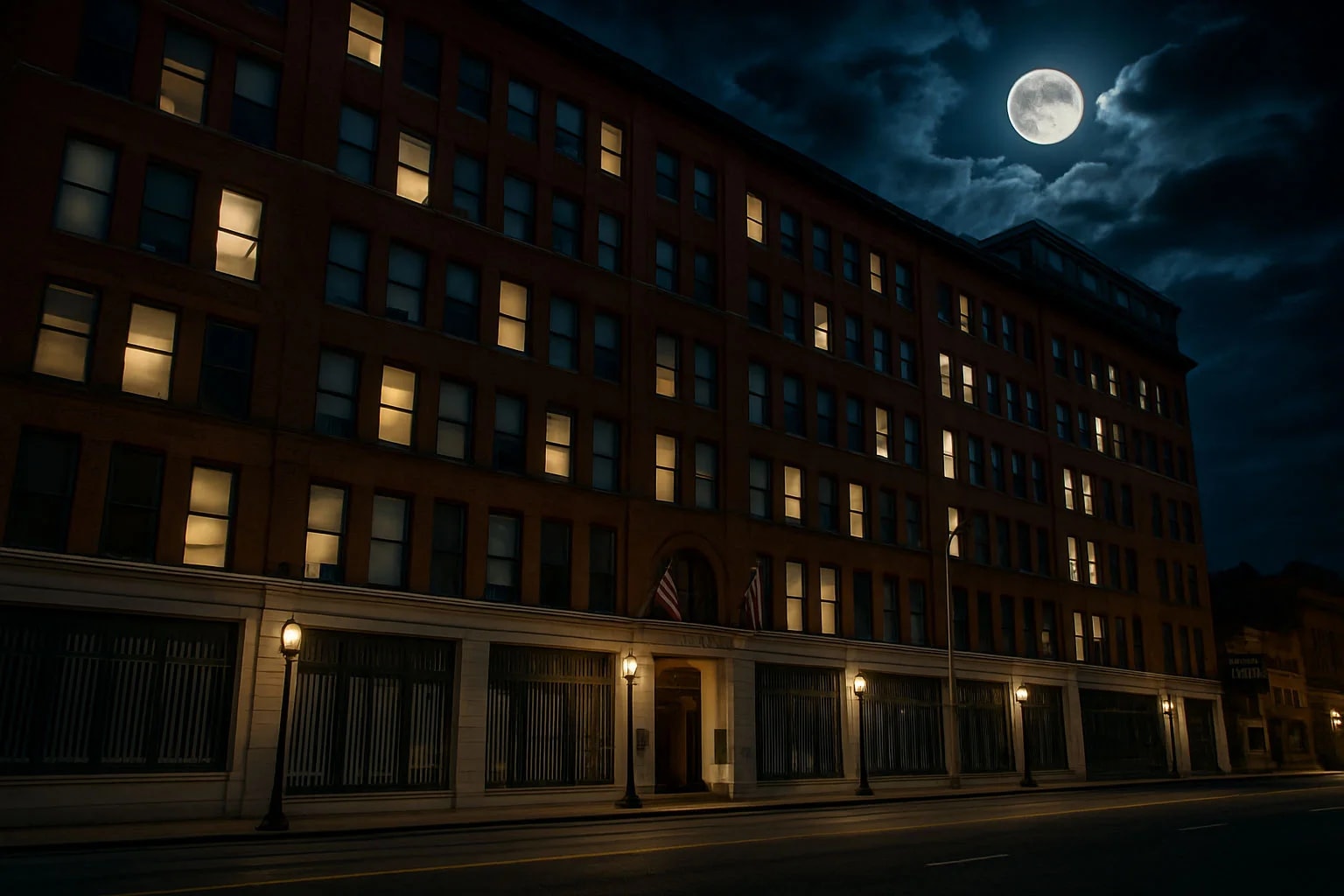
On West 9th Street in downtown Kansas City stands a building that has witnessed more than its share of human tragedy. The Savory Hotel, built in the late 1880s during Kansas City's boom years, was once a respectable middle-class hotel catering to traveling businessmen and visitors to the growing city. But over the decades, the hotel developed a dark reputation - one whispered about but rarely discussed openly.
The Savory became known as a place where people went to die.
Whether by coincidence, fate, or something more sinister, the Savory Hotel attracted an unusual number of suicides over its long history. Men and women checked in with no luggage, no return plans, and no intention of ever checking out. They chose the Savory for their final nights on earth, and their despair seems to have seeped into the very walls of the building.
Today, the Savory Hotel building still stands, repurposed over the years but never able to shake its haunted reputation. Those who work in or visit the building report encounters with spirits that seem trapped in their darkest moments - apparitions of despair, sounds of weeping, and an overwhelming sense of sadness that permeates certain areas.
The ghosts of the Savory Hotel are not the romantic specters of legend. They are the tortured souls of people who saw no other way out, whose final moments were spent in lonely hotel rooms far from anyone who loved them. Their stories are tragic, their hauntings are real, and their presence serves as a somber reminder of the depths of human suffering.
The History of the Savory Hotel
The Savory Hotel's history mirrors the larger story of downtown Kansas City - a tale of ambition and growth, followed by decline, and eventually, reinvention. But woven through this history is a darker thread of tragedy that sets the Savory apart from other historic hotels.
The Building's Origins
The building that would become the Savory Hotel was constructed in 1888, during one of Kansas City's most explosive periods of growth. The city was transforming from a frontier outpost into a major commercial center, and new hotels were desperately needed to accommodate the flood of travelers passing through.
The Savory was built as a mid-range hotel, more modest than luxury establishments like the Coates Hotel but still respectable and comfortable. It catered to traveling salesmen, businessmen on extended stays, and visitors to the city who needed clean, affordable accommodations.
The hotel's location on 9th Street placed it in the heart of the city's commercial district, surrounded by offices, shops, and other hotels. It was a convenient location for business travelers, close to the railroad stations that brought visitors from across the country.
A Reputation Develops
For its first decades, the Savory Hotel operated as an ordinary commercial hotel. But sometime in the early twentieth century, the hotel began developing a troubling pattern. Guests were dying in their rooms - not from natural causes, but by their own hands.
The first documented suicide at the Savory occurred in the early 1900s when a traveling salesman was found dead in his room. He had left no note, and no one knew why he had chosen to end his life. It was tragic, but such things happened at hotels. Life went on.
But then there was another. And another. Over the years, the Savory accumulated an unusual number of suicides, far more than would be expected for a hotel of its size. The victims were diverse - men and women, young and old, from various walks of life. What they had in common was their choice of the Savory Hotel as the place to end their lives.
Whispers began circulating about the hotel. Some said it was cursed, that something about the building attracted the desperate and despairing. Others blamed the hotel's anonymous, transient nature - it was easy to check in without raising questions, to spend final hours without interruption.
Whatever the cause, the Savory Hotel developed a dark reputation that it would never fully shake.
Notable Tragedies
Among the many deaths at the Savory Hotel, several stand out for their particular tragedy or mystery.
In 1922, a young woman registered under an assumed name and was found the next morning dead from poison. She had left letters for her family, revealing that she had been abandoned by a man who had promised to marry her. Unable to face the shame and the future alone, she had chosen death.
In 1931, during the depths of the Great Depression, a formerly successful businessman checked into the Savory after losing everything in the economic collapse. He spent two days in his room before hotel staff found him dead. He had been a pillar of his community, and his death shocked everyone who knew him.
In 1945, a returning soldier registered at the Savory and never emerged. When staff entered his room, they found evidence of a troubled mind - notes and drawings that suggested profound psychological trauma from the war. His death was one of countless tragedies among veterans struggling to readjust to civilian life.
These documented cases represent only a fraction of the deaths that occurred at the Savory over the decades. Many more went unrecorded or were kept out of the newspapers to protect families and the hotel's reputation. Each death added another layer of tragedy to the building, another spirit potentially trapped in the place where life ended.
Decline and Transformation
As the twentieth century progressed, the Savory Hotel declined along with much of downtown Kansas City. The rise of automobile travel shifted travelers away from downtown hotels to motor courts and motels along highways. The Savory's clientele changed, becoming more transient and less respectable.
By mid-century, the Savory had become a residential hotel, catering to long-term residents rather than travelers. Many of these residents were elderly, poor, or struggling with personal problems. The building's reputation for tragedy continued, though the deaths were now more often from natural causes - the lonely ends of lives lived in isolation.
The hotel eventually closed, and the building sat vacant for years. When it was finally renovated and repurposed, workers reported strange experiences - sounds with no source, cold spots, feelings of being watched, and an overwhelming sadness that seemed to emanate from the walls themselves.
Today, the Savory Hotel building has been converted to other uses, but its haunted reputation persists. Those who work in or visit the building speak of encounters with spirits that seem trapped in moments of despair, unable to move on from the place where they chose to end their earthly existence.
The Ghosts of the Savory Hotel
The paranormal activity at the Savory Hotel is among the most emotionally intense in Kansas City. Unlike playful or mischievous spirits, the ghosts of the Savory seem to carry the weight of their final moments, creating an atmosphere of profound sadness and unease.
The Weeping Woman
One of the most frequently reported ghosts at the Savory is a woman who can be heard weeping in certain areas of the building. The sound is heartbreaking - not theatrical crying, but the genuine, gut-wrenching sobs of someone in profound despair.
Witnesses report that the weeping seems to come from empty rooms or from behind closed doors. When the source is investigated, no one is found, but the crying continues, sometimes for extended periods. The sound is so realistic that witnesses have sometimes called for help, believing someone is in genuine distress.
Some believe the weeping woman is the spirit of the young woman who died in 1922, still grieving the betrayal that drove her to take her own life. Others suggest she might be a composite of the many women who ended their lives at the Savory over the years, their grief merging into a single, eternal expression of sorrow.
The weeping woman has never been seen, only heard. Her invisible presence makes her haunting somehow more disturbing - a voice of anguish with no face, a grief that cannot be comforted or confronted.
The Man in Room 307
Room 307 - or the space that was once Room 307 - is considered the most haunted location in the building. Multiple suicides occurred in this room over the years, and the paranormal activity there is intense and disturbing.
A male apparition has been seen in and around the former Room 307 area. Witnesses describe a man in outdated clothing, sometimes standing by the window, other times pacing the floor. His expression is one of torment and indecision, as if he's reliving his final hours over and over.
The man's apparition is sometimes accompanied by physical phenomena - sudden temperature drops, a feeling of pressure in the chest, and an overwhelming sense of despair that washes over witnesses without warning. Some people who have entered this area have been moved to tears without understanding why, as if absorbing the emotional residue left behind by the deaths that occurred there.
Who the man in Room 307 might be is uncertain. Given the number of deaths in that room, he could be any of several victims. Some paranormal researchers believe he might be a combination of multiple spirits, their energies merging in the space where they all met their ends.
The Shadow Figures
Throughout the building, witnesses report seeing shadow figures - dark, human-shaped forms that move through corridors and rooms. Unlike the more defined apparitions, these shadows have no distinguishing features, no indication of who they might have been in life.
The shadow figures appear suddenly and move with purpose, as if going somewhere specific. They don't acknowledge witnesses, don't respond to attempts at communication, and vanish when followed or confronted. Some witnesses describe a feeling of profound sadness emanating from these figures, while others report feeling nothing at all.
Some paranormal researchers believe shadow figures represent spirits that have lost their sense of individual identity, becoming mere echoes of the living beings they once were. If so, the shadow figures of the Savory Hotel might be the remains of souls so consumed by despair that they lost themselves entirely.
The shadow figures are most frequently seen at night, moving through areas that were once hotel corridors. They seem to follow the same paths over and over, as if trapped in routines they can no longer escape.
Residual Phenomena
Beyond the individual spirits, the Savory Hotel is saturated with residual paranormal phenomena - impressions of past events that replay without apparent consciousness or purpose.
Footsteps: The sound of footsteps is frequently heard throughout the building, particularly at night. These footsteps follow paths that correspond to the old hotel corridors, even in areas that have been reconfigured.
Door Sounds: The sounds of doors opening and closing are common, even when all doors are secured. These sounds often correspond to the locations of former hotel room doors.
Voices: Faint voices are sometimes heard - conversations too quiet to make out, someone calling out a name, or the sound of someone talking to themselves. These voices seem to come from everywhere and nowhere.
Temperature Anomalies: Cold spots are common throughout the building, particularly in areas where deaths occurred. These cold spots move and change, sometimes following witnesses as they walk through the building.
Emotional Imprints: Perhaps most significant are the emotional imprints left behind. People throughout the building report sudden waves of emotion - sadness, despair, loneliness, hopelessness - that have no apparent cause. These feelings can be overwhelming, bringing some visitors to tears.
The Nature of the Haunting
Paranormal researchers who have studied the Savory Hotel note that its haunting is qualitatively different from many other haunted locations. The spirits here seem to be trapped not by attachment to the building itself, but by the emotional states in which they died.
Unlike ghosts who remain because they loved a place or because they have unfinished business, the ghosts of the Savory seem bound by despair itself. They remain in the place where they made their final choice, perhaps still wrestling with that decision, perhaps unable to comprehend that they are dead, perhaps simply unable to escape the darkness that consumed them in life.
This makes the Savory Hotel a particularly challenging location for paranormal investigators. Attempts to communicate with the spirits often yield responses that are confused, repetitive, or heartbreaking. The ghosts don't seem to want help or acknowledgment - they seem stuck, playing out their final moments for eternity.
For visitors, this creates an atmosphere that many find oppressive and disturbing. The Savory Hotel is not a place of ghostly entertainment or thrilling scares. It's a place of genuine tragedy, and those who spend time there often come away affected by what they experience.
Visiting the Savory Hotel Building Today
The Savory Hotel building still stands in downtown Kansas City, though it has been converted to other uses over the years. Access to the building depends on its current function and the willingness of current occupants to discuss its haunted history.
Those interested in the Savory Hotel's paranormal activity should approach the building with respect and sensitivity. This is not a location for thrill-seeking or ghost hunting as entertainment. The spirits here represent real human tragedies - people who suffered enough to take their own lives. Any investigation or visit should be conducted with appropriate solemnity.
The area around the Savory Hotel is part of Kansas City's downtown, easily accessible by car or public transportation. The neighborhood has seen significant revitalization in recent years, and the contrast between the area's current vibrancy and the building's tragic history creates a poignant juxtaposition.
For those who wish to learn more about the Savory Hotel without visiting, historical records and newspaper archives contain accounts of some of the deaths that occurred there. The Kansas City Public Library and local historical societies can provide resources for research.
The Savory Hotel stands as a reminder that haunted places are not just sources of supernatural entertainment. They are repositories of human experience, including experiences of profound suffering. The ghosts of the Savory Hotel ask us to remember them - not as scary specters, but as human beings who found themselves in circumstances they could not bear.
