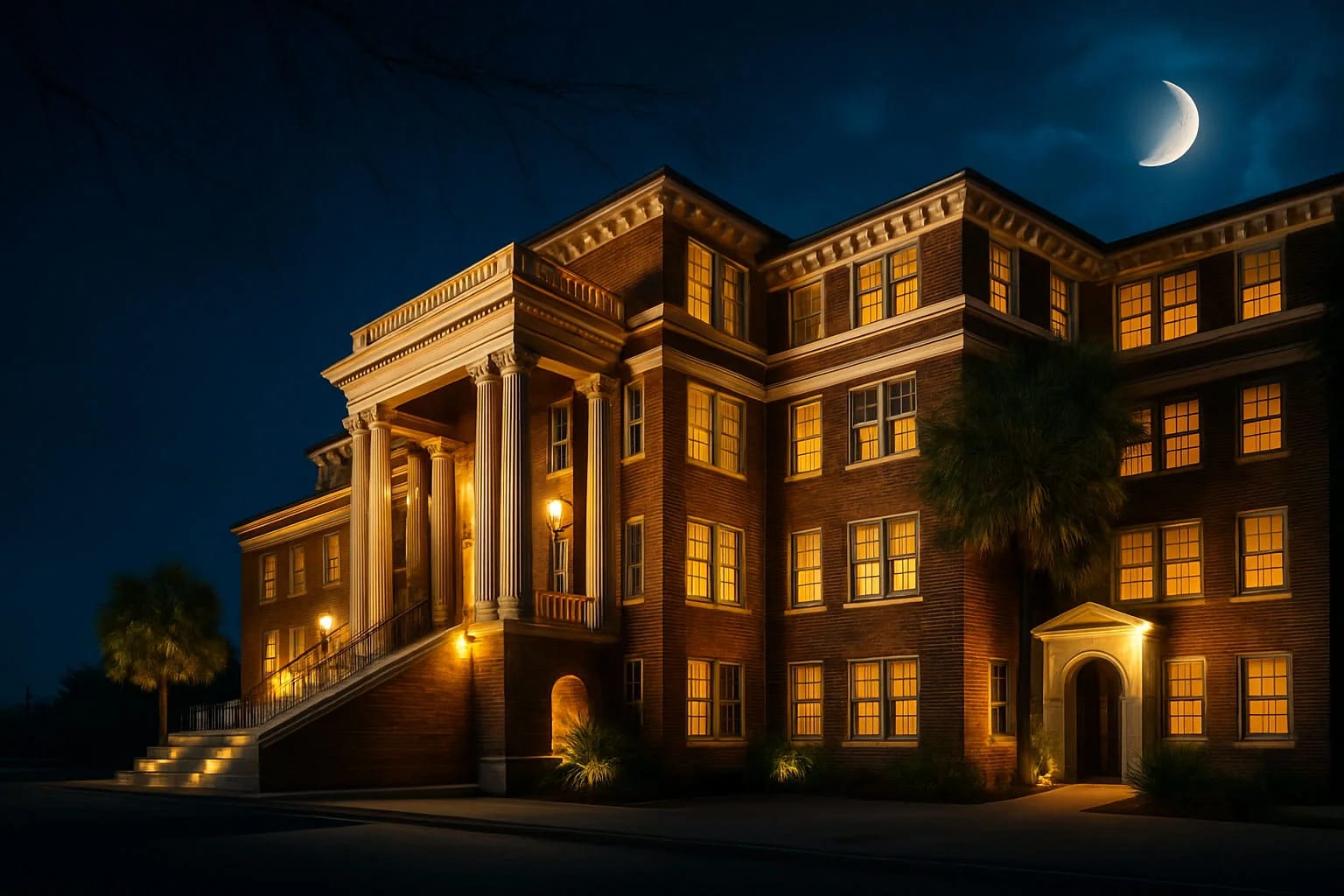
Some places are born haunted. Jefferson Davis Hospital didn't accumulate its ghosts over time—it was built on top of them. The stunning Art Deco building that rises at 1101 Elder Street sits directly atop one of Houston's oldest cemeteries, a burial ground that held thousands of bodies when construction began in 1924.
The city made no effort to move the remains. The dead were simply paved over, their bones becoming part of the foundation upon which the hospital was built. And if the countless witnesses who have experienced paranormal activity in this building are to be believed, the dead have spent the past century making their displeasure known.
Jefferson Davis Hospital is not for the faint of heart. This is not a location of gentle, benign spirits. The ghosts here are angry, confused, and sometimes malevolent. They are the forgotten dead, and they refuse to be ignored.
Did You Know?
- Jefferson Davis Hospital was built directly on top of the old City Cemetery, which contained an estimated 3,000 to 10,000 bodies when construction began.
- The cemetery had been the burial place for Confederate soldiers, yellow fever victims, paupers, and patients from the City Lunatic Asylum.
- Only about 200 bodies were relocated when the hospital was built; the rest remain beneath the foundation to this day.
- The hospital operated from 1924 to 1938 and included a psychiatric ward that treated patients with now-discredited and often brutal methods.
- The building was converted to artists' lofts in 2005, but residents report that the paranormal activity has not diminished—some say it has intensified.
Built on the Bones of the Forgotten
To understand why Jefferson Davis Hospital is so intensely haunted, you must understand what lies beneath it. The story begins in 1840, when the city of Houston established a public cemetery on what was then the outskirts of town. This was not a prestigious burial ground like Glenwood—this was the final resting place for those who had no other options.
The City Cemetery
The City Cemetery, as it was known, became the burial site for Houston's poorest and most marginalized residents. Paupers who died in the streets were buried here. Victims of the yellow fever epidemics that periodically ravaged the city were interred in mass graves. Confederate soldiers who died in Houston's military hospitals during the Civil War were laid to rest in unmarked plots.
Perhaps most disturbingly, the cemetery also received the bodies of patients who died at the nearby City Lunatic Asylum. These were people who had been locked away from society, often for conditions that we would not consider mental illnesses today. Women who were deemed 'hysterical,' men who suffered from shell shock, individuals whose families simply wanted them out of the way—all ended up at the asylum, and many ended up in the cemetery.
By the early 20th century, the City Cemetery was full and largely forgotten. The city had grown around it, and civic leaders began to view the old burial ground as an eyesore and an impediment to development. When the decision was made to build a new charity hospital for the city's poor, the cemetery site was chosen—and the dead were simply left in place.
A Hospital for the Poor
Jefferson Davis Hospital opened in 1924 as a charity hospital, providing medical care for Houston residents who could not afford private treatment. The building was designed in the Art Deco style, with decorative elements that made it one of the most architecturally significant structures in Houston.
But from the very beginning, there were problems. Construction workers reported strange occurrences while building on the site—tools would disappear and reappear in strange places, workers would feel hands pushing them when no one was there, and several reported seeing ghostly figures watching them from the edges of the construction zone.
Once the hospital opened, the reports only intensified. Patients and staff alike reported seeing apparitions in the halls, hearing screams coming from empty rooms, and feeling the unmistakable presence of the unseen dead.
The Psychiatric Ward
Perhaps no part of Jefferson Davis Hospital has accumulated more dark energy than the psychiatric ward. During the hospital's years of operation, this ward treated patients using methods that are now recognized as cruel and ineffective.
Electroshock therapy, hydrotherapy, and lobotomies were all performed at Jefferson Davis Hospital. Patients were sometimes restrained for days at a time. The screams of those undergoing 'treatment' echoed through the halls, adding to the suffering that permeated the building.
When the hospital closed in 1938 and operations moved to a new facility, the building sat largely abandoned for decades. During this time, it became a magnet for thrill-seekers, urban explorers, and paranormal investigators—many of whom reported experiences that left them shaken.
Rebirth as Artists' Lofts
In 2005, Jefferson Davis Hospital was converted to the Elder Street Artists Lofts, providing affordable housing for Houston's creative community. The developers preserved many of the building's historic features, including the Art Deco details and the general layout of the floors.
But they could not remove what lay beneath the foundation. And according to residents who have lived in the building since its conversion, they could not remove the ghosts, either.
The Ghosts of Jefferson Davis Hospital
The paranormal activity at Jefferson Davis Hospital is not subtle. This is not a location of cold spots and creaky floors. The ghosts here manifest with an intensity that has frightened even experienced paranormal investigators.
The Confederate Soldiers
Among the most frequently reported apparitions are Confederate soldiers in tattered gray uniforms. They have been seen in the hallways, in the basement, and on the grounds surrounding the building. Some appear to be wounded, with visible injuries that correspond to Civil War-era battle wounds.
Residents have reported waking to find a soldier standing at the foot of their bed, staring at them with eyes that seem to look through rather than at them. Others have heard the sounds of battle—gunfire, cannon blasts, and the screams of the wounded—coming from the basement and lower floors.
One particularly disturbing account comes from a resident who reported that she woke one night to find a soldier lying in her bed beside her. When she screamed, the figure simply faded away, leaving behind only the faint smell of blood and gunpowder.
The Epidemic Victims
The yellow fever victims buried beneath the hospital have also made their presence known. Residents have reported seeing emaciated figures with yellowed skin and sunken eyes wandering the hallways, sometimes reaching out as if pleading for help.
The smell of sickness—a cloying, sweetish odor associated with advanced fever—has been reported in various parts of the building with no apparent source. Some residents have experienced sudden onset of symptoms similar to early yellow fever: headache, chills, and nausea. These symptoms typically disappear as suddenly as they appeared.
The Psychiatric Patients
The spirits of those who suffered in the psychiatric ward are among the most active and most disturbing. Residents of the lofts that occupy the former ward space have reported hearing screams at all hours, seeing restraints appear on their furniture, and feeling as if they are being held down while lying in bed.
One former resident described being woken repeatedly by the sound of someone pounding on walls and doors, screaming for help. When she investigated, she found nothing—but the screaming continued. She moved out after three months.
Other residents have reported seeing the ghosts of nurses in old-fashioned uniforms, sometimes accompanied by orderlies pushing gurneys or wheelchairs. These figures typically ignore the living, going about their spectral business as if the hospital were still in operation.
The Shadow People
Perhaps the most unsettling phenomena reported at Jefferson Davis Hospital are the shadow people—dark, humanoid figures that lurk in corners, doorways, and at the edges of vision. Unlike the more identifiable ghosts of soldiers and patients, the shadow people seem to be something else entirely.
Witnesses describe them as pure darkness, absorbing rather than reflecting light. They are often seen watching—standing motionless in doorways or at the ends of hallways, their featureless faces somehow conveying intense malevolence. When approached, they simply vanish, only to reappear elsewhere.
Some paranormal researchers have speculated that the shadow people may not be ghosts at all, but something attracted by the intense concentration of death and suffering at this location. Whatever they are, they are one of the most commonly reported phenomena at Jefferson Davis Hospital.
Documented Paranormal Activity
Jefferson Davis Hospital has been investigated by numerous paranormal research groups, and the evidence collected is among the most compelling in the field.
EVP Evidence
Electronic Voice Phenomena recordings from the hospital have captured an astonishing variety of voices and sounds. Investigators have recorded what appear to be conversations in 19th-century dialects, screams that sound distinctly different from modern speech patterns, and direct responses to questions asked by investigators.
One particularly chilling EVP, recorded in the basement, appears to be a male voice saying, 'They put us here and forgot us. We will never forget them.' Another, recorded in the former psychiatric ward, captured what sounds like a woman screaming, 'Let me out! Please, let me out!'
Visual Evidence
Photographs and video recordings from Jefferson Davis Hospital have captured numerous anomalies. Full-bodied apparitions have appeared in photographs, sometimes in period clothing, sometimes in hospital gowns. Orbs, mists, and shadow figures have been documented throughout the building.
Some of the most compelling visual evidence comes from security cameras installed when the building was converted to lofts. These cameras have captured figures walking through hallways when no living person was present, doors opening and closing by themselves, and objects moving without any apparent cause.
Physical Evidence
Investigators have documented numerous instances of objects being moved, thrown, or manipulated by unseen forces. EMF meters regularly spike in areas with no electrical sources. Temperature fluctuations of 20 degrees or more have been recorded in seconds.
Several investigators have reported being touched, pushed, or scratched by unseen hands. At least one investigator claimed to have been shoved down a flight of stairs by an invisible force, suffering injuries that required medical treatment.
Resident Testimonies
The artists who live in the building have countless stories of their own. Many have come to accept the ghosts as a fact of life, part of the price of affordable housing in a historic building. Others have moved out after experiences too frightening to endure.
One long-term resident described his accommodation with the spirits: 'I acknowledge them when I come home. I tell them I mean no disrespect, that I'm just living here. It seems to help. The ones who don't do that, they have more problems.'
Visiting Jefferson Davis Hospital
Jefferson Davis Hospital, now the Elder Street Artists Lofts, remains a private residential building. Access to the interior is restricted to residents and their guests. However, there are still ways to experience this intensely haunted location.
The Exterior
The exterior of Jefferson Davis Hospital is accessible and is a striking example of Art Deco architecture. The building's distinctive design, with its geometric patterns and decorative elements, makes it a popular subject for photographers. Some visitors have reported unusual feelings even when simply standing outside the building—a sense of being watched, feelings of unease, and the persistent sensation that something is not right.
Ghost Tours
Several Houston ghost tours include Jefferson Davis Hospital on their routes. Knowledgeable guides share the building's dark history and the many ghost stories associated with it. While tours cannot enter the building, simply standing on the ground where thousands of bodies lie buried can be a powerful experience.
The Cemetery Grounds
Some areas adjacent to the hospital building still contain visible evidence of the old cemetery. Headstones that were not removed can sometimes be spotted in certain areas. Walking this ground, knowing what lies beneath your feet, creates an atmosphere that few other locations can match.
Photography and Investigation
Paranormal investigators and photographers have captured some of their most compelling evidence simply by photographing and recording the exterior of the building. Anomalies have appeared in images taken from across the street, and EVPs have been recorded from the surrounding grounds.
If you're interested in paranormal investigation, Jefferson Davis Hospital represents one of the most active sites in Houston—but also one of the most challenging, given its status as a private residence. Respect the privacy of the current residents and limit your investigation to public areas.
A Warning
Jefferson Davis Hospital is not a location for casual ghost hunters or those seeking a fun scare. The activity here is intense, sometimes frightening, and occasionally dangerous. Multiple investigators have reported negative physical and psychological effects from spending time at this location.
Approach with respect, both for the living residents and for the thousands of dead whose rest was disturbed when this building was constructed. The ghosts of Jefferson Davis Hospital have made it clear that they do not appreciate being forgotten—or being treated as entertainment.

The striking Art Deco exterior conceals one of Houston's darkest histories

The corridors where patients and staff reported ghostly encounters

Remnants of the cemetery that lies beneath the hospital's foundation
