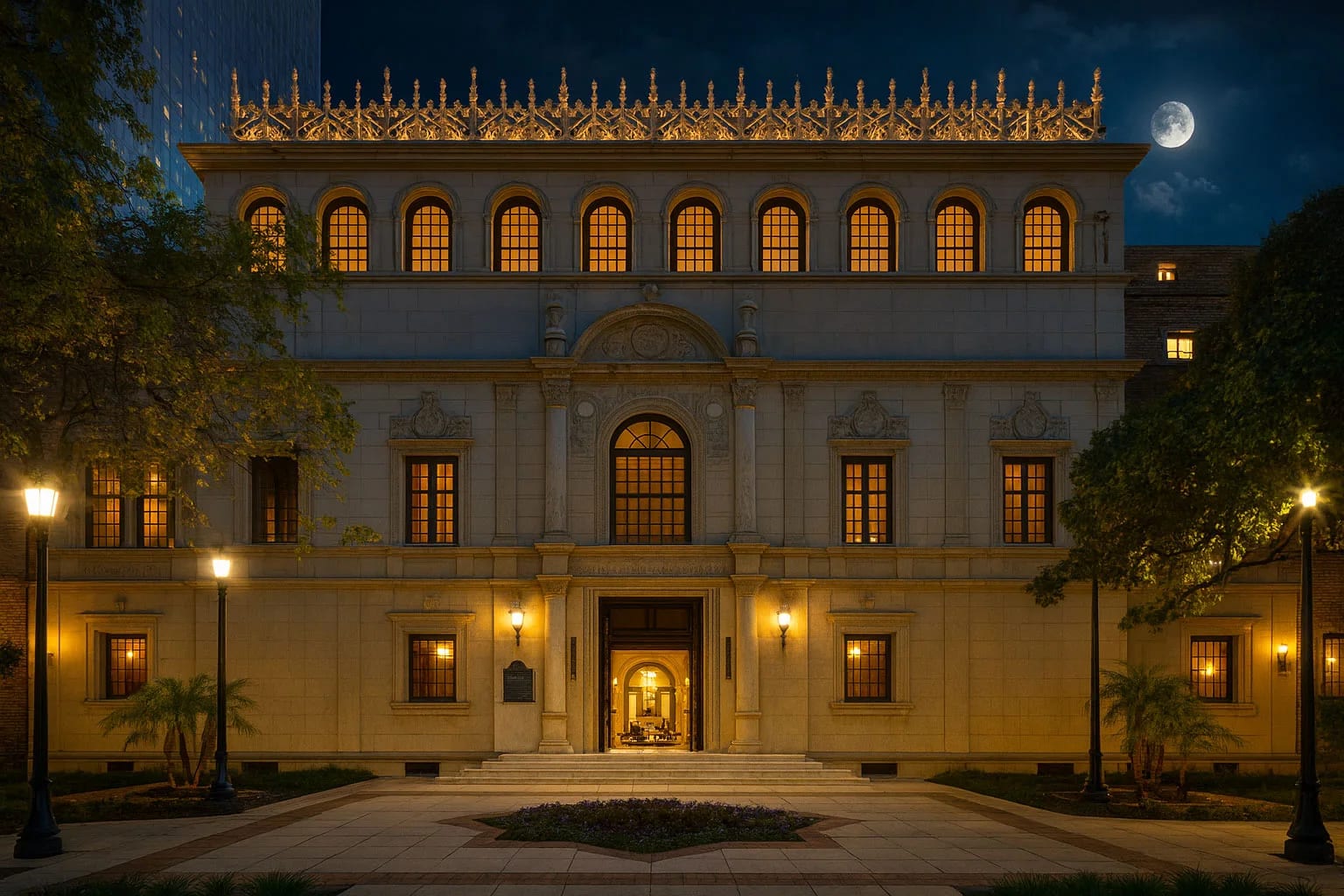
The Julia Ideson Building is a love story written in stone. From its Spanish Colonial arches to its hand-painted ceilings, from its magnificent reading rooms to its hidden basement corridors, every inch of this building speaks of devotion—to books, to learning, and to the city of Houston.
But there is another love story embedded in these walls, one that transcends death itself. It is the story of Jacob Frank, a janitor and caretaker who devoted his life to the Ideson Building, and his little terrier Petey, who was his constant companion. When Jacob died, his spirit stayed on, still performing his duties, still watching over the building he loved. And Petey stayed with him.
Unlike the angry spirits of Jefferson Davis Hospital or the melancholy ghosts of Glenwood Cemetery, the spirits of the Ideson Building are gentle and benevolent. They are guardians, not haunters—protectors of the books and the building they loved in life and continue to love in death.
Did You Know?
- The Julia Ideson Building was designed by renowned architect Ralph Adams Cram and opened in 1926 as Houston's main public library.
- The building is named for Julia Bedford Ideson, who served as Houston's first city librarian for 45 years and transformed the library system into one of the best in the South.
- Jacob Frank worked as the building's caretaker for decades, living in the basement with his dog Petey and playing violin in the evenings after the library closed.
- Staff members have reported hearing violin music coming from the basement late at night, long after Jacob's death.
- The building now houses the Houston Metropolitan Research Center and hosts events in its magnificent Tudor Gallery.
The History of the Julia Ideson Building
The story of the Julia Ideson Building is the story of Houston's intellectual awakening. When the building opened in 1926, it represented the city's aspirations to be more than just an oil boomtown—it was a statement that Houston valued culture, learning, and the life of the mind.
The Vision of Julia Ideson
Julia Bedford Ideson arrived in Houston in 1903 to take charge of a struggling public library. What she found was a small collection of books in a rented room, serving a rough frontier city that had little interest in literature. What she created over the next 45 years was nothing short of miraculous.
Ideson transformed the Houston Public Library into one of the finest library systems in the South. She fought for funding, built collections, and most importantly, advocated tirelessly for a proper library building. Her persistence paid off in 1926 when the magnificent Spanish Colonial Revival building that now bears her name opened its doors.
The building was designed by Ralph Adams Cram, one of America's most celebrated architects, and it was a masterpiece from the moment it opened. Its red tile roof, stucco walls, and decorative ironwork evoked the romance of old Spain, while its magnificent interior spaces—including the Tudor Gallery with its hand-painted beamed ceiling—provided worthy settings for the pursuit of knowledge.
The Devoted Caretaker
When the building opened, a man named Jacob Frank was hired as the janitor and caretaker. It was a modest position, but Jacob approached it with a devotion that bordered on reverence. He saw himself not just as an employee, but as a guardian of something precious.
Jacob lived in the basement of the building, in a small apartment that the library provided. His only companion was a small terrier named Petey, who followed him everywhere as he made his rounds, checking locks, adjusting thermostats, and ensuring that every book was in its proper place.
In the evenings, after the library closed and the patrons went home, Jacob would take out his violin and play. The music would drift up through the building, filling the empty reading rooms with melody. It was Jacob's way of serenading the books he protected, of expressing his love for the building in the only way he knew how.
Jacob served the Ideson Building for decades, until age and illness finally caught up with him. When he died, his spirit—and Petey's—stayed behind.
A Building Preserved
In 1976, the Houston Public Library moved to a new building, and the Ideson Building was closed. For years, the magnificent structure sat largely unused, its fate uncertain. Preservationists fought to save it, and in 1979, the building was added to the National Register of Historic Places.
After an extensive renovation, the Ideson Building reopened in the 1980s as the Houston Metropolitan Research Center, housing special collections, archives, and the Texas Room. It also became a popular venue for weddings, concerts, and other events, its Tudor Gallery providing an incomparable setting for special occasions.
But throughout the closure, the renovation, and the reopening, Jacob and Petey never left. They remain on duty to this day, the eternal caretakers of the building they loved.
The Ghosts of the Julia Ideson Building
The paranormal activity at the Ideson Building is consistent, well-documented, and remarkably benign. Unlike many haunted locations, there are no tales of terror here—only gentle reminders that Jacob and Petey are still watching over their beloved building.
Jacob Frank: The Eternal Caretaker
Library staff, security guards, and visitors have reported seeing Jacob's ghost for decades. He appears as an elderly man in work clothes, often carrying a broom or a ring of keys. He seems to be going about his duties, checking doors, inspecting rooms, and ensuring that everything is in order.
Some witnesses have reported that Jacob's ghost will look directly at them, sometimes nodding in acknowledgment before continuing on his rounds. Others have seen him simply fade away when they try to approach him. He never seems threatening or even particularly interested in the living—he's simply doing his job, as he always did.
One long-time staff member described her first encounter with Jacob: 'I was working late in the research center, and I heard footsteps in the hallway. When I looked up, I saw an old man walking past the door. I assumed it was a security guard, but when I went to say hello, the hallway was empty. There was nowhere he could have gone. I wasn't scared—it felt like he was just checking up on me, making sure I was okay.'
Jacob is most often seen in the basement, where he lived, and in the Tudor Gallery, where he would make his nightly rounds. Staff members have learned to recognize his presence by the sound of footsteps in empty corridors and the soft jingle of keys.
Petey: The Ghost Dog
Where Jacob goes, Petey follows—even in death. The little terrier's ghost has been seen by numerous witnesses, usually trotting alongside Jacob or waiting patiently outside a closed door.
Some visitors have reported feeling something brush against their legs in the basement and lower floors—the sensation of a small dog passing by, even though no animal is visible. Others have heard the clicking of dog claws on the marble floors, or the soft yipping of a small dog coming from empty rooms.
One particularly touching account comes from a security guard who was making his rounds late at night. He reported seeing a small white dog sitting at the foot of the main staircase, wagging its tail as if waiting for someone. When he approached, the dog stood up and trotted up the stairs. The guard followed, but when he reached the top of the stairs, both the dog and its master—Jacob's ghost—were waiting for him. They looked at him for a moment, and then both faded away.
'It wasn't scary at all,' the guard said later. 'It was actually kind of comforting. Like they were letting me know they approved of me being there.'
The Violin Music
Perhaps the most frequently reported phenomenon at the Ideson Building is the sound of violin music coming from the basement. Staff members who work late, security guards on night duty, and even visitors at evening events have reported hearing the faint strains of a violin, playing melodies that seem to come from another era.
The music is always soft, never intrusive—more like a memory of music than actual sound. It is most commonly heard in the late evening hours, the time when Jacob would have played for the empty building after the patrons had gone home.
Some have tried to record the music, with mixed results. A few investigators claim to have captured faint violin sounds on their recordings, though the quality is too poor to analyze in detail. Others have captured nothing at all, even when multiple witnesses reported hearing the music at the same time.
The Protective Presence
Beyond the specific apparitions of Jacob and Petey, many people who spend time in the Ideson Building report a general sense of being watched over and protected. It's not an uncomfortable feeling—more like the sensation of having a benevolent guardian nearby.
This protective presence seems to extend to the building's contents as well. Despite decades of use and the passage of thousands of visitors, the Ideson Building has suffered remarkably little damage or theft. Some staff members joke that Jacob is still on the job, protecting his books and his building from harm.
One archivist who worked in the building for many years put it this way: 'I always felt safe here, even when I was working alone at night. It's like there's someone watching out for you. Whether that's Jacob or just the building itself, I don't know. But it's a good feeling.'
Understanding the Haunting
The haunting of the Julia Ideson Building offers an interesting counterpoint to more frightening ghost stories. What makes the spirits here so gentle, when other locations are plagued by angry or malevolent presences?
A Life of Devotion
Paranormal researchers often note that the emotional state of a person at death can influence the nature of their haunting. Jacob Frank lived a life of quiet devotion to the Ideson Building. He wasn't a tragic figure or a victim of violence—he was simply a man who loved his work and found purpose in protecting something beautiful.
That positive emotional energy seems to have translated into a positive haunting. Jacob's ghost isn't trapped or tormented—he's simply continuing to do what he loved, in the place he loved, with his beloved companion by his side.
The Power of Place
The Ideson Building itself may also contribute to the benign nature of its haunting. This is a place dedicated to knowledge, learning, and the preservation of culture. The countless people who have passed through its doors over the decades—readers, researchers, students, scholars—have left their own positive imprints on the building.
The building was also the life's work of Julia Ideson herself, a woman who dedicated 45 years to serving the people of Houston. Her spirit of service may permeate the building, creating an atmosphere that encourages benevolent rather than malevolent manifestations.
Love After Death
Perhaps the simplest explanation is also the most profound: Jacob loved the Ideson Building so much that he couldn't bear to leave it, even in death. And Petey loved Jacob so much that he wouldn't leave without him.
In a world full of ghost stories about tragedy, violence, and unfinished business, the Ideson Building offers a different kind of tale—a story about love, devotion, and the ways that powerful emotions can transcend death itself.
Visiting the Julia Ideson Building
Unlike many haunted locations, the Julia Ideson Building is fully accessible to the public and welcomes visitors. Whether you're interested in history, architecture, or the paranormal, this magnificent building has something to offer.
The Houston Metropolitan Research Center
The building now houses the Houston Metropolitan Research Center, which includes the Texas Room, special collections, and archives related to Houston and Texas history. Researchers and history enthusiasts are welcome to explore these collections during regular business hours.
Architecture Tours
The Ideson Building is a masterpiece of Spanish Colonial Revival architecture, and periodic tours are offered that focus on the building's design and history. These tours provide access to areas not normally open to casual visitors and offer insights into the building's construction and preservation.
Events
The Tudor Gallery and other spaces in the Ideson Building are available for private events, including weddings, concerts, and receptions. Those who host events in the building often report unusual but benign occurrences—the sense of being watched, unexplained sounds, and the feeling of a protective presence.
Ghost Tours
Several Houston ghost tours include the Ideson Building on their routes. These tours share the stories of Jacob and Petey and allow visitors to experience the building's atmosphere after dark.
Tips for Visitors
If you're hoping to encounter Jacob or Petey, your best bet is to visit during quieter times. The ghosts seem to prefer the evening hours and tend to avoid large crowds. Be respectful—remember that you are visiting their home, not the other way around.
Some visitors have reported that simply speaking to Jacob and Petey, acknowledging their presence and thanking them for their service, seems to encourage activity. Whether this is true or not, it certainly can't hurt.
The Julia Ideson Building stands as a testament to the power of love—Julia Ideson's love of books and learning, Jacob Frank's love of the building, and a little dog's love of his master. For those who visit with open hearts and open minds, it offers a gentle reminder that not all ghosts are to be feared. Some are simply friends who refused to say goodbye.

The beautiful Julia Ideson Building, home to Houston's most beloved ghosts

The magnificent Tudor Gallery where Jacob makes his nightly rounds

The basement where Jacob lived and his violin music can still be heard
