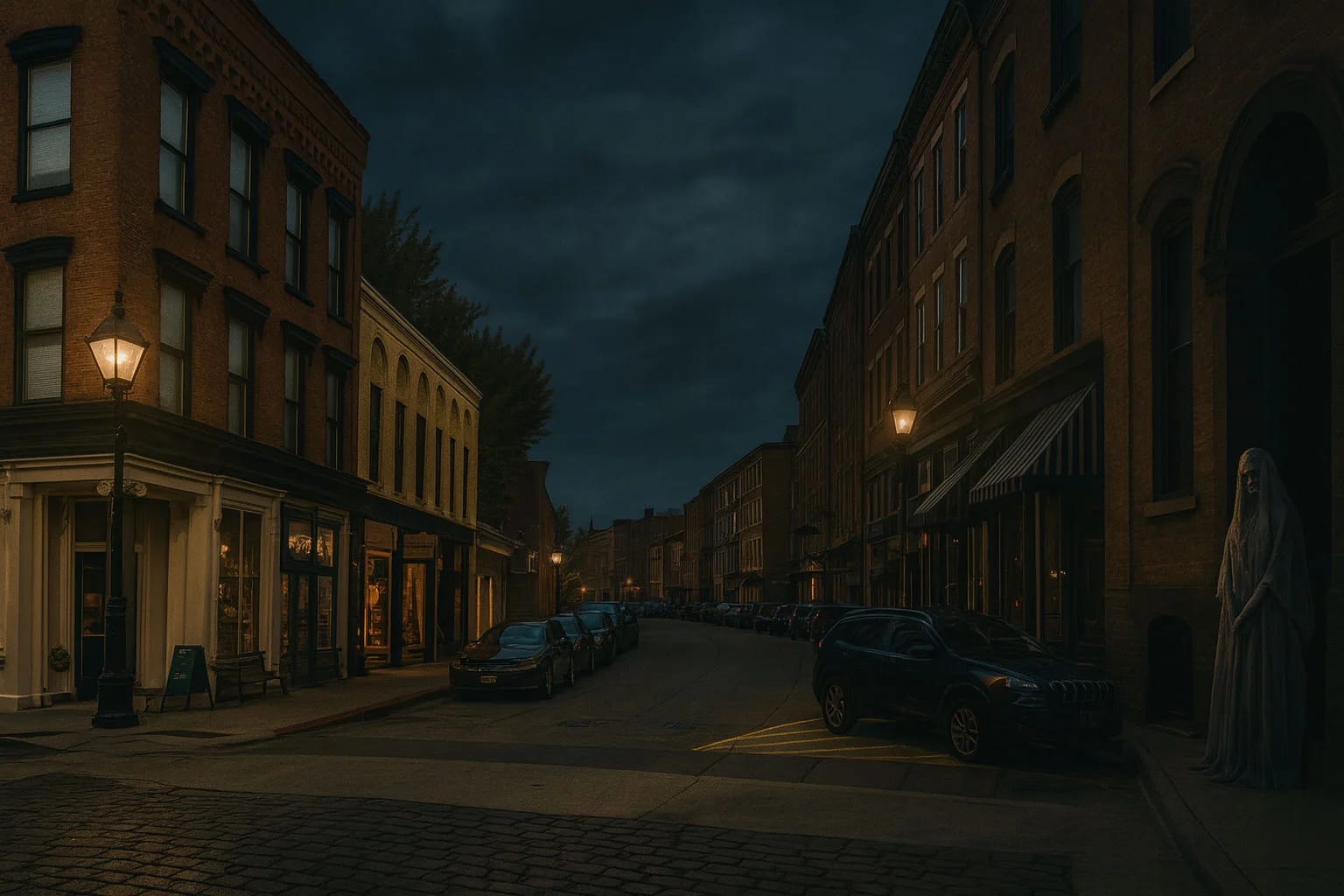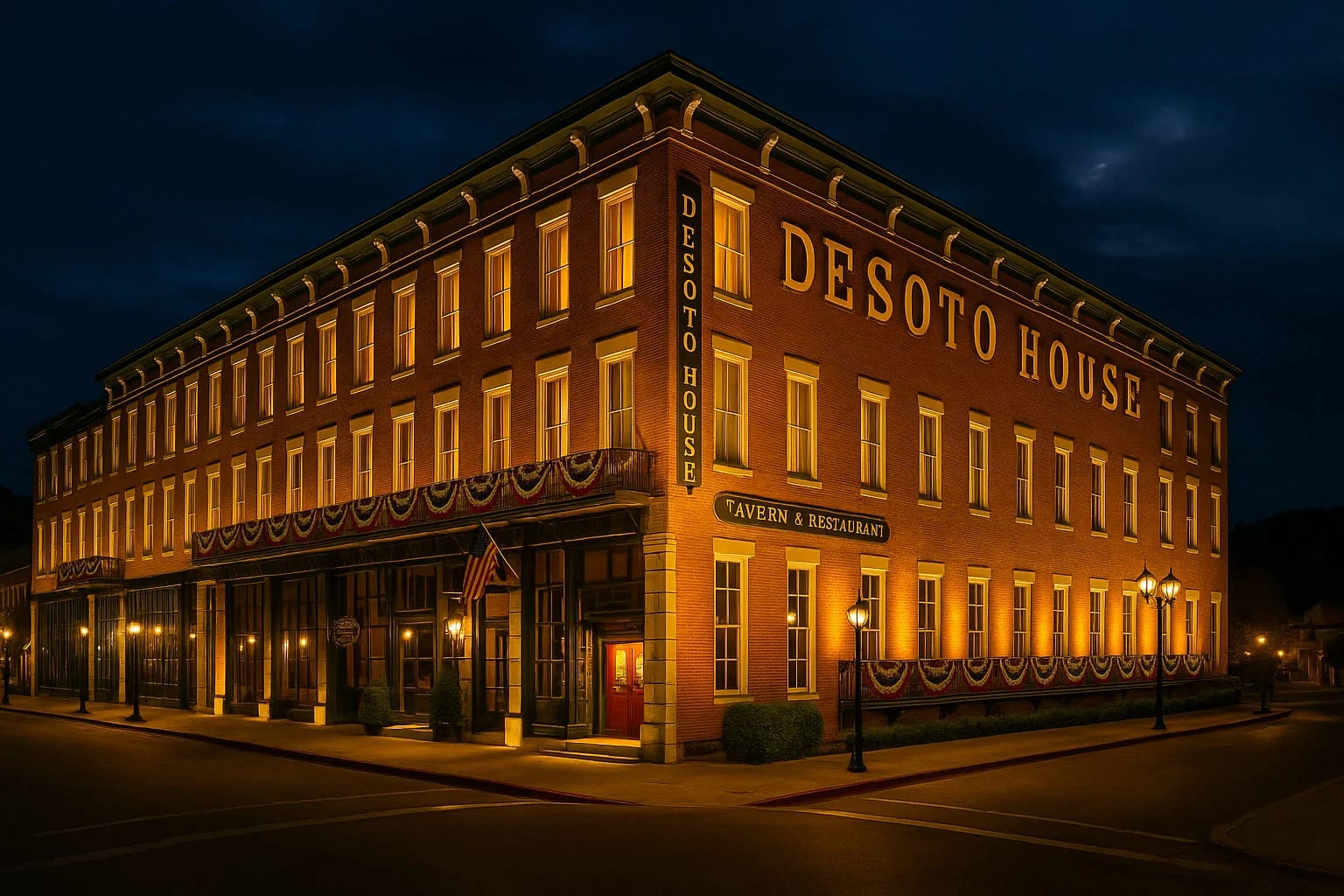
Stand on Main Street in Galena, Illinois, and look up at the DeSoto House Hotel, and you're looking at 170 years of American history. This is where Abraham Lincoln stood on the balcony in 1856, rallying support for John Fremont's presidential campaign. This is where Ulysses S. Grant returned as a conquering hero after the Civil War to be greeted by 25,000 cheering citizens. This is where Stephen Douglas delivered speeches, where Tom Thumb and his wife stayed on their tours, where the elite of the American frontier gathered to conduct business and celebrate victories.
But the DeSoto House Hotel is also a place of tragedy and mystery. Fire swept through the building in 1859. A boiler explosion rocked its basement in 1869. Economic collapse forced its doors closed in 1870. And through it all—through the prosperity and the decline, through the famous guests and the forgotten ones—something has remained in this grand old hotel. Something that walks the halls at night. Something that descends staircases that no longer exist and disappears through doorways that were bricked up generations ago.
The ghosts of the DeSoto House Hotel have been documented since the 1800s, making this one of Illinois' longest-running haunted locations. Our own CEO stayed at the DeSoto House Hotel and found it to be a beautiful, well-appointed hotel with genuine Victorian charm—and yes, genuinely haunted. The combination of historic elegance and supernatural activity makes the DeSoto House one of the most compelling haunted hotels in the Midwest.
The History of the DeSoto House Hotel
To understand why the DeSoto House Hotel is so haunted, you must first understand the extraordinary history that unfolded within its walls.
The Largest Hotel in the West
By the 1850s, Galena had become the most important city in Illinois. Situated at the confluence of the Galena River and the Mississippi, the town had grown wealthy from lead mining—the very name 'Galena' comes from the Latin word for lead ore. Steamboats crowded its wharves, bringing goods and travelers from New Orleans, St. Louis, and points south. The Illinois Central Railroad was extending its reach into the region. Galena was, quite literally, the 'Metropolis of the Northwest.'
A group of local investors formed the Galena Hotel Company, determined to build a hotel worthy of their booming city. They chose to name it after Hernando de Soto, the Spanish conquistador credited with being the first European to see the Mississippi River. When the DeSoto House opened on April 9, 1855, it was everything the investors had hoped for and more.
The original hotel was five stories tall with 225 guest rooms—an enormous establishment for its time. It featured a gentleman's reading room, ladies' parlors, a 300-seat dining hall, and its own gas works for lighting the public areas. Each room had its own fireplace. The furnishings were imported, the service impeccable, and the rates steep. The DeSoto House immediately became the place to stay in the Upper Mississippi Valley.
Presidents and Generals
The hotel's guest registry reads like a Who's Who of 19th-century America. On July 23, 1856, a tall, lanky lawyer from Springfield stepped onto the DeSoto House's second-floor balcony overlooking Main Street. Abraham Lincoln had come to Galena to speak in support of John Fremont's presidential campaign—the first presidential campaign of the newly formed Republican Party. Lincoln's words echoed across the crowd gathered below, one of many speeches that would eventually carry him to the White House.
Two years later, on July 25, 1858, Senator Stephen A. Douglas stood on that same balcony, delivering his own political address. The irony was not lost on observers—Lincoln and Douglas, bitter rivals who would soon face each other in the famous Lincoln-Douglas debates, had both spoken from the same spot.
But it was Ulysses S. Grant who would become most associated with the DeSoto House. Before the Civil War, Grant had worked in his family's leather goods store on Main Street, a humble clerk with no indication of the greatness that awaited him. When he returned to Galena in 1865 as the victorious commander of Union forces, 25,000 people—more than three times the town's population—flooded the streets to welcome him home.
Bands played, cannons fired salutes, and a grand reception ball for 2,000 guests was held at the DeSoto House. Grant would return to the hotel many times in the following years, and in 1868, he established his presidential campaign headquarters in rooms 209 and 211. From the DeSoto House, Grant launched his successful bid for the presidency, receiving guests and planning strategy in the same hotel where Lincoln had once rallied the faithful.
Fire, Explosion, and Decline
Tragedy first struck the DeSoto House on June 2, 1859, when fire swept through the building. The flames damaged the entire hotel and destroyed about twelve rooms on each floor. The hotel was repaired and reopened, but the disaster was a harbinger of misfortunes to come.
A decade later, on December 7, 1869, a steam boiler in the hotel's basement dye works exploded with catastrophic force. The blast and its aftermath left the hotel badly damaged and its reputation tarnished. By May 1870, the DeSoto House was put up for rent. In October, the furnishings were auctioned off. In December, barely fifteen years after its grand opening, the doors of the 'Largest Hotel in the West' closed.
The hotel's closure mirrored Galena's own decline. Railroads had replaced steamboats, and the routes that made Galena prosperous now bypassed it entirely. The lead mines were playing out. Chicago had risen to become the dominant city of Illinois and the Midwest. Galena, which had once been the largest city in Illinois, began its long fade into obscurity.
W.H. Blewett purchased the hotel in 1871 and attempted to revive it, but the DeSoto House would never again reach the heights of its early years. In 1880, faced with fire safety concerns and economic realities, the top two floors were removed, reducing the five-story landmark to three. The grand hotel that had hosted presidents was becoming a shadow of its former self.
The Ghosts of the DeSoto House Hotel
Ghost sightings at the DeSoto House Hotel have been documented since the 1800s, making this one of Illinois' longest-running haunted locations. The hotel embraces its supernatural reputation, acknowledging the spirits that seem to share the building with living guests.
The Lady in Black
The most famous ghost of the DeSoto House is known simply as the Lady in Black. For over a century, employees and guests have reported seeing a woman in a black Victorian-era dress descending a staircase in the hotel, then walking directly into a solid wall and vanishing.
Descriptions of the Lady in Black are remarkably consistent across generations of witnesses. She wears a black period dress with a black hat, has brown hair styled in the fashion of the late 1800s, and brown eyes. She appears solid enough to be mistaken for a living guest—until she walks through a wall.
For decades, the Lady in Black's behavior seemed inexplicable. Why would she walk into a wall? What could possibly draw her to that specific spot? The mystery persisted until 2011, when a flood caused water damage to the hotel's lower level. When contractors removed the damaged drywall near where the Lady in Black was always seen disappearing, they discovered something remarkable: a doorway.
The wall the Lady in Black had been walking through for over a century had once contained a door. At some point in the hotel's history, the doorway had been sealed up and covered over, forgotten by the living but remembered by the dead. The Lady in Black wasn't walking through a wall at all—she was walking through a door that existed in her time, a door she still remembers.
Today, instead of covering the doorway back up, the hotel has installed plexiglass so visitors can see the hidden door. There's even a photograph displayed nearby that appears to capture the Lady in Black in full apparition form—one of the clearest ghost photographs ever taken at the hotel.
The identity of the Lady in Black remains a mystery. Some speculate she may have been a guest who died in the hotel, perhaps during one of its many tragedies. Others believe she may have been connected to the hotel in some other way—a former employee, perhaps, or the wife or daughter of one of the owners. Whatever her story, she continues to walk the halls of the DeSoto House, forever descending a staircase, forever walking through a door that exists only for her.
The Third Floor Phenomena
The third floor of the DeSoto House is considered the most actively haunted area of the hotel, which is particularly interesting given the building's history. Remember that the hotel was originally five stories tall before the top two floors were removed in 1880.
Guests staying on the third floor regularly report hearing footsteps and noises coming from directly above them—from floors that no longer exist. The sounds are unmistakable: people walking, doors closing, the general bustle of a busy hotel floor. But there is nothing above the third floor now. The upper stories were demolished nearly 150 years ago.
Even more unsettling, some guests report hearing what sounds like parties in the non-existent space above them—music, laughter, the clinking of glasses, the murmur of conversation. It's as if the social events of the hotel's glory days continue to play out in some phantom dimension above the current structure.
Room 333 is reputed to be the most haunted room in the hotel. Guests who have stayed there report a variety of phenomena: disembodied voices, unexplained noises, the feeling of being watched, and occasionally the sensation of someone sitting on the edge of the bed. Some guests have requested to change rooms in the middle of the night, unable to sleep with the constant feeling of a presence in the room with them.
Phantom Children and Soldiers
Beyond the Lady in Black, multiple other spirits have been reported throughout the DeSoto House. Guests have seen ghostly apparitions of children in the hallways, running and playing as children do, their laughter echoing before they vanish around corners or through closed doors.
Union soldiers in Civil War uniforms have also been spotted in the hotel. Given the DeSoto House's connection to the Civil War—as a gathering place for officers, a campaign headquarters for Grant, and a landmark in a town that produced nine Civil War generals—the presence of spectral soldiers seems almost expected. These apparitions appear briefly, sometimes walking through the lobby or standing in hallways, before fading from view.
The smell of cigar smoke is frequently detected in areas where smoking has been prohibited for decades. This phantom tobacco scent is often associated with the hotel's 19th-century past, when gentlemen would gather in the smoking room after dinner. The smell appears without warning and dissipates just as quickly, leaving guests wondering if they really experienced it at all.
Orbs of light have been photographed and observed moving through various areas of the hotel, particularly on the third floor. Some guests have reported seeing these orbs with their naked eyes, watching them float slowly through hallways before winking out of existence.
The Presence on the Bed
One of the most commonly reported phenomena at the DeSoto House is the sensation of someone sitting or lying on the bed while guests are trying to sleep. Guests describe feeling the mattress depress as if someone is sitting on the edge, or sensing a presence lying beside them in the darkness. When they turn on the lights, no one is there—but the feeling of company persists.
This phenomenon is reported across multiple rooms, suggesting it may not be tied to a specific spirit but rather to the accumulated energy of the thousands of people who have slept within these walls over 170 years. Or perhaps there are simply many spirits at the DeSoto House, enough that guests in almost any room might encounter one.
Experiencing the DeSoto House Hotel Today
The DeSoto House Hotel continues to operate as a full-service hotel, welcoming guests who want to experience both its rich history and its supernatural residents. The hotel has been beautifully restored, with 55 Victorian-style rooms named after notable figures who visited Galena over the years, including rooms named for Lincoln and Grant.
The hotel doesn't hide from its haunted reputation—it embraces it. Staff are generally willing to discuss the ghost stories with interested guests, and the hotel has been featured in numerous paranormal investigations and travel programs. The plexiglass-covered doorway where the Lady in Black disappears has become something of a tourist attraction in itself.
The DeSoto House also features three restaurants, including the Generals' Restaurant named in honor of Galena's nine Civil War generals. Dining amidst the original brick walls and beamed ceilings, it's easy to imagine the great figures of American history who once ate in this very building.
Our Ghosts of Galena Tour passes by the DeSoto House Hotel, where our guides share the incredible history of this landmark building and the spirits that continue to call it home. We explore why some places accumulate so much paranormal activity—the combination of age, tragedy, intense emotional events, and thousands of lives passing through creates the perfect conditions for hauntings.
Join our Ghosts of Galena Tour to discover the DeSoto House Hotel and learn why Illinois' oldest hotel may also be its most haunted.