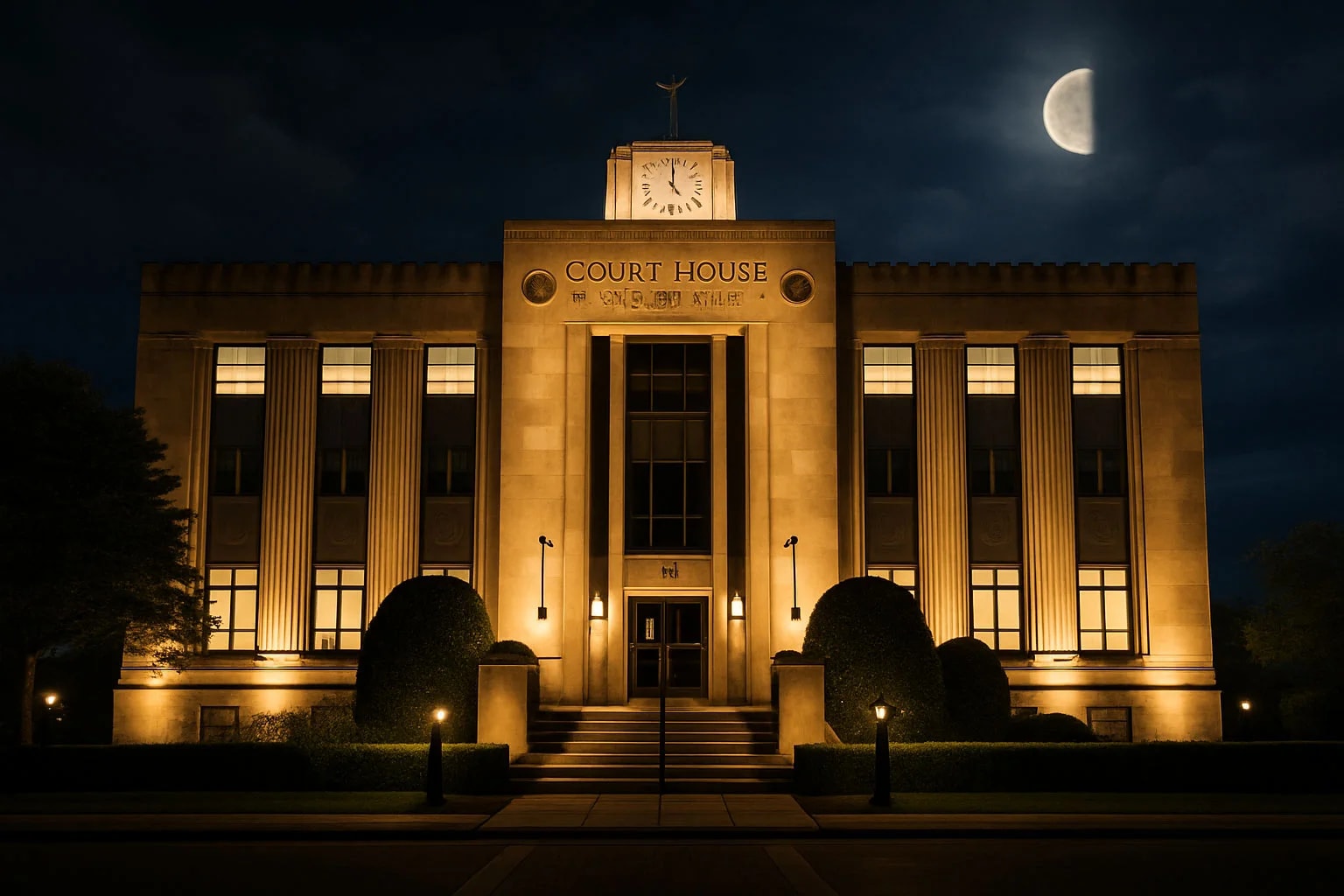
The man in the holding cell was screaming. Not the kind of yelling you'd expect from someone who'd just been arrested—this was raw terror, the sound of someone who'd seen something that shouldn't exist.
The deputy rushed back to check on him. The prisoner was pressed against the far wall, shaking, his face white as paper.
'There's a guy in a beard,' the man stammered. 'He told me to get out. He had a cigar and he blew smoke in my face. Then he disappeared.'
The deputy had heard this story before. Different prisoners, different nights, but always the same basic elements: the bearded man, the cigar, the warning to leave, the vanishing. Whatever haunts the holding cells behind the Williamson County Courthouse isn't shy about making itself known.
If you're exploring the haunted history of Franklin through one of our ghost tours, the courthouse is one of those buildings that looks perfectly normal from the outside—stately, historic, respectable. But the stories that come from inside its walls tell a different tale entirely.
A House of Justice and Death
The Williamson County Courthouse has stood at the heart of Franklin since the mid-1800s, dispensing justice in ways that would horrify modern sensibilities. This was the antebellum South, where the law was harsh and punishment was public.
The courthouse grounds witnessed numerous hangings—public executions where the whole town would gather to watch condemned prisoners take their last breaths. These weren't hidden away in prison yards; they were spectacles, meant to deter crime through terror. Men and women would bring their children to watch, to teach them what happened to those who broke the law.
But hangings weren't the only form of punishment administered here. The courthouse property was also used for brandings and beatings—the literal burning of flesh as a mark of criminal status, the public whipping of offenders while the community watched. The ground around this building has soaked up the suffering of countless people over generations.
Even before the Civil War, the courthouse was a place where fear lived. And then came November 1864, and everything got worse.
The Battle Comes to the Square
When the Battle of Franklin erupted on November 30, 1864, the fighting raged all the way to the Public Square. The courthouse, like every other building in downtown Franklin, was pressed into service as a makeshift hospital. The offices where judges heard cases and lawyers filed motions became wards filled with wounded and dying men.
Imagine the scene: courtrooms designed for orderly proceedings now crammed with bleeding soldiers, their screams echoing off walls that had heard so many other screams over the years. Surgeons working by candlelight, doing their best with limited supplies and no anesthesia. Bodies stacking up faster than they could be removed. Blood seeping into floors that had already witnessed so much violence.
The soldiers who died in the courthouse joined the spirits of everyone else who had suffered there—the hanged, the branded, the beaten. Layer upon layer of trauma accumulated in one building, creating a supernatural pressure cooker that has never fully released.
The Bearded Man with the Cigar
Of all the ghosts that haunt the Franklin Courthouse, the bearded man is the most famous—and the most aggressive. He doesn't just appear and fade away like most spirits. He interacts. He communicates. He makes his presence impossible to ignore.
The sightings follow a pattern. Someone is alone in the holding area behind the judge's chambers—usually a prisoner, sometimes a deputy working late. They become aware of someone else in the room. They turn, and there he is: a man with a full beard, dressed in clothing from another era, smoking a cigar that fills the air with the smell of tobacco.
He looks at them. Sometimes he speaks—'Get out' seems to be his favorite phrase. Sometimes he just stares, puffing on his cigar, the smoke curling around his face. And then, without warning, he vanishes. Not walks away. Vanishes. One moment solid and present, the next moment simply gone.
Who is he? The theories vary. Some believe he was a man who was hanged on the courthouse grounds, his spirit bound to the place of his execution. Others think he might have been a Civil War soldier who died in the hospital wards, possibly an officer given his commanding presence. Still others suggest he could be an earlier figure—a judge or sheriff from Franklin's rougher days, someone who administered harsh justice and can't move on from the place where he wielded such power.
Whatever his identity, he's consistent. Prisoners who know nothing about the courthouse's haunted reputation describe the same figure that prisoners described decades ago. Either this is the most elaborate ongoing hoax in Tennessee history, or something genuinely paranormal is happening in those holding cells.
Other Haunted Happenings
The bearded man isn't the only spirit in the courthouse. Staff members have reported a wide range of unexplained phenomena over the years:
Footsteps in Empty Hallways: Security guards on night duty regularly hear footsteps in corridors they know are empty. The sounds are clear and distinct—not the building settling, not pipes creaking, but the unmistakable rhythm of someone walking. When they investigate, there's no one there.
Cold Spots: Certain areas of the courthouse are dramatically colder than others, even when the HVAC system is working perfectly. These cold spots move around, appearing in different locations on different days, as if something is wandering through the building and bringing a chill wherever it goes.
Voices: Whispered conversations have been heard in empty courtrooms, fragments of dialogue in language that sounds both familiar and strange. Some who've heard it describe it as arguing—the kind of heated exchange you might expect between a lawyer and a witness, or a condemned man and his executioner.
Doors and Windows: Doors open and close on their own. Windows that were locked are found unlocked. Objects move from where they were placed to somewhere else entirely. It's as if the spirits in the courthouse are restless, constantly in motion, unable to find peace.
Shadows: Dark shapes that don't correspond to any physical object have been seen moving through the building, particularly in the older sections. They're usually glimpsed from the corner of the eye—when you turn to look directly, they're gone.
A Building Steeped in Sorrow
What makes the Franklin Courthouse so haunted isn't any single event—it's the accumulation of suffering over nearly two centuries. Think about everything that's happened within and around these walls:
Public executions where men breathed their last while crowds watched and cheered. Brandings that scarred flesh and marked people as criminals for life. Beatings administered in the name of justice. And then the horror of the Civil War, when the building that dispensed punishment became a building that tried—and often failed—to save lives.
Each trauma leaves a mark. Each death adds another presence to the spiritual population of the place. The courthouse has absorbed so much pain that the very stones seem to remember it, replaying moments of agony for anyone sensitive enough to perceive them.
Historian Allen Sircy, who has documented Franklin's haunted history extensively, notes that the courthouse is one of the most reliably haunted locations in a town full of them. 'The closer you get to downtown,' he observes, 'the courthouse has been known for ghost sightings, where lynchings, hangings, and branding of criminals took place.' The building's history is written in blood, and that blood has never fully dried.
The Ghosts of Justice
The Williamson County Courthouse continues to serve its original function, dispensing justice in a building that has witnessed some of the darkest chapters of Franklin's history. If you visit during business hours, you'll find lawyers and judges going about their work, seemingly unaware of—or deliberately ignoring—the supernatural presence that shares their space.
The most active area for paranormal encounters is reportedly the holding area behind the judge's chambers, but public access to that section is limited for obvious reasons. However, simply standing outside the courthouse, looking up at its windows, you might feel something of the weight that hangs over this place. The building has a presence, an atmosphere that's hard to define but impossible to ignore.
Many of Franklin's ghost tours include stops at the courthouse, sharing the stories of those who died here and those who've witnessed the spirits that remain. It's a sobering reminder that the charming Southern town we see today was built on foundations of suffering—suffering that has never entirely ended.
The next time you're in Franklin, stop by the courthouse. Stand where the gallows once stood. Think about the men and women who met their ends here, about the soldiers who died in hospital wards that used to be courtrooms, about the bearded man who still walks the halls with his cigar, telling the living to get out.
They didn't get out, of course. The dead never do. They're still here, still waiting, still replaying the moments of their greatest pain. And if you're quiet enough, patient enough, open enough—you might catch a glimpse of them. Just don't be surprised if one of them looks back.

The bearded man with the cigar has been seen by multiple witnesses over the years
