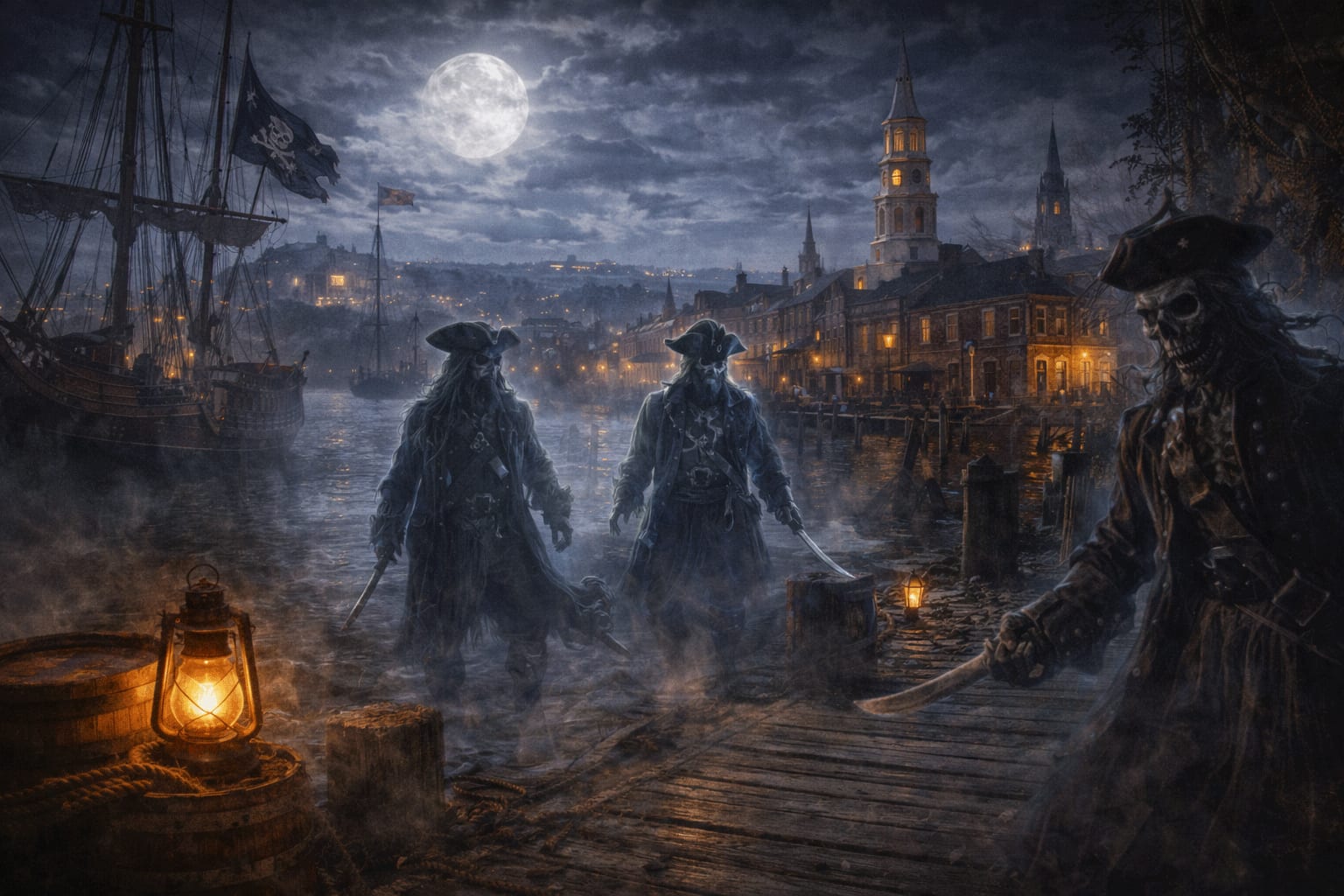
A Port Built for Plunder
Charleston was founded in 1670, and from the very beginning, the line between lawful commerce and outright piracy was blurred. The Lords Proprietors who governed the Carolina colony were more interested in profits than principles, and they weren't particularly concerned about where those profits came from. Privateers, men who carried government-issued letters of marque authorizing them to attack enemy ships, were welcomed into Charleston Harbor with open arms. They spent their plunder freely in the city's taverns, shops, and warehouses, and the local economy thrived on the arrangement.
The problem was that privateering and piracy were separated by nothing more than a piece of paper. When wars ended and letters of marque expired, many privateers simply kept doing what they had always done, only now without the legal cover. Charleston's merchants, who had been happy enough to do business with these men when it suited them, suddenly found their own ships being targeted by the same sailors they had once toasted in their drawing rooms.
By the early 1700s, the Carolina coast had become one of the most dangerous stretches of water in the Atlantic. Pirates operated openly, attacking ships within sight of the harbor, and Charleston's economy, built in part on the spoils of privateering, was now being strangled by the very forces it had helped create. The golden age of piracy had arrived in the Lowcountry, and it was about to get very bloody.
Blackbeard's Blockade
In May of 1718, the most feared pirate in the Atlantic sailed directly into Charleston's front door. Edward Teach, better known as Blackbeard, arrived off the coast with a fleet of four ships and a crew of roughly 300 men. He didn't sneak in under cover of darkness. He anchored his flagship, the Queen Anne's Revenge, at the mouth of the harbor and dared anyone to do something about it.
For nearly a week, Blackbeard blockaded the port of Charleston. No ship could enter or leave without his permission. He captured at least nine vessels during the blockade, seizing their cargo and taking their passengers hostage. Among the captives was Samuel Wragg, one of the wealthiest and most prominent members of the South Carolina colonial council. Blackbeard sent a demand to the colonial governor: deliver a chest of medicine or the hostages would be killed and their heads sent to shore.
The ransom was not gold or silver. Blackbeard wanted medical supplies, almost certainly mercury-based treatments for syphilis, a disease that ravaged pirate crews. The governor complied. The medicine was delivered, the hostages were released, stripped of their valuables and most of their clothing, and Blackbeard sailed away. The entire episode humiliated the colonial government and exposed just how vulnerable Charleston was to attack from the sea.
Blackbeard would never return to Charleston. He was killed in a brutal fight with British naval forces off the coast of North Carolina in November of 1718, just six months after the blockade. His head was severed and hung from the bowsprit of the ship that killed him. But the damage to Charleston's sense of security was done, and the city's leaders decided it was time to make an example of every pirate they could get their hands on.
The Gentleman Pirate: Stede Bonnet
If Blackbeard was the devil of Charleston's pirate nightmare, Stede Bonnet was its most tragic figure. Born into wealth on the island of Barbados, Bonnet was a retired British Army major, a landowner, and by all accounts a man who had no business being a pirate. Historians have long speculated about why he abandoned his comfortable life for the sea. Some say it was to escape a nagging wife. Others suggest he suffered from some form of mental disturbance. Whatever the reason, in 1717 Bonnet did something no respectable gentleman had ever done: he bought a ship, hired a crew, and set out to become a pirate.
He named his vessel the Revenge and sailed north from Barbados, raiding ships along the American coast. He was, by most accounts, a terrible pirate. He knew almost nothing about sailing or naval combat, and his crew quickly lost confidence in him. When he crossed paths with Blackbeard, the more experienced pirate essentially took over Bonnet's operation, installing his own man to captain the Revenge while Bonnet wandered the deck of the Queen Anne's Revenge in his bathrobe, reading books.
After Blackbeard's blockade of Charleston, the two men parted ways. Bonnet attempted to go straight, accepting a pardon from the governor of North Carolina, but the pull of piracy proved too strong. He returned to raiding under the alias Captain Thomas, and it was this decision that sealed his fate.
Colonel William Rhett, a Charleston plantation owner and militia leader, was dispatched to capture Bonnet. After a fierce battle in the Cape Fear River in September of 1718, Bonnet and his crew were taken prisoner and brought back to Charleston in chains. The Gentleman Pirate's days of freedom were over.
The Hangings at White Point
The trials of Stede Bonnet and his crew were the most dramatic legal proceedings Charleston had ever seen. Vice Admiralty Judge Nicholas Trott presided, and the outcome was never in doubt. Bonnet pleaded for mercy, reportedly weeping in the courtroom. It made no difference. Trott sentenced Bonnet and twenty-nine of his men to death by hanging.
The executions took place at White Point Garden, the marshy point at the southern tip of the Charleston peninsula where the Ashley and Cooper Rivers meet. In the autumn and winter of 1718, the gallows at White Point were busy. Over the course of roughly five weeks, forty-nine pirates were hanged at the water's edge. Their bodies were left swinging from the gibbets as a warning to any sailor who might consider flying the black flag in Carolina waters.
Stede Bonnet was executed on December 10, 1718. Accounts say he trembled violently as the noose was placed around his neck, clutching a small bouquet of wildflowers. Unlike the dramatic scaffold drops of later centuries, pirate hangings in 1718 were done by short-drop strangulation. The condemned were hauled up by the neck and left to slowly suffocate, a process that could take several agonizing minutes.
Bonnet's body, along with those of his crew, was buried in the marsh mud below the high-tide line at White Point, a deliberate indignity that denied them a proper Christian burial. The marsh has long since been filled in and landscaped into the genteel park that stands there today, but the bones of those forty-nine men almost certainly still lie beneath the grass and the ancient live oaks.
The Pirate Taverns of Charleston
Pirates didn't just terrorize Charleston from the sea. When they came ashore, they drank, gambled, brawled, and spent their plunder in the taverns and establishments that lined the waterfront. Charleston's early tavern culture was inseparable from its pirate history. These were the places where crews were recruited, where stolen goods were fenced, and where deals were struck between pirates and the supposedly respectable merchants who bought their plunder at a discount.
The area around East Bay Street and the old wharves was the heart of this activity. Taverns in colonial Charleston were rough, loud, and frequently dangerous. They served rum by the barrel, and the men who drank there carried weapons as a matter of course. Fights were common, and deaths in tavern brawls were not unusual enough to warrant much attention from the authorities, particularly when the authorities themselves were sometimes drinking at the next table.
Some of these establishments survived in one form or another for centuries. The buildings changed hands, were rebuilt after fires and hurricanes, and evolved from pirate dens into respectable restaurants and bars. But the energy of what happened inside their walls, the violence, the greed, the desperate living of men who knew the gallows might be waiting for them at the next port, seems to have left a mark that refuses to fade.
Staff and patrons at several historic establishments along the waterfront and in the French Quarter have reported unexplained phenomena for years: glasses sliding off bars untouched, the sound of heavy boots on wooden floors when no one is there, cold spots that appear and vanish, and the occasional apparition of a figure dressed in clothing that belongs to a century long gone. Whether these are the spirits of pirates or simply the accumulated energy of three hundred years of hard living is a question no one can definitively answer. But the stories persist, and they always seem to come from the same places.
The Ghosts of White Point Garden
Of all the haunted locations tied to Charleston's pirate history, White Point Garden is the most active and the most unsettling. The park is beautiful by day, shaded by massive live oaks draped in Spanish moss, with sweeping views of the harbor. But as the sun goes down, something changes.
Visitors walking through the garden at dusk and after dark have reported a range of disturbing experiences. Shadowy figures have been seen standing beneath the oak trees, motionless and watching, only to vanish when approached. Some have described hearing faint sounds that resemble creaking rope, as though something heavy is swinging from the branches overhead. Others have reported the sudden, overwhelming smell of the sea mixed with something foul, a smell that appears and disappears without explanation.
Paranormal investigators have documented cold spots, electromagnetic anomalies, and EVPs captured in the park. Some of the most compelling recordings seem to contain voices speaking in fragments, names, curses, and what sounds like pleading. One investigator reported capturing what appeared to be the words "not guilty" repeated in a hoarse whisper.
The theory most often put forward is that the sheer volume of violent death at White Point, forty-nine men strangled at the end of a rope in the space of five weeks, created a kind of spiritual scar on the landscape. The men who died there were not peaceful. They were terrified, angry, and many of them maintained their innocence to the last breath. If any place in Charleston is likely to hold onto the energy of the dead, it is the ground where their bones were buried without ceremony in the mud below the tide.
Why the Pirates Never Left
There is something about a pirate's death that seems uniquely suited to producing a ghost. These were men who lived outside the rules of society, who risked everything on every voyage, and who died, more often than not, in violence. The pirates who were hanged at Charleston did not go willingly. They were dragged to the gallows, many of them cursing the judges, the governor, and the city that killed them. They died slowly, publicly, and were denied the dignity of a proper grave.
In the language of the paranormal, these are the conditions that create what investigators call residual hauntings, emotional imprints so powerful that they become embedded in the physical environment. The terror of the condemned, the rage of men who believed they were no worse than the merchants who profited from their stolen goods, the sheer physical agony of death by strangulation: all of it concentrated in a single place, repeated dozens of times, in front of crowds who came to watch.
Charleston has always had an uneasy relationship with its pirate past. The city profited from piracy, then turned on the pirates when it became politically convenient, and then, centuries later, romanticized them into tourist attractions. But the ghosts, if they exist, are not romantic. They are reminders of something real and ugly that happened in this city, and they seem to have no intention of being forgotten.
Ghost City Tours' Ghosts of Liberty Tour and Death and Depravity Tour both visit locations tied to Charleston's pirate history. Led by expert storytellers, these tours bring you face to face with the places where pirates drank, fought, were imprisoned, and were executed, and where their restless spirits may still be waiting.
Walk Where the Pirates Walked
Charleston's pirate history isn't buried in a museum. It's alive in the cobblestone streets, the waterfront taverns, and the shadows beneath the oaks at White Point Garden. If you're ready to hear the stories that the history books leave out, and to stand in the places where condemned men took their last breaths, join Ghost City Tours on the Ghosts of Liberty Tour or the Death and Depravity Tour and discover why Charleston's pirates never truly left.