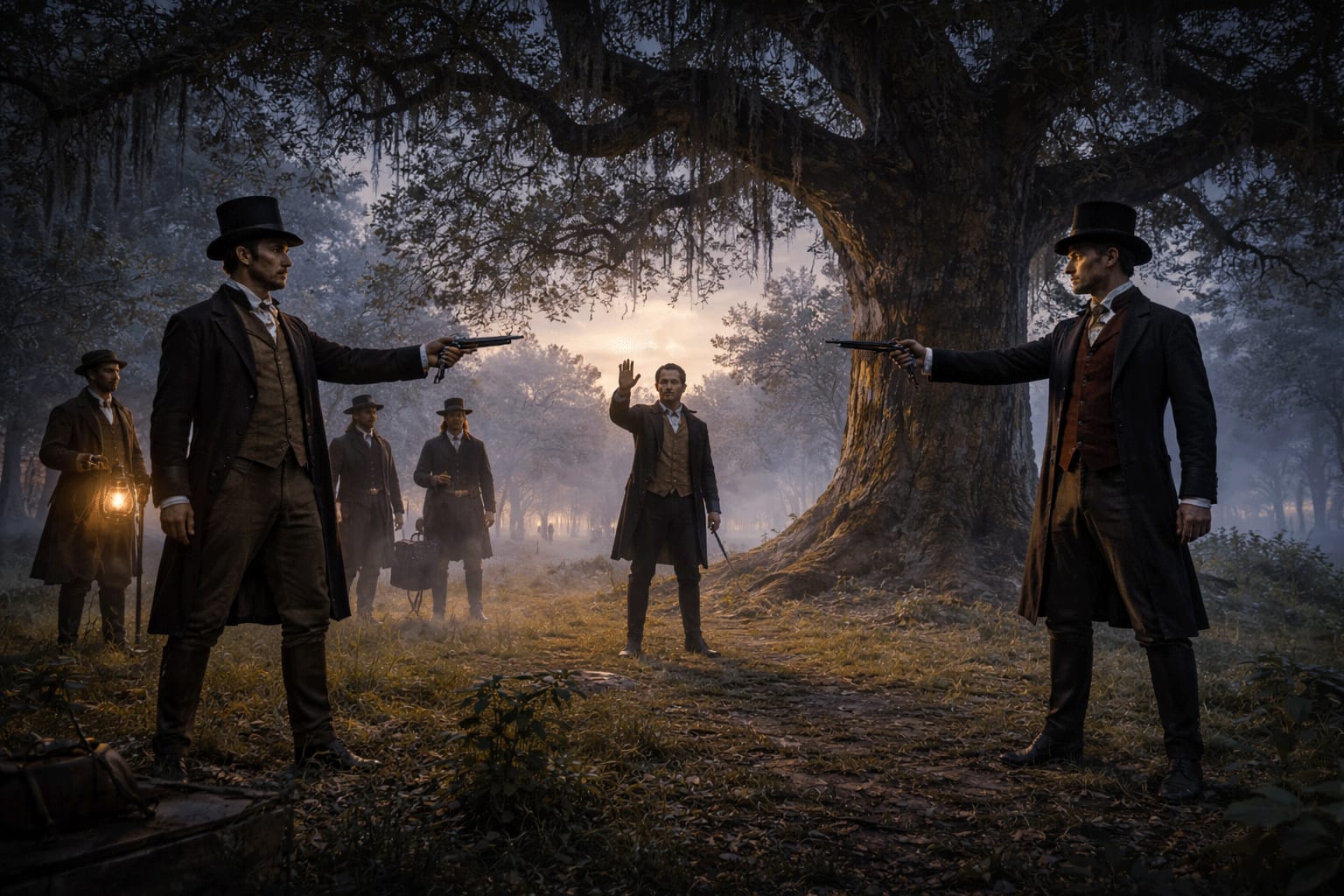
A City Built on the Code of Honor
Charleston, South Carolina has always been a city obsessed with reputation. From its founding in 1670, the planter aristocracy that built the city modeled itself on the English gentry, and with that came a rigid code of personal honor that governed nearly every aspect of public life. A man's word was his bond. His reputation was his currency. And if someone questioned either, there was one accepted way to settle the matter: a duel.
The Code Duello, the formal set of rules governing duels, was imported to Charleston from Europe and embraced with an enthusiasm that would have surprised even the French and Irish gentlemen who wrote it. In Charleston, dueling was not the act of hotheads and criminals. It was the province of lawyers, politicians, planters, and military officers, the most educated and powerful men in the colony and, later, the state. They dueled over insults, over women, over business deals, over political disagreements, and sometimes over slights so trivial that the original offense was forgotten long before the pistols were loaded.
Alongside this culture of private violence ran a parallel tradition of public violence: execution. Charleston's colonial and antebellum courts handed down death sentences with a frequency that shocks modern sensibilities. Pirates, murderers, enslaved people accused of insurrection, soldiers convicted of treason, all met their end on public gallows erected in full view of the citizenry. These executions were not hidden. They were events, attended by hundreds and sometimes thousands of spectators, designed to demonstrate the power of the law and the consequences of defying it.
Together, dueling and public execution defined the boundaries of life and death in Charleston for over two hundred years. The men who participated in both, whether holding a pistol or standing on a scaffold, left behind a legacy of violence that the city has never fully reckoned with. And if the stories are true, some of them never left at all.
The Code Duello in Charleston
The rules of dueling were precise, elaborate, and taken with deadly seriousness. When a gentleman felt his honor had been insulted, he issued a formal challenge, usually delivered in writing by a trusted friend who served as his "second." The challenged party could apologize, which sometimes ended the matter, or accept, which set the machinery of the duel in motion.
Seconds negotiated the terms: the weapon, usually smoothbore flint-lock pistols; the distance, typically ten paces; the time, almost always dawn; and the location, a secluded spot outside the city limits where the law was less likely to intervene. Both men were expected to appear sober, properly dressed, and prepared to die. A physician was customarily present, though his services were often rendered useless by the nature of the wounds.
Charleston's dueling culture reached its peak in the late 18th and early 19th centuries, a period when the city was one of the wealthiest in North America and its ruling class was fiercely protective of its social standing. Estimates suggest that between the Revolution and the Civil War, hundreds of duels were fought in and around Charleston. The actual number is impossible to know because many went unrecorded, particularly those that ended without a fatality.
The most popular dueling grounds were located just outside the city, on the islands and necks of land surrounding the peninsula. Charleston Neck, the strip of land connecting the peninsula to the mainland, was a favored spot. So were various clearings on James Island and Johns Island. These locations offered privacy and, critically, lay outside the jurisdiction of the Charleston city authorities, who were technically obligated to prosecute dueling but rarely did so with any enthusiasm.
Blood on the Field of Honor
Charleston's dueling history is studded with names that shaped American history. In 1788, Christopher Gadsden, the fiery patriot who designed the "Don't Tread on Me" flag and helped lead South Carolina through the Revolution, fought a duel with General Robert Howe at the age of sixty-four. Both men fired and missed, and honor was declared satisfied. Gadsden survived to die peacefully in his bed, but many of his contemporaries were not so fortunate.
Percy Drayton and Thomas Grimke, two of Charleston's most prominent citizens, met in a duel in 1786 over a political dispute. Grimke was killed, and Drayton carried the weight of that death for the rest of his life. The tragedy was compounded by the fact that the two men had been friends, a common and agonizing feature of Charleston's dueling culture.
Perhaps no Charleston duel captured the public imagination like the 1832 affair between Colonel William Ransom Davis and an officer named Captain James Carson. The men exchanged shots at close range on the outskirts of the city. Carson fell dead. Davis, wracked with guilt, reportedly visited Carson's grave for years afterward and was said to have been haunted by the encounter in ways that went beyond mere regret.
The culture extended far beyond the famous names. Young men fresh out of college fought over card games. Lawyers dueled over courtroom insults. Newspaper editors, who were frequent targets, sometimes fought multiple duels in a single year. The casualty count climbed steadily, and Charleston's churchyards filled with men who had died not in war or from disease, but from a lead ball fired by a friend or neighbor standing ten paces away at sunrise.
South Carolina was one of the last states to outlaw dueling, and even after the laws were passed, enforcement was lax. It was not until the aftermath of the Civil War, when the planter aristocracy that had sustained the tradition was broken, that dueling in Charleston finally died out. But by then, generations of blood had already soaked into the soil.
The Public Gallows
If dueling was the way Charleston's elite settled their private grievances, public execution was the way the city settled its public ones. From the colonial era through the mid-19th century, hangings were carried out in full public view, and they drew enormous crowds.
The locations shifted over the years. In the early colonial period, executions took place near the waterfront, often at White Point, where the famous mass hangings of pirates in 1718 sent a bloody message to anyone who threatened Charleston's commerce. Later, the gallows were erected at various locations around the city, including near the Old City Jail on Magazine Street and at public squares where crowds could gather to witness the spectacle.
The crimes that warranted execution ranged from murder and piracy to arson, counterfeiting, and, most devastatingly, enslaved people accused of planning rebellion. After the Denmark Vesey conspiracy was uncovered in 1822, thirty-five men were sentenced to death. The hangings were carried out in groups over several weeks that summer, and the bodies of the executed were turned over to the Medical Society for dissection, a final indignity that denied them even the dignity of a proper burial.
Public executions were intended to be deterrents, but they were also entertainment. Vendors sold food and drink to the crowds. Families brought children. Newspapers printed detailed accounts of the condemned person's behavior on the scaffold, noting whether they showed courage, fear, defiance, or repentance. The spectacle of death was woven into the fabric of Charleston's public life in a way that is almost impossible for modern sensibilities to comprehend.
The execution of Lavinia Fisher in 1820 was one of the most sensational events in the city's history, drawing a massive crowd to watch the first woman hanged in Charleston. Her defiance on the scaffold, her refusal to pray, and her famous last words became instant legend. But she was only one of hundreds who met their end on Charleston's gallows over the course of two centuries.
The Haunted Legacy of Honor and Death
Charleston's long history of dueling and public execution has left a paranormal footprint that stretches across the city. The locations where men bled out on the field of honor and where the condemned drew their last breath are among the most reliably haunted places in the Lowcountry.
The Dueling Grounds
The areas that once served as Charleston's informal dueling grounds have long been associated with unexplained phenomena. Residents and visitors near the old Charleston Neck have reported hearing what sounds like distant gunshots in the early morning hours, always around dawn, when no source can be identified. Others have described seeing brief, flickering figures standing face to face in open spaces, visible for only a moment before disappearing.
Paranormal investigators theorize that the intense emotional energy of a duel, two men facing the very real possibility of death, consumed by fear, adrenaline, and rage, creates the kind of psychic imprint that can linger for centuries. The repetitive nature of the violence, hundreds of duels fought in the same general locations over decades, may have amplified this effect, layering trauma upon trauma until the ground itself seems to hold a charge.
Washington Square & the Hanging Tree
Washington Square, the small park adjacent to City Hall, carries a particularly dark reputation. During the colonial period, the live oak trees in and around this area are said to have served as impromptu gallows for public hangings. Whether formal executions or extrajudicial lynchings, the trees bore the weight of the condemned, and the ground beneath them received the bodies.
Visitors to Washington Square after dark have reported seeing the shadowy outline of a figure hanging from the branches of the oldest oak, visible for a moment before vanishing. Others have described a feeling of crushing heaviness and dread that descends without warning as they pass through the park. Paranormal teams have recorded EVPs in the square that contain what appear to be gasping sounds and fragments of spoken words that do not match any identifiable source.
The Old City Jail
The Old City Jail on Magazine Street was the last stop for many of those condemned to die in Charleston. Built in 1802, the jail held everyone from common criminals to Civil War prisoners, and its proximity to the execution grounds meant that the condemned could sometimes hear the gallows being constructed from their cells.
The jail is widely considered one of the most haunted buildings in America. Visitors, staff, and paranormal investigators have reported a staggering range of activity: shadow figures moving through the empty corridors, the sound of chains dragging across stone floors, sudden drops in temperature, physical sensations of being touched or shoved, and apparitions that appear solid enough to be mistaken for living people before vanishing into walls. The energy of the Old City Jail seems to be a concentrated distillation of every desperate emotion that passed through its doors over nearly two centuries of operation.
Circular Churchyard
The Circular Church Graveyard, one of Charleston's oldest burial grounds, holds the remains of many who were connected to the city's culture of violence, both the duelists who survived and the families of those who did not. The churchyard has been a source of ghost sightings for generations. Visitors have reported glowing lights moving between the headstones, the sound of weeping where no mourner stands, and the unmistakable sensation of being watched from among the graves. Some have claimed to see a figure in period clothing standing motionless near the church wall, staring outward as if waiting for something that never arrives.
The Weight of All That Blood
Dueling and public execution were not aberrations in Charleston's history. They were central to it. The culture of honor that drove men to kill each other at dawn was the same culture that built the grand houses on the Battery and filled the pews of St. Michael's Church on Sunday morning. The public gallows that entertained crowds on execution day were erected by the same government that built the Exchange Building and hosted elegant balls in its great hall. Violence and refinement existed side by side in Charleston for centuries, and the city never fully separated the two.
This is what makes Charleston's hauntings so particular. The ghosts here are not the product of a single catastrophe or a single villain. They are the accumulated residue of a society that normalized killing as a matter of course, that treated death as both a private affair of honor and a public spectacle of justice. The sheer volume of violent death, spread across so many locations and so many generations, saturated the city in a way that few other American cities can match.
Ghost City Tours' Death and Depravity Tour takes you into the dark heart of this history. This adults-only tour does not shy away from the uncomfortable truths about Charleston's past. It visits the places where blood was spilled, where lives were taken in the name of honor and justice, and where the spirits of those who died may still linger. It is not a tour for the faint of heart, but it is a tour that tells the truth about a city that has always been more complicated, and more haunted, than its beautiful facade suggests.
Face the Ghosts of Charleston's Darkest Traditions
The dueling grounds may be overgrown and the gallows long gone, but the ghosts of Charleston's violent past are not so easily erased. If you are ready to walk the streets where men fought and died for honor, and stand in the places where the condemned met their fate, join Ghost City Tours on the Death and Depravity Tour or the Ghosts of Liberty Tour and discover the haunted legacy that Charleston's polite society would rather you not know about.