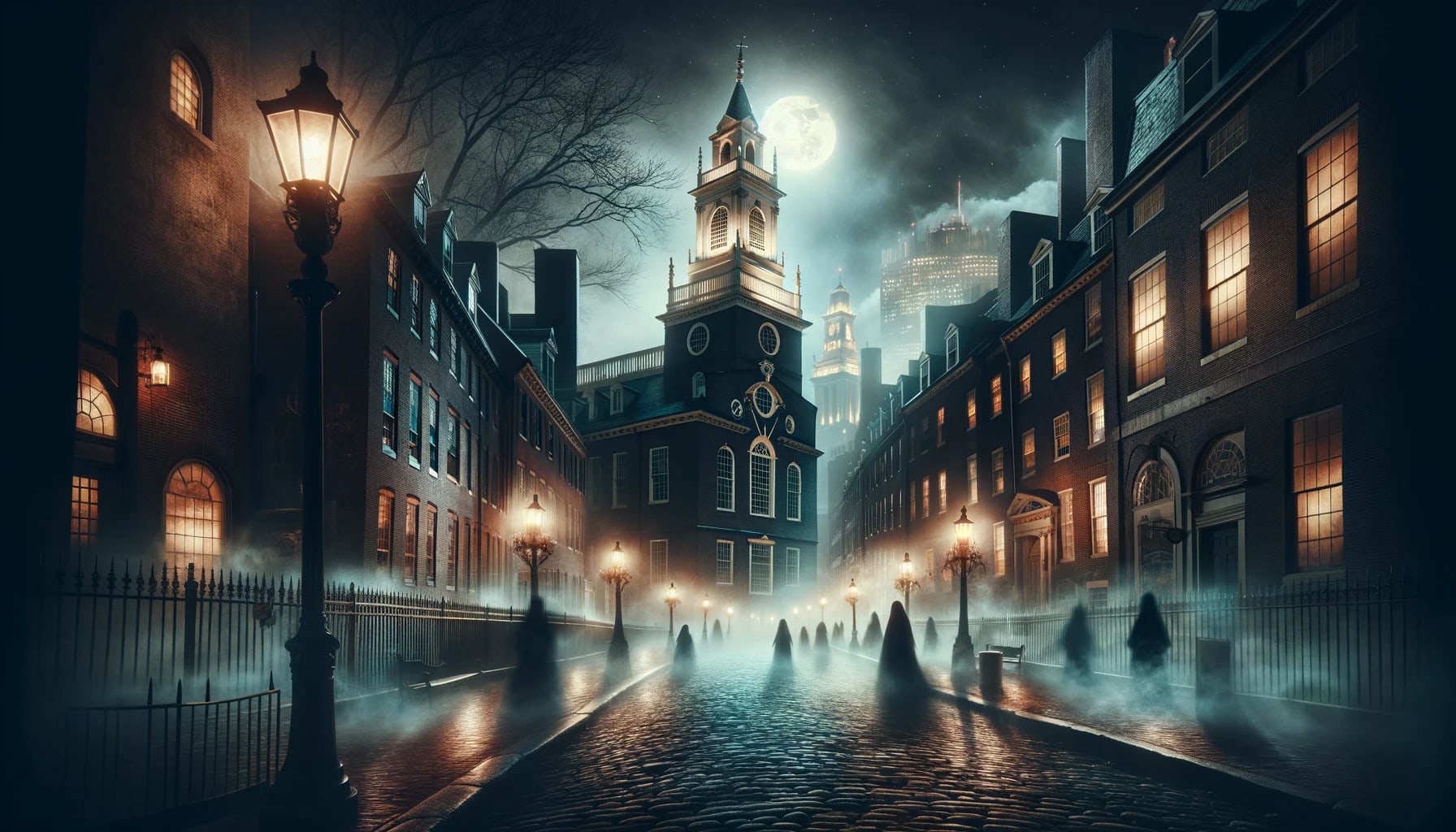
A City Built on Death and Survival
Boston was not built peacefully. It was built through struggle, starvation, disease, and death on a scale that most modern visitors cannot fathom.
When the Puritans arrived on the Shawmut Peninsula in 1630, they stepped into a landscape that had already been shaped by catastrophe. European diseases had swept through the indigenous population years before permanent settlement, leaving behind empty villages and unburied dead. The colonists who established Boston inherited a land marked by loss before they even broke ground.
The first winters were devastating. The settlers were unprepared for the harshness of New England weather, and starvation, exposure, and disease claimed lives at a staggering rate. Those who survived did so through sheer determination, burying their dead in shallow graves along the edges of the settlement and pressing forward because there was no alternative.
Smallpox arrived early and returned often. The epidemic of 1721 infected nearly half of Boston's population. The epidemic of 1752 was so severe that mass inoculation campaigns were attempted — controversial measures that divided the city and failed to prevent widespread death. The bodies accumulated in Boston's burial grounds faster than the ground could absorb them.
Public executions were a regular feature of early Boston life. The Puritans administered justice with an iron hand, and the gallows on Boston Common saw hangings for offenses that ranged from murder to witchcraft to piracy. The bodies of the executed were sometimes left on display as warnings. Mary Dyer, a Quaker who defied the Puritan ban on her faith, was hanged on Boston Common in 1660 — a death that still resonates in the city's collective memory and, some say, in the park itself after dark.
Death in early Boston was not an occasional tragedy. It was a constant companion, woven into the fabric of daily life in ways that modern cities have long since hidden behind hospitals and funeral homes. Boston's earliest residents lived alongside death in a way that left an imprint on the city that has never fully faded.

Granary Burying Ground
One of Boston's oldest and most famous burial grounds, the Granary holds the remains of Paul Revere, Samuel Adams, and thousands of colonial-era Bostonians. Visitors report unexplained phenomena among the weathered headstones.
Read More
King's Chapel Burying Ground
Boston's oldest cemetery, dating to 1630, holds the remains of the city's earliest settlers. The overcrowded burial ground is associated with ghost sightings and unexplained sounds reported for generations.
Read More
Copp's Hill Burying Ground
Overlooking the harbor from the North End, Copp's Hill has served as a burial ground since 1659. British soldiers used its headstones for target practice during the Revolution, and paranormal activity has been reported here for centuries.
Read MoreThe Burial Grounds Beneath Boston
Boston is literally built on its dead.
The city's three most famous colonial burial grounds — the Granary Burying Ground, King's Chapel Burying Ground, and Copp's Hill Burying Ground — hold thousands of bodies in spaces that were never designed to accommodate that many dead. The burial grounds were established in the 1600s when Boston was a small colonial settlement. As the city grew, the cemeteries did not. Bodies were stacked on top of bodies. Graves were reused. Headstones were moved to make room for new burials, severing the connection between the markers and the remains they were meant to identify.
But the three famous burial grounds are only part of the story. Boston's expansion over the centuries involved filling in marshland, leveling hills, and building over areas that had once been used for burials — both official and unofficial. Construction projects throughout Boston's history have unearthed human remains in locations far from any known cemetery, evidence of the emergency burials that took place during epidemics and the informal interments of the city's poorest residents.
The psychological weight of this is significant. Boston's residents have always known, on some level, that the ground beneath their feet holds more than dirt and rock. The burial grounds that remain visible are reminders of the thousands of dead who rest in marked graves. The remains that have been discovered — and the many more that almost certainly remain undiscovered — beneath Boston's streets, buildings, and parks represent a city that grew over its dead rather than around them.
If anywhere in America should be haunted, it is Boston. The sheer density of human remains beneath the city, combined with the violent and traumatic circumstances of many of those deaths, has created conditions that paranormal researchers consider ideal for supernatural activity. The dead are not gone. They are underfoot, and according to those who have experienced Boston's hauntings firsthand, they are not at rest.
The American Revolution Never Left
Boston is soaked in unresolved conflict, and nowhere is that more apparent than in the legacy of the American Revolution.
The events that ignited the Revolution did not happen in a vacuum. They happened on specific streets, in specific buildings, and to specific people whose deaths were sudden, violent, and politically charged in ways that guaranteed the emotional energy of those moments would never fully dissipate.
The Boston Massacre of March 5, 1770, left five colonists dead on King Street — now State Street — in front of the Old State House. The killings were not a battle. They were a confused, terrifying confrontation between armed British soldiers and an angry crowd that escalated in seconds. Crispus Attucks, the first to fall, became a symbol of American resistance, but in the immediate aftermath, the dead were simply dead — victims of a moment of chaos that no one had planned and no one could take back.
The British occupation of Boston that followed the Massacre and the events leading to the Revolution transformed the city into a military camp. Soldiers were quartered in homes and public buildings. Boston Common became a British military staging ground, and the Common's long history as a place of public execution took on a new dimension as tensions between soldiers and civilians produced confrontations, assaults, and deaths that went largely unrecorded.
Faneuil Hall, known as the "Cradle of Liberty," hosted the impassioned speeches and heated debates that pushed the colonies toward independence. The emotional intensity of those gatherings — men arguing for revolution while knowing that failure meant the gallows — left an imprint that visitors and staff report sensing to this day. Unexplained footsteps, disembodied voices, and the feeling of being watched in empty rooms have been reported at Faneuil Hall for generations.
The Revolution produced casualties on both sides, and many of those casualties were buried hastily in and around Boston without the ceremonies or markers that might have provided closure. The soldiers who died at Bunker Hill, the civilians who perished during the siege, and the prisoners who succumbed to disease and neglect — their stories did not end with death. In a city where the buildings and streets where they fell are still standing, their presence is felt by those who know where to look. Learn more about the Revolutionary War ghosts that still walk Boston's streets.

Boston Common
America's oldest public park has served as a cattle pasture, military camp, and public execution ground. The Common's long history of hangings, British occupation, and burial has made it one of Boston's most haunted locations.
Read More
Faneuil Hall
The 'Cradle of Liberty' where revolutionary speeches ignited a nation. Staff and visitors have long reported unexplained footsteps, voices, and the unmistakable feeling of being watched inside its historic walls.
Read MoreTaverns, Revolution, and Violence
Boston's taverns were not just places to drink. They were the nerve centers of a revolution — volatile, emotional environments where alliances were forged, conspiracies were hatched, and violence was never far from the surface.
The Green Dragon Tavern on Union Street earned its place in history as the headquarters of the Sons of Liberty and the meeting place where the Boston Tea Party was planned. Paul Revere, Samuel Adams, and John Hancock gathered in its upper rooms to plot acts of defiance that they knew could cost them their lives. The emotional intensity of those meetings — treason punishable by hanging, discussed over pints of ale — is difficult to overstate. The original tavern was demolished in 1854, but the site has never been free of the energy that accumulated within its walls during the most dangerous years of the American Revolution.
The Bell in Hand Tavern, established in 1795, is the oldest continuously operating tavern in the United States. Its founder, Jimmy Wilson, was Boston's last town crier, and the tavern he built became a gathering place for a city still processing the trauma of revolution and its aftermath. The Bell in Hand has accumulated over two centuries of stories, and the paranormal activity reported there — glasses moving on their own, unexplained cold spots, the sound of conversations in empty rooms — suggests that not all of its former patrons have moved on.
The Warren Tavern in Charlestown, named for Dr. Joseph Warren, the patriot leader killed at the Battle of Bunker Hill, was one of the first buildings erected after the British burned Charlestown to the ground in 1775. George Washington and Paul Revere both drank there. The tavern's connection to the Revolution and to the men who fought and died for it has made it a focal point of paranormal reports, including sightings of figures in colonial-era clothing and unexplained disturbances that staff have grown accustomed to over the years.
Boston's colonial taverns were places where alcohol fueled arguments, alliances, betrayals, and occasionally violence. The emotional residue of those encounters — revolutionary fervor mixed with fear, anger, and grief — is exactly the kind of energy that paranormal researchers believe can persist in a location long after the people who created it are gone. For guests who want to experience this history with a drink in hand, the Boston Haunted Pub Crawl visits some of the city's most spirited establishments.

The Green Dragon Tavern
Known as the 'Headquarters of the Revolution,' the Green Dragon Tavern is where the Boston Tea Party was planned and where the Sons of Liberty plotted acts of defiance against the British Crown.
Read More
Bell in Hand Tavern
The oldest continuously operating tavern in America, the Bell in Hand has accumulated over two centuries of history and persistent reports of paranormal activity.
Read More
Warren Tavern
Named for the patriot killed at Bunker Hill and frequented by George Washington and Paul Revere, the Warren Tavern is one of Charlestown's most historically significant — and reportedly haunted — buildings.
Read MoreCrime, Punishment, and Tragedy
Boston's justice system left behind an emotional residue that darkens the city to this day.
Public punishment was not merely accepted in colonial and early American Boston — it was a civic institution. The stocks, the pillory, and the whipping post stood on Boston Common as permanent fixtures, and their use was frequent enough that most Bostonians would have witnessed public punishment many times over the course of their lives. The gallows, also on the Common, dispatched convicted criminals, accused witches, religious dissenters, and pirates with a regularity that speaks to how deeply violence was embedded in the administration of justice.
The Charles Street Jail, built in 1851 and operational until 1990, stands as one of the most physically imposing reminders of Boston's carceral history. For nearly 140 years, the jail held prisoners in conditions that deteriorated steadily over the decades. By the time it closed, the Charles Street Jail had been condemned as unfit for human habitation — a designation that came too late for the generations of inmates who suffered within its granite walls. The building, now converted into the Liberty Hotel, has not shed its past. Guests and staff report encounters with presences that do not belong to the living — shadows in the corridors, unexplained sounds from the upper floors, and an atmosphere of unease that no amount of renovation has been able to eliminate.
The Great Boston Fire of 1872 destroyed 65 acres of the city's commercial district, leveling 776 buildings and killing at least 30 people in a conflagration that burned for two days. The fire started in the basement of a commercial warehouse and spread with terrifying speed through a district packed with dry goods, paper, and textiles. Firefighters were overwhelmed, and the equipment of the era was no match for the scale of the blaze. The people who died in the fire — trapped in buildings, overcome by smoke, crushed by collapsing walls — died in terror, and the area where the fire burned most intensely has been associated with paranormal reports ever since.

Haunted Hotels and Modern Encounters
The hauntings in Boston did not end when the city modernized. They evolved, moving into the hotels, restaurants, and public buildings that replaced — or were built directly on top of — the sites where Boston's darkest history unfolded.
The Omni Parker House, opened in 1855, is the longest continuously operating hotel in the United States. Its guest list reads like an American history textbook — Charles Dickens, John F. Kennedy, and Ho Chi Minh all walked its halls. But the hotel's most persistent resident may be its founder, Harvey Parker, whose ghost is said to roam the upper floors and the tenth-floor annex where he spent his final years. Guests report the smell of cigar smoke in non-smoking rooms, doors that open and close on their own, and the unmistakable presence of someone standing beside the bed in the middle of the night.
The Fairmont Copley Plaza, built in 1912 on the site where the original Museum of Fine Arts once stood, has accumulated its own collection of ghost stories over more than a century of operation. Staff members have reported encountering a woman in Victorian-era clothing on the upper floors who vanishes when approached. Unexplained temperature drops in specific rooms, electronic devices that malfunction without explanation, and the sound of a piano playing in empty ballrooms are among the recurring reports.
The Bostonian Hotel, situated near Faneuil Hall and the site of the Boston Massacre, occupies ground that has been central to Boston's history since the colonial era. The proximity to so many historically significant — and historically violent — locations has made the hotel a hotspot for paranormal reports. Guests have described hearing voices speaking in accents that do not match the modern era and seeing figures in period clothing who disappear through walls.
These are not isolated stories. Boston's hotels sit on ground that has been continuously occupied for nearly four centuries, and the buildings themselves have absorbed decades of human experience. The past does not stay buried in a city this old. It surfaces in the hallways, the stairwells, and the rooms where guests lie awake at night, aware that something in the room with them is not quite right.

Omni Parker House
America's longest continuously operating hotel, the Omni Parker House is known for ghost sightings on its upper floors, including the spirit of founder Harvey Parker.
Read More
Fairmont Copley Plaza
Built in 1912, the Fairmont Copley Plaza has been the site of recurring paranormal reports including a Victorian-era apparition, unexplained temperature drops, and phantom piano music.
Read More
The Bostonian Hotel
Situated near the site of the Boston Massacre and Faneuil Hall, the Bostonian Hotel sits on some of the most historically charged ground in America.
Read MoreWhy People Still Experience Ghosts in Boston
The question is not whether people experience ghosts in Boston. They do — consistently, across centuries, in locations scattered throughout the city. The question is why.
Paranormal researchers generally describe two types of hauntings. Residual hauntings are like recordings — they replay the same events, the same movements, the same sounds, without any awareness of or interaction with the living. A figure walking down a hallway at the same time every night, footsteps that follow the same path, a scream that echoes through a building on the anniversary of a tragedy — these are residual hauntings, and they are among the most commonly reported phenomena in Boston's oldest buildings.
Intelligent hauntings involve entities that seem aware of the living and respond to them. Doors opening when someone approaches, objects moving in response to questions, voices that answer when spoken to — these suggest a presence that is not simply replaying a moment from the past but actively engaging with the present.
The emotional imprint theory offers one framework for understanding why historic cities like Boston produce so many reports. The theory suggests that extreme emotional events — terror, grief, rage, despair — can leave an imprint on a physical location that persists long after the people who experienced those emotions are gone. If this theory has merit, then Boston, with its centuries of war, plague, execution, fire, and suffering, should be one of the most emotionally charged cities in America. And by all accounts, it is.
Our guides have spoken to countless locals, historians, and longtime residents who describe experiences they cannot explain — footsteps in empty rooms, figures glimpsed in peripheral vision, the overwhelming sense of a presence in buildings that should be empty. Many of these people are reluctant to speak openly, especially in historic or sacred locations where admitting to a ghostly encounter feels like inviting ridicule. But the consistency of their reports, across decades and across locations, is difficult to dismiss.
Boston does not need to manufacture its hauntings. The city's history has done that work already.
Experience Haunted Boston Yourself
Reading about Boston's haunted history is one thing. Walking the streets where it happened — standing in the burial grounds, passing through the tavern doorways, feeling the weight of four centuries pressing down on the cobblestones beneath your feet — is something else entirely.
Ghost City Tours offers three distinct ways to experience haunted Boston, each designed for a different kind of guest:
The Ghosts of Boston Tour is the perfect introduction to haunted Boston for visitors of all ages. This family-friendly walking tour covers the city's most famous haunted locations, from the burial grounds to the sites of Revolutionary War violence, with storytelling that balances historical accuracy with genuine atmosphere. It is the tour that has earned Ghost City Tours its reputation as the highest-rated ghost tour company in Boston.
The Death & Dying Tour goes darker. Designed for adults who want the unvarnished truth about Boston's most disturbing history, this tour explores the murders, executions, epidemics, and tragedies that the family-friendly tour only hints at. The stories are real, the locations are real, and the guides who lead this tour do not hold back.
The Haunted Pub Crawl combines Boston's ghost stories with its legendary tavern culture. For guests 21 and over, this tour visits haunted bars and historic pubs where revolutionaries once plotted and where the paranormal activity reported by staff and patrons has become part of the establishments' identities. It is the most social of our Boston tours and the perfect way to experience the city's haunted side with a drink in hand.
Whichever tour you choose, you will walk away with a deeper understanding of why Boston is one of the most haunted cities in America — and why the ghosts of this city have never left.
Frequently Asked Questions
Is Boston considered one of the most haunted cities in America?
Yes. Boston's haunted reputation is built on nearly four centuries of documented tragedy, including colonial-era epidemics, Revolutionary War violence, public executions, devastating fires, and the sheer density of human remains buried beneath the city's streets. The preservation of Boston's historic buildings and burial grounds means that the locations where these events occurred are still standing, and paranormal activity continues to be reported across the city.
What is the most haunted place in Boston?
Several locations are consistently cited. The Granary Burying Ground, which holds the remains of Paul Revere and Samuel Adams, is one of the most frequently reported. The Omni Parker House hotel, Boston Common, and the former Charles Street Jail — now the Liberty Hotel — are also known for persistent paranormal activity. The taverns of colonial Boston, including the Green Dragon Tavern site and the Bell in Hand Tavern, generate regular reports as well.
Why are there so many ghost stories in Boston?
Boston's ghost stories are the product of nearly 400 years of concentrated trauma on a small peninsula. Smallpox epidemics, the American Revolution, public executions, catastrophic fires, and the displacement and disturbance of burial grounds over centuries of urban expansion have created conditions that paranormal researchers consider ideal for supernatural activity. The city's commitment to preserving its historic architecture means that the buildings where these events occurred remain intact.
Are Boston ghost tours scary?
Ghost City Tours focuses on real history and documented events, which means the stories are compelling and sometimes deeply unsettling, but they are not designed to produce jump scares. Boston's colonial streets, ancient burial grounds, and centuries-old buildings provide a naturally atmospheric setting that enhances the experience. Guests consistently describe the tours as fascinating, immersive, and occasionally spine-tingling.
What ghost tours does Ghost City Tours offer in Boston?
Ghost City Tours offers three ghost tour experiences in Boston: the Ghosts of Boston Tour for a family-friendly exploration of the city's most famous haunted locations, the Death & Dying Tour for adults seeking the darker, unvarnished history of Boston's tragedies, and the Haunted Pub Crawl for a 21+ experience combining ghost stories with visits to Boston's historic and haunted taverns.
Are Boston's burial grounds really haunted?
Boston's three most famous colonial burial grounds — the Granary Burying Ground, King's Chapel Burying Ground, and Copp's Hill Burying Ground — are among the most frequently cited locations for paranormal activity in the city. Visitors, tour guides, and nearby residents have reported apparitions, unexplained sounds, cold spots, and the feeling of being watched among the centuries-old headstones for generations.
Can you visit haunted locations in Boston?
Many of Boston's most haunted locations are publicly accessible. The burial grounds are open during daytime hours. Historic taverns like the Bell in Hand and Warren Tavern welcome guests. Hotels like the Omni Parker House and the Liberty Hotel are open to the public. Ghost City Tours offers guided walking tours that visit multiple haunted locations in a single evening, providing the historical context and ghost stories behind each stop.