Walk through downtown Baltimore and you'll pass Westminster Hall, a Gothic Revival church built in 1852. Look closer, and you'll realize something strange: the church sits on brick piers, elevated above ground level. Why? Because the builders constructed it directly over an active cemetery, creating a unique catacomb structure where the dead lie beneath the living. Today, Westminster Burial Grounds is one of Baltimore's most historically significant sites - and according to countless witnesses, one of its most actively haunted.
Fast Facts
- Established in 1786 as the First Presbyterian Church burial ground
- Contains approximately 1,000 marked graves and countless unmarked burials
- Edgar Allan Poe buried here in 1849, reburied in current location in 1875
- Westminster Hall church built over the cemetery in 1852, creating catacombs
- Now a historic site maintained by the University of Maryland
- Famous burials include generals, mayors, and prominent Baltimore families
- Primary ghosts: Edgar Tuttle the gravedigger, Edgar Allan Poe, various Civil War soldiers
- Catacombs accessible through guided tours
- Listed on the National Register of Historic Places
The Birth of Westminster - Baltimore's First Burying Ground
When the First Presbyterian Church purchased the land in 1786, Baltimore was still a young city, barely more than a town. The congregation needed a burial ground, and this plot on the western edge of the developed area seemed perfect - far enough from residences to avoid complaints, close enough to remain accessible.
The cemetery quickly became the preferred burial site for Baltimore's elite. In an era when grave locations reflected social status, Westminster became the final resting place for merchants, military officers, politicians, and prominent families who shaped Baltimore's early history. The cemetery's location on a hill provided good drainage, and its distance from the harbor made it healthier than burial grounds closer to the waterfront.
But the cemetery's most distinctive feature wouldn't arrive until decades later, when the congregation decided to build a new church - right on top of their burial ground.
Building a Church Over the Dead
By the 1850s, Baltimore had grown dramatically. What had once been the western edge of the city was now centrally located, and the First Presbyterian Church congregation wanted a new, grander house of worship. But they faced a problem: their most valuable real estate was already occupied by hundreds of graves.
The solution was architecturally unique and, some would say, spiritually questionable. In 1852, architect Robert Cary Long Jr. designed Westminster Hall to be built directly over the existing cemetery. The church would sit on brick piers and arches, elevating the sanctuary five feet above ground level. The dead would remain in place, now enclosed in a network of catacombs beneath the church floor.
Construction proceeded despite protests from some families who felt the plan was disrespectful to the deceased. Workers reported feeling watched as they built the brick piers between gravestones, and several claimed to see figures among the graves after dark - figures that vanished when approached.
The resulting structure created something found nowhere else in America: a fully functional church literally hovering over a graveyard, with the dead in permanent residence in the catacombs below. Whether the spirits appreciated this arrangement remains a matter of debate.
The Famous Dead of Westminster
Westminster Burial Grounds serves as the final resting place for numerous notable Baltimoreans, including Revolutionary War officers, War of 1812 heroes, and civic leaders. General James McHenry, for whom Fort McHenry is named, was originally buried here (though later moved). Fifteen generals from various conflicts rest in Westminster's soil.
But one grave draws more visitors than all others combined: Edgar Allan Poe, America's master of Gothic horror, was originally buried in an unmarked grave in Westminster's back corner in 1849. His funeral was hasty and poorly attended, reflecting both his troubled life and Baltimore's ambivalence toward its literary son.
In 1875, schoolteacher Sara Sigourney Rice raised funds to move Poe to a more prominent location near the cemetery's gate and erect a proper monument. The reburial ceremony drew significant attention, but workers who moved Poe's remains reported a disturbing discovery: the coffin had deteriorated, and when they looked inside, they found Poe's body had somehow turned over in the grave, face down, as if he'd been trying to claw his way out.
This unsettling detail added fuel to theories that Poe had been buried alive, one of his own greatest fears. Whether true or legend, the story has contributed to the sense that something isn't quite right about Poe's grave - a feeling many visitors report to this day.
The Poe Toaster - Mystery and Tradition
For nearly 60 years, from 1949 to 2009, a mysterious figure dressed in black visited Poe's grave every January 19th (Poe's birthday). The "Poe Toaster" would arrive in the early morning hours, leave three roses and a half-bottle of cognac on the grave, toast Poe's memory, and disappear into the night.
No one ever discovered the Toaster's identity, though the tradition clearly passed from one person to another over the decades (notes left at the grave referenced events the original Toaster couldn't have witnessed). The tradition ended in 2009 when the Toaster failed to appear. Various attempts to revive it have occurred, but the original mystery remains unsolved.
Security guards and witnesses who observed the Toaster from a distance reported something curious: the figure seemed to flicker and fade in the darkness, sometimes appearing solid and other times translucent. Camera footage from various attempts to capture the Toaster often showed anomalies - unexplained shadows, orbs of light, and in some cases, the figure seemed to simply vanish between one frame and the next rather than walking away.
Some believe the Toaster was a devoted fan maintaining a tradition. Others wonder if the Toaster was himself a ghost, a spiritual guardian paying respects to the master of macabre from beyond the grave.
The Civil War Years and Aftermath
Westminster Burial Grounds saw significant activity during the Civil War. Baltimore, a border city with divided loyalties, experienced intense political tension throughout the conflict. Westminster became a burial site for Union soldiers who died at local hospitals, though many were later moved to national cemeteries.
The catacombs beneath Westminster Hall allegedly served various purposes during the war, though documentation is scarce. Local legend claims they were used to hide escaped slaves on the Underground Railroad, to store ammunition, and even to secretly bury Confederate sympathizers who couldn't be given public burials in the hostile political climate.
After the war, several families retrieved their soldier dead from temporary burials and interred them at Westminster. These reburials were often hasty and poorly documented, leading to confusion about who lies where in certain sections of the cemetery. Some grave markers don't match the bodies beneath them, and entire sections contain unidentified remains.
This confusion has paranormal implications: spirits who don't know where they're buried, or whose markers bear wrong names, might be more likely to wander, searching for their proper resting place or simply confused about why they can't find their own graves.
Decline, Abandonment, and Resurrection
By the early 20th century, Westminster Presbyterian Church had moved to a new location, and the old church building fell into disuse. The cemetery, no longer actively managed by a congregation, began to deteriorate. Tombstones toppled, vegetation overgrew graves, and the catacombs became a haven for vagrants and urban explorers.
For decades, Westminster existed in a limbo state - too historically significant to be completely abandoned, but without the resources for proper maintenance. The catacombs became notorious as a gathering place for Baltimore's underground scene, hosting everything from illegal parties to occult rituals.
People who explored Westminster during these years report intense paranormal experiences: shadow figures in the catacombs, disembodied voices, the sensation of being touched by unseen hands, and an overwhelming feeling of being unwelcome. Some explorers fled in terror, swearing they were chased by something they couldn't see but could definitely feel.
In 1977, the University of Maryland Law School, whose campus had grown around Westminster, began restoration efforts. Today, Westminster is maintained as a historic site, with tours offering access to the catacombs and grave sites. But restoration hasn't quieted the spirits - if anything, the increased human activity seems to have awakened entities that had lain dormant during the abandonment years.
Edgar Tuttle - The Phantom Gravedigger
Westminster's most frequently encountered ghost is Edgar Tuttle, the cemetery's longest-serving gravedigger, who worked at Westminster from 1885 until his death in 1923. Tuttle took immense pride in his work, treating each grave with meticulous care and maintaining the grounds with devotion that bordered on obsession. He lived in a small house just outside the cemetery gates and would often be found tending graves well after dark, working by lantern light to ensure every stone stood straight and every plot remained dignified. When Tuttle died at age 77, he was buried in Westminster - but his work, it seems, continues.
Tuttle's Life and Dedication
Edgar Tuttle came to Baltimore from rural Maryland in 1882, a young man seeking work in the growing city. He found employment at Westminster as an assistant gravedigger, and the job suited him perfectly. Tuttle was a quiet, methodical man who preferred the company of the dead to the living. He never married, had few friends, and seemed content to spend his days among the tombstones.
Over nearly four decades, Tuttle dug hundreds of graves and maintained thousands of plots. He developed an encyclopedic knowledge of Westminster's layout, knowing not just where every marked grave lay but also the locations of unmarked burials, disputed family plots, and graves whose markers had been lost to time.
Coworkers remember Tuttle as peculiar but devoted. He talked to the graves as he worked, addressing the deceased by name and updating them on cemetery news: "Mrs. Pemberton, we've got a new neighbor for you today... Mr. Harrison, your grandson was by yesterday to pay respects." He seemed to genuinely believe the dead could hear him - or perhaps he knew something others didn't.
In 1923, Tuttle collapsed while digging a grave on a humid August afternoon. He died before reaching the hospital. His funeral was small but well-attended by families whose loved ones Tuttle had buried with such care. He was interred in Westminster's northeast section, in a modest grave he had purchased years earlier and prepared himself, ensuring the measurements were exact and the location well-drained.
But death didn't end Edgar Tuttle's dedication to Westminster Burial Grounds.
First Sightings - The Gravedigger Who Won't Rest
The first reported sighting of Tuttle's ghost came less than a month after his burial. The cemetery's new gravedigger, a young man named Patrick Sullivan, arrived early one morning to find fresh dirt piled beside a grave that had sunken slightly - a common occurrence as coffins settle and soil compacts. Sullivan assumed a family member had noticed the depression and complained to management, but when he checked the records, no complaint had been filed.
The next morning, Sullivan found another grave repaired, this time with the sod carefully replaced and tamped down, work that would have taken hours. Sullivan mentioned this to the cemetery superintendent, who had no explanation. That night, Sullivan decided to watch the cemetery from a distance to see who was doing the unauthorized maintenance.
Just after midnight, Sullivan saw a figure emerge from the direction of Tuttle's grave. The man - and Sullivan was certain it was a man, not a trick of light - carried a lantern and walked directly to a sunken grave near the catacombs. The figure set down the lantern and began working, moving with practiced efficiency that reminded Sullivan eerily of stories he'd heard about old Edgar Tuttle.
Sullivan approached to confront the trespasser. As he got closer, he could see the figure more clearly: an elderly man in work clothes, methodically filling the grave depression with soil from a wheelbarrow that Sullivan hadn't seen him bring. Sullivan called out, asking what the man thought he was doing.
The figure straightened up, turned toward Sullivan, and in that moment, the young gravedigger saw the face clearly in the lantern light. It was Edgar Tuttle - Sullivan recognized him from a photograph in the superintendent's office. But Edgar Tuttle had been dead for a month.
Sullivan ran. When he returned the next morning with the superintendent and a police officer, they found the grave perfectly repaired, the work completed with professional skill. But there was no wheelbarrow, no tools, and no footprints in the soft earth except Sullivan's own from his flight the night before.
Tuttle's Routine - Patterns of a Ghost
Over the decades, numerous witnesses have encountered Edgar Tuttle's ghost, and these sightings follow consistent patterns that make them difficult to dismiss as imagination or misidentification.
Tuttle appears most frequently on foggy nights or just before dawn, times when he often worked in life. He's always seen wearing the same work clothes: dark pants, a work shirt, suspenders, and a cap. He carries an old-fashioned lantern that casts a yellowish light noticeably different from modern lighting.
Witnesses report that Tuttle seems unaware of the living. He moves through his routine as if alone, walking directly to graves that need attention - sunken plots, leaning stones, overgrown areas - and setting to work. Sometimes he's seen kneeling by a grave, appearing to pull weeds, though observers who check afterward find no evidence of his work beyond mysteriously tidied plots.
One university security guard who worked night shifts in the 1990s encountered Tuttle dozens of times. "I learned to recognize him," the guard recalled. "I'd see the lantern light moving between the stones, and I'd know it was Edgar. At first, I tried to investigate, but he'd always vanish when I got close. Eventually, I just nodded to him and let him work. He's more reliable than some living people I know."
The guard noted something particularly interesting: Tuttle only appears when there's actual work to be done. Graves that have sunken, stones that have shifted, areas where weather has caused damage - these draw Tuttle's attention. It's as if he's constantly surveying Westminster, noting problems that need fixing, and returning in death to complete tasks he can no longer finish.
Encounters with Tuttle - When the Dead Acknowledge the Living
While Tuttle usually seems oblivious to witnesses, several people report interactions suggesting he's aware of them - and perhaps still dedicated to Westminster's proper management.
In 2003, a group of college students sneaked into Westminster late at night, planning to drink beer among the tombstones and take supposedly spooky photographs. One student, drunk and disrespectful, began posing sprawled across a grave, making obscene gestures while friends photographed him.
A figure emerged from the darkness near the catacombs. The students initially assumed it was a security guard and prepared to run. But the man didn't have a flashlight, just an old-fashioned lantern, and his clothes seemed wrong for modern security.
He walked directly up to the student lying on the grave and spoke, his voice described as "hollow, like it was coming from far away": "Get off that grave. Show some respect for the dead."
The student scrambled up, suddenly sober. The figure with the lantern stared at each of them in turn, his face weathered and grim, his eyes reflecting the lantern light in a way that didn't seem quite right. Then he spoke again: "This is sacred ground. Leave. And don't come back unless you can behave with decency."
The students ran. When they looked back, the figure was gone, though they heard the sound of a shovel striking earth somewhere in the darkness behind them. All of them independently described the same man, and their description matched historical photographs of Edgar Tuttle.
Several of the students' photos showed anomalies: a dark figure standing among graves in images where none had been visible when the pictures were taken, and one photo clearly showed an elderly man with a lantern watching from behind a monument - a photo taken before they encountered Tuttle's ghost.
Other respectful visitors report different interactions. A woman who came to lay flowers on a family grave found the plot meticulously cleaned and weeded, though the cemetery's staff swore no work had been scheduled for that section. As she placed the flowers, she felt a presence beside her and heard a voice: "Your grandmother was a fine lady. I made sure she had a proper resting place." She turned to find an elderly man in old-fashioned work clothes standing there, smiling gently. He tipped his cap to her and walked away toward the catacombs. When she tried to follow to thank him, he was nowhere to be found, and security confirmed no one matching his description worked at Westminster.
The Sound of Digging in Empty Graves
Perhaps the most unnerving manifestation of Tuttle's presence is audio: the sound of digging when no one is there.
Multiple visitors, staff members, and tour guides report hearing the rhythmic sound of a shovel striking earth and lifting soil. The sound seems to come from specific locations in the cemetery, and when people investigate, they find nothing - no workers, no disturbed earth, no explanation.
What makes these incidents particularly disturbing is that the digging sounds often come from unmarked areas where old cemetery records indicate graves exist but no stones remain. It's as if Tuttle is systematically working his way through the cemetery, tending to every burial, marked or not, finishing a job that will never truly be complete.
One maintenance worker reported arriving early one morning to find fresh shovel marks in the earth near the catacombs entrance, as if someone had been digging. But the soil wasn't disturbed below the surface - the marks were there, clearly visible, but no actual digging had occurred. It was as if someone had left the impression of work without the substance, a ghost leaving traces of phantom labor.
Edgar Allan Poe - The Master Returns
It would be shocking if Edgar Allan Poe, buried in Westminster since 1849, didn't haunt the cemetery. The master of Gothic horror, who spent his career exploring themes of death, burial, and the thin line between life and death, seems an obvious candidate for restless spirit. And according to numerous witnesses, Poe's presence is very much felt at Westminster - particularly near his grave and in the catacombs he never knew in life but now seems to frequent in death.
Poe's Death and Burial - Mystery from the Start
Edgar Allan Poe died in Baltimore on October 7, 1849, under circumstances that remain mysterious. Found delirious on a Baltimore street, wearing clothes that weren't his own, Poe was taken to Washington College Hospital where he died four days later. His last words were reported as "Lord help my poor soul."
The cause of death was never definitively established. Theories range from alcoholism to rabies, from murder to "cooping" (a form of electoral fraud involving kidnapping and drugging victims to vote multiple times). Poe's medical records were lost, and his attending physician's notes were later destroyed, leaving his death shrouded in mystery.
Poe's funeral on October 8 was rushed and poorly attended. Only a handful of mourners gathered as he was buried in an unmarked grave in the back of Westminster cemetery. The service lasted mere minutes, and Poe's grave remained unmarked for years, its location gradually forgotten as cemetery records proved incomplete.
In 1875, schoolteacher Sara Sigourney Rice raised funds to move Poe to a prominent location near the cemetery gates and erect a proper monument. The reburial should have been straightforward, but workers reported disturbing discoveries that added to Poe's legend and perhaps contributed to his restless spirit.
The Reburial Discovery
When workers opened Poe's original grave in 1875, they found his coffin had deteriorated badly in the 26 years since burial. What they saw inside shocked them: Poe's body had somehow turned completely over, lying face-down in the remnants of the coffin.
The workers reported that Poe's skull and bones appeared to be in a position suggesting he'd been moving inside the coffin, and scratch marks on the inside of the coffin lid - though degraded by time - suggested frantic attempts to escape. This discovery gave credence to one of Poe's own greatest fears: being buried alive, a theme that appeared repeatedly in his stories like "The Premature Burial" and "The Fall of the House of Usher."
Whether Poe was actually buried alive or whether the body's position was due to natural settling and coffin deterioration, the discovery profoundly affected everyone present. Several workers refused to continue, and those who completed the reburial reported feeling watched and judged, as if an angry presence had been disturbed and was not pleased.
Poe's remains were placed in a new coffin and moved to the prominent grave site near the cemetery gates, where they remain today. But the question lingers: if Poe did regain consciousness in that first grave, if he did claw at the coffin lid in terror before finally dying, would that traumatic end leave an imprint strong enough to create a haunting?
Sightings Near Poe's Grave
The area around Poe's monument has been the site of numerous paranormal reports. Visitors frequently describe a sense of being watched when standing near the grave, particularly in the evening hours. Some report a sensation of profound sadness washing over them, while others feel anger or resentment, as if something nearby disapproves of their presence.
Photographs taken at Poe's grave frequently show anomalies. Orbs of light, unexplained shadows, and even what appear to be partial figures have been captured by hundreds of visitors. More disturbingly, some photos show a dark, human-shaped shadow standing behind or beside people posing at the grave - a shadow that wasn't visible when the photo was taken.
Multiple visitors report seeing a man in 19th-century clothing standing near Poe's grave, usually at dusk or after dark. The figure is described as thin, with dark hair and a mustache, wearing a dark suit typical of the 1840s. He appears to be reading the inscriptions on Poe's monument, sometimes reaching out to touch the stone as if confirming something.
When witnesses approach or try to photograph the figure, he typically turns to look directly at them - and his face, they report, is unmistakably Edgar Allan Poe, matching known photographs and portraits. The figure then either walks away toward the catacombs or simply fades from view, becoming progressively more transparent until he's gone.
One particularly detailed account comes from a literature professor visiting from New York in 2015. She arrived at Westminster around sunset specifically to see Poe's grave. As she stood reading the monument, she became aware of someone standing next to her and turned to find a man in period clothing also reading the inscription.
"I thought he was a historical reenactor or tour guide," she recalled. "He looked so real, so solid. I asked him if he knew much about Poe, and he turned to me with the saddest smile I've ever seen. He said, 'I know more about Poe than anyone living.' Then I really looked at his face, and I recognized him from pictures. I said, 'You're Edgar Allan Poe,' and he nodded once, then just... wasn't there anymore. I wasn't frightened, just sad for him. He seemed so lonely."
Poe in the Catacombs - Where the Dead Walk
While Poe died before Westminster Hall was built over the cemetery, his spirit apparently knows about the catacombs - and frequents them. Tour guides and visitors exploring the underground spaces consistently report encounters that suggest Poe's ghost walks beneath Westminster Hall.
The catacombs are atmospheric even without paranormal activity - brick archways, shadowy alcoves, tombstones visible through iron gates, the sense of being literally surrounded by the dead on all sides. But numerous people report seeing a figure in dark clothing moving through the shadows, always staying just out of clear view.
Unlike Edgar Tuttle, who seems focused on his gravekeeping tasks, Poe's presence in the catacombs feels observational, as if he's exploring a space he never knew in life but finds fascinating in death. He's often reported in the deepest sections of the catacombs, the areas farthest from sunlight, where the atmosphere is oppressive and the sense of being underground most pronounced.
One tour guide who has led hundreds of catacomb tours reports: "There's one alcove where you can feel him. Everyone feels it. The temperature drops, people get quiet without knowing why, and if you're sensitive at all, you feel watched. I've seen him there twice - just a glimpse of a man in dark clothes, standing in the shadows. Once, I heard him whisper, though I couldn't make out words. It sounded like poetry."
Visitors frequently report their electronic devices malfunctioning in certain areas of the catacombs, particularly near the section closest to Poe's current grave. Cameras drain instantly, flashlights flicker, and phones shut off despite full batteries. Recording devices often capture EVPs (electronic voice phenomena) in these areas - whispers, sighs, and occasionally what sounds like someone reciting verse in a low, rhythmic voice.
Some paranormal investigators believe Poe's spirit is drawn to the catacombs because they embody themes he explored in his writing - burial, entombment, the fear of being trapped with the dead. Others think he simply enjoys the macabre atmosphere, finally able to experience in death the Gothic spaces he imagined in life.
Poe's Message - Words from Beyond
Several psychics and sensitive individuals who have visited Poe's grave report receiving messages or impressions they believe come from Poe's spirit. While such claims are inherently unprovable, the consistency of certain themes is notable.
Multiple sensitives report that Poe wants people to know he wasn't buried alive in his first grave - that he was dead when interred. The position of his body in the coffin, they claim, was due to normal postmortem processes and coffin deterioration, not conscious movement. Poe allegedly wants this fear put to rest, as it's one of the main reasons his spirit remains active.
Other messages suggest Poe is pleased by the attention his grave receives and the fact that his work is still read and appreciated. One medium reported receiving an impression of profound gratitude that Poe died in obscurity and near-poverty but is now celebrated and remembered.
Most intriguingly, several people report impressions about Poe's death itself. The consistent message is that Poe knows how he died but chooses not to reveal it, finding the mystery fitting for an author who specialized in mysteries and Gothic tales. His death, according to these impressions, is his final story - and like his fiction, it's meant to remain unresolved, leaving readers to wonder and theorize forever.
Other Spirits of Westminster
While Edgar Tuttle and Edgar Allan Poe are Westminster's most famous ghosts, they're far from the only spirits reported in this densely haunted cemetery. With nearly 250 years of burials, countless tragedies, and the disturbing circumstance of having a church built over the graves, Westminster hosts a variety of paranormal phenomena.
The Weeping Woman of the Catacombs
Multiple visitors report hearing the sound of a woman crying in the catacombs, particularly in the section farthest from the entrance. The crying is described as heartbroken and desperate - the sound of someone grieving intensely.
When people follow the sound, it moves away from them, always staying out of sight. The crying will continue for several minutes before stopping abruptly, leaving an oppressive silence. Some witnesses report seeing a female figure in dark clothing - possibly mourning dress - standing near certain graves in the catacombs, her head bowed, shoulders shaking with sobs. When approached, she vanishes.
The identity of the Weeping Woman is unknown, but several theories exist. Some believe she's a mother who lost a child and was buried near the infant's grave, forever mourning her loss. Others think she might be a widow who couldn't bear life without her husband and took her own life, now trapped in eternal grief. The grave near which she's most often encountered belongs to the Turner family, who lost three children to scarlet fever in 1867, but whether the Weeping Woman is Mrs. Turner or someone else remains unknown.
The Confederate Soldier
Several witnesses have reported seeing a young man in Confederate uniform standing among the graves, looking lost and confused. Baltimore's position as a border city during the Civil War meant both Union and Confederate sympathizers lived in the city, and numerous soldiers from both sides are buried at Westminster.
The soldier appears to be in his early twenties, with a scraggly beard and a uniform that's mud-stained and torn. He's most often seen at dawn, standing as if on guard duty, musket at his side. When witnesses approach, he looks at them with an expression described as bewildered, as if he doesn't understand where he is or why he's there.
One Civil War reenactor visiting Westminster encountered the soldier and initially thought he was a fellow reenactor. "His uniform details were perfect," the man recalled. "The buttons, the equipment, the weapon - everything was exactly right for a Confederate infantryman from around 1863-1864. I walked up to compliment his authenticity, and he turned to me with the most haunted eyes I've ever seen. He said, 'I don't know where my unit is. I can't find anyone.' Then he just faded away. I mean literally faded - his figure became transparent and disappeared."
The Confederate soldier seems to be a residual haunting - a spirit trapped in a moment, endlessly searching for something he'll never find. Which grave he's buried in, or even if he's buried at Westminster at all, remains unknown. He might be one of the unidentified soldiers interred here during the war, now a ghost without even a name.
The Children in the Catacombs
Multiple tour guides and visitors report encountering the spirits of children in the catacombs. Victorian-era childhood was dangerous, and many children buried at Westminster died young from diseases that are easily prevented today.
Witnesses describe hearing children's laughter echoing through the catacombs, the sound of small feet running on stone floors, and even glimpses of children in period clothing playing among the graves. Unlike many ghost sightings that feel ominous or frightening, encounters with the children are described as bittersweet - sad because they're dead, but somehow comforting because they seem happy.
One woman visiting Westminster with her young daughter reported that the child insisted she saw "other children" in the catacombs and wanted to play with them. The mother saw nothing, but her daughter described in detail children wearing "old-fashioned nightgowns" who were playing hide-and-seek among the tombs. The daughter waved goodbye to her "new friends" as they left, and the mother swears she saw small handprints appear on the dusty gate as if invisible children were waving back.
Some believe the children's spirits remain because they don't fully understand they're dead. They continue playing as they did in life, finding joy even in the confines of a cemetery. Others think the children are aware of their state but choose to remain, finding the catacombs preferable to moving on to an uncertain afterlife.
Shadow Figures and Mass Manifestations
Beyond individual ghosts with apparent identities, Westminster experiences phenomena that suggest a general spiritual presence - shadow figures that move through the cemetery at night, dark masses that flow between tombstones, and collective manifestations where multiple spirits seem active simultaneously.
Photographers frequently capture shadow figures in images of Westminster, particularly photographs taken at night or during fog. These aren't subtle - they're distinct human-shaped shadows that move independently of any light source and don't correspond to any living person present.
Several witnesses report seeing what they describe as a "parade of the dead" - multiple translucent figures moving through the cemetery in a procession, as if attending a funeral. These mass manifestations typically occur on foggy nights and last only a few minutes before the figures fade away. Witnesses can never remember specific details about the figures' faces or clothing, only the overwhelming impression of many dead walking together.
Some paranormal researchers theorize that cemeteries like Westminster, with centuries of burials and countless emotional events, become saturated with spiritual energy. This energy occasionally manifests as these shadow figures and mass sightings - not individual ghosts but rather the collective impression of all the dead who rest in this ground, briefly making themselves visible to the living.
Experience Westminster Burial Grounds Today
Today, Westminster Burial Grounds and Westminster Hall are maintained by the University of Maryland and are open to visitors. The site serves as both a tourist attraction and an educational resource, with Edgar Allan Poe's grave drawing thousands of visitors annually from around the world.
The cemetery grounds are accessible during daylight hours, and visitors are free to walk among the tombstones, read the historic markers, and pay respects at Poe's grave. The catacombs beneath Westminster Hall are accessible only through guided tours, which run regularly throughout the year.
For those interested in the paranormal, Westminster offers a unique opportunity. This is an active historic site, not a deliberately spooky tourist attraction, yet paranormal activity is reported consistently across decades by credible witnesses including academics, security personnel, and casual visitors.
Some tips for visitors:
-
The cemetery is most atmospheric at dawn and dusk, when the living are few and the spirits seem most active. The golden hour before sunset is particularly striking for photography - and photographs taken during this time often capture interesting anomalies.
-
Edgar Tuttle is most often seen on foggy nights or early mornings. If you're in Westminster during these times and see a figure with a lantern tending graves, you might be witnessing the phantom gravedigger at work.
-
Poe's grave is located near the gates at Fayette and Greene Streets. The area immediately around the monument is where most supernatural activity related to Poe is reported. Visitors describe feeling sudden temperature drops, sensing a presence, and occasionally hearing whispers when alone at the grave.
-
The catacombs tours are the best way to experience the underground spaces. Tour guides are knowledgeable about both the history and the hauntings, and groups are small enough that you can have personal experiences rather than being lost in a crowd.
-
Be respectful. Whether you believe in ghosts or not, you're walking among the dead in a place that has been a cemetery for nearly 250 years. Disrespectful behavior is not only ethically wrong but, according to several witnesses' accounts, can provoke negative responses from spirits who are protective of this space.
-
Photography is allowed, and Westminster is an excellent location for capturing potential paranormal evidence. Many visitors who review their photos after leaving discover images they didn't expect - shadows, orbs, and occasionally distinct figures that weren't visible when the pictures were taken.
-
Night visits are not permitted except during special tours. The cemetery gates are locked after dark, and unauthorized presence in the cemetery at night is trespassing. However, several legitimate ghost tour companies offer evening visits to Westminster, providing legal access during the hours when paranormal activity is most frequently reported.
Join Ghost City Tours for our Baltimore ghost tour and learn more about Westminster Burial Grounds and other haunted locations throughout Charm City. Our expert guides share the documented history, the personal encounters, and the ongoing mysteries that make Baltimore one of America's most genuinely haunted cities.
Westminster Burial Grounds is located at 519 West Fayette Street in downtown Baltimore. The combination of genuine historical significance, architectural uniqueness, and consistent paranormal reports makes it an essential stop for anyone interested in American history, Edgar Allan Poe, or the possibility of life after death.
Whether you come for the history, the architecture, or the ghosts, Westminster offers an experience that stays with visitors long after they leave. And if you see an elderly man with a lantern tending the graves as you depart, take a moment to thank Edgar Tuttle for his continued dedication. He's been taking care of Westminster for more than a century now, and by all accounts, he has no plans to stop.
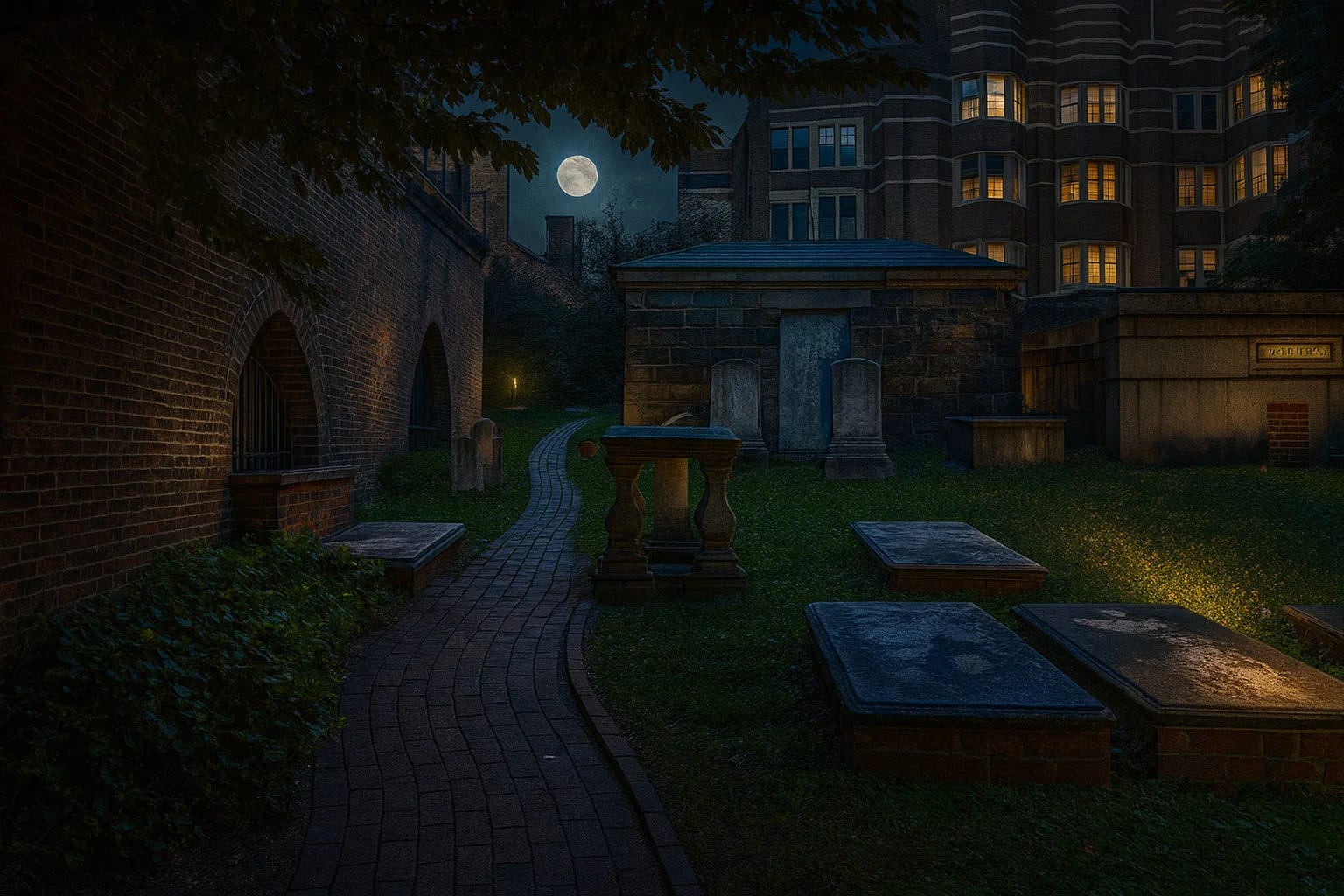
The historic Westminster Burial Grounds, where Edgar Allan Poe and the phantom gravedigger still walk
