Irish Ghost Stories
Ireland's Most Haunted Cities
Urban Legends and City Ghosts
January 11, 2025•12 min read•By Ghost City Tours
Urban Legends and City Ghosts
Where History Breathes, and the Dead Refuse to Leave
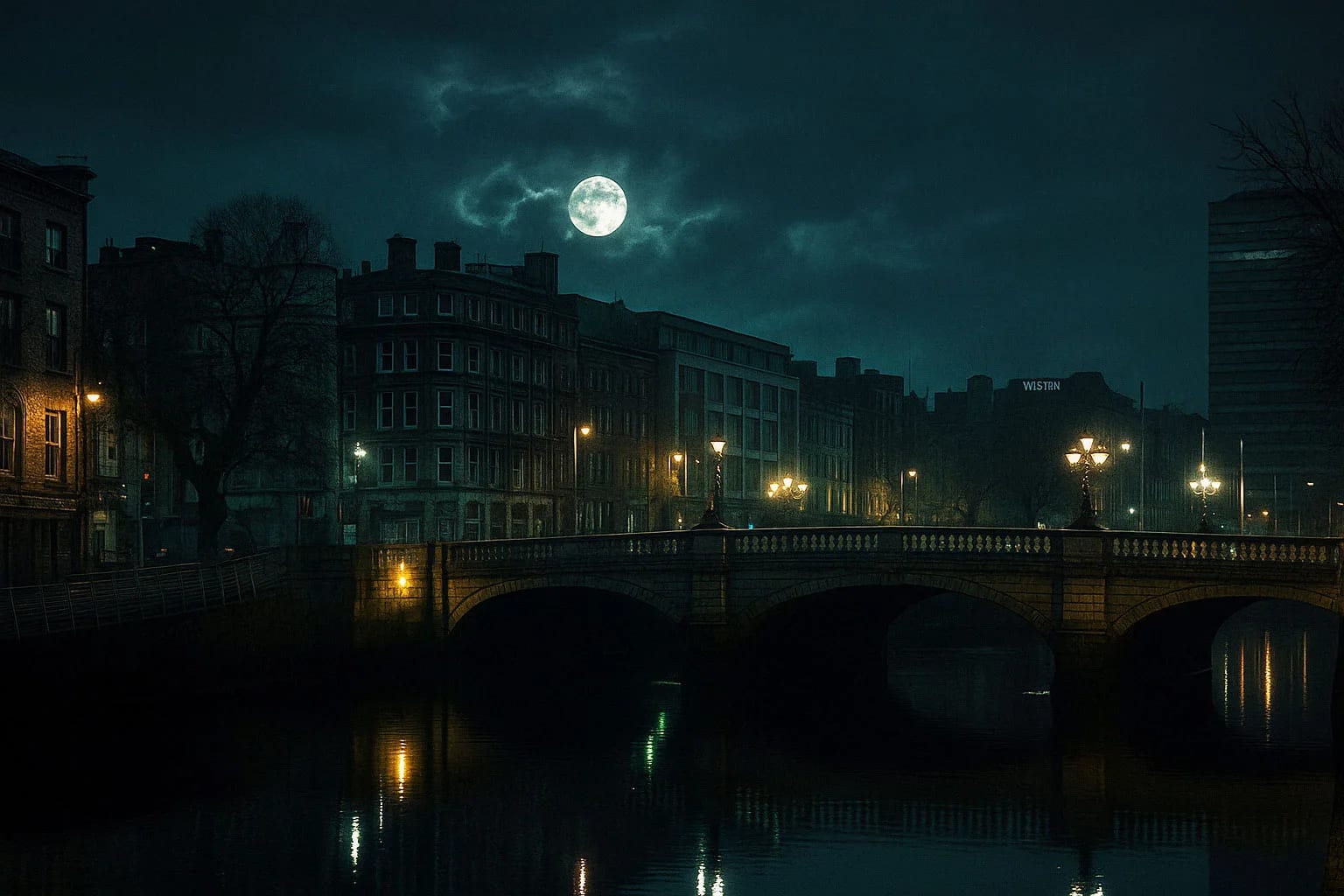
Ireland has never been a land short on ghosts. It's a place where the line between history and legend never really existed — it's blurred, tangled, and alive in every crumbling castle and cobblestoned street. The air itself feels heavy with memory, like the land remembers every heartbreak, every battle cry, every whispered prayer. And when you spend enough time here, you start to understand something deeper: Ireland doesn't just tell ghost stories… it lives them.
From mist-soaked coasts to candlelit taverns, Ireland's hauntings aren't just echoes of the past — they're living conversations between time and place. Each city carries its own energy, its own ghosts, and its own reasons for why the dead refuse to move on.
Let's take a look at five of Ireland's most haunted cities — and explore why these places seem to hold on to their spirits just a little tighter than most.
Dublin might be the beating heart of modern Ireland, but it's built on centuries of blood, betrayal, and dark faith. Beneath the pubs and Georgian facades lies a labyrinth of crypts, plague pits, and forgotten prisons — places where the past doesn't stay buried.
Start with Kilmainham Gaol, a place so soaked in sorrow it's hard to take a single step without feeling the weight of it. Built in 1796, it held everyone from petty thieves to the leaders of the Easter Rising — men and women executed for chasing Ireland's freedom. Visitors have reported cold spots, disembodied whispers, and even apparitions of the executed walking the cellblock at night. It's not hard to believe — the air inside feels thick, like grief never left.
Then there's St. Michan's Church, where actual mummified bodies rest in the crypt below the church floor. These centuries-old corpses, perfectly preserved by Dublin's dry air, are said to bring good luck to anyone brave enough to touch them. But those who do often report hearing voices later, or feeling something unseen brush past them on their way out.
And of course — The Hellfire Club, perched on the Dublin Mountains, is the stuff of pure legend. Built from stones stolen from an ancient cairn, it became the 18th-century playground for Ireland's elite occultists. The stories are wild — black masses, animal sacrifices, a spectral "man with cloven hooves." Even now, hikers say they feel watched when they approach the ruins.
Dublin is haunted because it's lived so much — rebellion, religion, famine, empire. It's a city that's seen it all, and maybe that's why it'll never truly sleep.
Cork has always marched to the beat of its own drum. Known as the "Rebel City," it's a place of fire and defiance — and where rebellion walks hand-in-hand with the supernatural. The ghosts here aren't shy, and the city seems to take a strange pride in that.
At the top of the list is Cork City Gaol, another of Ireland's old prisons that hums with uneasy energy. Inside its stone walls, voices echo long after closing time. Some visitors swear they've heard footsteps pacing empty corridors, while others claim to have seen the figure of a woman staring from the upper galleries — believed to be the ghost of a former inmate who never found peace.
But Cork's most chilling legend might belong to The Crawford Art Gallery, a stately building with more than paintings inside. Guards on night shifts report doors opening on their own, and one story — whispered for generations — tells of a statue that moves when no one's watching.
And just outside the city, Blarney Castle draws millions of tourists eager to kiss the Blarney Stone for luck. But beneath the charm and folklore is a darker layer — tunnels, dungeons, and echoes of battles fought long ago. Some say the castle's stones remember every drop of blood spilled defending it. Others say that gift of "eloquence" the stone gives comes from something older… something not entirely benevolent.
Cork's hauntings reflect its history — bold, defiant, and unwilling to be silenced. Maybe that's why its ghosts feel so alive.
If Dublin is the brain of Ireland, Galway is its soul. This west-coast city hums with creativity — music, poetry, laughter — but there's a melancholy undercurrent that runs through it all. Galway's ghosts don't scream for attention. They whisper through the fog, through old stone bridges and dim pubs where time seems to fold in on itself.
Take Lynch's Castle — one of the oldest buildings still standing on Shop Street. It once belonged to the powerful Lynch family, whose name became infamous when Mayor James Lynch FitzStephen allegedly executed his own son for murder in 1493. The term "lynching" comes from that act — and locals still say the young man's restless spirit lingers near the castle, pacing the windows at dusk.
Then there's St. Nicholas' Collegiate Church, dating back to the 14th century, where sailors once prayed before setting off across the Atlantic. Some never returned — but they're said to appear during storms, walking the church aisles dripping wet, as if still seeking a final blessing before they can move on.
And if you wander to The Spanish Arch, you'll feel it — the way the air thickens around sunset. Built in 1584, it's one of Galway's most photographed spots, but also one of its most haunted. Locals claim a female ghost in 18th-century dress roams the archway at night, waiting for a lover lost to the sea.
Galway is haunted not just by death, but by memory. It's a city that carries the ache of longing — the kind that never really fades, even after centuries.
Limerick doesn't get as much attention as Dublin or Galway when it comes to tourism, but when you start digging into its history — it's clear this city's ghosts deserve their own spotlight. Sitting on the River Shannon, Limerick has seen sieges, plague, executions, and more than its share of tragedy.
The centerpiece, of course, is King John's Castle — a fortress that has watched nearly 800 years of Irish history unfold. Built by the Normans in 1210, it's been the site of brutal sieges and countless deaths. Visitors today still report the sound of cannon fire echoing through the courtyard, or the faint wails of children — believed to be echoes from the Siege of Limerick in 1651, when civilians were trapped inside.
Just across town, St. Mary's Cathedral — one of Ireland's oldest churches still in daily use — is said to host ghostly monks who drift through its ancient cloisters at night. Their presence is so accepted that even clergy have admitted feeling watched or brushed by unseen hands during evening prayers.
But Limerick's most unsettling tale might be The Haunted Milk Market, where vendors once gathered to sell produce in the 19th century. After dark, the cobblestones echo with phantom footsteps, and disembodied voices call out names that no one recognizes.
Limerick's ghosts are tied to its resilience — this is a city that's been battered by centuries of hardship and keeps standing tall. Its spirits, like its people, are stubborn — they simply refuse to fade.
If there's a single city that could claim to be the most haunted in Ireland, it might be Kilkenny. This place feels ancient even when you're just walking its streets — narrow medieval alleys, stone towers, and a sense that you're walking straight through a thousand years of overlapping timelines.
The city's most famous ghost story is tied to Kilkenny Castle, the majestic fortress that dominates the skyline. Built in the 12th century, it's been home to noble families, political intrigue, and tragedy. Visitors have seen the figure of a woman in white gliding through the corridors — believed to be Lady Margaret Butler, grandmother of Anne Boleyn, who still roams the castle grounds centuries after her death.
Then there's the Black Abbey, a Dominican priory dating to the 13th century. During Cromwell's invasion, many monks were slaughtered inside its walls — and some say their chanting can still be heard after dark. The shadows in the abbey don't behave like normal shadows. They move against the light.
But Kilkenny's most infamous legend might be the story of Alice Kyteler, a wealthy innkeeper accused of witchcraft in 1324. She was Ireland's first recorded witch trial, accused of poisoning her husbands and consorting with demons. Alice escaped execution, but her servant Petronilla de Meath wasn't so lucky — she was burned alive. Her screams, locals say, can still be heard on St. Kieran's Street, carried on the wind when night falls.
Kilkenny is haunted because it's still a medieval city at heart — built on narrow streets and old secrets, where history is never just history. It's alive, restless, and watching.
Every city in Ireland carries its ghosts differently. In some places, they're loud — breaking glass, slamming doors, rattling chains. In others, they're quiet, showing up in the corner of a photo or whispering your name just as you drift to sleep.
But Ireland's hauntings aren't about cheap scares. They're about connection. Every ghost story here is a history lesson, a confession, or a warning whispered from one generation to the next.
This land has seen Viking invasions, religious wars, famine, and centuries of heartbreak — but also love, poetry, rebellion, and resilience. That emotional weight doesn't just disappear. It lingers, like the last note of a song that refuses to end.
And maybe that's the real secret — Ireland isn't haunted because of what died here. It's haunted because of what lived here. Because every inch of its soil remembers what it means to be human — the joy, the loss, the hope that tomorrow might finally bring peace.
So, if you ever find yourself walking through a fog-filled Irish street at night, and you feel that shiver on the back of your neck — don't run. Just stop. Listen. The dead aren't trying to scare you. They're just saying hello.
Join us for an unforgettable ghost tour and hear haunting tales like these from our expert storytellers
Find a Ghost Tour Near You